We've ranked the best xml books using expert recommendations, sales data, and millions of reader ratings. At Shortform, we know books. Our book guides are the best in the world. Learn why.
Cover unavailable
1
Learning XML
Erik T. Ray
5.0
The Barnes & Noble Review XML has grown into such a diverse set of technologies that it s almost impossible for newcomers to get their hands around it. Fortunately, there s a solution: Erik T. Ray s Learning XML, Second Edition.
This book presents an outstanding birds-eye view of the XML landscape. It s definitely not a programming book (though it does introduce some key XML programming issues). Rather, it s focused on key ideas you need to understand whatever you want to do with XML. That could be document management, web or print content delivery, application integration, B2B commerce, data storage, internationalization -- you name it.
Ray s day job is software developer and XML specialist at O Reilly. There, he s helped to implement a complete publishing solution, using DocBook-XML and Perl to produce books in print, on CD-ROM, and for online delivery. So he understands XML from the real-world point of view of someone with a job to do.
His first goal is to take on the big questions. First, What is XML? Ray attacks this question from multiple angles, introducing XML as a general-purpose information storage system, a markup language toolkit, and an open standard (or, increasingly, a collection of standards). What can (and can t) you do with XML? What s the history that led us here? And what tools do you need to get started?
Next, he introduces the basic building blocks of XML markup and all XML-derived languages: stuff you ll need to know regardless of your goals. Through easy examples, you ll understand elements, attributes, entities, and processing instructions -- and how they fit together in a well-formed XML document.
Then, it s on to representing information with XML -- in other words, understanding the nature and planning the structure of the documents you ll be using. Ray starts simply, then builds on his basic examples to discuss narrative documents with text flows, block and inline elements, and titled sections. Once you can handle those, he discusses more complex information modeling, as used in specialized markup languages such as VML.
This edition contains an entirely new chapter on XML Schemas -- what he calls the shepherds that keep documents from straying outside of the herd and causing trouble. Schemas, of course, have become hugely important. This is one of the best plain-English introductions to the topic we ve seen.
Ray then turns to presentation, introducing CSS stylesheets, basic usage, rule matching, properties, and more. A little later on, he returns to the subject -- this time with a complete introduction to XSL-FO that illuminates two powerful examples. The first is TEI-XML, a markup language for scholarly documents (Ray presents a Shakespearean sonnet, appropriately coded). The second is the immensely powerful DocBook -- which, as we ve observed, Ray knows inside and out.
Learning XML is superbly written. Clear explanations. Simple examples. Great metaphors and analogies. And excellent introductions to nearly every topic that matters, from links to presentation, transformation to internationalization. If you re just starting out with XML, you re lucky to have it. Bill Camarda
Bill Camarda is a consultant, writer, and web/multimedia content developer. His 15 books include Special Edition Using Word 2000 and Upgrading & Fixing Networks for Dummies, Second Edition.
…
Cover unavailable
2
XML in a Nutshell
Elliotte Rusty Harold and W. Scott Means
4.7
If you're a developer working with XML, you know there's a lot to know about XML, and the XML space is evolving almost moment by moment. But you don't need to commit every XML syntax, API, or XSLT transformation to memory; you only need to know where to find it. And if it's a detail that has to do with XML or its companion standards, you'll find it--clear, concise, useful, and well-organized--in the updated third edition of XML in a Nutshell.
With XML in a Nutshell beside your keyboard, you'll be able to:
Quick-reference syntax rules and usage examples for the core XML technologies, including XML, DTDs, Xpath, XSLT, SAX, and DOM Develop an understanding of well-formed XML, DTDs, namespaces, Unicode, and W3C XML Schema Gain a working knowledge of key technologies used for narrative XML documents such as web pages, books, and articles technologies like XSLT, Xpath, Xlink, Xpointer, CSS, and XSL-FO Build data-intensive XML applications Understand the tools and APIs necessary to build data-intensive XML applications and process XML documents, including the event-based Simple API for XML (SAX2) and the tree-oriented Document Object Model (DOM) This powerful new edition is the comprehensive XML reference. Serious users of XML will find coverage on just about everything they need, from fundamental syntax rules, to details of DTD and XML Schema creation, to XSLT transformations, to APIs used for processing XML documents. XML in a Nutshell also covers XML 1.1, as well as updates to SAX2 and DOM Level 3 coverage. If you need explanation of how a technology works, or just need to quickly find the precise syntax for a particular piece, XML in a Nutshell puts the information at your fingertips.
Simply put, XML in a Nutshell is the critical, must-have reference for any XML developer.
…
Cover unavailable
3
Learn Windows PowerShell in a Month of Lunches
Donald W. Jones
4.7
Summary
Learn Windows PowerShell in a Month of Lunches, Third Edition is an innovative tutorial designed for busy IT professionals. This updated edition covers PowerShell features that run on Windows 7, Windows Server 2008 R2 and later, PowerShell v3 and later, and includes v5 features like PowerShellGet.
Purchase of the print book includes a free eBook in PDF, Kindle, and ePub formats from Manning Publications.
About the Technology
PowerShell is both a scripting language and an administrative shell that lets you control and automate nearly every aspect of Windows. It accepts and executes commands interactively and you can write scripts to manage most Windows servers like Exchange, IIS, and SharePoint, as well as online services like Azure and Office 365.
About the Book
Learn Windows PowerShell in a Month of Lunches, Third Edition is an innovative tutorial designed for busy IT professionals. Just set aside one hour a day - lunchtime would be perfect - for a month, and you'll be automating Windows tasks faster than you ever thought possible. This updated edition covers PowerShell features that run on Windows 7, Windows Server 2008 R2 and later, PowerShell v3 and later, and includes v5 features like PowerShellGet.
What's Inside
Learn PowerShell from the beginning, no experience required! Covers PowerShell v3 and up, Windows 7, and Windows Server 2008 R2 and later Each lesson takes you an hour or less About the Reader
Experience with Windows administration is helpful. No programming or scripting experience needed.
About the Author
Veteran PowerShell MVPs Don Jones and Jeffery Hicks bring years as successful trainers to this concise, easy-to-follow book.
Table of Contents
Before you begin Meet PowerShell Using the help system Running commands Working with providers The pipeline: connecting commands Adding commands Objects: data by another name The pipeline, deeper Formatting - and why it's done on the right Filtering and comparisons A practical interlude Remote control: one-to-one, and one-to-many Using Windows Management Instrumentation and CIM Multitasking with background jobs Working with many objects, one at a time Security alert! Variables: a place to store your stuff Input and output Sessions: remote control with less work You call this scripting? Improving your parameterized script Advanced remoting configuration Using regular expressions to parse text files Additional random tips, tricks, and techniques Using someone else's script Never the end PowerShell cheat sheet
…
Cover unavailable
4
Head First HTML with CSS & XHTML
Eric Freeman
4.7
Tired of reading HTML books that only make sense after you're an expert? Then it's about time you picked up Head First HTML with CSS & XHTML and really learned HTML. You want to learn HTML so you can finally create those web pages you've always wanted, so you can communicate more effectively with friends, family, fans, and fanatic customers. You also want to do it right so you can actually maintain and expand your Web pages over time, and so your web pages work in all the browsers and mobile devices out there. Oh, and if you've never heard of CSS, that's okay - we won't tell anyone you're still partying like it's 1999 - but if you're going to create Web pages in the 21st century then you'll want to know and understand CSS.
Learn the real secrets of creating Web pages, and why everything your boss told you about HTML tables is probably wrong (and what to do instead). Most importantly, hold your own with your co-worker (and impress cocktail party guests) when he casually mentions how his HTML is now strict, and his CSS is in an external style sheet.
With Head First HTML with CSS & XHTML, you'll avoid the embarrassment of thinking web-safe colors still matter, and the foolishness of slipping a font tag into your pages. Best of all, you'll learn HTML and CSS in a way that won't put you to sleep. If you've read a Head First book, you know what to expect: a visually-rich format designed for the way your brain works. Using the latest research in neurobiology, cognitive science, and learning theory, this book will load HTML, CSS, and XHTML into your brain in a way that sticks.
So what are you waiting for? Leave those other dusty books behind and come join us in Webville. Your tour is about to begin.
"Elegant design is at the core of every chapter here, each concept conveyed with equal doses of pragmatism and wit." --Ken Goldstein, Executive Vice President, Disney Online
"This book is a thoroughly modern introduction to forward-looking practices in web page markup and presentation." --Danny Goodman, author of Dynamic HTML: The Definitive Guide
"What used to be a long trial and error learning process has now been reduced neatly into an engaging paperback." --Mike Davidson, CEO, Newsvine, Inc.
"I love Head First HTML with CSS & XHTML--it teaches you everything you need to learn in a 'fun coated' format!" --Sally Applin, UI Designer and Artist
"I haven't had as much fun reading a book (other than Harry Potter) in years. And your book finally helped me break out of my hapless so-last-century way of creating web pages." --Professor David M. Arnow, Department of Computer and Information Science, Brooklyn College
"If you've ever had a family member who wanted you to design a website for them, buy them Head First HTML with CSS and XHTML. If you've ever asked a family member to design you a web site, buy this book. If you've ever bought an HTML book and ended up using it to level your desk, or for kindling on a cold winter day, buy this book. This is the book you've been waiting for. This is the learning system you've been waiting for." --Warren Kelly, Blogcritics.org
…
Cover unavailable
5
Get Past the Tags!: How to Read (and Write) an XML Document
Jonathan R Price
4.6
Cover unavailable
6
Programming Perl: Unmatched power for text processing and scripting
Tom Christiansen, brian d foy, et al.
4.6
Adopted as the undisputed Perl bible soon after the first edition appeared in 1991, Programming Perl is still the go-to guide for this highly practical language. Perl began life as a super-fueled text processing utility, but quickly evolved into a general purpose programming language that’s helped hundreds of thousands of programmers, system administrators, and enthusiasts, like you, get your job done.
In this much-anticipated update to "the Camel," three renowned Perl authors cover the language up to its current version, Perl 5.14, with a preview of features in the upcoming 5.16. In a world where Unicode is increasingly essential for text processing, Perl offers the best and least painful support of any major language, smoothly integrating Unicode everywhere—including in Perl’s most popular feature: regular expressions.
Important features covered by this update include:
New keywords and syntax I/O layers and encodings New backslash escapes Unicode 6.0 Unicode grapheme clusters and properties Named captures in regexes Recursive and grammatical patterns Expanded coverage of CPAN Current best practices
…
Recommended by Garry Tan and James Hong.
James Hong
All legit OG web people will remember the camel book well... except @pud who somehow did amazing things all using .cfm 😉 https://t.co/n4pOpkOY6M [source]
Cover unavailable
7
Microsoft Excel 2013 Programming by Example with VBA, XML, and ASP
Julitta Korol
4.6
This book is suitable for readers already familiar with the Excel user interface and introduces programming concepts via numerous multi-step, practical exercises. More advanced topics are introduced via custom projects. Covers recording and editing a macro and writing VBA code through working with XML documents and using ASP to display data on the Web."Microsoft Excel 2013 Programming by Example with VBA, XML and ASP" is a practical how-to book on Excel programming, suitable for readers already familiar with the Excel user interface. The book introduces programming concepts via numerous multi-step, illustrated, hands-on exercises. More advanced topics are introduced via custom projects. From recording and editing a macro and writing VBA code to working with XML documents and using classic ASP to access and display data on the Web, this book takes you on a programming journey that will change the way you work with Excel. Completely updated for Excel 2010, this book provides information on performing automatic operations on files, folders, and other Microsoft Office applications. It also covers proper use of event procedures, testing and debugging, and programming advanced Excel features such as PivotTables, PivotCharts, and SmartTags. The chapters are loaded with illustrated hands-on projects and exercises that tell you exactly where to enter code, how to debug it, and then run it. Each exercise/project step is clearly explained as it is performed.Features: Explores in great detail the latest version of Excel and all of its features.Covers recording and editing a macro and writing VBA code through working with XL documents and using ASP to display data on the Web.Covers Office Web Apps.
…
Cover unavailable
8
Aprende inglés sin ir a clases
John Galeano
4.6
Cover unavailable
9
Mastering Regular Expressions
Jeffrey E. F. Friedl
4.6
Regular expressions are an extremely powerful tool for manipulating text and data. They are now standard features in a wide range of languages and popular tools, including Perl, Python, Ruby, Java, VB.NET and C# (and any language using the .NET Framework), PHP, and MySQL.
If you don't use regular expressions yet, you will discover in this book a whole new world of mastery over your data. If you already use them, you'll appreciate this book's unprecedented detail and breadth of coverage. If you think you know all you need to know about regularexpressions, this book is a stunning eye-opener.
As this book shows, a command of regular expressions is an invaluable skill. Regular expressions allow you to code complex and subtle text processing that you never imagined could be automated. Regular expressions can save you time and aggravation. They can be used to craft elegant solutions to a wide range of problems. Once you've mastered regular expressions, they'll become an invaluable part of your toolkit. You will wonder how you ever got by without them.
Yet despite their wide availability, flexibility, and unparalleled power, regular expressions are frequently underutilized. Yet what is power in the hands of an expert can be fraught with peril for the unwary. Mastering Regular Expressions will help you navigate the minefield to becoming an expert and help you optimize your use of regular expressions.
Mastering Regular Expressions, Third Edition, now includes a full chapter devoted to PHP and its powerful and expressive suite of regular expression functions, in addition to enhanced PHP coverage in the central "core" chapters. Furthermore, this edition has been updated throughout to reflect advances in other languages, including expanded in-depth coverage of Sun's java.util.regex package, which has emerged as the standard Java regex implementation.Topics include:
A comparison of features among different versions of many languages and tools How the regular expression engine works Optimization (major savings available here!) Matching just what you want, but not what you don't want Sections and chapters on individual languages Written in the lucid, entertaining tone that makes a complex, dry topic become crystal-clear to programmers, and sprinkled with solutions to complex real-world problems, Mastering Regular Expressions, Third Edition offers a wealth information that you can put to immediateuse.
Reviews of this new edition and the second edition:
"There isn't a better (or more useful) book available on regular expressions."
--Zak Greant, Managing Director, eZ Systems
"A real tour-de-force of a book which not only covers the mechanics of regexes in extraordinary detail but also talks about efficiency and the use of regexes in Perl, Java, and .NET...If you use regular expressions as part of your professional work (even if you already have a good book on whatever language you're programming in) I would strongly recommend this book to you."
--Dr. Chris Brown, Linux Format
"The author does an outstanding job leading the reader from regexnovice to master. The book is extremely easy to read and chock full ofuseful and relevant examples...Regular expressions are valuable toolsthat every developer should have in their toolbox. Mastering RegularExpressions is the definitive guide to the subject, and an outstandingresource that belongs on every programmer's bookshelf. Ten out of TenHorseshoes."
--Jason Menard, Java Ranch
…
Cover unavailable
10
Microsoft Access 2019 Programming by Example with VBA, XML, and ASP
Julitta Korol
4.6
Cover unavailable
11
JavaScript: The Definitive Guide
David Flanagan
4.6
Since 1996, JavaScript: The Definitive Guide has been the bible for JavaScript programmers—a programmer's guide and comprehensive reference to the core language and to the client-side JavaScript APIs defined by web browsers. The 6th edition covers HTML5 and ECMAScript 5, with new chapters on jQuery and server side JavaScript. It's recommended for experienced programmers who want to learn the programming language of the Web, and for current JavaScript programmers who want to master it.
…
Cover unavailable
12
HTML QuickStart Guide: The Simplified Beginner's Guide to HTML
ClydeBank Technology
4.6
The Ultimate Beginner's Guide To Learning HTML - Learning HTML Has Never Been Easier! *HTML Broken Down Into Easy To Follow Steps With Extensive Examples & Real Application!* Do you want to learn HTML but don't know where to start? Are you overwhelmed by the 1,000 page long books that simply have TOO much information and are impossible to follow? Do you want to be up and running with HTML in just a few hours? Do you like getting the best 'bang' for your 'buck'? (Of course you do!) If so, then look no further. The "HMTL QuickStart Guide" will take you step-by-step through the learning process so you will understand fundamental tags and elements all the way to building a full-fledged HMTL5 compliant web page. Are you looking to change careers to something that will pay you more and have more flexibility? Are you looking to learn just for fun on the side? No matter why you want to learn HTML the "HTML QuickStart Guide" has you covered. Extensive Examples & Screenshots of What You Should See Makes This Book Like Having An HTML Guru Right Over Your Shoulder While You Learn! Let's face it - HTML has been around for a LONG TIME and it is not going anywhere. With more opportunities for web development appearing every day, it is critical for anyone who planning on creating Anything online to understand HTML. HTML is everywhere you look on the web - it's on EVERY WEB PAGE on the Internet today! It's marking up this description right in front of your eyes! "HTML QuickStart Guide" has been specifically designed by HTML experts with ease of learning in mind to ensure you don't get stuck, lost or lose hope in the learning process. Never again will you need to waste your time searching the internet, watching YouTube videos and paying crazy amounts of money for online courses! What's Required? No Prior Knowledge Required! No Special Software or Programs! All You Need Is a Desire To Learn! Who Is This For? People With Zero To Little HTML Experience! HTML Experts Looking To Brush Up On The Basics! People Looking To Learn HTML For Fun! People Looking To Learn HTML For a Career! What You'll Learn... Foundational HTML Terminology Explained Basic Page Structure - Head & Body Mark Up Page Content Creation - Pagragraphs, Lists, Tables and Images Content Structure - Headers, Footers, Semantic Images The Importance of HTML5 Compatibility The Top Mistakes to AVOID That Those New To HTML Make! Our Personal Guarantee We are so confident that methods outlined in this book will help you learn HTML that we're willing to let you try the book risk-free. If you are not fully satisfied with the product, simply let us know and we will provide a 100% full refund. That's right, a 100% Money-Back Guarantee! What reason do you have to not give this book a try? Scroll Up To The Top Of The Page And Click The Orange "Add To Cart" On The Right Side Right Now! ClydeBank Media LLC All Rights Reserved
…
Cover unavailable
13
XSLT Cookbook (O'Reilly Cookbooks)
Sal Mangano
4.6
Forget those funky robot toys that were all the rage in the '80s, XSLT (Extensible Stylesheet Transformations) is the ultimate transformer. This powerful language is expert at transforming XML documents into PDF files, HTML documents, JPEG files—virtually anything your heart desires. As useful as XSLT is, though, most people have a difficult time learning its many peculiarities. And now Version 2.0, while elegant and powerful, has only added to the confusion.
XSLT Cookbook, Second Edition wants to set the record straight. It helps you sharpen your programming skills and overall understanding of XSLT through a collection of detailed recipes. Each recipe breaks down a specific problem into manageable chunks, giving you an easy-to-grasp roadmap for integrating XSLT with your data and applications. No other XSLT book around employs this practical problem-solution-discussion format.
In addition to offering code recipes for solving everyday problems with XSLT 1.0, this new edition shows you how to leverage the improvements found in XSLT 2.0, such as how to simplify the string manipulation and date/time conversion processes. The book also covers XPath 2.0, a critical companion standard, as well as topics ranging from basic transformations to complex sorting and linking. It even explores extension functions on a variety of different XSLT processors and shows ways to combine multiple documents using XSLT. Code examples add a real-world dimension to each technique.
Whether you're just starting out in XSLT or looking for advanced techniques, you'll find the level of information you need in XSLT Cookbook, Second Edition.
…
Cover unavailable
14
Windows Powershell in Action, Third Edition
Bruce Payette
4.6
Windows PowerShell transformed the way administrators and developers interact with Windows. PowerShell, an elegant dynamic language from Microsoft, lets its users script administrative tasks and control Windows from the command line. Because it's a full-featured, first-class Windows programming language, programmers and power- users can now do things in a shell that previously required VB, VBScript, or C#.
"Windows PowerShell in Action, Third Edition" is a completely revised edition of the bestselling book on PowerShell. It keeps the same crystal-clear introduction to PowerShell as the last edition and adds extensive coverage of v3, v4, and v5 features such as PowerShell Workflows, Desired State Configuration, PowerShell classes and the PowerShell APIs, new error handling and debugging features. It includes full chapters on these topics and also covers new language elements and operators, PowerShell remoting, CIM, events, working with data such as XML and flat files, The Second Edition's coverage of batch scripting and string processing, COM, WMI, and .NET have all been significantly revised and expanded. The book includes many popular usage scenarios and is rich in interesting examples that will spark the reader's imagination.
Purchase of the print book includes a free eBook in PDF, Kindle, and ePub formats from Manning Publications.
…
Cover unavailable
15
XML for Dummies
Lucinda Dykes and Ed Tittel
4.5
See how XML works for business needs and RSS feeds
Create consistency on the Web, or tag your data for different purposes
Tag -- XML is it! XML tags let you share your format as well as your data, and this handy guide will show you how. You'll soon be using this markup language to create everything from Web sites to business forms, discovering schemas and DOCTYPES, wandering the Xpath, teaming up XML with Office 2003, and more.
Discover how to • Make information portable • Use XML with Word 2003 • Store different types of data • Convert HTML documents to XHTML • Add CSS to XML • Understand and use DTDs
…
Cover unavailable
16
Svg Essentials: Producing Scalable Vector Graphics with XML
J. David Eisenberg and Amelia Bellamy-Royds
4.5
Learn the essentials of Scalable Vector Graphics, the mark-up language used by most vector drawing programs and interactive web graphics tools. SVG Essentials takes you through SVG's capabilities, beginning with simple line drawings and moving through complicated features such as filters, transformations, gradients, and patterns.
This thoroughly updated edition includes expanded coverage of animation, interactive graphics, and scripting SVG. Interactive examples online make it easy for you to experiment with SVG features in your web browser. Geared toward experienced designers, this book also includes appendices that explain basic concepts such as XML markup and CSS styling, so even if you have no web design experience, you can start learning SVG.
Create and style graphics to match your web design in a way that looks great when printed or displayed on high-resolution screens Make your charts and decorative headings accessible to search engines and assistive technologies Add artistic effects to your graphics, text, and photographs using SVG masks, filters, and transformations Animate graphics with SVG markup, or add interactivity with CSS and JavaScript Create SVG from existing vector data or XML data, using programming languages and XSLT
…
Recommended by Val Head.
Cover unavailable
17
XML: Visual QuickStart Guide
Kevin Howard Goldberg
4.5
What is XML? XML, or eXtensible Markup Language, is a specification for storing information. It is also a specification for describing the structure of that information. And while XML is a markup language (just like HTML), XML has no tags of its own. It allows the person writing the XML to create whatever tags they need. The only condition is that these newly created tags adhere to the rules of the XML specification.
In the seven years since the first edition of "XML: Visual QuickStart Guide" was published, XML has taken its place next to HTML as a foundational language on the Internet. XML has become a very popular method for storing data and the most popular method for transmitting data between all sorts of systems and applications. The reason being, where HTML was designed to display information, XML was designed to manage it.
This book begins by showing you the basics of the XML language. Then, by building on that knowledge, additional and supporting languages and systems will be discussed. To get the most out of this book, you should be somewhat familiar with HTML, although you don't need to be an expert coder by any stretch. No other previous knowledge is required.
"XML: Visual QuickStart Guide, 2nd Edition" is divided into seven parts. Each part contains one or more chapters with step-by-step instructions that explain how to perform XML-related tasks. Wherever possible, examples of the concepts being discussed are displayed, and the parts of the examples on which to focus are highlighted.
The order of the book is intentionally designed to be an introduction to the fundamentals of XML, followed by discussions of related XML technologies.
- In Part 1 of the book, you will learn how to create an XML document. It's relatively straightforward, and even more so if you know a little HTML.
- Part 2 focuses on XSL, which is a set of languages designed to transform an XML document into something else: an HTML file, a PDF document, or another XML document. Remember, XML is designed to store and transport data, not display it.
- Parts 3 and 4 of the book discuss DTD and XML Schema, languages designed to define the structure of an XML document. In conjunction with XML Namespaces (Part 5), you can guarantee that XML documents conform to a pre-defined structure, whether created by you or by someone else.
- Part 6, Developments and Trends, details some of the up-and-coming XML-related languages, as well as a few new versions of existing languages.
- Finally, Part 7 identifies some well-known uses of XML in the world today; some of which you may be surprised to learn.
This beginner's guide to XML is broken down as follows: - Introduction - Chapter 1: Writing XML
- Part 7: XML in Practice - Chapter 17: Ajax, RSS, SOAP and More
…
Cover unavailable
18
XML Pocket Reference: Extensible Markup Language
Simon St. Laurent, Michael James Fitzgerald
4.5
XML, the Extensible Markup Language, is everywhere: the syntax of choice for newly designed document formats across almost all computer applications. Now used daily by developers, XML is living up to its reputation as one of the most important developments in document interchange in the history of computing.
A perennial bestseller, the handy XML Pocket Reference from O'Reilly has been revised once again to give you quick access to the latest goods. In addition to its comprehensive look at XML, this third edition has been updated with new material on Namespaces and XML Schema--considered among the most important elements in current XML use--along with RELAX NG and Schematron, additional powerful tools for describing XML document structures.
Like other titles in O'Reilly's Pocket Reference series, the XML Pocket Reference, 3rd Edition features a well-organized format that gets right to the point. As a result, it's already won over the allegiance of developers everywhere. If you need XML answers quick and on the fly, this compact book is most definitely the book for you.
…
Cover unavailable
19
Definitive XML Schema, 2nd Edition
Priscilla Walmsley
4.5
""XML Schema 1.1 has gone from strong data typing to positively stalwart--so powerful it can enforce database level constraints and business rules, so your data transfer code won't have to. This book covers the 1.1 changes--and more--in its 500 revisions to Priscilla Walmsley's 10-year best-selling classic. It's the guide you need to navigate XML Schema's complexity--and master its power!"" --Charles F. Goldfarb For Ten Years the World's Favorite Guide to XML Schema--Now Extensively Revised for Version 1.1 and Today's Best Practices! To leverage XML's full power, organizations need shared vocabularies based on XML Schema. For a full decade, Definitive XML Schema has been the most practical, accessible, and usable guide to working with XML Schema. Now, author Priscilla Walmsley has thoroughly updated her classic to fully reflect XML Schema 1.1, and to present new best practices for designing successful schemas. Priscilla helped create XML Schema as a member of the W3C XML Schema Working Group, so she is well qualified to explain the W3C recommendation with insight and clarity. Her book teaches practical techniques for writing schemas to support any application, including many new use cases. You'll discover how XML Schema 1.1 provides a rigorous, complete specification for modeling XML document structure, content, and datatypes; and walk through the many aspects of designing and applying schemas, including composition, instance validation, documentation, and namespaces. Then, building on the fundamentals, Priscilla introduces powerful advanced techniques ranging from type derivation to identity constraints. This edition's extensive new coverage includes Many new design hints, tips, and tricks - plus a full chapter on creating an enterprise strategy for schema development and maintenance Design considerations in creating schemas for relational and object-oriented models, narrative content, and Web services An all-new chapter on assertions Coverage of new 1.1 features, including overrides, conditional type assignment, open content and more Modernized rules for naming and design Substantially updated coverage of extensibility, reuse, and versioning And much more If you're an XML developer, architect, or content specialist, with this Second Edition you can join the tens of thousands who rely on Definitive XML Schema for practical insights, deeper understanding, and solutions that work.
…
Cover unavailable
20
The Neuroicu Book, Second Edition
Kiwon Lee
4.5
Publisher's Note: Products purchased from Third Party sellers are not guaranteed by the publisher for quality, authenticity, or access to any online entitlements included with the product.
The acclaimed protocol-based guide to neurocritical care - essential for daily practice and the boards
An immediate classic, this groundbreaking text is based on the premise that neurointensivists must be trained to handle not only the brain, but the entire body. The NeuroICU Book, Second Edition does not limit coverage to the brain and spine - it spans all organ insufficiencies and failures - along with neurologic illnesses.
Thoroughly updated to keep pace with all the advances in this emerging field, the Second Edition of The NeuroICU Book combines the latest clinical perspectives in critical care medicine, neurology, and neurosurgery. This practical, evidence-based text standardizes neurocritical care and takes you through the rationale for those standards. Filled with detailed case studies and enhanced by a question-and-answer format, the book not only builds competency in recognizing acute changes in neurological function, but also addresses all organ insufficiencies and failures, reflecting the real-life challenges in the modern neuro-ICU.
FEATURES
- Strong emphasis on clinical practicality - Evidence-basedapproach leverages the scientific and controlled research that supports the key treatment methods outlined in the book - Practical tools include algorithms, tables, illustrations, photographs, detailed references, and critical take home points - Balanced coverage of neurologic and critical care and neurosurgery offers outstanding preparation for the neurocritical care board certification exam as well as an indispensable primer for daily clinical work - Second Edition includes new chapters covering CNS infection, paroxysmal sympathetic hyperactivity, acute liver failure, encephalopathy and delirium, spine trauma, pediatric neurosurgery, and carotid endarterectomy and extracranial-intracranial bypass
The NeuroICU Book is also available separately for iOS on the App Store, and Android on the Play Store. For more information, go to http: //bit.ly/NeuroICUBookApp
…
Cover unavailable
21
PYTHON: Python Programming, For Beginners, Learn Coding Fast! (With 100 Tests & Answers) Crash Course, A Quick Start Tutorial Book with Hands-On Projects. In Easy Steps! An Ultimate Beginner's Guide!
mohamed gomaa
4.5
Cover unavailable
22
XQuery: Search Across a Variety of XML Data
Priscilla Walmsley
4.5
Cover unavailable
23
PowerShell in Depth
Don Jones, Jeffery Hicks, et al.
4.5
If you're a Windows administrator, you'll want this book open on your desk most of the time. With over 40 short chapters, each focused on a specific area of PowerShell, you'll be able to find answers fast. Each valuable technique was developed and thoroughly tested by seasoned PowerShell experts, so you'll be able to consistently produce production quality, maintainable scripts that will save countless hours of time and effort.
"PowerShell in Depth, Second Edition" is the go-to reference for administrators working with Windows PowerShell. Every major technique, technology, and tactic is carefully explained and demonstrated, providing a hands-on guide to almost everything an admin would do in the shell. Written by three experienced authors and PowerShell MVPs, this is the PowerShell book you will keep next to your monitors--not on your bookshelf!
Purchase of the print book includes a free eBook in PDF, Kindle, and ePub formats from Manning Publications.
…
Cover unavailable
24
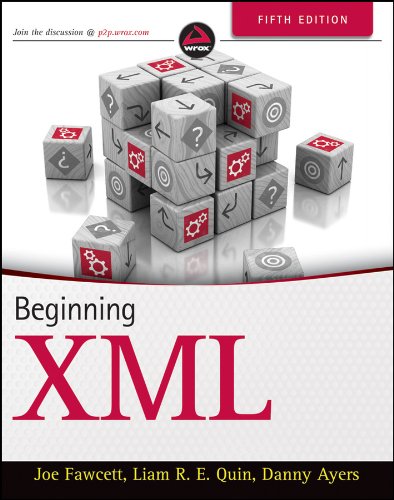
Beginning XML
Joe Fawcett, Danny Ayers, et al.
4.4
A complete update covering the many advances to the XML language The XML language has become the standard for writing documents on the Internet and is constantly improving and evolving. This new edition covers all the many new XML-based technologies that have appeared since the previous edition four years ago, providing you with an up-to-date introductory guide and reference. Packed with real-world code examples, best practices, and in-depth coverage of the most important and relevant topics, this authoritative resource explores both the advantages and disadvantages of XML and addresses the most current standards and uses of XML.
Features the most updated content built on audience feedback from the previous edition as well as the vast knowledge from XML developer teams Boasts new chapters on RELAX NG and Schematron, XML functionality in databases, LINQ to XML, Jabber and XMLPP, XHTML, HTML5, and more Offers in-depth coverage on extracting data from XML and updated material on Web Services Beginning XML, Fifth Edition delivers the most important aspects of XML in regard to what it is, how it works, what technologies surround it, and how it can best be used in a variety of situations.
…
Cover unavailable
25
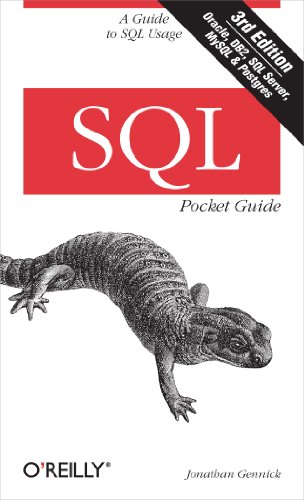
SQL Pocket Guide
Jonathan Gennick
4.4
If you're a programmer or database administrator who uses SQL in your day-to-day work, this popular pocket guide is the ideal on-the-job reference. You'll find many examples that address the language's complexity, along with key aspects of SQL used in IBM DB2 Release 9.7, MySQL 5.1, Oracle Database 11g Release 2, PostgreSQL 9.0, and Microsoft SQL Server 2008 Release 2.
SQL Pocket Guide describes how these database systems implement SQL syntax for querying, managing transactions, and making changes to data. It also shows how the systems use SQL functions, regular expression syntax, and type conversion functions and formats.
All example SQL statements in this book execute against a set of tables, with data that you can quickly download. The third edition covers important database changes, including:
Oracle's support of the recursive WITH syntax, and addition of PIVOT and UNPIVOT operators Functions new to Oracle, such as LISTAGG, NTH_VALUE, and more PostgreSQL’s support of recursive WITH and some window functions DB2 syntax and datatypes, some compatible with Oracle MySQL features such as the TIMESTAMP type and the TO_SECONDS function
…
Cover unavailable
26
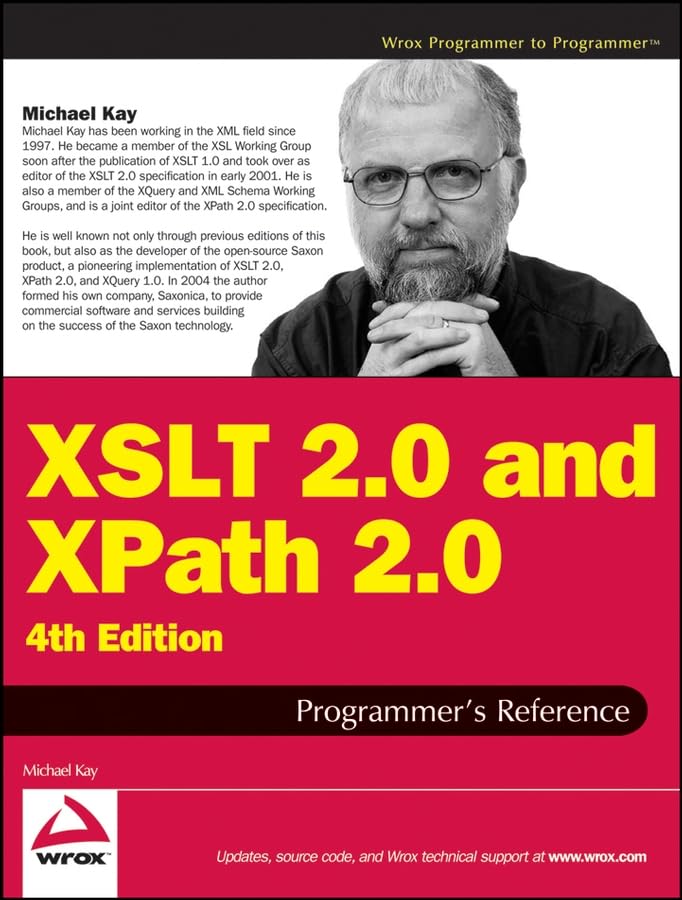
XSLT 2.0 and XPath 2.0 Programmer's Reference
Michael Kay
4.4
This book is primarily a practical reference book for professional XSLT developers. It assumes no previous knowledge of the language, and many developers have used it as their first introduction to XSLT; however, it is not structured as a tutorial, and there are other books on XSLT that provide a gentler approach for beginners. The book does assume a basic knowledge of XML, HTML, and the architecture of the Web, and it is written for experienced programmers. There's no assumption that you know any particular language such as Java or Visual Basic, just that you recognize the concepts that all programming languages have in common.
The book is suitable both for XSLT 1.0 users upgrading to XSLT 2.0, and for newcomers to XSLT. The book is also equally suitable whether you work in the Java or .NET world.
As befits a reference book, a key aim is that the coverage should be comprehensive and authoritative. It is designed to give you all the details, not just an overview of the 20 percent of the language that most people use 80 percent of the time. It's designed so that you will keep coming back to the book whenever you encounter new and challenging programming tasks, not as a book that you skim quickly and then leave on the shelf. If you like detail, you will enjoy this book; if not, you probably won't.
But as well as giving the detail, this book aims to explain the concepts, in some depth. It's therefore a book for people who not only want to use the language but who also want to understand it at a deep level.
The book aims to tell you everything you need to know about the XSLT 2.0 language. It gives equal weight to the things that are new in XSLT 2.0 and the things that were already present in version 1.0. The book is about the language, not about specific products. However, there are appendices about Saxon (the author's own implementation of XSLT 2.0), about the Altova XSLT 2.0 implementation, and about the Java and Microsoft APIs for controlling XSLT transformations, which will no doubt be upgraded to handle XSLT 2.0 as well as 1.0. A third XSLT 2.0 processor, Gestalt, was released shortly before the book went to press, too late to describe it in any detail. But the experience of XSLT 1.0 is that there has been a very high level of interoperability between different XSLT processors, and if you can use one of them, then you can use them all.
In the previous edition we split XSLT 2.0 and XPath 2.0 into separate volumes. The idea was that some readers might be interested in XPath alone. However, many bought the XSLT 2.0 book without its XPath companion and were left confused as a result; so this time, the material is back together. The XPath reference information is in self-contained chapters, so it should still be accessible when you use XPath in contexts other than XSLT.
The book does not cover XSL Formatting Objects, a big subject in its own right. Nor does it cover XML Schemas in any detail. If you want to use these important technologies in conjunction with XSLT, there are other books that do them justice.
This book contains twenty chapters and eight appendixes (the last of which is a glossary) organized into four parts. The following section outlines what you can find in each part, chapter, and appendix.
Part I: Foundations: The first part of the book covers essential concepts. You should read these before you start coding. If you ignore this advice, as most people do, then you read them when you get to that trough of despair when you find it impossible to make the language do anything but the most trivial tasks. XSLT is different from other languages, and to make it work for you, you need to understand how it was designed to be used.
Chapter 1: XSLT in Context: This chapter explains how XSLT fits into the big picture: how the language came into being and how it sits alongside other technologies. It also has a few simple coding examples to keep you alert.
Chapter 2: The XSLT Processing Model: This is about the architecture of an XSLT processor: the inputs, the outputs, and the data model. Understanding the data model is perhaps the most important thing that distinguishes an XSLT expert from an amateur; it may seem like information that you can't use immediately, but it's knowledge that will stop you making a lot of stupid mistakes.
Chapter 3: Stylesheet Structure: XSLT development is about writing stylesheets, and this chapter takes a bird's eye view of what stylesheets look like. It explains the key concepts of rule-based programming using templates, and explains how to undertake programming-in-the-large by structuring your application using modules and pipelines.
Chapter 4: Stylesheets and Schemas: A key innovation in XSLT 2.0 is that stylesheets can take advantage of knowledge about the structure of your input and output documents, provided in the form of an XML Schema. This chapter provides a quick overview of XML Schema to describe its impact on XSLT development. Not everyone uses schemas, and you can skip this chapter if you fall into that category.
Chapter 5: The Type System: XPath 2.0 and XSLT 2.0 offer strong typing as an alternative to the weak typing approach of the 1.0 languages. This means that you can declare the types of your variables, functions, and parameters, and use this information to get early warning of programming errors. This chapter explains the data types available and the mechanisms for creating user-defined types.
Part II: XSLT and XPath Reference: This section of the book contains reference material, organized in the hope that you can easily find what you need when you need it. It's not designed for sequential reading, though you might well want to leaf through the pages to discover what's there.
Chapter 6: XSLT Elements: This monster chapter lists all the XSLT elements you can use in a stylesheet, in alphabetical order, giving detailed rules for the syntax and semantics of each element, advice on usage, and examples. This is probably the part of the book you will use most frequently as you become an expert XSLT user. It's a "no stone unturned" approach, based on the belief that as a professional developer you need to know what happens when the going gets tough, not just when the wind is in your direction.
Chapter 7: XPath Fundamentals: This chapter explains the basics of XPath: the low-level constructs such as literals, variables, and function calls. It also explains the context rules, which describe how the evaluation of XPath expressions depends on the XSLT processing context in which they appear.
Chapter 8: XPath: Operators on Items: XPath offers the usual range of operators for performing arithmetic, boolean comparison, and the like. However, these don't always behave exactly as you would expect, so it's worth reading this chapter to see what's available and how it differs from the last language that you used.
Chapter 9: XPath: Path Expressions: Path expressions are what make XPath special; they enable you to navigate around the structure of an XML document. This chapter explains the syntax of path expressions, the 13 axes that you can use to locate the nodes that you need, and associated operators such as union, intersection, and difference.
Chapter 10: XPath: Sequence Expressions: Unlike XPath 1.0, in version 2.0 all values are sequences (singletons are just a special case). Some of the most important operators in XPath 2.0 are those that manipulate sequences, notably the «for� expression, which translates one sequence into another by applying a mapping.
Chapter 11: XPath: Type Expressions: The type system was explained in Chapter 5; this chapter explains the operations that you can use to take advantage of types. This includes the «cast� operation which is used to convert values from one type to another.A big part of this chapter is devoted to the detailed rules for how these conversions are done.
Chapter 12: XSLT Patterns: This chapter returns from XPath to a subject that's specific to XSLT. Patterns are used to define template rules, the essence of XSLT's rule-based programming approach. The reason for explaining them now is that the syntax and semantics of patterns depends strongly on the corresponding rules for XPath expressions.
Chapter 13: The Function Library: XPath 2.0 includes a library of functions that can be called from any XPath expression; XSLT 2.0 extends this with some additional functions that are available only when XPath is used within XSLT. The library has grown immensely since XPath 1.0. This chapter provides a single alphabetical reference for all these functions.
Chapter 14: Regular Expressions: Processing of text is an area where XSLT 2.0 and XPath 2.0 are much more powerful than version 1.0, and this is largely through the use of constructs that exploit regular expressions. If you're familiar with regexes from languages such as Perl, this chapter tells you how XPath regular expressions differ. If you're new to the subject, it explains it from first principles.
Chapter 15: Serialization: Serialization in XSLT means the ability to generate a textual XML document from the tree structure that's manipulated by a stylesheet. This isn't part of XSLT processing proper, so (following W3C's lead) it's separated it into its own chapter. You can control serialization from the stylesheet using an declaration, but many products also allow you to control it directly via an API.
Part III: Exploitation: The final section of the book is advice and guidance on how to take advantage of XSLT to write real applications. It's intended to make you not just a competent XSLT coder, but a competent designer too. The best way of learning is by studying the work of others, so the emphasis here is on practical case studies.
Chapter 16: Extensibility: This chapter describes the "hooks" provided in the XSLT specification to allow vendors and users to plug in extra functionality. The way this works will vary from one implementation to another, so we can't cover all possibilities, but one important aspect that the chapter does cover is how to use such extensions and still keep your code portable.
Chapter 17: Stylesheet Design Patterns: This chapter explores a number of design and coding patterns for XSLT programming, starting with the simplest "fill-in-the-blanks" stylesheet, and extending to the full use of recursive programming in the functional programming style, which is needed to tackle problems of any computational complexity. This provides an opportunity to explain the thinking behind functional programming and the change in mindset needed to take full advantage of this style of development.
Chapter 18: Case Study: XMLSpec: XSLT is often used for rendering documents, so where better to look for a case study than the stylesheets used by the W3C to render the XML and XSLT specifications, and others in the same family, for display on the web? The resulting stylesheets are typical of those you will find in any publishing organization that uses XML to develop a series of documents with a compatible look-and-feel.
Chapter 19: Case Study: A Family Tree: Displaying a family tree is another typical XSLT application. This example with semi-structured data--a mixture of fairly complex data and narrative text--that can be presented in many different ways for different audiences. It also shows how to tackle another typical XSLT problem, conversion of the data into XML from a legacy text-based format. As it happens, this uses nearly all the important new XSLT 2.0 features in one short stylesheet. But another aim of this chapter is to show a collection of stylesheets doing different jobs as part of a complete application.
Chapter 20: Case Study: Knight's Tour: Finding a route around a chessboard where a knight visits every square without ever retracing its steps might sound a fairly esoteric application for XSLT, but it's a good way of showing how even the most complex of algorithms are within the capabilities of the language. You may not need to tackle this particular problem, but if you want to construct an SVG diagram showing progress against your project plan, then the problems won't be that dissimilar.
Part IV: Appendices: Appendix A: XPath 2.0 Syntax Summary: Collects the XPath grammar rules and operator precedences into one place for ease of reference.
Appendix B: Error Codes: A list of all the error codes defined in the XSLT and XPath language specifications, with brief explanations to help you understand what's gone wrong.
Appendix C: Backward Compatibility: The list of things you need to look out for when converting applications from XSLT 1.0.
Appendix D: Microsoft XSLT Processors: Although the two Microsoft XSLT processors don't yet support XSLT 2.0, we thought many readers would find it useful to have a quick summary here of the main objects and methods used in their APIs.
Appendix E: JAXP: the Java API for XML Processing: JAXP is an interface rather than a product. Again, it doesn't have explicit support yet for XSLT 2.0, but Java programmers will often be using it in XSLT 2.0 projects, so the book includes an overview of the classes and methods available.
Appendix F: Saxon: At the time of writing Saxon (developed by the author of this book) provides the most comprehensive implementation of XSLT 2.0 and XPath 2.0, so its interfaces and extensions are covered in some detail.
Appendix G: Altova: Altova, the developers of XML Spy, have an XSLT 2.0 processor that can be used either as part of the development environment or as a freestanding component. This appendix gives details of its interfaces.
Appendix H: Glossary
Note: CD-ROM/DVD and other supplementary materials are not included as part of eBook file.
…
Cover unavailable
27
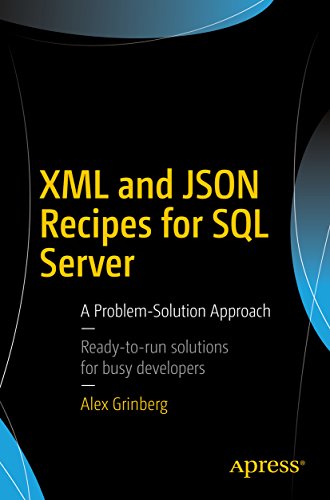
XML and Json Recipes for SQL Server: A Problem-Solution Approach
Alex Grinberg
4.4
Quickly find solutions to dozens of common problems encountered while using XML and JSON features that are built into SQL Server. Content is presented in the popular problem-solution format. Look up the problem that you want to solve. Read the solution. Apply the solution directly in your own code. Problem solved! This book shows how to take advantage of XML and JSON to share data and automate tasks. JSON is commonly used to move data back and forth between the database and front-end applications, often running in a browser. This book shows all you need to know about transforming query results into JSON format, and back again. Also covered are the processes and techniques for moving data into and out of XML format for business intelligence and other purposes, such as when transferring data from a reporting system into a data warehouse, or between different database brands such as between SQL Server and Oracle. Microsoft intensively implements XML in SQL Server, and in many related products. Execution plans are generated in XML format, and this book shows you how to parse those plans and automate the detection of performance problems. The relatively new Extended Events feature writes tracing data into XML files, and the recipes in this book help in parsing those files. XML is also used in SQL Server's BI tool set, including in SSIS, SSR, and SSAS. XML is used in many configuration files, and is even behind the construction of DDL triggers. In reading this book you'll dive deeply into the features that allow you to build and parse XML, and also JSON, which is a specific format of XML used to transmit objects in a web-friendly format between a database and its front-end applications. What You Will Learn Build XML and JSON objects in support of automation and data transfer
Import and parse XML and JSON from operating system files Build appropriate indexes on XML objects to improve query performance Move data from query result sets into JSON format, and back again Automate the detection of database performance problems by querying and parsing the database's own execution plans
Replace external and manual JSON processes with SQL Server's internal, JSON functionality Who This Book Is For Database administrators, .NET developers, business intelligence developers, and other professionals who want a deep and detailed skill set around working with XML and JSON in a SQL Server database environment. Web developers will particularly find the book useful for its coverage of transforming database result sets into JSON text that can be transmitted to front-end web applications.
…
Cover unavailable
28
XSLT Programmer's Reference 2nd Edition
Michael H. Kay
4.4
Cover unavailable
29
Making Sense of NoSQL: A guide for managers and the rest of us
Dan McCreary, Ann Kelly
4.4
Summary
Making Sense of NoSQL clearly and concisely explains the concepts, features, benefits, potential, and limitations of NoSQL technologies. Using examples and use cases, illustrations, and plain, jargon-free writing, this guide shows how you can effectively assemble a NoSQL solution to replace or augment the traditional RDBMS you have now.
About this Book
If you want to understand and perhaps start using the new data storage and analysis technologies that go beyond the SQL database model, this book is for you. Written in plain language suitable for technical managers and developers, and using many examples, use cases, and illustrations, this book explains the concepts, features, benefits, potential, and limitations of NoSQL.
Making Sense of NoSQL starts by comparing familiar database concepts to the new NoSQL patterns that augment or replace them. Then, you'll explore case studies on big data, search, reliability, and business agility that apply these new patterns to today's business problems. You'll see how NoSQL systems can leverage the resources of modern cloud computing and multiple-CPU data centers. The final chaptersshow you how to choose the right NoSQL technologies for your own needs.
Managers and developers will welcome this lucid overview of the potential and capabilities of NoSQL technologies.
Purchase of the print book includes a free eBook in PDF, Kindle, and ePub formats from Manning Publications.
What's Inside
NoSQL data architecture patterns NoSQL for big data Search, high availability, and security Choosing an architecture
About the Authors
Dan McCreary and Ann Kelly lead an independent training and consultancy firm focused on NoSQL solutions and are cofounders of the NoSQL Now! Conference.
Table of Contents
PART 1 INTRODUCTION NoSQL: It's about making intelligent choices NoSQL concepts PART 2 DATABASE PATTERNS Foundational data architecture patterns NoSQL data architecture patterns Native XML databases PART 3 NOSQL SOLUTIONS Using NoSQL to manage big data Finding information with NoSQL search Building high-availability solutions with NoSQL Increasing agility with NoSQL PART 4 ADVANCED TOPICS NoSQL and functional programming Security: protecting data in your NoSQL systems Selecting the right NoSQL solution
…
Cover unavailable
30
MySQL Cookbook
Paul DuBois
4.4
Along with MySQL's popularity has come a flood of questions about solving specific problems, and that's where this Cookbook is essential. Designed as a handy resource when you need quick solutions or techniques, the book offers dozens of short, focused pieces of code and hundreds of worked-out examples for programmers of all levels who don't have the time (or expertise) to solve MySQL problems from scratch.
The new edition covers MySQL 5.0 and its powerful new features, as well as the older but still widespread MySQL 4.1. One major emphasis of this book is how to use SQL to formulate queries for particular kinds of questions, using the mysql client program included in MySQL distributions. The other major emphasis is how to write programs that interact with the MySQL server through an API. You'll find plenty of examples using several language APIs in multiple scenarios and situations, including the use of Ruby to retrieve and format data. There are also many new examples for using Perl, PHP, Python, and Java as well.
Other recipes in the book teach you to:
Access data from multiple tables at the same time Use SQL to select, sort, and summarize rows Find matches or mismatches between rows in two tables Determine intervals between dates or times, including age calculations Store images into MySQL and retrieve them for display in web pages Get LOAD DATA to read your data files properly or find which values in the file are invalid Use strict mode to prevent entry of bad data into your database Copy a table or a database to another server Generate sequence numbers to use as unique row identifiers Create database events that execute according to a schedule And a lot more MySQL Cookbook doesn't attempt to develop full-fledged, complex applications. Instead, it's intended to assist you in developing applications yourself by helping you get past problems that have you stumped.
…
Cover unavailable
31
Microsoft Access 2016 Programming by Example: With VBA, XML, and ASP
Julitta Korol
4.4
Updated for Access 2016 and based on the bestselling editions from previous versions, Microsoft Access 2016 Programming by Example with VBA, XML and ASP is a practical how-to book on Access programming, suitable for readers already proficient with the Access user interface (UI). If you are looking to automate Access routine tasks, this book will progressively introduce you to programming concepts via numerous illustrated hands-on exercises. More advanced topics are demonstrated via custom projects. Includes a comprehensive disc with source code, supplemental files, and color screen captures (Also available from the publisher for download by writing to info@merclearning.com). With concise and straightforward explanations, you learn how to write and test your programming code with the built-in Visual Basic Editor; understand and use common VBA programming structures such as conditions, loops, arrays, and collections; code a -message box-; reprogram characteristics of a database; and use various techniques to query and manipulate your Access .mdb and .accdb databases. The book shows you how you can build database solutions with Data Access Objects (DAO) and ActiveX Data Objects (ADO); define database objects and manage database security with SQL; enhance and alter the way users interact with database applications with Ribbon customizations and event programming in forms and reports. You also learn how to program Microsoft Access databases for Internet access with Active Server Pages (Classic ASP), HTML, and XML.
Features:
+ Contains over thirty chapters loaded with illustrated -Hands-On- exercises and projects that guide you through the VBA programming language. Each example tells you exactly where to enter code and how to test it and then run it.
+ Includes a comprehensive disc with source code, supplemental files, and color screen captures (Also available from the publisher for download by writing to info@merclearning.com).
+ Explains how to store data for further manipulation in variables, arrays, and collections while teaching you to write both simple and complex VBA programming routines and functions.
+ Teaches you how to programmatically create and access database tables and fields.
+ Shows you how to insert, update, and delete data via programming code using various data access techniques.
+ Gets you proficient creating and running simple and parameterized queries against your Access databases.
+ Gets you comfortable using external data sources with Access (Excel, Word, flat files, XML, and SQL Server).
+ Teaches you how to take control of your forms and reports by writing programming code known as event procedures.
+ Shows you how to use various types of macros and templates.
+ Takes your programming skills to the Web by introducing you to dynamic XML and Classic ASP pages.
On the disc: (Also available from the publisher for download by writing to info@merclearning.com).
+ All source code and supplemental files for the Hands-On exercises and custom projects
+ All images from the text (including 4-color screenshots)
…
Cover unavailable
32
Processing XML with Java�: A Guide to Sax, Dom, Jdom, Jaxp, and Trax
Elliotte Rusty Harold
4.4
-- Author is uniquely qualified to write this book! He is the author of numerous well-received books on Java and has written two of the best-selling books on XML. This is the book that brings his skills together.-- Harold has a fantastic reputation, is a skilled writer, and has excellent publicity channels.
-- A complete guide to writing Java programs that read and write XML documents.
Java is the ideal language for processing XML documents. Consequently, more XML tools have been written in Java than in any other language. More open source XML tools are written in Java than in any other language. Processing XML with Java fills an immediate need for developers who are working with XML in Java. It is a comprehensive tutorial and reference to the major APIs. This book shows developers how to: save XML documents from their applications written in Java; read XML documents produced by other programs; communicate with network servers that send and receive XML data; validate documents they receive against DTDs, schemas, and business rules; and integrate XSLT into their programs.
…
Cover unavailable
33
Learn Ant: In The Simple Way.
Virender Singh
4.4
Cover unavailable
34
Html 5 Black Book, Covers Css 3, Javascript, Xml, Xhtml, Ajax, Php And Jquery, 2Ed
Dt Editorial Services
4.4
Cover unavailable
35
Programming Entity Framework: Code First
Julia Lerman, Rowan Miller
4.4
Take advantage of the Code First data modeling approach in ADO.NET Entity Framework, and learn how to build and configure a model based on existing classes in your business domain. With this concise book, you’ll work hands-on with examples to learn how Code First can create an in-memory model and database by default, and how you can exert more control over the model through further configuration.
Code First provides an alternative to the database first and model first approaches to the Entity Data Model. Learn the benefits of defining your model with code, whether you’re working with an existing database or building one from scratch. If you work with Visual Studio and understand database management basics, this book is for you.
Learn exactly what Code First does—and does not—enable you to do Understand how property attributes, relationships, and database mappings are inferred from your classes by Code First Use Data Annotations and the Fluent API to configure the Code First data model Perform advanced techniques, such as controlling the database schema and overriding the default model caching This book is a continuation of author Julia Lerman’s Programming Entity Framework, widely recognized as the leading book on the topic.
…
Cover unavailable
36
CSS Pocket Reference
Eric A. Meyer
4.3
More proof that good things come in small--and sometimes even inexpensive--packages: the "CSS Pocket Reference" has been completely revised and updated to reflect the latest Cascading Style Sheet specifications, CSS2 and CSS2.1.An indispensable reference for web designers and developers, this slim little book covers the essential information needed to effectively implement CSS, with an introduction to the key concepts of CSS and a complete alphabetical reference to the CSS2 and CSS 2.1 properties. And since browser incompatibility is the biggest CSS headache for most developers, it also includes an invaluable chart displaying detailed information about CSS support for every style element across all browsers. For anyone who wants to correctly implement CSS, this book condenses all the details in its companion volume, "Cascading Style Sheets: The Definitive Guide," into one easy-to-use cheat-sheet.The "CSS Pocket Reference" delivers just the CSS details that you need to complete the task at hand. When you're stuck and want an answer quickly, the tiny "CSS Pocket Reference" is the book you'll want by your keyboard or in your back pocket. (Yes, it really does fit in a back pocket, but it's too useful to stay there long.)
…
Cover unavailable
37
Pro SQL Server 2008 XML
Michael Coles
4.3
Knowledge and ability to apply XML are de rigueur in today's world, and SQL Server developers and administrators are no exception to that rule. Pro SQL Server 2008 XML is your key to unlocking the powerful XML feature set first introduced in SQL Server 2005 and since refined in SQL Server 2008. Author Michael Coles shows how to store XML using SQL Server's built-in XML data type. Learn to query and manipulate XML data using standard technologies such as XQuery and XSLT. No SQL Server database professional can afford to be without knowledge of the XML feature set. Pro SQL Server 2008 XML delivers on the knowledge that you need to remain competitive in your career.
Shows how to store, query, and manipulate XML documents in SQL Server Provides step-by-step examples showing best practices and advanced features Accurately discusses how SQL Server's XML feature set stacks up against the ISO XML standards
…
Cover unavailable
38
MySQL Stored Procedure Programming: Building High-Performance Web Applications in MySQL
Guy Harrison, Steven Feuerstein
4.3
The implementation of stored procedures in MySQL 5.0 a huge milestone -- one that is expected to lead to widespread enterprise adoption of the already extremely popular MySQL database. If you are serious about building the web-based database applications of the future, you need to get up to speed quickly on how stored procedures work -- and how to build them the right way. This book, destined to be the bible of stored procedure development, is a resource that no real MySQL programmer can afford to do without.
In the decade since MySQL burst on the scene, it has become the dominant open source database, with capabilities and performance rivaling those of commercial RDBMS offerings like Oracle and SQL Server. Along with Linux and PHP, MySQL is at the heart of millions of applications. And now, with support for stored procedures, functions, and triggers in MySQL 5.0, MySQL offers the programming power needed for true enterprise use.
MySQL's new procedural language has a straightforward syntax, making it easy to write simple programs. But it's not so easy to write secure, easily maintained, high-performance, and bug-free programs. Few in the MySQL world have substantial experience yet with stored procedures, but Guy Harrison and Steven Feuerstein have decades of combined expertise.
In MySQL Stored Procedure Programming, they put that hard-won experience to good use. Packed with code examples and covering everything from language basics to application building to advanced tuning and best practices, this highly readable book is the one-stop guide to MySQL development. It consists of four major sections:
MySQL stored programming fundamentals -- tutorial, basic statements, SQL in stored programs, and error handling Building MySQL stored programs -- transaction handling, built-in functions, stored functions, and triggers MySQL stored programs in applications -- using stored programs with PHP, Java, Perl, Python, and .NET (C# and VB.NET) Optimizing MySQL stored programs -- security, basic and advanced SQL tuning, optimizing stored program code, and programming best practices A companion web site contains many thousands of lines of code, that you can put to use immediately.
Guy Harrison is Chief Architect of Database Solutions at Quest Software and a frequent speaker and writer on MySQL topics. Steven Feuerstein is the author of Oracle PL/SQL Programming, the classic reference for Oracle stored programming for more than ten years. Both have decades of experience as database developers, and between them they have authored a dozen books.
…
Cover unavailable
39
XSLT: Mastering XML Transformations
Doug Tidwell
4.3
Cover unavailable
40
XML in easy steps
Mike McGrath
4.3
XML in Easy Steps is designed for new users who want to quickly get up to speed, from job seekers to programmers to hobbyists. In clear, step-by-step instructions, and with screenshots illustrating every example, it demonstrates the parts of XML that have become popular in today's real-world applications. The book begins with a description of eXtensible Markup Language (XML) along with the associated technologies of Document Type Definition (DTD), XmlSchema Documents (XSD), and the eXtensible Stylesheet Language (XSL). It then illustrates how XML can be used to create Scalable Vector Graphics (SVG), how to access XML data with JavaScript, and how to deploy XML in modern AJAX web applications. At the book’s end, even the newcomer has a solid understanding of XML and can create well-formed documents and validating schemas.
…
Cover unavailable
41
Git Pocket Guide
Richard E. Silverman
4.3
This pocket guide is the perfect on-the-job companion to Git, the distributed version control system. It provides a compact, readable introduction to Git for new users, as well as a reference to common commands and procedures for those of you with Git experience.
Written for Git version 1.8.2, this handy task-oriented guide is organized around the basic version control functions you need, such as making commits, fixing mistakes, merging, and searching history.
Examine the state of your project at earlier points in time Learn the basics of creating and making changes to a repository Create branches so many people can work on a project simultaneously Merge branches and reconcile the changes among them Clone an existing repository and share changes with push/pull commands Examine and change your repository’s commit history Access remote repositories, using different network protocols Get recipes for accomplishing a variety of common tasks
…
Cover unavailable
42
Water: Simplified Web Services and XML Programming
Mike Plusch
4.3
• The essential guide to this exciting new programming language and the first book on the topic, written by one of the creators of Water programming • Water is a new, native Web service programming language that allows the developer to program in XML syntax, replacing the different languages of the various technologies required to build Web applications • Shows readers how to greatly speed and simplify their Web applications and Web services development using Water • Offers hands-on tutorials with more than 100 fully functional examples of Water applications • Companion Web site provides additional information and connects the reader with an active user community
…
Cover unavailable
43
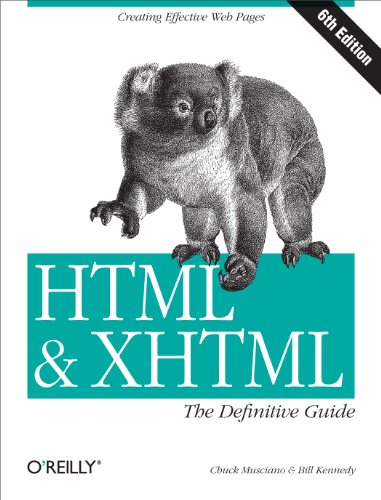
HTML & XHTML: The Definitive Guide
Chuck Musciano
4.3
"...lucid, in-depth descriptions of the behavior of every HTML tag on every major browser and platform, plus enough dry humor to make the book a pleasure to read." --Edward Mendelson, PC Magazine
"When they say 'definitive' they're not kidding." --Linda Roeder, About.com
Put everthing you need to know about HTML & XHTML at your fingertips. For nearly a decade, hundreds of thousands of web developers have turned to HTML & XHTML: The Definitive Guide to master standards-based web development. Truly a definitive guide, the book combines a unique balance of tutorial material with a comprehensive reference that even the most experienced web professionals keep close at hand. From basic syntax and semantics to guidelines aimed at helping you develop your own distinctive style, this classic is all you need to become fluent in the language of web design.
The new sixth edition guides you through every element of HTML and XHTML in detail, explaining how each element works and how it interacts with other elements. You'll also find detailed discussions of CSS (Cascading Style Sheets), which is intricately related to web page development. The most all-inclusive, up-to-date book on these languages available, this edition covers HTML 4.01, XHTML 1.0, and CSS2, with a preview of the upcoming XHTML2 and CSS3. Other topics include the newer initiatives in XHTML (XForms, XFrames, and modularization) and the essentials of XML for advanced readers. You'll learn how to:
Use style sheets to control your document's appearance Work with programmatically generated HTML Create tables, both simple and complex Use frames to coordinate sets of documents Design and build interactive forms and dynamic documents Insert images, sound files, video, Java applets, and JavaScript programs Create documents that look good on a variety of browsers The authors apply a natural learning approach that uses straightforward language and plenty of examples. Throughout the book, they offer suggestions for style and composition to help you decide how to best use HTML and XHTML to accomplish a variety of tasks. You'll learn what works and what doesn't, and what makes sense to those who view your web pages and what might be confusing. Written for anyone who wants to learn the language of the Web--from casual users to the full-time design professionals--this is the single most important book on HTML and XHTML you can own.
Bill Kennedy is chief technical officer of MobileRobots, Inc. When not hacking new HTML pages or writing about them, "Dr. Bill" (Ph.D. in biophysics from Loyola University of Chicago) is out promoting the company's line of mobile, autonomous robots that can be used for artificial intelligence, fuzzy logic research, and education.
Chuck Musciano began his career as a compiler writer and crafter of tools at Harris Corporations' Advanced Technology Group and is now a manager of Unix Systems in Harris' Corporate Data Center.
…
Cover unavailable
44
Dita - The Topic-Based XML Standard: A Quick Start
Sissi Closs
4.3
This book presents a concise, real-world description of DITA principles. Explanations are provided on the basis of simple, applicable examples. The book will be an excellent introduction for DITA novices and is ideal as a first orientation for optimizing your information environment.
Cover unavailable
45
SVG Animations: From Common UX Implementations to Complex Responsive Animation
Sarah Drasner
4.3
SVG is extremely powerful, with its reduced HTTP requests and crispness on any display. It becomes increasingly more interesting as you explore its capabilities for responsive animation and performance boons. When you animate SVG, you must be aware of normal image traits like composition, color, implementation, and optimization. But when you animate, it increases the complexity of each of these factors exponentially.
This practical book takes a deep dive into how you can to solve these problems with stability, performance, and creativity in mind.
Learn how to make SVG cross-browser compatible, backwards compatible, optimized, and responsive Plan and debug animation Make a complex animation responsive, as many sites are responsive Profile each animation technique in terms of performance so that you know what you're getting in to with each library or native technology
…
Cover unavailable
46
Aprende XML (Spanish Edition)
Juan Diego Gutiérrez Gallardo
4.3
Cover unavailable
47
Programming Entity Framework: Dbcontext: Querying, Changing, and Validating Your Data with Entity Framework
Julia Lerman
4.3
The DbContext API captures Entity Framework's (EF) most commonly used features and tasks, simplifying development with EF. This concise book shows you how to use the API to perform set operations with the DbSet class, handle change tracking and resolve concurrency conflicts with the Change Tracker API, and validate changes to your data with the Validation API.
With DbContext, you'll be able to query and update data, whether you're working with individual objects or graphs of objects and their related data. You'll find numerous C# code samples to help you get started. All you need is experience with Visual Studio and database management basics.
Use EF's query capabilities to retrieve data, and use LINQ to sort and filter data Learn how to add new data, and change and delete existing data Use the Change Tracker API to access information EF keeps about the state of entity instances Control change tracking information of entities in disconnected scenarios, including NTier applications Validate data changes before they're sent to the database, and set up validation rules Bypass EF's query pipeline and interact directly with the database
…
Cover unavailable
48
XSLT and Xpath on the Edge
Jeni Tennison
4.2
Extensible Stylesheet Language Transformations, along with the XML Path Language, give you the power to transform XML documents into HTML documents, or to other XML documents that you can use in Web-based applications. But how do you implement XSLT in the real world? This book provides the answers. Covering everything from reformatting numbers to creating dynamic XSLT applications, XSLT expert Jeni Tennison delivers a wealth of ready-to-use utility templates and practical XSLT solutions -- everything you need to jump-start XSLT development. With XSLT and XPath on the Edge, Unlimited Edition, you'll: • Take advantage of utility templates for searching and replacing strings, calculating minimums, and more • Build your own recursive templates or use simple XPaths • Discover ready-made solutions for filtering, numbering, grouping, and other transformations • Understand the building blocks of XSLT applications • Separate style from format and break up your stylesheet into functional modules that are easier to maintain and reuse • Build dynamic applications that use client-side processing with MSXML or server-side processing with Cocoon • Fine-tune stylesheets to work more efficiently and deliver exactly the output you're looking for • Harness the power of the XSLT extensions available with MSXML, Saxon, and Xalan With this Unlimited Edition, owners of the book can download all-new content from the Web and access a searchable version of the book online.
…
Cover unavailable
49
Pro LINQ: Language Integrated Query in C# 2008
Joseph C. Rattz
4.2
LINQ is the project name for a set of extensions to the .NET Framework that provide a generic approach to querying data from different data sources. LINQ will premier in Visual Studio 2008, and will become the next must-have skill for .NET developers. For more information about LINQ, you can check out the author's portal at www.LINQdev.com.
Pro LINQ: Language Integrated Query in C# 2008 is all about code.
Literally, this book starts with code and ends with code. In most books, the author shows the simplest example demonstrating how to use a method, but they so rarely show how to use the more complex prototypes. Pro LINQ: Language Integrated Query in C# 2008 is different. Demonstrating the overwhelming majority of LINQ operators and protoypes, it is a veritable treasury of LINQ examples.
Rather than obscure the relevant LINQ principles in code examples by focusing on a demonstration application you have no interest in writing, Pro LINQ: Language Integrated Query in C# 2008 cuts right to the chase of each LINQ operator, method, or class. However, where complexity is necessary to truly demonstrate an issue, the examples are right there in the thick of it. For example, code samples demonstrating how to handle concurrency conflicts actually create concurrency conflicts so you can step through the code and see them unfold.
Most books tell you about the simple stuff, while few books warn you of the pitfalls. Where Pro LINQ: Language Integrated Query in C# 2008 returns your investment is in the hours, and sometimes days, spent by the author determining why something may not work as expected. Sometimes this results in an innocent looking paragraph that may take you a minute to read and understand, but took days to research and explain.
Face it, most technical books while informative, are dull. LINQ need not be dull. Written with a sense of humor, Pro LINQ: Language Integrated Query in C# 2008 will attempt to entertain you on your journey through the wonderland of LINQ and C# 2008.
…
Cover unavailable
50
DocBook XSL: The Complete Guide
Bob Stayton
4.2
DocBook XSL: The Complete Guide (Fourth Edition) by Bob Stayton is the definitive guide to using the DocBook XSL stylesheets. It provides the missing documentation to realize the full potential of DocBook publishing. It covers all aspects of DocBook publishing tools, including installing, using, and customizing the stylesheets and processing tools. With this book, you can: (a) select the DocBook components that are appropriate for your needs and budget, (b) set up and configure the tools for efficient processing of your documents, (c) generate HTML and print output from the same DocBook files, (d) customize your HTML and print output (e) discover and use advanced features of the DocBook stylesheets. The book is suitable for new users just getting started, as well as more advanced users needing a complete reference. It is thoroughly indexed and cross referenced so you can quickly find what you need. The Fourth Edition updates the content to the latest stylesheets and DocBook version 5.
…
Cover unavailable
51
Beginning XSLT
Jeni Tennison
4.2
Welcome Welcome to Beginning XSLT, a comprehensive introduction to the Extensible Stylesheet Language Transformations. Who is this Book For? This book introduces those with a little knowledge of markup languages (HTML, XML, etc.) to the exciting world of XSLT. No prior programming knowledge is assumed or needed. This is a beginning book, so we will aim to teach you everything you need to know from scratch. This book will be equally beneficial to designers and programmers alike. What's Covered in this Book This book is divided into two parts. The first part introduces XML and XSL T bit by bit, gradually demonstrating the techniques that you need to generate HTML (and other formats) from XML. The second part pulls the theory together by looking at some of the other things that you can do with XSLT, including generating formats other than HTML, pulling information out of a variety of XML formats, and validating XML.
…
Cover unavailable
52
Learning Python, Java, JavaScript, C, C++, C#, CSS, HTML, jQuery, MySQL, SQL, LINUX, Perl, PHP or XML: Quick web links to FREE 300+ textbooks, 100+ cheat sheets, 100+ video tutorials and More!
Dr. Web Links
4.2
Cover unavailable
53
Xquery
Priscilla Walmsley
4.2
With the XQuery 1.0 standard, you finally have a tool that will make it much easier to search, extract and manipulate information from XML content stored in databases. This in-depth tutorial not only walks you through the XQuery specification, but also teaches you how to program with this widely anticipated query language.
XQuery is for query writers who have some knowledge of XML basics, but not necessarily advanced knowledge of XML-related technologies. It can be used both as a tutorial, by reading cover to cover, and as a reference, by using the comprehensive index and appendixes. Either way, you will find the background knowledge in namespaces, schemas, built-in types and regular expressions that is relevant to writing XML queries. This book provides:
A high-level overview and quick tour of XQuery Information to write sophisticated queries, without being bogged down by the details of types, namespaces, and schemas Advanced concepts for users who want to take advantage of modularity, namespaces, typing and schemas Guidelines for working with specific types of data, such as numbers, strings, dates, URIs and processing instructions A complete alphabetical reference to the built-in functions and types You will also learn about XQuery's support for filtering, sorting, and grouping data, as well as how to use FLWOR expressions, XPath, and XQuery tools for extracting and combining information. With this book, you will discover how to apply all of these tools to a wide variety of data sources, and how to recombine information from multiple sources into a single final output result.
Whether you're coming from SQL, XSLT, or starting from scratch, this carefully paced tutorial takes you through the final 1.0 standard in detail.
…
Cover unavailable
54
Special Edition Using XHTML
Molly E. Holzschlag
4.2
Molly Holzschlag brings her trademark style and and enthusiasm to Special Edition Using XHTML, including comprehensive information that will help web professionals to get the most from XHTML. The book starts by explaining how XHTML differs from HTML, and why its necessary. It then covers the meat of XHTML, including syntax and document creation. Additional topics include creating tables and frames, designing pages effectively, using graphics, color, images and tools, working with stylesheets, adding multimedia and embedded objects, and the relationship between XHTML and XML. Later sections discuss the concept of XHTML modularization, which can be applied to create web content for alternative browsers including pagers, cell phones, and hand held devices.
…
Cover unavailable
55
WiX 3.6: A Developer's Guide to Windows Installer XML
Nick Ramirez
4.2
A step-by-step tutorial with plenty of code and examples to improve your learning curve. If you are a developer and want to create installers for software targeting the Windows platform, then this book is for you. You'll be using plenty of XML and ought to know the basics of writing a well-formed document. No prior experience in WiX or Windows Installer is assumed. You should know your way around Visual Studio to compile projects, add project references and tweak project properties.
…
Cover unavailable
56
Embodiment And Cognitive Science
Raymond W. Gibbs Jr
4.2
This book describes the many ways that the mind and body are closely interrelated, and how human thought and language are fundamentally linked to bodily action. The embodied nature of mind is explored through many topics, such as perception, thinking, language use, development, emotions, and consciousness. People's embodied experiences are critical to the ways they think and speak and, most generally, understand themselves, other people, and the world around them. This work provides a strong defense of the idea that embodied action is critical to the study of human cognition.
…
Cover unavailable
57
Think Like a Data Scientist: Tackle the data science process step-by-step
Brian Godsey
4.2
Think Like a Data Scientist presents a step-by-step approach to data science, combining analytic, programming, and business perspectives into easy-to-digest techniques and thought processes for solving real world data-centric problems.
About the Technology
Data collected from customers, scientific measurements, IoT sensors, and so on is valuable only if you understand it. Data scientists revel in the interesting and rewarding challenge of observing, exploring, analyzing, and interpreting this data. Getting started with data science means more than mastering analytic tools and techniques, however; the real magic happens when you begin to think like a data scientist. This book will get you there.
About the Book
Think Like a Data Scientist teaches you a step-by-step approach to solving real-world data-centric problems. By breaking down carefully crafted examples, you'll learn to combine analytic, programming, and business perspectives into a repeatable process for extracting real knowledge from data. As you read, you'll discover (or remember) valuable statistical techniques and explore powerful data science software. More importantly, you'll put this knowledge together using a structured process for data science. When you've finished, you'll have a strong foundation for a lifetime of data science learning and practice.
What's Inside
The data science process, step-by-step How to anticipate problems Dealing with uncertainty Best practices in software and scientific thinking About the Reader
Readers need beginner programming skills and knowledge of basic statistics.
About the Author
Brian Godsey has worked in software, academia, finance, and defense and has launched several data-centric start-ups.
…
Cover unavailable
58
Programming Web Services with XML-RPC
Simon St. Laurent, Edd Dumbill, Joe Johnston
4.2
Have you ever needed to share processing between two or more computers running programs written in different languages on different operating systems? Or have you ever wanted to publish information on the Web so that programs other than browsers could work with it? XML-RPC, a system for remote procedure calls built on XML and the ubiquitous HTTP protocol, is the solution you've been looking for.
Programming Web Services with XML-RPC introduces the simple but powerful capabilities of XML-RPC, which lets you connect programs running on different computers with a minimum of fuss, by wrapping procedure calls in XML and establishing simple pathways for calling functions. With XML-RPC, Java programs can talk to Perl scripts, which can talk to Python programs, ASP applications, and so on. You can provide access to procedure calls without having to worry about the system on the other end, so it's easy to create services that are available on the Web.
XML-RPC isn't the only solution for web services; the Simple Object Access Protocol (SOAP) is another much-hyped protocol for implementing web services. While XML-RPC provides fewer capabilities than SOAP, it also has far fewer interoperability problems and its capabilities and limitations are much better understood. XML-RPC is also stable, with over 30 implementations on a wide variety of platforms, so you can start doing real work with it immediately.
Programming Web Services with XML-RPC covers the details of five XML-RPC implementations, so you can get started developing distributed applications in Java, Perl, Python, ASP, or PHP. The chapters on these implementations contain code examples that you can use as the basis for your own work. This book also provides in-depth coverage of the XML-RPC specification, which is helpful for low-level debugging of XML-RPC clients and servers. And if you want to build your own XML-RPC implementation for another environment, the detailed explanations in this book will serve as a foundation for that work.
…
Cover unavailable
59
Semantic Web for the Working Ontologist: Effective Modeling in RDFS and OWL
Dean Allemang, James Hendler
4.2
The promise of the Semantic Web to provide a universal medium to exchange data information and knowledge has been well publicized. There are many sources too for basic information on the extensions to the WWW that permit content to be expressed in natural language yet used by software agents to easily find, share and integrate information. Until now individuals engaged in creating ontologies-- formal descriptions of the concepts, terms, and relationships within a given knowledge domain-- have had no sources beyond the technical standards documents.
Semantic Web for the Working Ontologist transforms this information into the practical knowledge that programmers and subject domain experts need. Authors Allemang and Hendler begin with solutions to the basic problems, but don't stop there: they demonstrate how to develop your own solutions to problems of increasing complexity and ensure that your skills will keep pace with the continued evolution of the Semantic Web.
…
Cover unavailable
60
Xul Mozilla, Xpfe, Xpcom, Xbl, Xpi, Css, Java Script, Xml, Rdf, Dom, Php5: Les Cahiers Du Programmeur
Jonathan Protzenko, Benoît Picaud
4.2
Cover unavailable
61
Programming Microsoft ASP.NET MVC
Dino Esposito
4.2
Cover unavailable
62
Web Technologies: Tcp/Ip Architecture And Java Programming, 2nd Edition
XSLT is an essential tool for converting XML into other kinds of documents: HTML, PDF file, and many others. It's a critical technology for XML-based platforms such as Microsoft .NET, Sun Microsystems' Sun One, as well as for most web browsers and authoring tools. As useful as XSLT is, however, most people have a difficult time getting used to its peculiar characteristics. The ability to use advanced techniques depends on a clear and exact understanding of how XSLT templates work and interact.
The XSLT 1.0 Pocket Reference from O'Reilly wants to make sure you achieve that level of understanding. With its concise approach, this handy pocket guide quickly gets you up to speed on XSLT 1.0 so you can covert XML like a seasoned pro. In addition to covering the basics of stylesheet structure, it also explains how to:
use template rules create a result tree apply conditional processing transform multiple source documents employ number formatting
Thanks to their convenient, quick-reference format, O'Reilly's Pocket References spare you from having to hunt through larger books for answers. They deliver just what you need to get the job done in a timely fashion. And the XSLT 1.0 Pocket Reference is no different--it's the ideal companion to have at your desk when you need an answer fast.
…
Cover unavailable
64
The Compass: Essential Reading about XML, Dita, and Web 2.0 (Second Edition)
Sarah S. O'Keefe and Publishing Scriptorium Publishing
4.2
Your guide to modern technical communication These white papers, also available at scriptorium.com, introduce you to critical tools and technologies, including structured authoring, Extensible Markup Language (XML), the Darwin Information Typing Architecture (DITA) and the DITA Open Toolkit, and user-generated content (blogs, wikis, and forums). The Compass provides essential information about the direction of technical publishing today. NOTE: The Compass is a compilation of white papers that are also available free at scriptorium.com. The book does not contain different or updated content.
…
Cover unavailable
65
Beginning XML
David Hunter, Jeff Rafter, Joe Fawcett, Eric van der Vlist, Danny Ayers, Jon Duckett, Andrew Watt, Linda McKinnon
4.2
When the first edition of this book was written, XML was a relatively new language but already gaining ground fast and becoming more and more widely used in a vast range of applications. By the time of the second edition, XML had already proven itself to be more than a passing fad, and was in fact being used throughout the industry for an incredibly wide range of uses. With the third edition, it was clear that XML was a mature technology, but more important, it became evident that the XML landscape was dividing into several areas of expertise. Now in this edition, we needed to categorize the increasing number of specifications surrounding XML, which either use XML or provide functionality in addition to the XML core specification. So what is XML? It's a markup language, used to describe the structure of data in meaningful ways. Anywhere that data is input/output, stored, or transmitted from one place to another, is a potential fit for XML's capabilities. Perhaps the most well-known applications are web-related (especially with the latest developments in handheld web access--for which some of the technology is XML-based). However, there are many other non-web-based applications for which XML is useful--for example, as a replacement for (or to complement) traditional databases, or for the transfer of financial information between businesses. News organizations, along with individuals, have also been using XML to distribute syndicated news stories and blog entries.
This book aims to teach you all you need to know about XML--what it is, how it works, what technologies surround it, and how it can best be used in a variety of situations, from simple data transfer to using XML in your web pages. It answers the fundamental questions:
* What is XML?
* How do you use XML?
* How does it work?
* What can you use it for, anyway?
This book is for people who know that it would be a pretty good idea to learn XML but aren't 100 percent sure why. You've heard the hype but haven't seen enough substance to figure out what XML is and what it can do. You may be using development tools that try to hide the XML behind user interfaces and scripts, but you want to know what is really happening behind the scenes. You may already be somehow involved in web development and probably even know the basics of HTML, although neither of these qualifications is absolutely necessary for this book.
What you don't need is knowledge of markup languages in general. This book assumes that you're new to the concept of markup languages, and we have structured it in a way that should make sense to the beginner and yet quickly bring you to XML expert status.
The word "Beginning" in the title refers to the style of the book, rather than the reader's experience level. There are two types of beginner for whom this book is ideal:
* Programmers who are already familiar with some web programming or data exchange techniques. Programmers in this category will already understand some of the concepts discussed here, but you will learn how you can incorporate XML technologies to enhance those solutions you currently develop.
* Those working in a programming environment but with no substantial knowledge or experience of web development or data exchange applications. In addition to learning how XML technologies can be applied to such applications, you will be introduced to some new concepts to help you understand how such systems work.
The subjects covered in this book are arranged to take you from novice to expert in as logical a manner as we could. This Fourth Edition is structured in sections based on various areas of XML expertise. Unless you are already using XML, you should start by reading the introduction to XML in Part I. From there, you can quickly jump into specific areas of expertise, or, if you prefer, you can read through the book in order. Keep in mind that there is quite a lot of overlap in XML, and that some of the sections make use of techniques described elsewhere in the book.
* The book begins by explaining what exactly XML is and why the industry felt that a language like this was needed.
* After covering the why, the next logical step is the how, so it shows you how to create well-formed XML.
* Once you understand the whys and hows of XML, you'll go on to some more advanced things you can do when creating your XML documents, to make them not only well formed, but valid. (And you'll learn what "valid" really means.)
* After you're comfortable with XML and have seen it in action, the book unleashes the programmer within and looks at an XML-based programming language that you can use to transform XML documents from one format to another.
* Eventually, you will need to store and retrieve XML information from databases. At this point, you will learn not only the state of the art for XML and databases, but also how to query XML information using an SQL-like syntax called XQuery.
* XML wouldn't really be useful unless you could write programs to read the data in XML documents and create new XML documents, so we'll get back to programming and look at a couple of ways that you can do that.
* Understanding how to program and use XML within your own business is one thing, but sending that information to a business partner or publishing it to the Internet is another. You'll learn about technologies that use XML that enable you to send messages across the Internet, publish information, and discover services that provide information.
* Since you have all of this data in XML format, it would be great if you could easily display it to people, and it turns out you can. You'll see an XML version of HTML called XHTML. You'll also look at a technology you may already be using in conjunction with HTML documents called CSS. CSS enables you to add visual styles to your XML documents. In addition, you'll learn how to design stunning graphics and make interactive forms using XML.
* Finally, the book ends with a case study, which should help to give you ideas about how XML can be used in real-life situations, and which could be used in your own applications.
This book builds on the strengths of the earlier editions, and provides new material to reflect the changes in the XML landscape--notably XQuery, RSS and Atom, and AJAX. Updates have been made to reflect the most recent versions of specifications and best practices throughout the book. In addition to the many changes, each chapter has a set of exercise questions to test your understanding of the material. Possible solutions to these questions appear in Appendix A.
Part I: Introduction: The introduction is where most readers should begin. The first three chapters introduce some of the goals of XML as well as the specific rules for constructing XML. Once you have read this part you should be able to read and create your own XML documents.
Chapter 1: What Is XML?: This chapter cover some basic concepts, introducing the fact that XML is a markup language (a bit like HTML) whereby you can define your own elements, tags, and attributes (known as a vocabulary). You'll see that tags have no presentation meaning--they're just a way to describe the structure of the data.
Chapter 2: Well-Formed XML: In addition to explaining what well-formed XML is, we offer a look at the rules that exist (the XML 1.0 and 1.1 Recommendations) for naming and structuring elements--you need to comply with these rules in order to produce well-formed XML.
Chapter 3: XML Namespaces: Because tags can be made up, you need to avoid name conflicts when sharing documents. Namespaces provide a way to uniquely identify a group of tags, using a URI. This chapter explains how to use namespaces.
Part II: Validation: In addition to the well-formedness rules you learn in Part I, you will most likely want to learn how to create and use different XML vocabularies. This Part introduces you to DTDs, XML Schemas, and RELAX NG: three languages that define custom XML vocabularies. It also shows you how to utilize these definitions to validate your XML documents.
Chapter 4: Document Type Definitions: You can specify how an XML document should be structured, and even provide default values, using Document Type Definitions (DTDs). If XML conforms to the associated DTD, it is known as valid XML. This chapter covers the basics of using DTDs.
Chapter 5: XML Schemas: XML Schemas, like DTDs, enable you to define how a document should be structured. In addition to defining document structure, they enable you to specify the individual datatypes of attribute values and element content. They are a more powerful alternative to DTDs.
Chapter 6: RELAX NG: RELAX NG is a third technology used to define the structure of documents. In addition to a new syntax and new features, it takes the best from XML Schemas and DTDs, and is therefore very simple and very powerful. RELAX NG has two syntaxes; both the full syntax and compact syntax are discussed.
Part III: Processing: In addition to defining and creating XML documents, you need to know how to work with documents to extract information and convert it to other formats. In fact, easily extracting information and converting it to other formats is what makes XML so powerful.
Chapter 7: XPath: The XPath language is used to locate sections and data in the XML document, and it's important in many other XML technologies.
Chapter 8: XSLT: XML can be transformed into other XML documents, HTML, and other formats using XSLT stylesheets, which are introduced in this chapter.
Part IV: Databases: Creating and processing XML documents is good, but eventually you will want to store those documents. This section describes strategies for storing and retrieving XML documents and document fragments from different databases.
Chapter 9: XQuery, the XML Query Language: Very often, you will need to retrieve information from within a database. XQuery, which is built on XPath and XPath2, enables you to do this in an elegant way.
Chapter 10: XML and Databases: XML is perfect for structuring data, and some traditional databases are beginning to offer support for XML. This chapter discusses these, and provides a general overview of how XML can be used in an n-tier architecture. In addition, new databases based on XML are introduced.
Part V: Programming: At some point in your XML career, you will need to work with an XML document from within a custom application. The two most popular methodologies, the Document Object Model (DOM) and the Simple API for XML (SAX), are explained in this part.
Chapter 11: The Document Object Model (DOM): Programmers can use a variety of programming languages to manipulate XML using the Document Object Model's objects, interfaces, methods, and properties, which are described in this chapter.
Chapter 12: Simple API for XML (SAX): An alternative to the DOM for programmatically manipulating XML data is to use the Simple API for XML (SAX) as an interface. This chapter shows how to use SAX and utilizes examples from the Java SAX API.
Part VI: Communication: Sending and receiving data from one computer to another is often difficult, but several technologies have been created to make communication with XML much easier. This part discusses RSS and content syndication, as well as web services and SOAP. This edition includes a new chapter on Ajax techniques.
Chapter 13: RSS, Atom, and Content Syndication: RSS is an actively evolving technology that is used to publish syndicated news stories and website summaries on the Internet. This chapter not only discusses how to use the different versions of RSS and Atom, it also covers the future direction of the technology. In addition, it demonstrates how to create a simple newsreader application that works with any of the currently published versions.
Chapter 14: Web Services: Web services enable you to perform cross-computer communications. This chapter describes web services and introduces you to using remote procedure calls in XML (using XML-RPC and REST), as well as giving you a brief look at major topics such as SOAP. Finally, it breaks down the assortment of specifications designed to work in conjunction with web services.
Chapter 15: SOAP and WSDL: Fundamental to XML web services, the Simple Object Access Protocol (SOAP) is one of the most popular specifications for allowing cross-computer communications. Using SOAP, you can package up XML documents and send them across the Internet to be processed. This chapter explains SOAP and the Web Services Description Language (WSDL) that is used to publish your service.
Chapter 16: Ajax Ajax enables you to utilize JavaScript with web services and SOAP, or REST communications. Additionally, Ajax patterns can be used within web pages to communicate with the web server without refreshing. This chapter is new to the Fourth Edition.
Part VII: Display: Several XML technologies are devoted to displaying the data stored inside of an XML document. Some of these technologies are web-based, and some are designed for applications and mobile devices. This part discusses the primary display strategies and formats used today.
Chapter 17: Cascading Style Sheets (CSS): Website designers have long been using Cascading Style Sheets (CSS) with their HTML to easily make changes to a website's presentation without having to touch the underlying HTML documents. This power is also available for XML, enabling you to display XML documents right in the browser. Or, if you need a bit more flexibility with your presentation, you can use XSLT to transform your XML to HTML or XHTML and then use CSS to style these documents.
Chapter 18: XHTML: XHTML is a new version of HTML that follows the rules of XML. This chapter discusses the differences between HTML and XHTML, and shows you how XHTML can help make your sites available to a wider variety of browsers, from legacy browsers to the latest browsers on mobile phones.
Chapter 19: Scalable Vector Graphics (SVG): Do you want to produce a custom graphic using XML? SVG enables you to describe a graphic using XML-based vector commands. This chapter teaches you the basics of SVG and then dives into a more complex SVG-based application that can be published to the Internet.
Chapter 20: XForms: XForms are XML-based forms that can be used to design desktop applications, paper-based forms, and of course XHTML-based forms. This chapter demonstrates both the basics and some of the more interesting uses of XForms.
Part VIII: Case Study: Throughout the book you'll gain an understanding of how XML is used in web, business-to-business (B2B), data storage, and many other applications. The case study covers an example application and shows how the theory can be put into practice in real-life situations. The case study is new to this edition.
Chapter 21: Case Study: Payment Calculator: This case study explores some of the possibilities and strategies for using XML in your website. It includes an example that demonstrates a loan payment calculator by creating a web page using XHTML and CSS, communicating with a local web service using AJAX, utilizing an XML Schema to build data structures in .NET, and ultimately using the Document Object Model to display the results in SVG. An online version of this case study on the book's website covers the same material using Ruby on Rails instead of .NET.
Appendixes: Appendix A provides answers to the exercise questions that appear throughout the book. The remaining appendixes provide reference material that you may find useful as you begin to apply the knowledge gained throughout the book in your own applications. These are: Appendix B: XPath Reference; Appendix C: XSLT Reference; Appendix D: The XML Document Object Model; Appendix E: XML Schema Element and Attribute Reference; Appendix F: XML Schema Datatypes Reference; Appendix G: SAX 2.0.2 Reference. Appendixes A, B, and C are included within the book; Appendixes D-G are available on the book's website.
…
Cover unavailable
66
HTML Pocket Reference
Jennifer Niederst Robbins
4.2
In this pocket reference, Jennifer Niederst, the author of the best-selling Web Design in a Nutshell, delivers a concise guide to every HTML tag.
Each tag entry includes:
Detailed information on the tag's attributes Support information on browsers such as Netscape Navigator, Microsoft Internet Explorer, Opera, and WebTV HTML 4.0 support information, including whether the tag is deprecated in the current spec In addition to tag-by-tag descriptions, you'll find useful charts on such topics as:
Character entities Decimal-to-hexadecimal conversions Color names Niederst also provides context for the tags, indicating which tags are grouped together and bare-bones examples of how standard web page elements are constructed.
This pocket reference is targeted at web designers and web authors and is likely to be the most dog-eared book on every web professional's desk.
…
Cover unavailable
67
Professional XML
Mark Birbeck, Michael Kay, stev Livingstone, Stephen F. Mohr, Jonathan Pinnock, Brian Loesgen, Steven Livingston, Didier Martin, Nikola Ozu, Mark Seabourne, David Baliles
4.2
XML stands for eXtensible Markup Language, and is a rapidly maturing data format for structured document interchange on the Web. However, XML is in no way limited to Internet use. In fact, XML's main strength - organizing information - makes it perfect for exchanging data between different systems, regardless of whether the Internet is part of the picture.
Cover unavailable
68
Effective XML: 50 Specific Ways to Improve Your XML
Elliotte Rusty Harold
4.1
The author teaches programmers how to use XML effectively and produce better code. Harold explains the critical rules of thumb employed by the experts to get the most out of XML and provides 50 ways to use XML to produce code that is extensible, legible and maintainable.
Cover unavailable
69
XML Schema
Eric van der Vlist
4.1
If you need to create or use formal descriptions of XML vocabularies, the W3C's XML Schema offers a powerful set of tools for defining acceptable document structures and content. An alternative to DTDs as the way to describe and validate data in an XML environment, XML Schema enables developers to create precise descriptions with a richer set of datatypes?such as booleans, numbers, currencies, dates and times?that are essential for today?s applications.
Schemas are powerful, but that power comes with substantial complexity. This concise book explains the ins and outs of XML Schema, including design choices, best practices, and limitations. Particularly valuable are discussions of how the type structures fit with existing database and object-oriented program contexts. With XML Schema, you can define acceptable content models and annotate those models with additional type information, making them more readily bound to programs and objects. Schemas combine the easy interchange of text-based XML with the more stringent requirements of data exchange, and make it easier to validate documents based on namespaces.
You?ll find plenty of examples in this book that demonstrate the details necessary for precise vocabulary definitions. Topics include:
Foundations of XML Schema syntax Flat, "russian-doll", and other schema approaches Working with simple and complex types in a variety of contexts The built-in datatypes provided by XML Schema Using facets to extend datatypes, including regular expression-based patterns Using keys and uniqueness rules to limit how and where information may appear Creating extensible schemas and managing extensibility Documenting schemas and extending XML Schema capabilities through annotations In addition to the explanatory content, XML Schemaprovides a complete reference to all parts of both the XML Schema Structures and XML Schema Datatypes specifications, as well as a glossary. Appendices explore the relationships between XML Schema and other tools for describing document structures, including DTDs, RELAX NG, and Schematron, as well as work in progress at the W3C to more tightly integrate XML Schema with existing specifications.
No matter how you intend to use XML Schema - for data structures or document structures, for standalone documents or part of SOAP transactions, for documentation, validation, or data binding ? all the foundations you need are outlined in XML Schema.
…
Cover unavailable
70
Programming Wpf: Building Windows Ui with Windows Presentation Foundation
Chris Sells
4.1
If you want to build applications that take full advantage of Windows Vista's new user interface capabilities, you need to learn Microsoft's Windows Presentation Foundation (WPF). This new edition, fully updated for the official release of .NET 3.0, is designed to get you up to speed on this technology quickly. By page 2, you'll be writing a simple WPF application. By the end of Chapter 1, you'll have taken a complete tour of WPF and its major elements.
WPF is the new presentation framework for Windows Vista that also works with Windows XP. It's a cornucopia of new technologies, which includes a new graphics engine that supports 3-D graphics, animation, and more; an XML-based markup language, called XAML, for declaring the structure of your Windows UI; and a radical new model for controls.
This second edition includes new chapters on printing, XPS, 3-D, navigation, text and documents, along with a new appendix that covers Microsoft's new WPF/E platform for delivering richer UI through standard web browsers -- much like Adobe Flash. Content from the first edition has been significantly expanded and modified. Programming WPF includes:
Scores of C# and XAML examples that show you what it takes to get a WPF application up and running, from a simple "Hello, Avalon" program to a tic-tac-toe game Insightful discussions of the powerful new programming styles that WPF brings to Windows development, especially its new model for controls A color insert to better illustrate WPF support for 3-D, color, and other graphics effects A tutorial on XAML, the new HTML-like markup language for declaring Windows UI An explanation and comparison of the features that support interoperability with Windows Forms and other Windows legacy applications WPF represents the best of the control-based Windows world and the content-based web world. Programming WPF helps you bring it all together.
…
Cover unavailable
71
New Perspectives on Html, Css, and XML, Comprehensive
Patrick Carey
4.1
NEW PERSPECTIVES ON HTML, CSS, AND XML, COMPREHENSIVE, 4E teaches students how to create simple to complex Web sites from scratch using HTML, CSS, AND XML. Students are asked to think critically in order to solve problems and complete Case Studies, which reinforces key concepts critical to creating Web pages.
Cover unavailable
72
GWT in Action
Adam Tacy
4.1
Summary
GWT in Action, Second Edition is a completely revised edition of the best-selling GWT book. It covers the new features introduced in GWT 2.4 and 2.5, as well as the best development practices that have emerged in the GWT community. It begins with a rapid-fire introduction to GWT and Ajax to get you up to speed with GWT concepts and tools. Then, you'll explore key concepts like managing events, interacting with the server, creating UI components, building your user interface declaratively using UiBinder ... and more.
About the Technology
Google Web Toolkit works on a simple idea. Write your web application in Java, and GWT crosscompiles it into JavaScript. It is open source, supported by Google, and version 2.5 now includes a library of high-quality interface components and productivity tools that make using GWT a snap. The JavaScript it produces is really good.
About this Book
GWT in Action, Second Edition is a revised edition of the best-selling GWT book. In it, you'll explore key concepts like managing events, interacting with the server, and creating UI components. As you move through its engaging examples, you'll absorb the latest thinking in application design and industry-grade best practices, such as implementing MVP, using dependency injection, and code optimization.
Written for Java developers, the book requires no prior knowledge of GWT.
Purchase of the print book comes with an offer of a free PDF, ePub, and Kindle eBook from Manning. Also available is all code from the book.
What's Inside
Covers GWT 2.4 and up Efficient use of large data sets Optimizing with client bundles, deferred binding, and code splitting Using generators and dependency injection
About the Authors
Adam Tacy and Robert Hanson coauthored the first edition of GWT in Action. Jason Essington is a Java developer and an active contributor to the GWT mailing list and the GWT IRC channel. Anna Tökke is a programmer and solutions architect working with GWT on a daily basis. Table of Contents PART 1 BASICS GWT Building a GWT application: saying "Hello World!" Building a GWT application: enhancing Hello World PART 2 NEXT STEPS Creating your own widgets Using client bundles Interface design with UiBinder Communicating with GWT-RPC Using RequestFactory The Editor framework Data-presentation (cell) widgets Using JSNI—JavaScript Native Interface Classic Ajax and HTML forms Internationalization, localization, and accessibility PART 3 ADVANCED Advanced event handling and event busses Building MVP-based applications Dependency injection Deferred binding Generators Metrics and code splitting
…
Cover unavailable
73
Exam Ref 70-480: Programming in HTML5 with JavaScript and CSS3
Rick Delorme
4.1
Prepare for Microsoft Exam 70-480—and help demonstrate your real-world mastery of programming with HTML5, JavaScript, and CSS3. Designed for experienced developers ready to advance their status, Exam Ref focuses on the critical-thinking and decision-making acumen needed for success at the Microsoft Specialist level.
Focus on the expertise measured by these objectives:
Implement and manipulate document structures and objects Implement program flow Access and secure data Use CSS3 in applications This Microsoft Exam Ref:
Organizes its coverage by exam objectives. Features strategic, what-if scenarios to challenge you. Includes a 15% exam discount from Microsoft. (Limited time offer)
…
Cover unavailable
74
Learning XSLT
Michael James Fitzgerald
4.1
XSLT is a powerful language for transforming XML documents into something else. That something else can be an HTML document, another XML document, a Portable Document Format (PDF) file, a Scalable Vector Graphics (SVG) file, a Virtual Reality Modeling Language (VRML) file, Java code, or a number of other things. You write an XSLT stylesheet to define the rules for transforming an XML document, and the XSLT processor does the work.
As useful as XSLT is, its peculiar characteristics make it a difficult language in which to get started. In fact, newcomers are often a little dazed on first contact. Learning XSLT offers a hands-on introduction to help them get up to speed with XSLT quickly. The book will help web developers and designers understand this powerful but often mystifying template-driven and functional-styled language, getting them over the many differences between XSLT and the more conventional programming languages.
Learning XSLT moves smoothly from the simple to complex, illustrating all aspects of XSLT 1.0 through step-by-step examples that you'll practice as you work through the book. Thorough in its coverage of the language, the book makes few assumptions about what you may already know. You'll learn about XSLT's template-based syntax, how XSLT templates work with each other, and gain an understanding of XSLT variables. Learning XSLT also explains how the XML Path Language (XPath) is used by XSLT and provides a glimpse of what the future holds for XSLT 2.0 and XPath 2.0.
The ability to transform one XML vocabulary to another is fundamental to exploiting the power of XML. Learning XSLT is a carefully paced, example-rich introduction to XSLT that will have you understanding and using XSLT on your own in no time.
…
Cover unavailable
75
XML Security
Blake Dournaee
4.1
This volume explains how to implement XML security. The book brings the reader up to speed fast with both an XML primer and a security primer.
Cover unavailable
76
Microsoft Visual C++/CLI Step by Step (Step by Step Developer)
Julian Templeman
4.1
Your hands-on guide to Visual C++/CLI fundamentals
Expand your expertise--and teach yourself the fundamentals of the Microsoft Visual C++/CLI language. If you have previous programming experience but are new to Visual C++, this tutorial delivers the step-by-step guidance and coding exercises you need to master core topics and techniques.
Discover how to: Write and debug object-oriented C++ programs in Visual Studio 2012 Utilize the various features of the C++/CLI language Make use of the Microsoft .NET Framework Class Library Create a simple Windows Store app Use .NET features such as properties, delegates and events Access data from disparate sources using ADO.NET Create and consume web services using Windows Communication Foundation Work effectively with legacy code and COM
…
Cover unavailable
77
Beginning XML Databases
Gavin Powell
4.1
Supported by all major database systems, XML provides an easy, standardized method of transferring data between databases and to and from the Web, independent of the software in use Offers database programmers and data-driven Web developers detailed guidance on how to understand and work with XML as data Numerous hands-on, step-by-step examples help readers learn to simplify database work using XML Shows how to use XML to exchange data between multiple databases either internally or with external customers and partners Covers XML in popular databases including Oracle Database, SQL Server, and brief coverage of DB2 Database Covers basic syntax for XML, the XML DOM, and XSL - with an emphasis on database use, and native XML databases Additional topics covered include Native XML databases, XPath, XQuery, XLink, XPointer, DTDs, XML Schemas, among others
Document Object Model Analogy: In many ways, the Document Object Model (DOM) can be compared to the schematic of a house. A house's schematic details the relation and placement of objects within a house. For instance, within a schematic, you are able to understand the relationship of the sink to the wall, as well as the corresponding plumbing. In other words, the schematic defines the relationship of one object to another and often, illustrates the rules by which they are governed. HTML and XML documents are also composed of objects, and although these objects may not be physical, like a sink, their organisation and interaction is still coordinated by a set of rules. In this case, the DOM acts as a foundation for the placement and interaction of objects within a document. Whether the object is a table, a piece of information, or a script, the DOM specifies a model for the interaction of these objects. For developers, a thorough understanding of these relationships is paramount, and often, it forms the basis for a system's development.
…
Cover unavailable
79
Hadoop in Practice
Alex Holmes
4.1
Hadoop in Practice collects nearly 100 Hadoop examples and presents them in a problem/solution format. Each technique addresses a specific task you'll face, like querying big data using Pig or writing a log file loader. You'll explore each problem step by step, learning both how to build and deploy that specific solution along with the thinking that went into its design. As you work through the tasks, you'll find yourself growing more comfortable with Hadoop and at home in the world of big data.
…
Cover unavailable
80
Applied XML Programming for Microsoft® .NET
Dino Esposito
4.1
XML is everywhere in the Microsoft® .NET Framework, from Remoting to Web services and from data access to configuration. Learn about the extensive XML core classes in .NET and find out how to program against its parser in this in-depth guide—written by a popular programming author and consultant on cutting-edge technologies such as Microsoft ASP.NET and Microsoft ADO.NET. You’ll find authoritative explanations of technologies such as schemas, transformations, and XPath, plus extensive discussion of data access issues such as synchronization and serialization, the DiffGram format, and the XML extensions in Microsoft SQL Server™ 2000. Along the way, you’ll learn exactly how to get the best performance out of XML in the .NET world. You’ll also get answers to common questions such as, “When should I use XML Web services instead of Remoting?”
Topics covered include:
XML CORE CLASSES IN THE .NET FRAMEWORK
The .NET XML parsing model XML readers and writers Validating readers and writers XML Schema XML DATA MANIPULATION
The XML DOM in .NET XPath XSLT XML AND DATA ACCESS
XML extensions in SQL Server 2000 DataSet serialization The DiffGram format APPLICATION INTEROPERABILITY
The XML Serializer .NET Remoting XML Web services XML data islands Configuration files
…
Cover unavailable
81
XML, Web Services, and the Data Revolution
Frank Coyle
4.1
Putting XML and Web services in context, this text explains what they really mean to business, IT, and the developer.
Cover unavailable
82
XML All in One Desk Reference for Dummies
Richard Wagner and Richard Mansfield
4.1
• The complete solution! This revolution in product design incorporates 6 books in 1 straightforward desk reference. Provides in depth coverage of the many features and specifications of XML, the data interchange standard of choice. * XML All in One For Dummies is a true desk reference designed to guide readers through the features and specifications of the leading edge XML dialects and help them develop their own custom Web applications all under one cover. * Covers XML basics, using DTD's with XML, XML namespaces, XML schemas, styling XML documents, XML's linking languages, XML tools, using XML in the real world, and more. * The first two editions of XML For Dummies have sold more than 85,000 units. * According to Microsoft's CEO Steve Ballmer "XML will become the universal medium by which Web sites and users of Web sites communicate." * Written by NIIT a global training, IT consulting and software development organization. NIIT trains over 150,000 individuals each year in Information Technology areas. * The For Dummies series a repeat winner, now with more than 100 million books in print.
…
Cover unavailable
83
Essential XML Quick Reference: A Programmer's Reference to XML, Xpath, XSLT, XML Schema, Soap, and More
Aaron Skonnard, Martin Gudgin
4.1
XML and the technologies surrounding it have grown immensely in recent years -- in both use and complexity. There's more to know than any one individual can possibly remember. In Essential XML Quick Reference, two leading XML experts present an authoritative reference that covers all the XML-related technologies that matter.KEY TOPICS: In one concise, accessible, example-rich guide, Aaron Skonnard and Martin Gudgin bring together critical information about XML, XSL, XSLT, schemas, namespaces, XPath, SAX, DOM, SOAP, even Microsoft's BizTalk. Following the hugely successful format pioneered by Patrick Chan's Java Almanacs, the authors provide a complete catalog of syntax references, combined with brief, to-the-point overviews of each technology and standard. This ultimate XML reference contains three times the coverage of its nearest competitor.MARKET: For all developers and Web professionals familiar with the basics of XML.
…
Cover unavailable
84
XML for Catalogers and Metadata Librarians
Timothy W. Cole
4.1
How are today's librarians to manage and describe the ever-expanding volumes of resources, in both digital and print formats? The use of XML in cataloging and metadata workflows can improve metadata quality, the consistency of cataloging workflows, and adherence to standards. This book is intended to enable current and future catalogers and metadata librarians to progress beyond a bare surface-level acquaintance with XML, thereby enabling them to integrate XML technologies more fully into their cataloging workflows.
Building on the wealth of work on library descriptive practices, cataloging, and metadata, XML for Catalogers and Metadata Librarians explores the use of XML to serialize, process, share, and manage library catalog and metadata records. The authors' expert treatment of the topic is written to be accessible to those with little or no prior practical knowledge of or experience with how XML is used. Readers will gain an educated appreciation of the nuances of XML and grasp the benefit of more advanced and complex XML techniques as applied to applications relevant to catalogers and metadata librarians.
…
Cover unavailable
85
Fonts & Encodings
Yannis Haralambous
4.1
This reference is a fascinating and complete guide to using fonts and typography on the Web and across a variety of operating systems and application software. Fonts & Encodings shows you how to take full advantage of the incredible number of typographic options available, with advanced material that covers everything from designing glyphs to developing software that creates and processes fonts.
The era of ASCII characters on green screens is long gone, and industry leaders such as Apple, HP, IBM, Microsoft, and Oracle have adopted the Unicode Worldwide Character Standard. Yet, many software applications and web sites still use a host of standards, including PostScript, TrueType, TeX/Omega, SVG, Fontlab, FontForge, Metafont, Panose, and OpenType. This book explores each option in depth, and provides background behind the processes that comprise today's "digital space for writing":
Part I introduces Unicode, with a brief history of codes and encodings including ASCII. Learn about the morass of the data that accompanies each Unicode character, and how Unicode deals with normalization, the bidirectional algorithm, and the handling of East Asian characters. Part II discusses font management, including installation, tools for activation/deactivation, and font choices for three different systems: Windows, the Mac OS, and the X Window System (Unix). Part III deals with the technical use of fonts in two specific cases: the TeX typesetting system (and its successor, W, which the author co-developed) and web pages. Part IV describes methods for classifying fonts: Vox, Alessandrini, and Panose-1, which is used by Windows and the CSS standard. Learn about existing tools for creating (or modifying) fonts, including FontLab and FontForge, and become familiar with OpenType properties and AAT fonts. Nowhere else will you find the valuable technical information on fonts and typography that software developers, web developers, and graphic artists need to know to get typography and fonts to work properly.
…
Cover unavailable
86
Medical Management of Vulnerable and Underserved Patients: Principles, Practice, Populations
Talmadge E. King Jr, Margaret B. Wheeler, et al.
4.0
Publisher's Note: Products purchased from Third Party sellers are not guaranteed by the publisher for quality, authenticity, or access to any online entitlements included with the product.
The leading reference and text on caring for underserved patients and those with highly unique health requirements - updated and expanded in full color
A Doody's Core Title for 2019!
Medical Management of Vulnerable and Underserved Patients: Principles, Practice and Populations, Second Edition is designed to clarify current issues and instruct you in best practices and compliance with legislation, such as the Affordable Care Act, when caring for patients living with chronic diseases in poor and minority populations. How do these laws affect you, your practice, and patient care?
Medical Management of Vulnerable and Underserved Patients is ideally suited for clinical and educational programs and policy-oriented institutions concerned with addressing health disparities and caring for the underserved and vulnerable patient. Comprehensive in scope and authored by many of the leading names in the field, the book takes complex concepts and issues and helps you understand them, resulting in a "roadmap" to guide real-world applications and compliance with the terms of the law. Each chapter integrates key concepts, core competencies, and common pitfalls and concludes with useful lists of web resources and stimulating discussion questions.
Highlights of the Second Edition:
…
Cover unavailable
87
DITA for Practitioners Volume 1: Architecture and Technology
Eliot Kimber
4.0
DITA expert Eliot Kimber takes you inside the DITA XML standard, explaining the architecture and technology that make DITA unique. Volume 1 of his two-volume exploration of DITA starts with a hands-on explanation of end-to-end DITA processing that will get you up and running fast. Then, he explores the DITA architecture, explaining maps and topics, structural patterns, metadata, linking and addressing, keys and key references, relationship tables, conditional processing, reuse, and more.
Kimber's unique perspective unwraps the puzzle that is DITA, explaining the rationale for its design and structure, and giving you an unvarnished, detailed look inside this important technology.
Inside the Book:
Where Do I Start? Background and history of the DITA standard Essential background for practitioners Terminology
End to End DITA Processing: Setting up your development environment Authoring, managing, and producing a DITA-based publication Running, configuring and customizing the Open Toolkit.
An Overview of the DITA Architecture: Vocabulary composition and specialization Maps and topics Structural patterns in DITA Linking and addressing The content reference facility Filtering and Flagging SubjectScheme maps
About the Author
Eliot Kimber is Senior Solutions Architect with RSI Content Solutions. He leads publishers through content management implementations, XML and desktop publishing applications, DITA requirements and standardization, and information and process analyses. He is fluent in XML, XSLT, XSL-FO, DTD development, XML Schema, XPath, XQuery, XInclude, Xlink, and other information management and publishing standards. As a member of the DITA Technical Committee at OASIS Open, he has been a leader in developing the DITA standard since its earliest days, and continues to be a driving force for the evolution and adoption of DITA.
…
Cover unavailable
88
MCTS Self-Paced Training Kit (Exam 70-433): Microsoft SQL Server 2008 - Database Development
Tobias Thernstrom, Mike Hotek, Ann Weber, GrandMasters
4.0
Ace your preparation for the skills measured by MCTS Exam 70-433—and on the job. Work at your own pace through a series of lessons and reviews that fully cover each exam objective. Then, reinforce and apply what you’ve learned through real-world case scenarios and practice exercises. This official Microsoft study guide is designed to help you make the most of your study time.
Maximize your performance on the exam by learning to:
Create and manage database objects Query and modify data; implement subqueries and CTEs • Optimize table structures and data integrity Create stored procedures, functions, and triggers Manage transactions, error handling, and change tracking Tune query performance Implement database mail, full-text search, Service Broker, scripts Work with XML and SQLCLR Assess your skills with the practice tests on CD. You can work through hundreds of questions using multiple testing modes to meet your specific learning needs. You get detailed explanations for right and wrong answers—including a customized learning path that describes how and where to focus your studies. Your kit includes:
15% exam discount from Microsoft. Offer expires 12/31/13. Details inside. Official self-paced study guide. Practice tests with multiple, customizable testing options and a learning plan based on your results. 200 practice and review questions. 180-day trial of SQL Server 2008 Enterprise Edition. Case scenarios, exercises, and best practices. Fully searchable eBook of this guide, plus sample chapters from related books. A Note Regarding the CD or DVD and Practice Files
Assess your skills with practice tests. You can work through hundreds of questions using multiple testing modes to meet your specific learning needs. You get detailed explanations for right and wrong answers—including a customized learning path that describes how and where to focus your studies.
…
Cover unavailable
89
Dynamic Web Application Development Using Xml And Java
David Parsons
4.0
Cover unavailable
90
Unicode Explained
Jukka K. Korpela
4.0
Fundamentally, computers just deal with numbers. They store letters and other characters by assigning a number for each one. There are hundreds of different encoding systems for mapping characters to numbers, but Unicode promises a single mapping. Unicode enables a single software product or website to be targeted across multiple platforms, languages and countries without re-engineering. It's no wonder that industry giants like Apple, Hewlett-Packard, IBM andMicrosoft have all adopted Unicode.
Containing everything you need to understand Unicode, this comprehensive reference from O'Reilly takes you on a detailed guide through the complex character world. For starters, it explains how to identify and classify characters - whether they're common, uncommon, or exotic. It then shows you how to type them, utilize their properties, and process character data in a robust manner.
The book is broken up into three distinct parts. The first few chapters provide you with a tutorial presentation of Unicode and character data. It gives you a firm grasp of the terminology you need to reference various components, including character sets, fonts and encodings, glyphs and character repertoires.
The middle section offers more detailed information about using Unicode and other character codes. It explains the principles and methods of defining character codes, describes some of the widely used codes, and presents code conversion techniques. It also discusses properties of characters, collation and sorting, line breaking rules and Unicode encodings. The final four chapters cover more advanced material, such as programming to support Unicode.
You simply can't afford to be without the nuggets of valuable information detailed in Unicode Explained.
…
Cover unavailable
91
Sams Teach Yourself XSLT in 21 Days
Michiel Van Otegem
4.0
Sams Teach Yourself XSLT in 21 Days covers XSLT and Xpath (as a part of XSLT), as these topics have everything to do with processing XML. It also covers XML from an XSLT processing and design point-of-view. Other XML technologies will not be discussed, most notably XSL, as superset of XSLT. XSL Formatting Objects alone form enough material for an entire book. Apart from that XSLT and Xpath form the processing/programming section of the entire XSL specification.
…
Cover unavailable
92
Perl and XML
Erik T. Ray, Jason Mcintosh
4.0
XML is a text-based markup language that has taken the programming world by storm. More powerful than HTML yet less demanding than SGML, XML has proven itself to be flexible and resilient. XML is the perfect tool for formatting documents with even the smallest bit of complexity, from Web pages to legal contracts to books. However, XML has also proven itself to be indispensable for organizing and conveying other sorts of data as well, thus its central role in web services like SOAP and XML-RPC.
As the Perl programming language was tailor-made for manipulating text, few people have disputed the fact that Perl and XML are perfectly suited for one another. The only question has been what's the best way to do it. That's where this book comes in.
Perl & XML is aimed at Perl programmers who need to work with XML documents and data. The book covers all the major modules for XML processing in Perl, including XML::Simple, XML::Parser, XML::LibXML, XML::XPath, XML::Writer, XML::Pyx, XML::Parser::PerlSAX, XML::SAX, XML::SimpleObject, XML::TreeBuilder, XML::Grove, XML::DOM, XML::RSS, XML::Generator::DBI, and SOAP::Lite. But this book is more than just a listing of modules; it gives a complete, comprehensive tour of the landscape of Perl and XML, making sense of the myriad of modules, terminology, and techniques. This book covers:
parsing XML documents and writing them out again working with event streams and SAX tree processing and the Document Object Model advanced tree processing with XPath and XSLT
Most valuably, the last two chapters of Perl & XML give complete examples of XML applications, pulling together all the tools at your disposal. All together, Perl & XML is the single book that gives you a solid grounding in XML processing with Perl.
…
Cover unavailable
93
Inside the Microsoft Build Engine: Using Msbuild and Team Foundation Build
Sayed Hashimi
4.0
As software complexity increases, proper build practices become ever more important. This essential reference--fully updated for Visual Studio 2010--drills inside MSBuild and shows you how to maximize your control over the build and deployment process. Learn how to customize and extend build processes with MSBuild--and scale them to the team, product, or enterprise level with Team Foundation Build.
…
Cover unavailable
94
Beginning XML with Dom and Ajax: From Novice to Professional
Sas Jacobs
4.0
Don't waste time on 1,000-page tomes full of syntax; this book is all you need to get ahead in XML development. Renowned web developer Sas Jacobs presents an essential guide to XML. Beginning XML with DOM and Ajax is practical and comprehensive. It includes everything you need to know to get up to speed with XML development quickly and painlessly.
Jacobs begins by presenting an overview of XMLits syntax, rules, vocabularies, and the hows and whys of validity. She also covers the current state of XML support in todays web browsers. Next, Jacobs covers all of the basic essential uses of XML. You'll learn how to display XML data using CSS, and transform XML data using XSLT. You'll even learn about dynamic XML scripting using the XML DOM.
The last part of the book covers advanced server-side XML uses in real-world applications, including displaying XML data in Flash, and XML-driven PHP and ASP.NET applications. And last but not least, Jacobs provides a perfect introduction to Ajax development.
…
Cover unavailable
95
JavaScript QuickStart Guide: The Simplified Beginner's Guide to JavaScript
ClydeBank Technology
4.0
Do you want to learn JavaScript but don't know where to start? Are you overwhelmed by the 1,000-page long books that simply have TOO much information and are impossible to follow? Do you want to be up and running with JavaScript in just a few hours? Do you like getting the best 'bang' for your 'buck'? (Of course you do!) If so, then look no further. "JavaScript QuickStart Guide" will take you step-by-step through the learning process so you will understand the fundamentals of JavaScript and how to integrate JavaScript into your web pages in minutes! Are you looking to change careers to something that will pay you more and have more flexibility? Are you looking to learn just for fun on the side? No matter why you want to learn JavaScript the "JavaScript QuickStart Guide" has you covered. Extensive Examples & Screenshots of What You Should See Makes This Book Like Having An JavaScript Guru Right Over Your Shoulder While You Learn! Every web developer must known JavaScript if want to really be considered a professional. JavaScript is ones of the most in demand programming languages at the moment and is one of the most sought after skills for developers. Not only is JavaScript highly marketable, it is one of the most fun programming languages to learn! "JavaScript QuickStart Guide" has been specifically designed by JavaScript experts with ease of learning in mind to ensure you don't get stuck, lost or lose hope in the learning process. Never again will you need to waste your time searching the internet, watching YouTube videos and paying crazy amounts of money for online courses! Who Is This For? -People With Zero To Little JavaScript Experience! -JavaScript Experts Looking To Brush Up On The Basics! -People Looking To Learn JavaScript For Fun! -People Looking To Learn JavaScript For a Career! What You'll Learn... -Foundational JavaScript Terminology Explained -Condtional & Loop Statements -Creating and Controlling Functions -Fundamental Document Object Model Concepts -Event Types & How to React To Events -The Top Mistakes to AVOID That Those New To JavaScript Make! -Much, Much More!
…
Cover unavailable
96
Beginning XHTML
Frank Boumphrey, Dave Raggett, Ted Wugofski, Jenny Raggett, Cassandra Greer, Sebastian Schnitzenbaumer
4.0
Cover unavailable
97
RTF Pocket Guide
Sean M. Burke
4.0
Rich Text Format, or RTF, is the internal markup language used by Microsoft Word and understood by dozens of other word processors. RTF is a universal file format that pervades practically every desktop. Because RTF is text, it's much easier to generate and process than binary .doc files. Any programmer working with word processing documents needs to learn enough RTF to get around, whether it's to format text for Word (or almost any other word processor), to make global changes to an existing document, or to convert Word files to (or from) another format.
RTF Pocket Guide is a concise and easy-to-use tutorial and quick-reference for anyone who occasionally ends up mired in RTF files. As the first published book to cover the RTF format in any detail, this small pocket guide explains the syntax of RTF with examples throughout, including special sections on Unicode RTF and MSHelp RTF, and several full programs that demonstrate how to work in RTF effectively.
Most word processors produce RTF documents consisting of arcane and redundant markup. This book is the first step to finding order in the disorder of RTF.
…
Cover unavailable
98
Phpunit Pocket Guide: Test-Driven Development in PHP
Sebastian Bergmann
4.0
Smart web developers will tell you that the sooner you detect your code mistakes, the quicker you can fix them, and the less the project will cost in the long run. Well, the most efficient way to detect your mistakes in PHP is with PHPUnit, an open source framework that automates unit testing by running a battery of tests as you go. The benefits of PHPUnit are significant:
a reduction in the effort required to frequently test code fewer overall defects added confidence in your code improved relations with your open source teammates The only problem with this popular testing tool was its lack of documentation-until now, that is. For this, O'Reilly went right to the source, as Sebastian Bergmann, the author of PHPUnit Pocket Guide, also happens to be PHPUnit's creator. This little book brings together hard-to-remember information, syntax, and rules for working with PHPUnit. It also delivers the insight and sage advice that can only come from the technology's creator. Coverage of testing under agile methodologies and Extreme Programming (XP) is also included.
The latest in O'Reilly's series of handy Pocket Guides, this quick-reference book puts all the answers are right at your fingertips. It's an invaluable companion for anyone interested in testing the PHP code they write for web applications.
…
Cover unavailable
99
XML for the World Wide Web: Visual QuickStart Guide
Elizabeth Castro
4.0
[There is a new edition of this book: XML, Second Edition: Visual QuickStart Guide by Kevin Howard Goldberg (ISBN: 0-321-55967-3)] Web-maven Elizabeth Castro, who has penned Peachpit books on HTML, Perl and CGI, and Netscape, now tackles XML--an indispensable tool for creating personalized, updated content for each visitor on your site. Whether you build Web pages for a living or you're taking on anew hobby, XML for the World Wide Web contains everything you need to create dynamic Web sites by writing XML code, developing custom XML applications with DTDs and schemas, transforming XML into personalized Web content through XSLT-based transformations, and professionally formatting XML documents with Cascading Style Sheets.The real power of XML lies in combining information from various sources and generating personalized content for different visitors.Castro's easy-to-follow graphics show exactly what XML looks like, and her real-world examples explain how to transform and streamline your Web-site creation process by automatically updating content.


 1
1