We've ranked the best travel books using expert recommendations, sales data, and millions of reader ratings. At Shortform, we know books. Our book guides are the best in the world. Learn why.
Cover unavailable
1
A Walk in the Woods: Rediscovering America on the Appalachian Trail
Bill Bryson
5.0
The Appalachian Trail stretches from Georgia to Maine and covers some of the most breathtaking terrain in America—majestic mountains, silent forests, sparking lakes. If you’re going to take a hike, it’s probably the place to go. And Bill Bryson is surely the most entertaining guide you’ll find. He introduces us to the history and ecology of the trail and to some of the other hardy (or just foolhardy) folks he meets along the way—and a couple of bears. Already a classic, A Walk in the Woods will make you long for the great outdoors (or at least a comfortable chair to sit and read in).
A celebrated writer's irresistible, candid, and eloquent account of her pursuit of worldly pleasure, spiritual devotion, and what she really wanted out of life.
Around the time Elizabeth Gilbert turned thirty, she went through an early-onslaught midlife crisis. She had everything an educated, ambitious American woman was supposed to want—a husband, a house, a successful career. But instead of feeling happy and fulfilled, she was consumed with panic, grief, and confusion. She went through a divorce, a crushing depression, another failed love, and the eradication of everything she ever thought she was supposed to be.
To recover from all this, Gilbert took a radical step. In order to give herself the time and space to find out who she really was and what she really wanted, she got rid of her belongings, quit her job, and undertook a yearlong journey around the world—all alone. Eat, Pray, Love is the absorbing chronicle of that year. Her aim was to visit three places where she could examine one aspect of her own nature set against the backdrop of a culture that has traditionally done that one thing very well. In Rome, she studied the art of pleasure, learning to speak Italian and gaining the twenty-three happiest pounds of her life. India was for the art of devotion, and with the help of a native guru and a surprisingly wise cowboy from Texas, she embarked on four uninterrupted months of spiritual exploration. In Bali, she studied the art of balance between worldly enjoyment and divine transcendence. She became the pupil of an elderly medicine man and also fell in love the best way—unexpectedly.
An intensely articulate and moving memoir of self-discovery, Eat, Pray, Love is about what can happen when you claim responsibility for your own contentment and stop trying to live in imitation of society’s ideals. It is certain to touch anyone who has ever woken up to the unrelenting need for change.
…
Recommended by Chelsea Frank and Gabriel Coarna.
Chelsea Frank
I read everything with an open mind, often challenging myself by choosing books with an odd perspective or religious/spiritual views. These books do not reflect my personal feelings but are books that helped shape my perspective on life, love, and happiness. [source]
Gabriel Coarna
I started reading "Eat, Pray, Love" as soon as I finished watching Elizabeth Gilbert give this talk. [source]
Cover unavailable
3
Wild: From Lost to Found on the Pacific Crest Trail
Cheryl Strayed
4.9
An alternate cover for this ISBN can be found here.
At twenty-two, Cheryl Strayed thought she had lost everything. In the wake of her mother’s death, her family scattered and her own marriage was soon destroyed. Four years later, with nothing more to lose, she made the most impulsive decision of her life. With no experience or training, driven only by blind will, she would hike more than a thousand miles of the Pacific Crest Trail from the Mojave Desert through California and Oregon to Washington State — and she would do it alone. Told with suspense and style, sparkling with warmth and humor, Wild powerfully captures the terrors and pleasures of one young woman forging ahead against all odds on a journey that maddened, strengthened, and ultimately healed her.
I found the narrative honest and riveting. The author used the journey through the hiking trail to work out her problems. [source]
Cover unavailable
4
In a Sunburned Country
Bill Bryson
4.9
A CLASSIC FROM THE NEW YORK TIMES BESTSELLING AUTHOR OF ONE SUMMER
Every time Bill Bryson walks out the door, memorable travel literature threatens to break out. His previous excursion along the Appalachian Trail resulted in the sublime national bestseller A Walk in the Woods. In A Sunburned Country is his report on what he found in an entirely different place: Australia, the country that doubles as a continent, and a place with the friendliest inhabitants, the hottest, driest weather, and the most peculiar and lethal wildlife to be found on the planet. The result is a deliciously funny, fact-filled, and adventurous performance by a writer who combines humor, wonder, and unflagging curiousity.
Despite the fact that Australia harbors more things that can kill you in extremely nasty ways than anywhere else, including sharks, crocodiles, snakes, even riptides and deserts, Bill Bryson adores the place, and he takes his readers on a rollicking ride far beyond that beaten tourist path. Wherever he goes he finds Australians who are cheerful, extroverted, and unfailingly obliging, and these beaming products of land with clean, safe cities, cold beer, and constant sunshine fill the pages of this wonderful book. Australia is an immense and fortunate land, and it has found in Bill Bryson its perfect guide.
…
Cover unavailable
5
Notes from a Small Island
Bill Bryson
4.7
"Suddenly, in the space of a moment, I realized what it was that I loved about Britain-which is to say, all of it."
After nearly two decades spent on British soil, Bill Bryson - bestselling author of The Mother Tongue and Made in America-decided to return to the United States. ("I had recently read," Bryson writes, "that 3.7 million Americans believed that they had been abducted by aliens at one time or another, so it was clear that my people needed me.") But before departing, he set out on a grand farewell tour of the green and kindly island that had so long been his home.
Veering from the ludicrous to the endearing and back again, Notes from a Small Island is a delightfully irreverent jaunt around the unparalleled floating nation that has produced zebra crossings, Shakespeare, Twiggie Winkie's Farm, and places with names like Farleigh Wallop and Titsey. The result is an uproarious social commentary that conveys the true glory of Britain, from the satiric pen of an unapologetic Anglophile.
Paulo Coelho's enchanting novel has inspired a devoted following around the world. This story, dazzling in its powerful simplicity and inspiring wisdom, is about an Andalusian shepherd boy named Santiago who travels from his homeland in Spain to the Egyptian desert in search of a treasure buried in the Pyramids. What starts out as a journey to find worldly goods turns into a discovery of the treasure found within. Lush, evocative, and deeply humane, the story of Santiago is an eternal testament to the transforming power of our dreams and the importance of listening to our hearts.
There's a great quote in this book: When you're on the right path the universe conspires to help you! [source]
Daniel Ek
It was fascinating to talk to the author about how this book came to be such a hit—he never backed down, and he allowed people to read it for free in order to then boost sales—much like how Spotify’s freemium model was perceived in the early days. [source]
Eric Ripert
Speaks of everyone having an ultimate goal in life, but most of us are too afraid to pursue it. The encouragement to fulfill your dreams is very inspirational! [source]
Cover unavailable
7
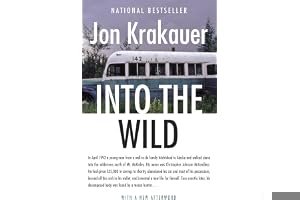
Into the Wild
Jon Krakauer
4.7
Librarian's Note: An alternate cover edition can be found here
In April, 1992, a young man from a well-to-do family hitchhiked to Alaska and walked alone into the wilderness north of Mt. McKinley. His name was Christopher Johnson McCandless. He had given $25,000 in savings to charity, abandoned his car and most of his possessions, burned all the cash in his wallet, and invented a new life for himself. Four months later, a party of moose hunters found his decomposed body. How McCandless came to die is the unforgettable story of Into the Wild.
Immediately after graduating from college in 1991, McCandless had roamed through the West and Southwest on a vision quest like those made by his heroes Jack London and John Muir. In the Mojave Desert he abandoned his car, stripped it of its license plates, and burned all of his cash. He would give himself a new name, Alexander Supertramp, and, unencumbered by money and belongings, he would be free to wallow in the raw, unfiltered experiences that nature presented. Craving a blank spot on the map, McCandless simply threw away the maps. Leaving behind his desperate parents and sister, he vanished into the wild.
…
Recommended by Holger Seim.
Holger Seim
When it comes to adventure stories, Into the Wild. [source]
Cover unavailable
8
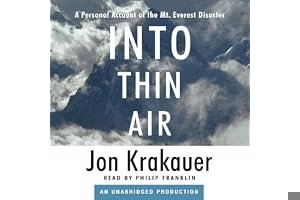
Into Thin Air: A Personal Account of the Mt. Everest Disaster
Jon Krakauer
4.6
When Jon Krakauer reached the summit of Mt. Everest in the early afternoon of May 10, 1996, he hadn't slept in fifty-seven hours and was reeling from the brain-altering effects of oxygen depletion. As he turned to begin his long, dangerous descent from 29,028 feet, twenty other climbers were still pushing doggedly toward the top. No one had noticed that the sky had begun to fill with clouds. Six hours later and 3,000 feet lower, in 70-knot winds and blinding snow, Krakauer collapsed in his tent, freezing, hallucinating from exhaustion and hypoxia, but safe. The following morning, he learned that six of his fellow climbers hadn't made it back to their camp and were desperately struggling for their lives. When the storm finally passed, five of them would be dead, and the sixth so horribly frostbitten that his right hand would have to be amputated.
Into Thin Air is the definitive account of the deadliest season in the history of Everest by the acclaimed journalist and author of the bestseller Into the Wild. On assignment for Outside Magazine to report on the growing commercialization of the mountain, Krakauer, an accomplished climber, went to the Himalayas as a client of Rob Hall, the most respected high-altitude guide in the world. A rangy, thirty-five-year-old New Zealander, Hall had summited Everest four times between 1990 and 1995 and had led thirty-nine climbers to the top. Ascending the mountain in close proximity to Hall's team was a guided expedition led by Scott Fischer, a forty-year-old American with legendary strength and drive who had climbed the peak without supplemental oxygen in 1994. But neither Hall nor Fischer survived the rogue storm that struck in May 1996.
Krakauer examines what it is about Everest that has compelled so many people -- including himself -- to throw caution to the wind, ignore the concerns of loved ones, and willingly subject themselves to such risk, hardship, and expense. Written with emotional clarity and supported by his unimpeachable reporting, Krakauer's eyewitness account of what happened on the roof of the world is a singular achievement.
Into the Wild is available on audio, read by actor Campbell Scott.
…
Recommended by Richard Branson, Cristina Riesen, Fabrice Grinda, and 2 others.
Today is World Book Day, a wonderful opportunity to address this #ChallengeRichard sent in by Mike Gonzalez of New Jersey: Make a list of your top 65 books to read in a lifetime. [source]
Cristina Riesen
First, a word on career paths. In time, I realised that career paths are like one-way streets. Magic happens in unexplored territories. Plus life is how you choose to live every moment, every day. So today, rather than building a career, I prefer to make lateral moves in life, working with great people and being part of ambitious projects impacting the world. There are a few books that got me here: … Jon Krakauer "Into Thin Air". [source]
Fabrice Grinda
I have lots of books to recommend, but they are not related to my career path. The only one that is remotely related is Peter Thiel’s Zero to One. That said here are books I would recommend. [source]
Cover unavailable
9
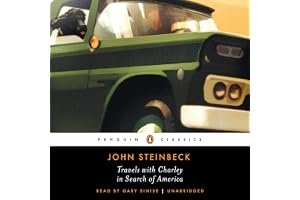
Travels with Charley: In Search of America
John Steinbeck
4.6
To hear the speech of the real America, to smell the grass and the trees, to see the colors and the light— these were John Steinbeck's goals as he set out, at the age of fifty-eight, to rediscover the country he had been writing about for so many years.
I wanted to include an older book that has been on my bookshelves for decades, and is a less obvious example of reading to lead. John Steinbeck took a road trip with his dog Charley for company across the length and breadth of the US, and recorded what he saw, who he met and what he learned. With his inimitable charm, it opens your eyes to the small pleasures of life, and the great wonders of humanity in the little moments that matter. Less a direction on how to lead, you could see it as a subtle guide on how to live. [source]
Cover unavailable
10
1,000 Places to See Before You Die: Revised Second Edition
Patricia Schultz
4.6
The world is calling. Time to answer.
The world’s wonders, continent by continent: A trek through Morocco’s Atlas Mountains. Sri Lanka’s Hill Country. A sunrise balloon safari over the Masai Mara. Canyon de Chelly. The sacred festivals of Bhutan. The Amalfi Coast. Sailing the Mekong River.
In all, 1,000 places guaranteed to give travelers the shivers: sacred ruins, coral reefs, hilltop villages, deserted beaches, wine trails, hidden islands, opera houses, wildlife preserves, castles, museums, and more. Each entry tells why it’s essential to visit and includes hotels, restaurants, and festivals to check out. Then come the completely updated nuts and bolts: websites, phone numbers, prices, best times to visit.
1,000 Places to See Before You Die is the world’s bestselling travel book and a #1 New York Times bestseller. 1,000 Places reinvented the idea of travel book as both wish list and practical guide. As Newsweek wrote, it “tells you what’s beautiful, what’s fun, and what’s just unforgettable—everywhere on earth.” Second edition includes 600 full-color photographs, over 200 entirely new entries. More suggestions for places to stay, restaurants to visit, festivals to check out. And along with starred restaurants and historic hotels, you'll also find moderately priced gems that don’t compromise on atmosphere or charm.
…
Cover unavailable
11
Neither Here nor There: Travels in Europe
Bill Bryson
4.6
Bill Bryson's first travel book, The Lost Continent, was unanimously acclaimed as one of the funniest books in years. In Neither Here nor There he brings his unique brand of humour to bear on Europe as he shoulders his backpack, keeps a tight hold on his wallet, and journeys from Hammerfest, the northernmost town on the continent, to Istanbul on the cusp of Asia. Fluent in, oh, at least one language, he retraces his travels as a student twenty years before.
Whether braving the homicidal motorist of Paris, being robbed by gypsies in Florence, attempting not to order tripe and eyeballs in a German restaurant, window-shopping in the sex shops of the Reeperbahn or disputing his hotel bill in Copenhagen, Bryson takes in the sights, dissects the culture and illuminates each place and person with his hilariously caustic observations. He even goes to Liechtenstein.
The harrowing tale of British explorer Ernest Shackleton's 1914 attempt to reach the South Pole, one of the greatest adventure stories of the modern age.
In August 1914, polar explorer Ernest Shackleton boarded the Endurance became locked in an island of ice. Thus began the legendary ordeal of Shackleton and his crew of twenty-seven men. When their ship was finally crushed between two ice floes, they attempted a near-impossible journey over 850 miles of the South Atlantic's heaviest seas to the closest outpost of civilization.
In Endurance, the definitive account of Ernest Shackleton's fateful trip, Alfred Lansing brilliantly narrates the harrowing and miraculous voyage that has defined heroism for the modern age.
50 plus years old, this is a story that more than stands the test of time. Sir Ernest Shackleton makes his daring attempt to cross Antarctic continent but his crew and boat are trapped in the ice flows. What follows are 600 days of harrowing survival, first from the elements, then from hunger, then from the sea as he makes a daring attempt in a small lifeboat to reach land 650 miles away, then again as he struggles over land and mountains to bring relief to his men. And when he finally arrives with it, Shackleton simply boards them on the boat and returns home as if nothing had happened. He was an immensely brave man in the midst of terrible adversity and we see this so clearly in a book based on the remarkable diaries of his men. He never quit, never seemed to despair. This book (and his life) were living proof of his family motto: “Fortitudine vincimus” (By endurance we conquer). [source]
Truly inspiring story of determination, grit and beating all odds. [source]
Cover unavailable
13
The Lost Continent: Travels in Small Town America
Bill Bryson
4.5
'I come from Des Moines. Somebody had to'
And, as soon as Bill Bryson was old enough, he left. Des Moines couldn't hold him, but it did lure him back. After ten years in England, he returned to the land of his youth, and drove almost 14,000 miles in search of a mythical small town called Amalgam, the kind of trim and sunny place where the films of his youth were set. Instead, his search led him to Anywhere, USA; a lookalike strip of gas stations, motels and hamburger outlets populated by lookalike people with a penchant for synthetic fibres. Travelling around thirty-eight of the lower states - united only in their mind-numbingly dreary uniformity - he discovered a continent that was doubly lost; lost to itself because blighted by greed, pollution, mobile homes and television; lost to him because he had become a stranger in his own land.
The Lost Continent is a classic of travel literature - hilariously, stomach-achingly funny, yet tinged with heartache - and the book that first staked Bill Bryson's claim as the most beloved writer of his generation.
…
Cover unavailable
14
A Year in Provence
Peter Mayle
4.5
National Bestseller
In this witty and warm-hearted account, Peter Mayle tells what it is like to realize a long-cherished dream and actually move into a 200-year-old stone farmhouse in the remote country of the Lubéron with his wife and two large dogs. He endures January's frosty mistral as it comes howling down the Rhône Valley, discovers the secrets of goat racing through the middle of town, and delights in the glorious regional cuisine. A Year in Provence transports us into all the earthy pleasures of Provençal life and lets us live vicariously at a tempo governed by seasons, not by days.
…
Recommended by Fabrice Grinda.
Fabrice Grinda
I have lots of books to recommend, but they are not related to my career path. The only one that is remotely related is Peter Thiel’s Zero to One. That said here are books I would recommend. [source]
Cover unavailable
15
I'm a Stranger Here Myself: Notes on Returning to America After Twenty Years Away
Bill Bryson
4.5
After living in Britain for two decades, Bill Bryson recently moved back to the United States with his English wife and four children (he had read somewhere that nearly 3 million Americans believed they had been abducted by aliens--as he later put it, "it was clear my people needed me"). They were greeted by a new and improved America that boasts microwave pancakes, twenty-four-hour dental-floss hotlines, and the staunch conviction that ice is not a luxury item.
Delivering the brilliant comic musings that are a Bryson hallmark, I'm a Stranger Here Myself recounts his sometimes disconcerting reunion with the land of his birth. The result is a book filled with hysterical scenes of one man's attempt to reacquaint himself with his own country, but it is also an extended if at times bemused love letter to the homeland he has returned to after twenty years away.
…
Cover unavailable
16
Vagabonding: An Uncommon Guide to the Art of Long-Term World Travel
Rolf Potts, Timothy Ferriss
4.5
Vagabonding is about taking time off from your normal life - from six weeks to four months to two years - to discover and experience the world on your own terms. Veteran shoestring traveler Rolf Potts shows how anyone armed with an independent spirit can achieve the dream of extended overseas travel. Potts gives the necessary information on:
- financing your travel time - determining your destination - adjusting to life on the road - working and volunteering overseas - handling travel adversity - re-assimilating back into ordinary life
Not just a plan of action, vagabonding is an outlook on life that emphasizes creativity, discovery, and the growth of the spirit. Visit the vagabonding community's hub at www.vagabonding.net.
…
Recommended by Joel Gascoigne.
Joel Gascoigne
Travel is something we've found to crave and seek out within the team, and the fact we're set up as a distributed team gives us all a lot of freedom to explore the world. Vagabonding is one of the best books out there to think about travel in a whole new way. Rather than going to places for just a few days and cramming in seeing all the sights, it suggests that if we can we should spend weeks or months rather than days in a place. That way we can get to know the culture and people or even become part of it. [source]
Cover unavailable
17
The Travel Book: A Journey Through Every Country in the World
Lonely Planet
4.5
Lonely Planet: The world's leading travel guide publisher
Take a journey through every country in the world. 850 images. 230 countries. One complete picture.
With details of every United Nations-approved country in the world, and a few more principalities and dependencies besides, Lonely Planet's Travel Book is the ultimate introduction to a world of travel and the essential travel reference book for every household!
Each country is profiled by Lonely Planet's expert authors and features details of when to visit, what to see and do, and how to learn more about the country's culture from its film, music, food and drink. Every entry has a map and statistics about the country.
All brand new, incredible photography illustrates each country, depicting what life is like in each nation from photographic portraits of people, beautiful landscape photographs and vibrant street photography.
About Lonely Planet: Started in 1973, Lonely Planet has become the world's leading travel guide publisher with guidebooks to every destination on the planet, gift and lifestyle books and stationery, as well as an award-winning website, magazines, a suite of mobile and digital travel products, and a dedicated traveller community. Lonely Planet's mission is to enable curious travellers to experience the world and to truly get to the heart of the places they find themselves in.
Hemingway's memories of his life as an unknown writer living in Paris in the twenties are deeply personal, warmly affectionate, and full of wit. Looking back not only at his own much younger self, but also at the other writers who shared Paris with him - James Joyce, Wyndham Lewis, Scott and Zelda Fitzgerald - he recalls the time when, poor, happy, and writing in cafes, he discovered his vocation. Written during the last years of Hemingway's life, his memoir is a lively and powerful reflection of his genius that scintillates with the romance of the city.
…
Recommended by Janine di Giovanni, Mohsin Hamid, and Wai Chee Dimock.
Janine di Giovanni
The fact that Hemingway writes it as an old, rather bitter man trapped in his Idaho home with a bullying wife while he dreams of his youth in Paris with his first wife and child is so touching to me. [source]
We think of Hemingway as an American writer, but much of his writing is set outside of the United States, just as much of his life was set outside of the United States. [source]
Wai Chee Dimock
This is a memoir by Hemingway about his time in Paris, which includes sketches of people like F Scott Fitzgerald. [source]
Cover unavailable
19
Zen and the Art of Motorcycle Maintenance: An Inquiry Into Values
This lyrical, evocative, thought-provoking journal of a man's quest for truth - and for himself - has touched and changed an entire generation, and is ready to reach out to a new one. At its heart, the story is all too simple: a man and his son take a motorcycle trip across America. But this is not a simple trip at all, for around every corner, through mountain and desert, wind and rain, and searing heat and biting cold, their pilgrimage leads them to new vistas of self-discovery and renewal.
Zen and the Art of Motorcycle Maintenance is an elemental work that has helped to shape and define the past 25-years of American culture. This special audio edition presents this adventure in an exciting new way - for the millions who have already taken this journey and want to travel these roads again, and for the many more who will discover for the first time the wonders and challenges of a story that will change the way they think and feel about their lives. Unique to audio, this edition features a new introduction by the author.
…
Recommended by Brad Feld, Drew Houston, Ev Williams, and 7 others.
Brad Feld
Co-Founder/Foundry Group
I think every entrepreneur or aspiring entrepreneur should read the book Zen and the Art of Motorcycle Maintenance. It was written in the 1970s by a guy named Robert Pirsig. It was his first book, it's kind of a hippie philosophy treatised journey. The word that sort of came out of it was Chautauqua, he's like having a conversation with his son as they do a motorcycle trip across the country, and it's just this incredible treatise on philosophy, product, quality, accomplishing what your goal is, against the backdrop of the narrator, the author, going crazy and having a psychotic break. And so it's this very powerful mix of accessible philosophy, combined with this pretty captivating journey in a book that, again, anybody who builds anything, there's so much in it that's so worth reading and just soaking in. But it's not what you'd expect, it's not a "here's how you do it", you have to read it slowly and think about it. So, it's one of my favorites. [source]
Drew Houston
CEO/Dropbox
There are engineers who dismiss all these things that can’t be fit into an algorithm, or that don’t have some kind of mathematical rigor underpinning them, this book is about that question. [source]
Honorable mentions: Jonathan Livingston Seagull, Zen and the Art of Motorcycle Maintenance, and The Joy of Sex, all given to me by my mother. I believe they helped inculcate some of the 1960s-70s ethos of individual freedom into my thinking. [source]
Cover unavailable
20
Under the Tuscan Sun
Frances Mayes
4.4
An enchanting and lyrical look at the life, the traditions, and the cuisine of Tuscany, in the spirit of Peter Mayle's A Year in Provence.
Frances Mayes entered a wondrous new world when she began restoring an abandoned villa in the spectacular Tuscan countryside. There were unexpected treasures at every turn: faded frescos beneath the whitewash in her dining room, a vineyard under wildly overgrown brambles in the garden, and, in the nearby hill towns, vibrant markets and delightful people. In Under the Tuscan Sun, she brings the lyrical voice of a poet, the eye of a seasoned traveler, and the discerning palate of a cook and food writer to invite readers to explore the pleasures of Italian life and to feast at her table.
…
Cover unavailable
21
On the Road
Jack Kerouac
4.4
When Jack Kerouac’s On the Road first appeared in 1957, readers instantly felt the beat of a new literary rhythm. A fictionalised account of his own journeys across America with his friend Neal Cassady, Kerouac’s beatnik odyssey captured the soul of a generation and changed the landscape of American fiction for ever.
Influenced by Jack London and Thomas Wolfe, Kerouac always wanted to be a writer, but his true voice only emerged when he wrote about his own experiences in On the Road. Leaving a broken marriage behind him, Sal Paradise (Kerouac) joins Dean Moriarty (Cassady), a tearaway and former reform school boy, on a series of journeys that takes them from New York to San Francisco, then south to Mexico. Hitching rides and boarding buses, they enter a world of hobos and drifters, fruit-pickers and migrant families, small towns and wide horizons. Adrift from conventional society, they experience America in the raw: a place where living is hard, but ‘life is holy and every moment is precious’.
With its smoky, jazz-filled atmosphere and its restless, yearning spirit of adventure, On the Road left its mark on the culture of the late 20th century, influencing countless books, films and songs. Kerouac’s prose is remarkable both for its colloquial swing and for the pure lyricism inspired by the American landscape – ‘the backroads, the black-tar roads that curve among the mournful rivers like Susquehanna, Monongahela, old Potomac and Monocacy’. This Folio Society edition is illustrated with evocative photographs of Kerouac and the landscapes of 1950s America. Now acknowledged as a modern classic, On the Road remains a thrilling and poignant story of the road less travelled.
…
Recommended by Ev Williams and Bogdan Iordache.
Bogdan Iordache
My favourite book is "On the road" by Jack Kerouac. Apart from being probably one of the best well written books in the world, I appreciate Kerouac's philosophy to dedicate himself entirely to what was important to him, something that I have applied in my life as much as possible. I've simplified my life in many ways, and stay focused on what I think it's really important. For Jack it was the experimentation of life with friends, drinks and jazz, and the dedication he put into it is simply transformative. For me it is a very different mix, though, but doing things your way will make your life meaningful and unique. Obviously, first of all you have to decide what is important for you, that's a process in itself. Also, I loved the "own less, live more" approach he took at life. I don't plan to be a bum, but even if someday I will own billions of dollars I don't want to worry about a yacht in some harbour, I find it meaningless. But I know that's also a trait of our generation, to pay for experience and not for ownership. [source]
Cover unavailable
22
Blue Highways
William Least Heat Moon
4.4
Hailed as a masterpiece of American travel writing, Blue Highways is an unforgettable journey along our nation's backroads. William Least Heat-Moon set out with little more than the need to put home behind him and a sense of curiosity about "those little towns that get on the map-if they get on at all-only because some cartographer has a blank space to fill: Remote, Oregon; Simplicity, Virginia; New Freedom, Pennsylvania; New Hope, Tennessee; Why, Arizona; Whynot, Mississippi." His adventures, his discoveries, and his recollections of the extraordinary people he encountered along the way amount to a revelation of the true American experience.
The Road to Little Dribbling: Adventures of an American in Britain
Bill Bryson
4.4
The hilarious and loving sequel to a hilarious and loving classic of travel writing: Notes from a Small Island, Bill Bryson’s valentine to his adopted country of England
In 1995 Bill Bryson got into his car and took a weeks-long farewell motoring trip about England before moving his family back to the United States. The book about that trip, Notes from a Small Island, is uproarious and endlessly endearing, one of the most acute and affectionate portrayals of England in all its glorious eccentricity ever written. Two decades later, he set out again to rediscover that country, and the result is The Road to Little Dribbling. Nothing is funnier than Bill Bryson on the road—prepare for the total joy and multiple episodes of unseemly laughter.
…
Cover unavailable
24
Atlas Obscura: An Explorer's Guide to the World's Hidden Wonders
Joshua Foer
4.4
Inspiring equal parts wonder and wanderlust, Atlas Obscura celebrates over 600 of the strangest and most curious places in the world.
Here are natural wonders—the dazzling glowworm caves in New Zealand, or a baobob tree in South Africa that’s so large it has a pub inside where 15 people can drink comfortably. Architectural marvels, including the M.C. Escher-like stepwells in India. Mind-boggling events, like the Baby Jumping Festival in Spain, where men dressed as devils literally vault over rows of squirming infants. Not to mention the Great Stalacpipe Organ in Virginia, Turkmenistan’s 45-year hole of fire called the Door of Hell, coffins hanging off a side of a cliff in the Philippines, eccentric bone museums in Italy, or a weather-forecasting invention that was powered by leeches, still on display in Devon, England.
Atlas Obscura revels in the weird, the unexpected, the overlooked, the hidden, and the mysterious. Every page expands our sense of how strange and marvelous the world really is. And with its compelling descriptions, hundreds of photographs, surprising charts, maps for every region of the world, it is a book you can open anywhere.
Atlas Obscura. Go to the site. Buy the book. Seriously great content. My favorite way to travel (this endorsement based only in love) @atlasobscura https://t.co/zLMm126yXD [source]
David Plotz
I'm here to solve your holiday gift buying problems! Today we release the Second Edition of the No. 1 bestselling Atlas Obscura book, with 100 new wondrous places, 12 city guides, a foldout map. It's gorgeous and fun and an amazing gift. https://t.co/ids7kNjImW https://t.co/95ULoJOKJg [source]
Cover unavailable
25
The Geography of Bliss: One Grump's Search for the Happiest Places in the World
Eric Weiner
4.4
Weiner spent a decade as a foreign correspondent reporting from such discontented locales as Iraq, Afghanistan, and Indonesia. Unhappy people living in profoundly unstable states, he notes, inspire pathos and make for good copy, but not for good karma. So Weiner, admitted grump and self-help book aficionado, undertook a year's research to travel the globe, looking for the "unheralded happy places." The result is this book, equal parts laugh-out-loud funny and philosophical, a journey into both the definition of and the destination for true contentment.
Apparently, the happiest places on earth include, somewhat unexpectedly, Iceland, Bhutan, and India. Weiner also visits the country deemed most malcontent, Moldova, and finds real merit in the claim.
But the question remains: What makes people happy? Is it the freedom of the West or the myriad restrictions of Singapore? The simple ashrams of India or the glittering shopping malls of Qatar? From the youthful drunkenness of Iceland to the despond of Slough, a sad but resilient town in Heathrow's flight path, Weiner offers wry yet profound observations about the way people relate to circumstance and fate.
Both revealing and inspirational, perhaps the best thing about this hilarious trip across four continents is that for the reader, the "geography of bliss" is wherever they happen to find themselves while reading it.
…
Cover unavailable
26
The Art of Travel
Alain De Botton
4.4
Any Baedeker will tell us where we ought to travel, but only Alain de Botton will tell us how and why. With the same intelligence and insouciant charm he brought to How Proust Can Save Your Life, de Botton considers the pleasures of anticipation; the allure of the exotic, and the value of noticing everything from a seascape in Barbados to the takeoffs at Heathrow.
Even as de Botton takes the reader along on his own peregrinations, he also cites such distinguished fellow-travelers as Baudelaire, Wordsworth, Van Gogh, the biologist Alexander von Humboldt, and the 18th-century eccentric Xavier de Maistre, who catalogued the wonders of his bedroom. The Art of Travel is a wise and utterly original book. Don’t leave home without it.
…
Recommended by Emily Thomas.
Emily Thomas
It’s a thoughtful account of de Botton’s engagement with artists about travel. He focuses on painters and novelists with a view to asking what light they can shed on why we travel, and picking up titbits from them for our own travels. One of my favourite examples he discusses is Edward Hopper. [source]
Cover unavailable
27
A Time of Gifts
Patrick Leigh Fermor, Jan Morris
4.4
In 1933, at the age of 18, Patrick Leigh Fermor set out on an extraordinary journey by foot - from the Hook of Holland to Constantinople. A Time of Gifts is the first volume in a trilogy recounting the trip, and takes the reader with him as far as Hungary. It is a book of compelling glimpses - not only of the events which were curdling Europe at that time, but also of its resplendent domes and monasteries, its great rivers, the sun on the Bavarian snow, the storks and frogs, the hospitable burgomasters who welcomed him, and that world's grandeurs and courtesies. His powers of recollection have astonishing sweep and verve, and the scope is majestic. First published to enormous acclaim, it confirmed Fermor's reputation as the greatest living travel writer, and has, together with its sequel Between the Woods and the Water (the third volume is famously yet to be published), been a perennial seller for 25 years.
This is the first volume of his journey in 1933-34 from the Hook of Holland, as he called it, to what he insisted on calling Constantinople (Istanbul). It was to be in three volumes. This one takes him beyond Vienna. The second volume, Between the Woods and the Water, takes him through Hungary to the Balkans. The third volume was going to get him across Romania to Istanbul, but he never wrote it. There is a very modified version of it, which will probably be published – people are so longing to see this third volume that even an outline of it will suffice. But it’s not finished by his standards, which were very exacting. [source]
Quentin Hardy
@parul_sehgal @DwightGarner @jenszalai Excellent list. "This Boy's Life" pairs well with "The Duke of Deception," brother Geoffrey Wolff's boyhood with their con man father. Also "A Time of Gifts" is a memoir as well as a great travel book, particularly when the way it came about becomes part of the tale. [source]
Cover unavailable
28
The Sex Lives of Cannibals: Adrift in the Equatorial Pacific
J. Maarten Troost
4.3
At the age of twenty-six, Maarten Troost who had been pushing the snooze button on the alarm clock of life by racking up useless graduate degrees and muddling through a series of temp jobs decided to pack up his flip-flops and move to Tarawa, a remote South Pacific island in the Republic of Kiribati. He was restless and lacked direction, and the idea of dropping everything and moving to the ends of the Earth was irresistibly romantic. He should have known better. The Sex Lives of Cannibals tells the hilarious story of what happens when Troost discovers that Tarawa is not the island paradise he dreamed of. Falling into one amusing misadventure after another, Troost struggles through relentless, stifling heat, a variety of deadly bacteria, polluted seas, toxic fish, and worst of all, no television or coffee. And that's just the first day. Sunburned, emaciated, and stinging with sea lice, Troost spends the next two years battling incompetent government officials, alarmingly large critters, erratic electricity, and a paucity of food options. He contends with a cast of bizarre local characters, including "Half-Dead Fred" and the self-proclaimed Poet Laureate of Tarawa (a British drunkard who's never written a poem in his life), and eventually settles into the ebb and flow of island life, just before his return to the culture shock of civilization. With the rollicking wit of Bill Bryson, the brilliant travel exposition of Paul Theroux, and a hipster edge that is entirely Troost's own, The Sex Lives of Cannibals is the ultimate vicarious adventure. Readers may never long to set foot on Tarawa, but they'll want to travel with Troost time and time again.
…
Recommended by Jennifer Steil.
Jennifer Steil
The Sex Lives of Cannibals. I’m not sure the book legitimises the title and, in any case, it’s such a funny, engaging book that it doesn’t need a title like that. It’s the funniest of all the books I read. It’s about this guy, the author J Maarten Troost, who’s in his early 20s, hasn’t developed a career yet, hasn’t launched into a job after university, and how his girlfriend gets a job with an NGO in this tiny Pacific island nation called Kiribati, on a tiny strip of land called the Tarawa atoll. It’s the middle absolutely nowhere, zillions of miles from civilisation, and it’s this flat, baking strip of land that’s overpopulated, full of trash, people defecating on the sea shore: the worst detritus of modern society. All there is to eat is tuna. And while his girlfriend’s working there, he’s trying to write the great American novel. [source]
Cover unavailable
29
The Great Railway Bazaar
Paul Theroux
4.3
First published in 1975, Paul Theroux's strange, unique, and hugely entertaining railway odyssey has become a modern classic of travel literature. Here Theroux recounts his early adventures on an unusual grand continental tour. Asia's fabled trains -- the Orient Express, the Khyber Pass Local, the Frontier Mail, the Golden Arrow to Kuala Lumpur, the Mandalay Express, the Trans-Siberian Express -- are the stars of a journey that takes him on a loop eastbound from London's Victoria Station to Tokyo Central, then back from Japan on the Trans-Siberian. Brimming with Theroux's signature humor and wry keen observations, this engrossing chronicle is essential reading for both the ardent adventurer and the armchair traveler.
…
Cover unavailable
30
The Lost City of Z: A Tale of Deadly Obsession in the Amazon
DAVID GRANN
4.3
A grand mystery reaching back centuries. A sensational disappearance that made headlines around the world. A quest for truth that leads to death, madness or disappearance for those who seek to solve it. The Lost City of Z is a blockbuster adventure narrative about what lies beneath the impenetrable jungle canopy of the Amazon.
After stumbling upon a hidden trove of diaries, New Yorker writer David Grann set out to solve "the greatest exploration mystery of the 20th century": What happened to the British explorer Percy Fawcett & his quest for the Lost City of Z?
In 1925, Fawcett ventured into the Amazon to find an ancient civilization, hoping to make one of the most important discoveries in history. For centuries Europeans believed the world's largest jungle concealed the glittering kingdom of El Dorado. Thousands had died looking for it, leaving many scientists convinced that the Amazon was truly inimical to humans. But Fawcett, whose daring expeditions inspired Conan Doyle's The Lost World, had spent years building his scientific case. Captivating the imagination of millions round the globe, Fawcett embarked with his 21-year-old son, determined to prove that this ancient civilisation--which he dubbed Z--existed. Then his expedition vanished. Fawcett's fate, & the tantalizing clues he left behind about Z, became an obsession for hundreds who followed him into the uncharted wilderness.
For decades scientists & adventurers have searched for evidence of Fawcett's party & the lost City of Z. Countless have perished, been captured by tribes or gone mad. As Grann delved ever deeper into the mystery surrounding Fawcett's quest, & the greater mystery of what lies within the Amazon, he found himself, like the generations who preceded him, being irresistibly drawn into the jungle's green hell. His quest for the truth & discoveries about Fawcett's fate & Z form the heart of this complexly enthralling narrative.
…
Recommended by The Jupiter Girl.
The Jupiter Girl
The Lost City of Z (I have the book and it remains unread in Australia) is an odd little film, it's really more about the father-son relationship rather than what motivates Fawcett. It's a slow and dreamy film about a dreamer searching for some great achievement in his life [source]
Cover unavailable
31
Shantaram
Gregory David Roberts
4.3
"It took me a long time and most of the world to learn what I know about love and fate and the choices we make, but the heart of it came to me in an instant, while I was chained to a wall and being tortured."
So begins this epic, mesmerizing first novel set in the underworld of contemporary Bombay. Shantaram is narrated by Lin, an escaped convict with a false passport who flees maximum security prison in Australia for the teeming streets of a city where he can disappear.
Accompanied by his guide and faithful friend, Prabaker, the two enter Bombay's hidden society of beggars and gangsters, prostitutes and holy men, soldiers and actors, and Indians and exiles from other countries, who seek in this remarkable place what they cannot find elsewhere.
As a hunted man without a home, family, or identity, Lin searches for love and meaning while running a clinic in one of the city's poorest slums, and serving his apprenticeship in the dark arts of the Bombay mafia. The search leads him to war, prison torture, murder, and a series of enigmatic and bloody betrayals. The keys to unlock the mysteries and intrigues that bind Lin are held by two people. The first is Khader Khan: mafia godfather, criminal-philosopher-saint, and mentor to Lin in the underworld of the Golden City. The second is Karla: elusive, dangerous, and beautiful, whose passions are driven by secrets that torment her and yet give her a terrible power.
Burning slums and five-star hotels, romantic love and prison agonies, criminal wars and Bollywood films, spiritual gurus and mujaheddin guerrillas – this huge novel has the world of human experience in its reach, and a passionate love for India at its heart. Based on the life of the author, it is by any measure the debut of an extraordinary voice in literature.
…
Recommended by Richard Branson, Henry Medine, Irina Marinescu, and 3 others.
Today is World Book Day, a wonderful opportunity to address this #ChallengeRichard sent in by Mike Gonzalez of New Jersey: Make a list of your top 65 books to read in a lifetime. [source]
Henry Medine
I promote range and diversity. Thus, I recommend readers to expose themselves to as many different topics as possible. I usually have 2-4 books I refer back to at any given time. They range in topics from management, art, spirituality and philosophy. Trying to get the engineering thing going but don't much of a mind for science. [source]
Irina Marinescu
I am always eager to learn how people think and form friendships, how they deal with life's challenges and still remain human. This book delivers that and even more! Shantaram takes you on an incredible journey and you return a changed person. [source]
At Walden Pond, Henry David Thoreau reflected on simpler living in the natural world. By removing himself from the distractions of materialism, Thoreau hoped to not only improve his spiritual life but also gain a better understanding of society through solitary introspection.
In Walden, Thoreau condenses his two-year, two-month, two-day stay into a single year, using the four seasons to symbolize human development—a cycle of life shared by both nature and man. A celebration of personal renewal through self-reliance, independence, and simplicity, composed for all of us living in “quiet desperation,” Walden is eternal.
…
Recommended by Emma Watson, Donna Dickenson, Emily Thomas, and 5 others.
Donna Dickenson
He discusses how the original ideals that America was founded on were being compromised, and how massive industrial interests were starting to dominate. [source]
Emily Thomas
The beginning is hard going. Once you get past that, then suddenly you’re into these beautiful and inspiring descriptions of nature. [source]
Joan Boixados
In case you were deceived and expected me to name Walden by Henry David Thoreau, you should read it too if you haven’t, it obviously is the inspiration to Walden Two. :) [source]
Cover unavailable
33
In Patagonia
Bruce Chatwin, Nicholas Shakespeare
4.3
An exhilarating look at a place that still retains the exotic mystery of a far-off, unseen land, Bruce Chatwin’s exquisite account of his journey through Patagonia teems with evocative descriptions, remarkable bits of history, and unforgettable anecdotes. Fueled by an unmistakable lust for life and adventure and a singular gift for storytelling, Chatwin treks through “the uttermost part of the earth”— that stretch of land at the southern tip of South America, where bandits were once made welcome—in search of almost forgotten legends, the descendants of Welsh immigrants, and the log cabin built by Butch Cassidy. An instant classic upon publication in 1977, In Patagonia is a masterpiece that has cast a long shadow upon the literary world.
Today is World Book Day, a wonderful opportunity to address this #ChallengeRichard sent in by Mike Gonzalez of New Jersey: Make a list of your top 65 books to read in a lifetime. [source]
This struck me as a rather different way of travel writing. It is very individual, with stark, short passages….His research isn’t a history of that area, it’s all about the strange inhabitants of it, and the weird leftovers. Anything that was incongruous he loved – a Welsh community in southern Argentina, that sort of thing. It was a world of oddities, of leftovers, of communities that had been isolated, people that had gone there for God knows what reason. He always felt himself to be an outsider in the world, and that’s what fascinated him. [source]
Cover unavailable
34
Dark Star Safari: Overland from Cairo to Cape Town
Paul Theroux
4.3
In Dark Star Safari the wittily observant and endearingly irascible Paul Theroux takes readers the length of Africa by rattletrap bus, dugout canoe, cattle truck, armed convoy, ferry, and train. In the course of his epic and enlightening journey, he endures danger, delay, and dismaying circumstances.
Gauging the state of affairs, he talks to Africans, aid workers, missionaries, and tourists. What results is an insightful mediation on the history, politics, and beauty of Africa and its people.
In a new postscript, Theroux recounts the dramatic events of a return to Africa to visit Zimbabwe.
…
Cover unavailable
35
A Cook's Tour: Global Adventures in Extreme Cuisines
Anthony Bourdain
4.3
From the star of No Reservations, Anthony Bourdain's New York Times-bestselling chronicle of travelling the world in search the globe's greatest cuilnary adventures
The only thing "gonzo gastronome" and internationally bestselling author Anthony Bourdain loves as much as cooking is traveling. Inspired by the question, "What would be the perfect meal?," Tony sets out on a quest for his culinary holy grail, and in the process turns the notion of "perfection" inside out. From California to Cambodia, A Cooks' Tour chronicles the unpredictable adventures of America's boldest and bravest chef.
Fans of Bourdain will find much to love in revisting this classic culinary and travel memoir.
…
Cover unavailable
36
The Snow Leopard
Peter Matthiessen
4.3
When Matthiessen went to Nepal to study the Himalayan blue sheep and, possibly, to glimpse the rare and beautiful snow leopard, he undertook his five-week trek as winter snows were sweeping into the high passes. This is a radiant and deeply moving account of a "true pilgrimage, a journey of the heart."
Recommended by Nick Pyenson.
Nick Pyenson
The book stands apart and it remains fresh because of the ways that Matthiessen weaves his exploration of the outer world with his own inner one. [source]
Cover unavailable
37
Turn Right at Machu Picchu: Rediscovering the Lost City One Step at a Time
Mark Adams
4.3
What happens when an adventure travel expert-who's never actually done anything adventurous-tries to re-create the original expedition to Machu Picchu?
July 24, 1911, was a day for the history books. For on that rainy morning, the young Yale professor Hiram Bingham III climbed into the Andes Mountains of Peru and encountered an ancient city in the clouds: the now famous citadel of Machu Picchu. Nearly a century later, news reports have recast the hero explorer as a villain who smuggled out priceless artifacts and stole credit for finding one of the world's greatest archaeological sites.
Mark Adams has spent his career editing adventure and travel magazines, so his plan to investigate the allegations against Bingham by retracing the explorer's perilous path to Machu Picchu isn't completely far- fetched, even if it does require him to sleep in a tent for the first time. With a crusty, antisocial Australian survivalist and several Quechua-speaking, coca-chewing mule tenders as his guides, Adams takes readers through some of the most gorgeous and historic landscapes in Peru, from the ancient Inca capital of Cusco to the enigmatic ruins of Vitcos and Vilcabamba.
Along the way he finds a still-undiscovered country populated with brilliant and eccentric characters, as well as an answer to the question that has nagged scientists since Hiram Bingham's time: Just what was Machu Picchu?
…
Cover unavailable
38
Seven Years in Tibet
Heinrich Harrer, Richard Graves, Peter Fleming, His Holiness The Dalai Lama
4.3
Recounts how the author, an Austrian, escaped from an English internment camp in India in 1943 and spent the next seven years in Tibet, observing its social practices, religion, politics, and people.
Cover unavailable
39
Tales of a Female Nomad: Living at Large in the World
Rita Golden Gelman
4.3
“I move throughout the world without a plan, guided by instinct, connecting through trust, and constantly watching for serendipitous opportunities.” —From the Preface
Tales of a Female Nomad is the story of Rita Golden Gelman, an ordinary woman who is living an extraordinary existence. At the age of forty-eight, on the verge of a divorce, Rita left an elegant life in L.A. to follow her dream of connecting with people in cultures all over the world. In 1986 she sold her possessions and became a nomad, living in a Zapotec village in Mexico, sleeping with sea lions on the Galapagos Islands, and residing everywhere from thatched huts to regal palaces. She has observed orangutans in the rain forest of Borneo, visited trance healers and dens of black magic, and cooked with women on fires all over the world. Rita’s example encourages us all to dust off our dreams and rediscover the joy, the exuberance, and the hidden spirit that so many of us bury when we become adults.
…
Cover unavailable
40
Last Chance to See
Douglas Adams, Mark Carwardine
4.2
"Very funny and moving...The glimpses of rare fauna seem to have enlarged [Adams'] thinking, enlivened his world; and so might the animals do for us all, if we were to help them live." THE WASHINGTON POST BOOK WORLD Join bestselling author Douglas Adams and zooligist Mark Carwardine as they take off around the world in search of exotic, endangered creatures. Hilarious and poignant--as only Douglas Adams can be--LAST CHANCE TO SEE is an entertaining and arresting odyssey through the Earth's magnificent wildlife galaxy.
…
Recommended by Beth Shapiro, Gaia Vince, and Mark Lynas.
Beth Shapiro
He describes in this book not only the beauty of these animals, but the human landscape they live in and what a disastrous time he has getting to these locations. [source]
Gaia Vince
This is a book obviously for readers but it’s also a book for writers of science to understand how to capture the imagination of readers. [source]
Mark Lynas
For me, Last Chance to See is a real eye-opener, with the idea that you can take a depressing subject – species on the verge of extinction – and present it in a way which is so engaging, so funny and so humane. [source]
Cover unavailable
41
The Comfort Crisis: Embrace Discomfort To Reclaim Your Wild, Happy, Healthy Self
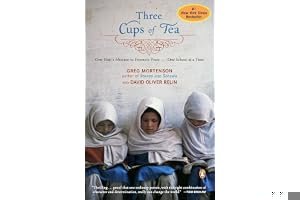
Three Cups of Tea: One Man's Mission to Promote Peace ... One School at a Time
Greg Mortenson, David Oliver Relin
4.2
The inspiring account of one man's campaign to build schools in the most dangerous, remote, and anti-American reaches of Asia.
In April 2011, the CBS documentary "60 Minutes" called into question Greg Mortenson's work. The program alleged several inaccuracies in Three Cups of Tea, and its sequel, Stones into Schools, as well as financial improprieties in the operation of Mortenson's Central Asia Institute. Questions were also raised about Mortenson's claim that he got lost near K2 and ended up in Korphe; that he was captured by the Taliban in 1996; the number of schools the CAI claimed to have built; and whether CAI funds had been used appropriately for Mortenson's book tours. Jon Krakauer, who had supported the CAI to the tune of $75,000, also questioned Mortenson's accounts, and released his allegations in a lengthy article titled Three Cups of Deceit.
…
Recommended by Gretchen Peters, Jennifer Steil, and Nicholas Kristof.
Gretchen Peters
I went to a refugee camp after 9/11 where people were living in tents and boiling grass to make tea and at least one family offered to let me sleep in their tent. [source]
Jennifer Steil
Greg Mortenson has changed literally thousands and thousands of lives. [source]
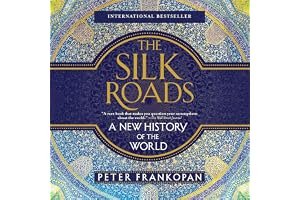
The sun is setting on the Western world. Slowly but surely, the direction in which the world spins has reversed: where for the last five centuries the globe turned westwards on its axis, it now turns to the east...For centuries, fame and fortune was to be found in the west - in the New World of the Americas. Today, it is the east which calls out to those in search of adventure and riches. The region stretching from eastern Europe and sweeping right across Central Asia deep into China and India, is taking centre stage in international politics, commerce and culture - and is shaping the modern world. This region, the true centre of the earth, is obscure to many in the English-speaking world. Yet this is where civilization itself began, where the world's great religions were born and took root. The Silk Roads were no exotic series of connections, but networks that linked continents and oceans together. Along them flowed ideas, goods, disease and death. This was where empires were won - and where they were lost. As a new era emerges, the patterns of exchange are mirroring those that have criss-crossed Asia for millennia. The Silk Roads are rising again. A major reassessment of world history, The Silk Roads> is an important account of the forces that have shaped the global economy and the political renaissance in the re-emerging east.
…
Recommended by Professor Frank Mcdonough and Raoul Pal.
Professor Frank Mcdonough
Christmas is coming and if you want to give a thought-provoking book to that history fan in your life then the recent books by the brilliant @peterfrankopan will satisfy. Some write books, this guy changes perceptions. https://t.co/gWZWZnv5TN [source]
Raoul Pal
@The92ers @zerohedge It’s fascinating. The Peter Frankopan book on the Silk Roads told history well from the perspective of Iran in particular [source]
Cover unavailable
44
Round Ireland with a Fridge
Tony Hawks
4.2
Have you ever made a drunken bet? Worse still, have you ever tried to win one? In attempting to hitchhike round Ireland with a fridge, Tony Hawks did both, and his foolhardiness led him to one of the best experiences of his life. Joined by his trusty traveling companion-cum-domestic appliance, he made his way from Dublin to Donegal, from Sligo through Mayo, Galway, Clare, Kerry, Cork, Wexford, Wicklow--and back again to Dublin. In their month of madness, Tony and his fridge met a real prince, a bogus king, and the fridge got christened. They surfed together, entered a bachelor festival, and one of them had sex without the other knowing. And unexpectedly, the fridge itself became a momentary focus for the people of Ireland.
An international bestseller, Round Ireland with a Fridge is a classic travel adventure in the tradition of Bill Bryson with a dash of Dave Barry.
…
Cover unavailable
45
My Family and Other Animals (Corfu Trilogy #1)
Gerald Durrell
4.2
When the unconventional Durrell family can no longer endure the damp, gray English climate, they do what any sensible family would do: sell their house and relocate to the sunny Greek isle of Corfu. My Family and Other Animals was intended to embrace the natural history of the island but ended up as a delightful account of Durrell's family's experiences, from the many eccentric hangers-on to the ceaseless procession of puppies, toads, scorpions, geckoes, ladybugs, glowworms, octopuses, bats, and butterflies into their home.
…
Recommended by M G Leonard.
M G Leonard
It’s a real work of genius and needs to be kept on every child’s bedside table. [source]
Cover unavailable
46
Kon-Tiki
Thor Heyerdahl
4.2
Kon-Tiki is the record of an astonishing adventure -- a journey of 4,300 nautical miles across the Pacific Ocean by raft. Intrigued by Polynesian folklore, biologist Thor Heyerdahl suspected that the South Sea Islands had been settled by an ancient race from thousands of miles to the east, led by a mythical hero, Kon-Tiki. He decided to prove his theory by duplicating the legendary voyage.
On April 28, 1947, Heyerdahl and five other adventurers sailed from Peru on a balsa log raft. After three months on the open sea, encountering raging storms, whales, and sharks, they sighted land -- the Polynesian island of Puka Puka.
Translated into sixty-five languages, Kon-Tiki is a classic, inspiring tale of daring and courage -- a magnificent saga of men against the sea.
Washington Square Press' Enriched Classics present the great works of world literature enhanced for the contemporary reader. This edition of Kon-Tiki has been prepared by an editorial committee headed by Harry Shefter, professor of English at New York University. It includes a foreword by the author, a selection of critical excerpts, notes, an index, and a unique visual essay of the voyage.
…
Recommended by Ovidiu Drugan.
Ovidiu Drugan
Expedition books from north pole to across the oceans with ships or rafts. [source]
Cover unavailable
47
Without Reservations: The Travels of an Independent Woman
Alice Steinbach
4.2
"In many ways, I was an independent woman," writes Pulitzer Prize–winning journalist Alice Steinbach. “For years I’d made my own choices, paid my own bills, shoveled my own snow.” But somehow she had become dependent in quite another way. “I had fallen into the habit of defining myself in terms of who I was to other people and what they expected of me.” But who was she away from the people and things that defined her? In this exquisite book, Steinbach searches for the answer to this question in some of the most beautiful and exciting places in the world: Paris, where she finds a soul mate; Oxford, where she takes a course on the English village; and Milan, where she befriends a young woman about to be married.
Beautifully illustrated with postcards from Steinbach’s journeys, this revealing and witty book transports you into a fascinating inner and outer journey, an unforgettable voyage of discovery.
…
Cover unavailable
48
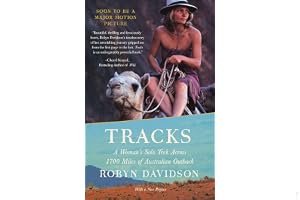
Tracks: A Woman's Solo Trek Across 1700 Miles of Australian Outback
Robyn Davidson
4.2
NOW A MAJOR MOTION PICTURE
Robyn Davidson's opens the memoir of her perilous journey across 1,700 miles of hostile Australian desert to the sea with only four camels and a dog for company with the following words: “I experienced that sinking feeling you get when you know you have conned yourself into doing something difficult and there's no going back."
Enduring sweltering heat, fending off poisonous snakes and lecherous men, chasing her camels when they get skittish and nursing them when they are injured, Davidson emerges as an extraordinarily courageous heroine driven by a love of Australia's landscape, an empathy for its indigenous people, and a willingness to cast away the trappings of her former identity. Tracks is the compelling, candid story of her odyssey of discovery and transformation.
“An unforgettably powerful book.”—Cheryl Strayed, author of Wild
Now with a new postscript by Robyn Davidson.
…
Recommended by Alastair Humphreys.
Alastair Humphreys
Tracks is just fantastically well written. [source]
Cover unavailable
49
A Short Walk in the Hindu Kush
Eric Newby
4.2
When Eric Newby, fashion industry worker and inexperienced hill walker, decided after 10 years in haute couture he needed a change he took 4 days training in Wales then walked the Hindu Kush. This is his account of an entertaining time in the hills!
Recommended by Sandy Gall.
Sandy Gall
Well, it’s terribly funny. I think Eric Newby is one of the best travel writers Britain has ever produced. I love reading this book. I’ve read it two or three times, and each time I fell about laughing. He writes terribly well. Evelyn Waugh actually wrote the preface to this book thinking it was by another Eric Newby, and ended up admiring this one. The book is about Newby and his young diplomat friend who went off on an expedition to Afghanistan in the 1950s with the intention of climbing Mir Samir – the highest mountain there – although neither had any experience of mountaineering or had even used a rope before. But they were young, fit and enthusiastic and they very nearly got to the top. [source]
Cover unavailable
50
The Places in Between
Rory Stewart
4.2
In January 2002 Rory Stewart walked across Afghanistan-surviving by his wits, his knowledge of Persian dialects and Muslim customs, and the kindness of strangers. By day he passed through mountains covered in nine feet of snow, hamlets burned and emptied by the Taliban, and communities thriving amid the remains of medieval civilizations. By night he slept on villagers' floors, shared their meals, and listened to their stories of the recent and ancient past. Along the way Stewart met heroes and rogues, tribal elders and teenage soldiers, Taliban commanders and foreign-aid workers. He was also adopted by an unexpected companion-a retired fighting mastiff he named Babur in honor of Afghanistan's first Mughal emperor, in whose footsteps the pair was following. Through these encounters--by turns touching, confounding, surprising, and funny--Stewart makes tangible the forces of tradition, ideology, and allegiance that shape life in the map's countless places in between.
…
Cover unavailable
51
The Innocents Abroad
Mark Twain and Jane Jacobs
4.2
The Innocents Abroad is one of the most prominent and influential travel books ever written about Europe and the Holy Land.
Recommended by Charles Glass.
Charles Glass
In 1867, Mark Twain accompanied a group of American Christian pilgrims to the Holy Land. As part of this excursion, they also enter Russia and various places in and around continental Europe. In this book, he sends them up marvellously – their pretensions, their messianic belief that they were better than anyone else in the world and their inability to understand what was going on around them. It’s a wonderfully wry look at a certain type of American who is striding the world, probably at just about the stage where America was about to take over the world. [source]
Cover unavailable
52
Ghost Train to the Eastern Star
Paul Therou
4.2
National Bestseller
In Ghost Train to the Eastern Star, Theroux recreates an epic journey he took thirty years ago, a giant loop by train (mostly) through Eastern Europe, Turkey, the Caucasus, Central Asia, the Indian Subcontinent, China, Japan, and Siberia. In short, he traverses all of Asia top to bottom, and end to end. In the three decades since he first travelled this route, Asia has undergone phenomenal change. The Soviet Union has collapsed, China has risen, India booms, Burma slowly smothers, and Vietnam prospers despite the havoc unleashed upon it the last time Theroux passed through. He witnesses all this and so much more in a 25,000 mile journey, travelling as the locals do, by train, car, bus, and foot.
His odyssey takes him from Eastern Europe, still hungover from Communism, through tense but thriving Turkey, into the Caucasus, where Georgia limps back toward feudalism while its neighbour Azerbaijan revels in oil-driven capitalism. As he penetrates deeper into Asia’s heart, his encounters take on an otherworldly cast. The two chapters that follow show us Turkmenistan, a profoundly isolated society at the mercy of an almost comically egotistical dictator, and Uzbekistan, a ruthless authoritarian state. From there, he retraces his steps through India, Mayanmar, China, and Japan, providing his penetrating observations on the changes these countries have undergone.
Brilliant, caustic, and totally addictive, Ghost Train to the Eastern Star is Theroux at his very best.
…
Cover unavailable
53
Down and Out in Paris and London
George Orwell
4.2
This unusual fictional memoir - in good part autobiographical - narrates without self-pity and often with humor the adventures of a penniless British writer among the down-and-outs of two great cities. The Parisian episode is fascinating for its expose of the kitchens of posh French restaurants, where the narrator works at the bottom of the culinary echelon as dishwasher, or plongeur. In London, while waiting for a job, he experiences the world of tramps, street people, and free lodging houses. In the tales of both cities we learn some sobering Orwellian truths about poverty and of society.
…
Recommended by D J Taylor, David Downie, David Kramaley, and 2 others.
D J Taylor
The fascination of Down and Out in Paris and London is that it’s his first book. In it, you can see Orwell stumbling, moving towards the kind of writer he wants to be, choosing the sort of subject matter he thinks will be appropriate. He spent time in Paris, working humbly in hotels and restaurants as what the French called a plongeur, someone who basically does the washing up. Then, he came back to England and went on what he called his ‘tramping adventures,’ masquerading as a down and out. [source]
David Downie
That is a book I read when I was young – in my teens – and it really marked me. [source]
David Kramaley
I really enjoyed Down and Out in Paris and London. I think it’s meant to be a semi-autobiographical novel by George Orwell. I liked it because it was one of those books that had a big influence on the way I perceive and think about the world. Highly recommended. [source]
Cover unavailable
54
Born to Run: A Hidden Tribe, Superathletes, and the Greatest Race the World Has Never Seen
Christopher McDougall
4.2
Full of incredible characters, amazing athletic achievements, cutting-edge science, and, most of all, pure inspiration, Born to Run is an epic adventure that began with one simple question: Why does my foot hurt? In search of an answer, Christopher McDougall sets off to find a tribe of the world’s greatest distance runners and learn their secrets, and in the process shows us that everything we thought we knew about running is wrong.
Isolated by the most savage terrain in North America, the reclusive Tarahumara Indians of Mexico’s deadly Copper Canyons are custodians of a lost art. For centuries they have practiced techniques that allow them to run hundreds of miles without rest and chase down anything from a deer to an Olympic marathoner while enjoying every mile of it. Their superhuman talent is matched by uncanny health and serenity, leaving the Tarahumara immune to the diseases and strife that plague modern existence. With the help of Caballo Blanco, a mysterious loner who lives among the tribe, the author was able not only to uncover the secrets of the Tarahumara but also to find his own inner ultra-athlete, as he trained for the challenge of a lifetime: a fifty-mile race through the heart of Tarahumara country pitting the tribe against an odd band of Americans, including a star ultramarathoner, a beautiful young surfer, and a barefoot wonder.
With a sharp wit and wild exuberance, McDougall takes us from the high-tech science labs at Harvard to the sun-baked valleys and freezing peaks across North America, where ever-growing numbers of ultrarunners are pushing their bodies to the limit, and, finally, to the climactic race in the Copper Canyons. Born to Run is that rare book that will not only engage your mind but inspire your body when you realize that the secret to happiness is right at your feet, and that you, indeed all of us, were born to run.
…
Recommended by Ed Stafford and Turia Pitt.
Ed Stafford
An honour to be asked to do an impromptu little talk tonight after #christophermcdougall. Great to see the big man in the flesh in the UK. #BornToRun was a book that definitely changed the path of my life. #legend @vivobarefoot #barefootrunning https://t.co/3QgVKZ0OQ4 [source]
Turia Pitt
If people are interested in running, I give them this book. [source]
Cover unavailable
55
The Old Patagonian Express: By Train Through the Americas
Paul Theroux
4.2
A witty sharply observed journey down the length of North and South America.
Beginning his journey in Boston, where he boarded the subway commuter train, and catching trains of all kinds on the way, Paul Theroux tells of his voyage from ice-bound Massachusetts and Illinois to the arid plateau of Argentina's most southerly tip. Sweating and shivering by turns as the temperature and altitude shoot up and down, thrown in with the appalling Mr Thornberry in Limón and reading nightly to the blind writer, Borges, in Buenos Aires, Theroux vividly evokes the contrasts of a journey 'to the end of the line'.
…
Cover unavailable
56
Getting Stoned with Savages: A Trip Through the Islands of Fiji and Vanuatu
J. Maarten Troost
4.2
With The Sex Lives of Cannibals, Maarten Troost established himself as one of the most engaging and original travel writers around. Getting Stoned with Savages again reveals his wry wit and infectious joy of discovery in a side-splittingly funny account of life in the farthest reaches of the world. After two grueling years on the island of Tarawa, battling feral dogs, machete-wielding neighbors, and a lack of beer on a daily basis, Maarten Troost was in no hurry to return to the South Pacific. But as time went on, he realized he felt remarkably out of place among the trappings of twenty-first-century America. When he found himself holding down a job—one that might possibly lead to a career—he knew it was time for him and his wife, Sylvia, to repack their bags and set off for parts unknown. Getting Stoned with Savages tells the hilarious story of Troost’s time on Vanuatu—a rugged cluster of islands where the natives gorge themselves on kava and are still known to “eat the man.” Falling into one amusing misadventure after another, Troost struggles against typhoons, earthquakes, and giant centipedes and soon finds himself swept up in the laid-back, clothing-optional lifestyle of the islanders. When Sylvia gets pregnant, they decamp for slightly-more-civilized Fiji, a fallen paradise where the local chiefs can be found watching rugby in the house next door. And as they contend with new parenthood in a country rife with prostitutes and government coups, their son begins to take quite naturally to island living—in complete contrast to his dad.
…
Cover unavailable
57
The Motorcycle Diaries: Notes on a Latin American Journey
Ernesto Che Guevara
4.1
The young Che Guevara’s lively and highly entertaining travel diary, now a popular movie and a New York Times bestseller.
This new, expanded edition features exclusive, unpublished photos taken by the 23-year-old Ernesto on his journey across a continent, and a tender preface by Aleida Guevara, offering an insightful perspective on the man and the icon.
Features of this edition include:
A preface by Che Guevara’s daughter Aleida Introduction by Cintio Vintier, well-known Latin American poet Photos & maps from the original journey Postcript: Che’s personal reflections on his formative years: “A child of my environment.”
Published in association with the Che Guevara Studies Center, Havana
…
Cover unavailable
58
River Town: Two Years on the Yangtze
Peter Hessler
4.1
In the heart of China's Sichuan province lies the small city of Fuling. Surrounded by the terraced hills of the Yangtze River valley, Fuling has long been a place of continuity, far from the bustling political centers of Beijing and Shanghai. But now Fuling is heading down a new path, and gradually, along with scores of other towns in this vast and ever-evolving country, it is becoming a place of change and vitality, tension and reform, disruption and growth. As the people of Fuling hold on to the China they know, they are also opening up and struggling to adapt to a world in which their fate is uncertain.
Fuling's position at the crossroads came into remarkably sharp focus when Peter Hessler arrived as a Peace Corps volunteer in 1996, marking the first time in more than half a century that the city had an American resident. He found himself teaching English and American literature at the local college, discovering how Shakespeare and other classics look when seen through the eyes of students who have been raised in the Sichuan countryside and educated in Communist Party doctrine. His students, though, are the ones who taught him about the ways of Fuling — and about the complex process of understanding that takes place when one is immersed in a radically different society.
As he learns the language and comes to know the people, Hessler begins to see that it is indeed a unique moment for Fuling. In its past is Communist China's troubled history — the struggles of land reform, the decades of misguided economic policies, and the unthinkable damage of the Cultural Revolution — and in the future is the Three Gorges Dam, which upon completion will partly flood thecity and force the resettlement of more than a million people. Making his way in the city and traveling by boat and train throughout Sichuan province and beyond, Hessler offers vivid descriptions of the people he meets, from priests to prostitutes and peasants to professors, and gives voice to their views. This is both an intimate personal story of his life in Fuling and a colorful, beautifully written account of the surrounding landscape and its history. Imaginative, poignant, funny, and utterly compelling, River Town is an unforgettable portrait of a city that, much like China itself, is seeking to understand both what it was and what it someday will be.
…
Recommended by Jennifer Steil.
Jennifer Steil
Let’s start with River Town by Peter Hessler. River Town is his memoir of two years teaching for the Peace Corps at a teacher training college in China in a very remote city – a small city of 200,000 people or so, very few of whom had ever met foreigners. So Hessler really was in a very isolated, alien place. I love this book for many reasons. Firstly because he’s a beautiful writer and he gives you this wonderful sense of what it’s like to actually be there: the landscape and the people and the hustle and bustle, the pollution and the way the city’s built in the mountains with stairs going up and down, and the porters to carry your stuff that they call ‘stick-stick men’. He makes it really easy for you to visualise this foreign place. [source]
Cover unavailable
59
The Shadow of the Sun
Ryszard Kapuscinski
4.1
In 1957, Ryszard Kapuscinski arrived in Africa to witness the beginning of the end of colonial rule as the first African correspondent of Poland's state newspaper. From the early days of independence in Ghana to the ongoing ethnic genocide in Rwanda, Kapuscinski has crisscrossed vast distances pursuing the swift, and often violent, events that followed liberation. Kapuscinski hitchhikes with caravans, wanders the Sahara with nomads, and lives in the poverty-stricken slums of Nigeria. He wrestles a king cobra to the death and suffers through a bout of malaria. What emerges is an extraordinary depiction of Africa--not as a group of nations or geographic locations--but as a vibrant and frequently joyous montage of peoples, cultures, and encounters. Kapuscinski's trenchant observations, wry analysis and overwhelming humanity paint a remarkable portrait of the continent and its people. His unorthodox approach and profound respect for the people he meets challenge conventional understandings of the modern problems faced by Africa at the dawn of the twenty-first century.
Once you discover Kapuściński, it’s a love affair for life. He’s such a beautiful writer. [source]
Cover unavailable
60
The Beach
Alex Garland
4.1
After discovering a seemingly Edenic paradise on an island in a Thai national park, Richard soon finds that since civilized behavior tends to dissolve without external restraints, the utopia is hard to maintain. (Nancy Pearl)
Recommended by Cat Barton.
Cat Barton
This is a great book to read on the beach, and it’s much better than the film. It’s an interesting pop-culture musing on the idea of backpackers travelling around in search of unspoilt beaches. It deals with themes many people are likely to think about when travelling around the region. For example, is it possible to find an unspoilt beach? And what do backpackers do to the societies we visit? For example, how much good has it done the locals to have areas with thriving sex industries? Yes, the money flowing in is good, but how much has it really benefited the area? [source]
Cover unavailable
61
Arabian Sands
Wilfred Thesiger
4.1
"Arabian Sands" is Wilfred Thesiger's record of his extraordinary journey through the parched "Empty Quarter" of Arabia. Educated at Eton and Oxford, Thesiger was repulsed by the softness and rigidity of Western life-"the machines, the calling cards, the meticulously aligned streets." In the spirit of T. E. Lawrence, he set out to explore the deserts of Arabia, traveling among peoples who had never seen a European and considered it their duty to kill Christian infidels. His now-classic account is invaluable to understanding the modern Middle East.
…
Recommended by Bernard Haykel and Jo Tatchell.
Bernard Haykel
This is an older book and an unusual choice. I contracted malaria when I was in Yemen doing fieldwork. Between bouts of feverish hallucination, I read this book. It’s the authority on the Arabian Desert. He ventures into The Empty Quarter, one of the great deserts of the world. Arabia was an incredibly harsh place for human beings to live. Thesiger shows how Arabs, especially nomadic Arabs, were in tune with this ecology. They developed a culture that enabled them to survive. He shows the humanity of the Bedouin, otherwise thought to be savages. [source]
Jo Tatchell
This was written in the 1950s after Thesiger returned from five years of Arabian travel. He was one of the few non-indigenous people to cross “the Empty Quarter”, the desert that occupies a huge part of what is now Saudi Arabia and the United Arab Emirates. It’s almost a million square kilometres of billowing amber dunes – and more terrifying than an ocean. Usually, people travelled around the peninsula by sea, hugging the coast to get from town to town. A group travelling from Qatar to Mecca would make their way around the southern part of the peninsula. But there were ways of crossing it and, after World War II, Thesiger was offered a role mapping out the patters of locusts travelling across the desert. He jumped at the chance and joined the Rashid, a Bedu tribe, who lived in the old way, unsullied by the modernity that would soon accompany the arrival of oil prospectors. Thesiger relished the intimacy of the desert brotherhood. His passion for their simple way of life grew ever greater as he spent time with them. They cared for each other, knowing their lives depended upon it. And it had to be so; if one is cast out in the wilderness like that, it isn’t possible to survive alone. The camaraderie he describes is exclusively male; but he appreciated the regimen of the desert’s “barbaric splendour”. He valued the austerity of the lifestyle and the keen hardness of the people he declared most noble, pure in thought and deed. [source]
Cover unavailable
62
Around the World in Eighty Days (Extraordinary Voyages, #11)
Jules Verne, Michael Glencross, Brian Aldiss
4.1
One night in the reform club, Phileas Fogg bets his companions that he can travel across the globe in just eighty days. Breaking the well-established routine of his daily life, he immediately sets off for Dover with his astonished valet Passepartout. Passing through exotic lands and dangerous locations, they seize whatever transportation is at hand—whether train or elephant—overcoming set-backs and always racing against the clock.
…
Recommended by Cristina Riesen.
Cristina Riesen
Chronologically, my first favourite book probably was Jules Verne’s Around the World in Eighty Days. [source]
Cover unavailable
63
Lost on Planet China: The Strange and True Story of One Man's Attempt to Understand the World's Most Mystifying Nation, or How He Became Comfortable Eating Live Squid
J. Maarten Troost
4.1
The bestselling author of The Sex Lives of Cannibals returns with a sharply observed, hilarious account of his adventures in China—a complex, fascinating country with enough dangers and delicacies to keep him, and readers, endlessly entertained.
Maarten Troost has charmed legions of readers with his laugh-out-loud tales of wandering the remote islands of the South Pacific. When the travel bug hit again, he decided to go big-time, taking on the world’s most populous and intriguing nation. In Lost on Planet China, Troost escorts readers on a rollicking journey through the new beating heart of the modern world, from the megalopolises of Beijing and Shanghai to the Gobi Desert and the hinterlands of Tibet. Lost on Planet China finds Troost dodging deadly drivers in Shanghai; eating Yak in Tibet; deciphering restaurant menus (offering local favorites such as Cattle Penis with Garlic); visiting with Chairman Mao (still dead, very orange); and hiking (with 80,000 other people) up Tai Shan, China’s most revered mountain. But in addition to his trademark gonzo adventures, the book also delivers a telling look at a vast and complex country on the brink of transformation that will soon shape the way we all work, live, and think. As Troost shows, while we may be familiar with Yao Ming or dim sum or the cheap, plastic products that line the shelves of every store, the real China remains a world—indeed, a planet--unto itself.
Maarten Troostbrings China to life as you’ve never seen it before, and his insightful, rip-roaringly funny narrative proves that once again he is one of the most entertaining and insightful armchair travel companions around.
…
Cover unavailable
64
Riding the Iron Rooster
Paul Theroux
4.1
Paul Theroux invites you to join him on the journey of a lifetime, in the grand romanttic tradition, by train across Euope, through the vast underbelly of Asia and in the heart of Russia, and then up to China. Here is China by rail, as seen and heard through the eyes and ears of one of the most intrepid and insightful travel writers of our time.
Cover unavailable
65
Desert Solitaire
Edward Abbey
4.1
First published in 1968, Desert Solitaire is one of Edward Abbey’s most critically acclaimed works and marks his first foray into the world of nonfiction writing. Written while Abbey was working as a ranger at Arches National Park outside of Moab, Utah, Desert Solitaire is a rare view of one man’s quest to experience nature in its purest form.
Through prose that is by turns passionate and poetic, Abbey reflects on the condition of our remaining wilderness and the future of a civilization that cannot reconcile itself to living in the natural world as well as his own internal struggle with morality. As the world continues its rapid development, Abbey’s cry to maintain the natural beauty of the West remains just as relevant today as when this book was written.
Abbey is full of passion, fury and contempt – a fiery fighter to shake up the sometimes over-tranquil atmosphere of nature writing. [source]
Cover unavailable
66
50 States, 5,000 Ideas: Where to Go, When to Go, What to See, What to Do
National Geographic and Joe Yogerst
4.1
This richly illustrated book from the travel experts at National Geographic showcases the best travel experiences in every state, from the obvious to the unexpected. Sites include national parks, beaches, hotels, Civil War battlefields, dude ranches, out-of-the-way museums, and more. You'll discover the world's longest yard sale in Tennessee, swamp tours in Louisiana, dinosaur trails in Colorado, America's oldest street in NYC, and the best spot to watch for sea otters on the central California coast. Each entry provides detailed travel information as well as fascinating facts about each state that will help fuel your wanderlust and ensure the best vacation possible. In addition to 50 states in the U.S., the book includes a section on the Canadian provinces and territories.
…
Cover unavailable
67
Long Way Round: Chasing Shadows Across the World
Ewan McGregor, Charley Boorman
4.1
It started as a daydream. Poring over a map of the world at home one quiet Saturday afternoon, Ewan McGregor - actor and self-confessed bike nut - noticed that it was possible to ride all the way round the world, with just one short hop across the Bering Strait from Russia to Alaska. It was a revelation he couldn't get out of his head. So he picked up the phone and called Charley Boorman, his best friend, fellow actor and bike enthusiast. 'Charley, ' he said. 'I think you ought to come over for dinner...'From London to New York, Ewan and Charley chased their shadows through Europe, the Ukraine, Kazakhstan, Mongolia and Russia, across the Pacific to Alaska, then down through Canada and America. But as the miles slipped beneath the tyres of their big BMWs, their troubles started. Exhaustion, injury and accidents tested their strength. Treacherous roads, unpredictable weather and turbulent politics challenged their stamina. They were chased by paparazzi in Kazakhstan, courted by men with very large guns in the Ukraine, hassled by the police, and given bulls' testicles for supper by Mongolian nomads.
And yet despite all these obstacles they managed to ride over 20,000 miles in four months, changing their lives forever in the process. As they travelled they documented their trip, taking photographs, and writing diaries by the campfire. "Long Way Round" is the result of their adventures - a fascinating, frank and highly entertaining travel book about two friends riding round the world together and, against all the odds, realising their dream.
…
Cover unavailable
68
The Old Ways: A Journey on Foot
Robert Macfarlane
4.1
Cover unavailable
69
Blue Latitudes: Boldly Going Where Captain Cook Has Gone Before
Tony Horwitz
4.1
Boldly Going Where Captain Cook Has Gone BeforeTwo centuries after James Cook's epic voyages of discovery, Tony Horwitz takes readers on a wild ride across hemispheres and centuries to recapture the Captain's adventures and explore his embattled legacy in today's Pacific. Horwitz, a Pulitzer Prize-winner and author of Confederates in the Attic, works as a sailor aboard a replica of Cook's ship, meets island kings and beauty queens, and carouses the South Seas with a hilarious and disgraceful travel companion, an Aussie named Roger. He also creates a brilliant portrait of Cook: an impoverished farmboy who became the greatest navigator in British history and forever changed the lands he touched. Poignant, probing, antic, and exhilarating, Blue Latitudes brings to life a man who helped create the global village we inhabit today.
…
Cover unavailable
70
The Songlines
Bruce Chatwin
4.1
In this extraordinary book, Bruce Chatwin has adapted a literary form common until the eighteenth century though rare in ours; a story of ideas in which two companions, traveling and talking together, explore the hopes and dreams that animate both them and the people they encounter. Set in almost uninhabitable regions of Central Australia, The Songlines asks and tries to answer these questions: Why is man the most restless, dissatisfied of animals? Why do wandering people conceive the world as perfect whereas sedentary ones always try to change it? Why have the great teachers—Christ or the Buddha—recommended the Road as the way. to salvation? Do we agree with Pascal that all man's troubles stem from his inability to sit quietly in a room?
We do not often ask these questions today for we commonly assume that living in a house is normal and that the wandering life is aberrant. But for more than twenty years Chatwin has mulled over the possibility that the reverse might be the case.
Pre-colonial Australia was the last landmass on earth peopled not by herdsmen, farmers, or city dwellers, but by hunter-gatherers. Their labyrinths of invisible pathways across the continent are known to us as Songlines or Dreaming Tracks, but to the Aboriginals as the tracks of their ancestors—the Way of the Law. Along these "roads" they travel in order to perform all those activities that are distinctively human—song, dance, marriage, exchange of ideas, and arrangements of territorial boundaries by agreement rather than force.
In Chatwin's search for the Songlines, Arkady is an ideal friend and guide: Australian by birth, the son of a Cossack exile, with all the strength and warmth of his inheritance. Whether hunting kangaroo from a Land Cruiser, talking to the diminutive Rolf in his book-crammed trailer, buying drinks for a bigoted policeman (and would-be writer), cheering as Arkady's true love declares herself (part of The Songlines is a romantic comedy), Chatwin turns this almost implausible picaresque adventure into something approaching the scale of a Greek tragedy.
The life of the Aboriginals stands in vivid contrast, of course, to the prevailing cultures of our time. And The Songlines presents unforgettable details about the kinds of disputes we know all too well from less traumatic confrontations: over sacred lands invaded by railroads, mines, and construction sites, over the laws and rights of a poor people versus a wealthy invasive one. To Chatwin these are but recent, local examples of an eternal basic distinction between settlers and wanderers. His book, devoted to the latter, is a brilliant evocation of this profound optimism: that man is by nature not a bellicose aggressor but a pacific, song-creating, adaptive species whose destiny is to quest for the truth.
…
Cover unavailable
71
Rick Steves Europe Through the Back Door: The Travel Skills Handbook
Rick Steves
4.1
You can count on Rick Steves to tell you what you really need to know when traveling through Europe, including how to:
Plan your itinerary and maximize your time Pack light-and right Find good-value hotels and restaurants Travel smoothly by train, bus, car, and plane Avoid crowds and tourist scams Hurdle the language barrier Understand cultural differences and connect with locals Save money while enjoying the trip of a lifetime
After 30 years of exploring Europe, Rick considers this travel skills handbook his life's work. He shares his favorite off-the-beaten-path towns, trails, and natural wonders. With this guidebook, you'll experience the culture like a local, spend less money, and have more fun.
…
Cover unavailable
72
The Road to Oxiana
Robert Byron and Paul Fussell
4.1
In 1933 the delightfully eccentric Robert Byron set out on a journey through the Middle East via Beirut, Jerusalem, Baghdad and Teheran to Oxiana -the country of the Oxus, the ancient name for the river Amu Darya which forms part of the border between Afghanistan and the Soviet Union. His arrival at his destination, the legendary tower of Qabus, although a wonder in itself, it not nearly so amazing as the thoroughly captivating, at times zany, record of his adventures.
In addition to its entertainment value, The Road to Oxiana also serves as a rare account of the architectural treasures of a region now inaccessible to most Western travellers. When Paul Fussell "rediscovered" The Road to Oxiana in his recent book Abroad, he whetted the appetite of a whole new generation of readers. In his new introduction, written especially for this volume, Fussell writes: "Reading the book is like stumbling into a modern museum of literary kinds presided over by a benign if eccentric curator. Here armchair travellers will find newspaper clippings, public signs and notices, official forms, letters, diary entries, essays on current politics, lyric passages, historical and archaeological dissertations, brief travel narratives (usually of comic-awful delays and disasters), and--the triumph of the book--at least twenty superb comic dialogues, some of them virtually playlets, complete with stage directions and musical scoring."
…
Recommended by Colin Thubron, Nicholas Shakespeare, Sandy Gall, and 1 others.
Oxiana is a coinage of his, and it doesn’t geographically specifically exist. It was a way of saying Persia (as it was to him) and Afghanistan. Byron’s journey starts in Venice and ends in what is now Pakistan. He went there in 1933-34, not long before he died in World War II, drowned when his ship was torpedoed. Although the book is terrifically chauvinistic – he’s appalling when he writes about the local people, almost always without sympathy and sometimes with extreme colonial arrogance – it’s full of wonderful descriptions. [source]
Nicholas Shakespeare
Byron was Chatwin’s first conscious model. The book is a candid account of a journey made in 1933 in search of Seljuk tombs. [source]
Sandy Gall
One of the classic books about travelling in Afghanistan. It’s fun to travel with Byron and hear what he has to say, although he is quite a snob. [source]
Cover unavailable
73
Toujours Provence
Peter Mayle
4.1
Taking up where his beloved A Year in Provence leaves off, Peter Mayle offers us another funny, beautifully (and deliciously) evocative book about life in Provence. With tales only one who lives there could know—of finding gold coins while digging in the garden, of indulging in sumptuous feasts at truck stops—and with characters introduced with great affection and wit—the gendarme fallen from grace, the summer visitors ever trying the patience of even the most genial Provençaux, the straightforward dog "Boy"—Toujours Provence is a heart-warming portrait of a place where, if you can't quite "get away from it all," you can surely have a very good time trying.
…
Cover unavailable
74
One Man In: The Explosive Firsthand Account of the Lone Special-Ops Commando Who Fought Off a Major Terrorist Attack in Kenya
Christian Craighead
4.1
The gripping and heroic firsthand account—like American Sniper mixed with a real-life version of Die Hard—by an off-duty special forces soldier who battled against a terrorist attack for twenty-two hours, and saved scores of American, Kenyan, and European lives.After an otherwise ordinary morning of training with his firearms, British SAS soldier Chris Craighead was just beginning to relax in his new home in the bustling city of Nairobi, Kenya. Then the phone rang. It was a friend, a former British soldier. In the background, Chris heard gunfire. The friend gave the address of an upscale DusitD2 hotel and office complex in Nairobi’s affluent Westgate neighborhood. He said it was under attack. Within minutes, Chris was in his pickup truck with his weapons case in the back seat, racing to the scene. For the next twenty-two hours, he relied on his nearly three decades of elite military training to win a deadly game of hide-and-seek with a unit of ethnic Somali terrorists who had already detonated one suicide bomb and were intent on killing as many other people as possible. Told in white-knuckle, minute-by-minute detail, One Man In is an unforgettable true story of heroism from a special forces soldier who happened to be in the right place at the right time—and decided to act.
…
Cover unavailable
75
The Year of Living Danishly: My Twelve Months Unearthing the Secrets of the World's Happiest Country
Helen Russell
4.1
Denmark is officially the happiest nation on Earth. When Helen Russell is forced to move to rural Jutland, can she discover the secrets of their happiness? Or will the long, dark winters and pickled herring take their toll?
A Year of Living Danishly looks at where the Danes get it right, where they get it wrong, and how we might just benefit from living a little more Danishly ourselves.
Cover unavailable
76
Boundaries: When to Say Yes, How to Say No to Take Control of Your Life
Henry Cloud, John Townsend
4.1
Having clear boundaries is essential to a healthy, balanced lifestyle. A boundary is a personal property line that marks those things for which we are responsible. In other words, boundaries define who we are and who we are not. Boundaries impact all areas of our lives: Physical boundaries help us determine who may touch us and under what circumstances -- Mental boundaries give us the freedom to have our own thoughts and opinions -- Emotional boundaries help us to deal with our own emotions and disengage from the harmful, manipulative emotions of others -- Spiritual boundaries help us to distinguish God's will from our own and give us renewed awe for our Creator -- Often, Christians focus so much on being loving and unselfish that they forget their own limits and limitations. When confronted with their lack of boundaries, they ask: - Can I set limits and still be a loving person? - What are legitimate boundaries? - What if someone is upset or hurt by my boundaries? - How do I answer someone who wants my time, love, energy, or money? - Aren't boundaries selfish? - Why do I feel guilty or afraid when I consider setting boundaries? Dr. Henry Cloud and Dr. John Townsend offer biblically-based answers to these and other tough questions, showing us how to set healthy boundaries with our parents, spouses, children, friends, co-workers, and even ourselves.
Continuing the epic foot journey across Europe begun in A Time of Gifts
The journey that Patrick Leigh Fermor set out on in 1933—to cross Europe on foot with an emergency allowance of one pound a day—proved so rich in experiences that when much later he sat down to describe them, they overflowed into more than one volume. Undertaken as the storms of war gathered, and providing a background for the events that were beginning to unfold in Central Europe, Leigh Fermor’s still-unfinished account of his journey has established itself as a modern classic. Between the Woods and the Water, the second volume of a projected three, has garnered as many prizes as its celebrated predecessor, A Time of Gifts.
The opening of the book finds Leigh Fermor crossing the Danube—at the very moment where his first volume left off. A detour to the luminous splendors of Prague is followed by a trip downriver to Budapest, passage on horseback across the Great Hungarian Plain, and a crossing of the Romanian border into Transylvania. Remote castles, mountain villages, monasteries and towering ranges that are the haunt of bears, wolves, eagles, gypsies, and a variety of sects are all savored in the approach to the Iron Gates, the division between the Carpathian mountains and the Balkans, where, for now, the story ends.
…
Cover unavailable
78
Midnight in Chernobyl: The Untold Story of the World's Greatest Nuclear Disaster
Adam Higginbotham
4.1
The definitive, dramatic untold story of the Chernobyl nuclear power plant disaster, based on original reporting and new archival research.
April 25, 1986, in Chernobyl, was a turning point in world history. The disaster not only changed the world’s perception of nuclear power and the science that spawned it, but also our understanding of the planet’s delicate ecology. With the images of the abandoned homes and playgrounds beyond the barbed wire of the 30-kilometer Exclusion Zone, the rusting graveyards of contaminated trucks and helicopters, the farmland lashed with black rain, the event fixed for all time the notion of radiation as an invisible killer.
Chernobyl was also a key event in the destruction of the Soviet Union, and, with it, the United States’ victory in the Cold War. For Moscow, it was a political and financial catastrophe as much as an environmental and scientific one. With a total cost of 18 billion rubles—at the time equivalent to $18 billion—Chernobyl bankrupted an already teetering economy and revealed to its population a state built upon a pillar of lies.
The full story of the events that started that night in the control room of Reactor No.4 of the V.I. Lenin Nuclear Power Plant has never been told—until now. Through two decades of reporting, new archival information, and firsthand interviews with witnesses, journalist Adam Higginbotham tells the full dramatic story, including Alexander Akimov and Anatoli Dyatlov, who represented the best and worst of Soviet life; denizens of a vanished world of secret policemen, internal passports, food lines, and heroic self-sacrifice for the Motherland. Midnight in Chernobyl, award-worthy nonfiction that reads like sci-fi, shows not only the final epic struggle of a dying empire but also the story of individual heroism and desperate, ingenious technical improvisation joining forces against a new kind of enemy.
…
Recommended by Maggie Koerthbaker.
Maggie Koerthbaker
So I'm reading "Midnight in Chernobyl" because obviously TV viewing needs to come with a syllabus afterwards. https://t.co/bWCLHTy7fq It is very interesting contrasting the fictionalized show, the history book, and the essays meant to debunk aspects of the show. [source]
Cover unavailable
79
Holy Cow: An Indian Adventure
Sarah Macdonald
4.1
In her twenties, journalist Sarah Macdonald backpacked around India and came away with a lasting impression of heat, pollution and poverty. So when an airport beggar read her palm and told her she would return to India—and for love—she screamed, “Never!” and gave the country, and him, the finger.
But eleven years later, the prophecy comes true. When the love of Sarah’s life is posted to India, she quits her dream job to move to the most polluted city on earth, New Delhi. For Sarah this seems like the ultimate sacrifice for love, and it almost kills her, literally. Just settled, she falls dangerously ill with double pneumonia, an experience that compels her to face some serious questions about her own fragile mortality and inner spiritual void. “I must find peace in the only place possible in India,” she concludes. “Within.” Thus begins her journey of discovery through India in search of the meaning of life and death.
Holy Cow is Macdonald’s often hilarious chronicle of her adventures in a land of chaos and contradiction, of encounters with Hinduism, Islam and Jainism, Sufis, Sikhs, Parsis and Christians and a kaleidoscope of yogis, swamis and Bollywood stars. From spiritual retreats and crumbling nirvanas to war zones and New Delhi nightclubs, it is a journey that only a woman on a mission to save her soul, her love life—and her sanity—can survive.
…
Cover unavailable
80
100 Parks, 5,000 Ideas: Where to Go, When to Go, What to See, What to Do
Joe Yogerst
4.1
Filled with helpful travel tips and beautiful National Geographic photography, this expert guide showcases the best experiences in the top national, state, and city parks throughout North America.
In the sequel to the best-selling 50 States, 5,000 ideas, National Geographic turns to the United States' and Canada's most pristine--and adventure-filled--national, state, and city parks with 5,000 ideas for the ultimate vacation. Showcasing the best experiences, both obvious and unexpected, each entry in this robust guide provides an overview of the park, detailed travel advice, fascinating facts, insider knowledge about wildlife, and expert tips for hiking, biking, camping, and exploring. From the geysers of Yellowstone National Park to the Everglades' Nine Mile Pond Canoe Trail and the stunning peaks of Banff and Jasper in Alberta, each page will fuel your wanderlust. Plus, explore the natural beauty tucked away in cities like New York's Central Park and Boston Commons, and find bonus parks with day-trip suggestions to nearby neighbors. Top 10 lists throughout highlight best-of destinations for river trips, monuments, panoramic views, beaches, and more. This comprehensive book provides all the inspiration and information you need to plan your next park visit--and make it a memorable one.
…
Cover unavailable
81
A Walk Across America
Peter Jenkins
4.0
Twenty-five years ago, a disillusioned young man set out on a walk across America. This is the book he wrote about that journey -- a classic account of the reawakening of his faith in himself and his country.
"I started out searching for myself and my country," Peter Jenkins writes, "and found both." In this timeless classic, Jenkins describes how disillusionment with society in the 1970s drove him out onto the road on a walk across America. His experiences remain as sharp and telling today as they were twenty-five years ago -- from the timeless secrets of life, learned from a mountain-dwelling hermit, to the stir he caused by staying with a black family in North Carolina, to his hours of intense labor in Southern mills. Many, many miles later, he learned lessons about his country and himself that resonate to this day -- and will inspire a new generation to get out, hit the road and explore.
…
Cover unavailable
82
Assassination Vacation
Sarah Vowell
4.0
Sarah Vowell exposes the glorious conundrums of American history and culture with wit, probity, and an irreverent sense of humor. With Assassination Vacation, she takes us on a road trip like no other—a journey to the pit stops of American political murder and through the myriad ways they have been used for fun and profit, for political and cultural advantage.
From Buffalo to Alaska, Washington to the Dry Tortugas, Vowell visits locations immortalized and influenced by the spilling of politically important blood, reporting as she goes with her trademark blend of wisecracking humor, remarkable honesty, and thought-provoking criticism. We learn about the jinx that was Robert Todd Lincoln (present at the assassinations of Presidents Lincoln, Garfield, and McKinley) and witness the politicking that went into the making of the Lincoln Memorial. The resulting narrative is much more than an entertaining and informative travelogue—it is the disturbing and fascinating story of how American death has been manipulated by popular culture, including literature, architecture, sculpture, and—the author's favorite— historical tourism. Though the themes of loss and violence are explored and we make detours to see how the Republican Party became the Republican Party, there are all kinds of lighter diversions along the way into the lives of the three presidents and their assassins, including mummies, show tunes, mean-spirited totem poles, and a nineteenth-century biblical sex cult.
…
Cover unavailable
83
Black Lamb and Grey Falcon: A Journey through Yugoslavia
Rebecca West
4.0
Part travelogue, part history, part love letter on a thousand-page scale, Rebecca West's Black Lamb and Grey Falcon is a genre-bending masterwork written in elegant prose. But what makes it so unlikely to be confused with any other book of history, politics, or culture--with, in fact, any other book--is its unashamed depth of feeling: think The Decline and Fall of the Roman Empire crossed with Let Us Now Praise Famous Men. West visited Yugoslavia for the first time in 1936. What she saw there affected her so much that she had to return--partly, she writes, because it most resembled "the country I have always seen between sleeping and waking," and partly because "it was like picking up a strand of wool that would lead me out of a labyrinth in which, to my surprise, I had found myself immured." Black Lamb is the chronicle of her travels, but above all it is West following that strand of wool: through countless historical digressions; through winding narratives of battles, slavery, and assassinations; through Shakespeare and Augustine and into the very heart of human frailty.
West wrote on the brink of World War II, when she was "already convinced of the inevitability of the second Anglo-German war." The resulting book is colored by that impending conflict, and by West's search for universals amid the complex particulars of Balkan history. In the end, she saw the region's doom--and our own--in a double infatuation with sacrifice, the "black lamb and grey falcon" of her title. It's the story of Abraham and Isaac without the last-minute reprieve: those who hate are all too ready to martyr the innocent in order to procure their own advantage, and the innocent themselves are all too eager to be martyred. To West, in 1941, "the whole world is a vast Kossovo, an abominable blood-logged plain." Unfortunately, little has happened since then to prove her wrong. --Mary Park
I guess it’s good that we’re starting with this, because it’s a seriously off-putting book. It’s close to 1,200 pages – a travelogue-history of Yugoslavia. [source]
Cover unavailable
84
The Lost Girls: Three Friends. Four Continents. One Unconventional Detour Around the World.
Jennifer Baggett, Holly C. Corbett, Amanda Pressner
4.0
“Brave, funny, and deeply moving.” — Cathy Alter, author of Up for Renewal: What Magazines Taught Me About Love, Sex, and Starting Over
“Three cheers to The Lost Girls for showing us, with good humor and graceful prose, the beauty and importance of leading life astray.” — Franz Wisner, New York Times Bestselling author of Honeymoon with My Brother
Three friends, each on the brink of a quarter-life crisis, make a pact to quit their high pressure New York City media jobs and leave behind their friends, boyfriends, and everything familiar to embark on a year-long backpacking adventure around the world in The Lost Girls.
…
Cover unavailable
85
City of Djinns: A Year in Delhi
William Dalrymple
4.0
Sparkling with irrepressible wit, City of Djinns peels back the layers of Delhi's centuries-old history, revealing an extraordinary array of characters along the way-from eunuchs to descendants of great Moguls. With refreshingly open-minded curiosity, William Dalrymple explores the seven "dead" cities of Delhi as well as the eighth city-today's Delhi. Underlying his quest is the legend of the djinns, fire-formed spirits that are said to assure the city's Phoenix-like regeneration no matter how many times it is destroyed. Entertaining, fascinating, and informative, City of Djinns is an irresistible blend of research and adventure.
…
Cover unavailable
86
Driving Over Lemons: An Optimist in Andalucía
Chris Stewart
4.0
No sooner had Chris Stewart set eyes on El Valero than he handed over a check. Now all he had to do was explain to Ana, his wife, that they were the proud owners of an isolated sheep farm in the Alpujarra Mountains in Southern Spain. That was the easy part.
Lush with olive, lemon, and almond groves, the farm lacks a few essentials—running water, electricity, an access road. And then there's the problem of rapacious Pedro Romero, the previous owner who refuses to leave. A perpetual optimist, whose skill as a sheepshearer provides an ideal entrée into his new community, Stewart also possesses an unflappable spirit that, we soon learn, nothing can diminish. Wholly enchanted by the rugged terrain of the hillside and the people they meet along the way—among them farmers, including the ever-resourceful Domingo, other expatriates and artists—Chris and Ana Stewart build an enviable life, complete with a child and dogs, in a country far from home.
…
Cover unavailable
87
The Happy Isles of Oceania: Paddling the Pacific
Paul Theroux
4.0
"Possibly his best travel book...an observant and frequently hilarious account of a trip that took him to 51 Pacific Islands." TIME Renowned travel writer and novelist Paul Theroux has been many places in his life and tried almost everything. But this trip in and around the lands of the Pacific may be his boldest, most fascinating yet. From New Zealand's rain forests, to crocodile-infested New Guinea, over isolated atolls, through dirty harbors, daring weather and coastlines, he travels by Kayak wherever the winds take him--and what he discovers is the world to explore and try to understand.
…
Cover unavailable
88
McCarthy's Bar: A Journey of Discovery in Ireland
Pete McCarthy
4.0
The #1 Irish Bestseller
Despite the many exotic places Pete McCarthy has visited, he finds that nowhere else can match the particular magic of Ireland, his mother's homeland. In McCarthy's Bar, his journey begins in Cork and continues along the west coast to Donegal in the north. Traveling through spectacular landscapes, but at all times obeying the rule, "never pass a bar that has your name on it," he encounters McCarthy's bars up and down the land, meeting fascinating people before pleading to be let out at four o'clock in the morning.
Written by someone who is at once an insider and an outside, McCarthy's Bar is a wonderfully funny and affectionate portrait of a rapidly changing country.
…
Cover unavailable
89
What I Was Doing While You Were Breeding
Kristin Newman
4.0
A funny, sexy, and ultimately poignant memoir about mastering the art of the "vacationship."
Kristin Newman spent much of her twenties and thirties buying dresses to wear to her friends' weddings and baby showers. Not ready to settle down and in need of an escape from her fast-paced job as a sitcom writer, Kristin instead traveled the world, often alone, for several weeks each year. In addition to falling madly in love with the planet, Kristin fell for many attractive locals, men who could provide the emotional connection she wanted without costing her the freedom she desperately needed. Kristin introduces readers to the Israeli bartenders, Finnish poker players, sexy Bedouins, and Argentinean priests who helped her transform into "Kristin-Adjacent" on the road–a slower, softer, and, yes, sluttier version of herself at home.
Equal parts laugh-out-loud storytelling, candid reflection, and wanderlust-inspiring travel tales, What I Was Doing While You Were Breeding is a compelling debut that will have readers rushing to renew their passports.
…
Cover unavailable
90
Out of Africa
Isak Dinesen
4.0
Out of Africa is Isak Dinesen's memoir of her years in Africa, from 1914 to 1931, on a four-thousand-acre coffee plantation in the hills near Nairobi. She had come to Kenya from Denmark with her husband, and when they separated she stayed on to manage the farm by herself, visited frequently by her lover, the big-game hunter Denys Finch-Hatton, for whom she would make up stories "like Scheherazade." In Africa, "I learned how to tell tales," she recalled many years later. "The natives have an ear still. I told stories constantly to them, all kinds." Her account of her African adventures, written after she had lost her beloved farm and returned to Denmark, is that of a master storyteller, a woman whom John Updike called "one of the most picturesque and flamboyant literary personalities of the century."
…
Recommended by Brigid Keenan and Helena Frith Powell.
Brigid Keenan
An incredible introduction to Africa, and I read the book when I needed it most. [source]
Helena Frith Powell
I found the book itself inspirational, and I found the fact that a woman had written it doubly inspirational. [source]
Cover unavailable
91
West with the Night
Beryl Markham
4.0
West with the Night is the story of Beryl Markham--aviator, racehorse trainer, beauty--and her life in the Kenya of the 1920s and '30s.
Recommended by Cal Fussman and David Maraniss.
Cal Fussman
"I note: Tim Ferriss asked Cal, "If you were a billionaire and could give 2 to 3 books to every graduating high school senior in the country this year, what would they be?" His answer (updated since the podcast) is: "For everyone: How to Win Friends and Influence People by Dale Carnegie. For females: West with the Night by Beryl Markham. For males: The Right Stuff by Tom Wolfe. That's a good start for a journey". [source]
David Maraniss
She’s always been attracted to flying and space, she grew up near O’Hare Airport. [source]
Cover unavailable
92
The Day the World Came to Town: 9/11 in Gander, Newfoundland
Jim DeFede
4.0
Cover unavailable
93
Undaunted Courage: Meriwether Lewis, Thomas Jefferson, and the Opening of the American West
Stephen Ambrose
4.0
'This was much more than a bunch of guys out on an exploring and collecting expedition. This was a military expedition into hostile territory'. In 1803 President Thomas Jefferson selected his personal secretary, Captain Meriwether Lewis, to lead a pioneering voyage across the Great Plains and into the Rockies. It was completely uncharted territory; a wild, vast land ruled by the Indians. Charismatic and brave, Lewis was the perfect choice and he experienced the savage North American continent before any other white man. UNDAUNTED COURAGE is the tale of a hero, but it is also a tragedy. Lewis may have received a hero's welcome on his return to Washington in 1806, but his discoveries did not match the president's fantasies of sweeping, fertile plains ripe for the taking. Feeling the expedition had been a failure, Lewis took to drink and piled up debts. Full of colourful characters - Jefferson, the president obsessed with conquering the west; William Clark, the rugged frontiersman; Sacagawea, the Indian girl who accompanied the expedition; Drouillard, the French-Indian hunter - this is one of the great adventure stories of all time and it shot to the top of the US bestseller charts. Drama, suspense, danger and diplomacy combine with romance and personal tragedy making UNDAUNTED COURAGE an outstanding work of scholarship and a thrilling adventure.
Whatever You Do, Don't Run: True Tales of a Botswana Safari Guide
Peter Allison
4.0
A hilarious, highly original collection of essays based on the Botswana truism: “only food runs!”
In the tradition of Bill Bryson, a new writer brings us the lively adventures and biting wit of an African safari guide. Peter Allison gives us the guide’s-eye view of living in the bush, confronting the world’s fiercest terrain of wild animals and, most challenging of all, managing herds of gaping tourists. Passionate for the animals of the Kalahari, Allison works as a top safari guide in the wildlife-rich Okavango Delta. As he serves the whims of his wealthy clients, he often has to stop the impulse to run as far away from them as he can, as these tourists are sometimes more dangerous than a pride of lions.
No one could make up these outrageous-but-true tales: the young woman who rejected the recommended safari-friendly khaki to wear a more “fashionable” hot pink ensemble; the lost tourist who happened to be drunk, half-naked, and a member of the British royal family; establishing a real friendship with the continent’s most vicious animal; the Japanese tourist who requested a repeat performance of Allison’s being charged by a lion so he could videotape it; and spending a crazy night in the wild after blowing a tire on a tour bus, revealing that Allison has as much good-natured scorn for himself.
The author’s humor is exceeded only by his love and respect for the animals, and his goal is to limit any negative exposure to humans by planning trips that are minimally invasive—unfortunately it doesn’t always work out that way!
Peter Allison is originally from Sydney, Australia. His safaris have been featured in National Geographic, Conde Nast Traveler, and on television programs such as Jack Hanna's Animal Adventures. He travels frequently to speaking appearances, and splits most of his time between Botswana, Sydney, and San Francisco.
…
Cover unavailable
95
Journeys of a Lifetime: 500 of the World's Greatest Trips
National Geographic
4.0
No one knows the world like National Geographic—and in this lavish volume, we reveal our picks for the world's most fabulous journeys, along with helpful information for readers who want to try them out.
Compiled from the favorite trips of National Geographic's travel writers, Journeys of a Lifetime spans the globe to highlight the best of the world's most famous and lesser known sojourns. It presents an incredible diversity of possibilities, from ocean cruises around Antarctica to horse treks in the Andes. Every continent and every possible form of transport is covered.
A timely resource for the burgeoning ranks of active travelers who crave adventurous and far-flung trips, Journeys of a Lifetime provides scores of creative ideas: trekking the heights of Mt. Kilimanjaro in Tanzania... mountain biking in Transylvania... driving through the scenic highlands of Scotland... or rolling through the outback on Australia's famous Ghan train... and dozens of other intriguing options all over the world.
Journeys of a Lifetime also features 22 fun Top 10 lists in all sorts of categories. What are the world's top 10 elevator rides, bridges to walk across, trolley rides, ancient highways, or underground walking adventures? Readers will love evaluating and debating the selections.
Each chapter showcases stunning photography, full-color maps, evocative text, and expert advice—including how to get there, when to visit, and how to make the most of the journey—all packaged in a luxurious oversize volume to treasure for years to come.
…
Cover unavailable
96
To Shake the Sleeping Self: A Journey from Oregon to Patagonia, and a Quest for a Life with No Regret
Jedidiah Jenkins
4.0
Cover unavailable
97
Paris to the Moon
Adam Gopnik
4.0
With singular wit and insight, Gopnik weaves the magical with the mundane in a wholly delightful, often hilarious look at what it was to be an American family man in Paris at the end of the twentieth century.
Paris. The name alone conjures images of chestnut-lined boulevards, sidewalk cafés, breathtaking façades around every corner--in short, an exquisite romanticism that has captured the American imagination for as long as there have been Americans.
In 1995, Adam Gopnik, his wife, and their infant son left the familiar comforts and hassles of New York City for the urbane glamour of the City of Light. Gopnik is a longtime New Yorker writer, and the magazine has sent its writers to Paris for decades--but his was above all a personal pilgrimage to the place that had for so long been the undisputed capital of everything cultural and beautiful. It was also the opportunity to raise a child who would know what it was to romp in the Luxembourg Gardens, to enjoy a croque monsieur in a Left Bank café--a child (and perhaps a father, too) who would have a grasp of that Parisian sense of style we Americans find so elusive.
So, in the grand tradition of the American abroad, Gopnik walked the paths of the Tuileries, enjoyed philosophical discussions at his local bistro, wrote as violet twilight fell on the arrondissements. Of course, as readers of Gopnik's beloved and award-winning "Paris Journals" in The New Yorker know, there was also the matter of raising a child and carrying on with day-to-day, not-so-fabled life. Evenings with French intellectuals preceded middle-of-the-night baby feedings; afternoons were filled with trips to the Musée d'Orsay and pinball games; weekday leftovers were eaten while three-star chefs debated a "culinary crisis."
As Gopnik describes in this funny and tender book, the dual processes of navigating a foreign city and becoming a parent are not completely dissimilar journeys--both hold new routines, new languages, a new set of rules by which everyday life is lived. With singular wit and insight, Gopnik weaves the magical with the mundane in a wholly delightful, often hilarious look at what it was to be an American family man in Paris at the end of the twentieth century. "We went to Paris for a sentimental reeducation - I did anyway - even though the sentiments we were instructed in were not the ones we were expecting to learn, which I believe is why they call it an education."
…
Cover unavailable
98
Travel as a Political Act
Rick Steves
4.0
Change the world one trip at a time. In this illuminating collection of stories and lessons from the road, acclaimed travel writer Rick Steves shares a powerful message that resonates now more than ever.
With the world facing divisive and often frightening events, from Trump, Brexit, and Erdogan, to climate change, nativism, and populism, there's never been a more important time to travel.
Rick believes the risks of travel are widely exaggerated, and that fear is for people who don't get out much. After years of living out of a suitcase, he still marvels at how different cultures find different truths to be self-evident. By sharing his experiences from Europe, Central America, Asia, and the Middle East, Rick shows how we can learn more about own country by viewing it from afar.
With gripping stories from Rick's decades of exploration, this fully revised edition of Travel as a Political Act is an antidote to the current climate of xenophobia. When we travel thoughtfully, we bring back the most beautiful souvenir of all: a broader perspective on the world that we all call home.
All royalties from the sale of Travel as a Political Act are donated to support the work of Bread for the World, a non-partisan organization working to end hunger at home and abroad.
…
Cover unavailable
99
The Ultimate Kauai Guidebook: Kauai Revealed
Andrew Doughty and Leona Boyd
4.0
The finest guidebook ever written for Kaua'i. Now you can plan your best vacation--ever. This all new eleventh edition is a candid, humorous guide to everything there is to see and do on the island. Best-selling author and longtime Hawai'i resident, Andrew Doughty, unlocks the secrets of an island so lush and diverse that many visitors never realize all that it has to offer. Explore with him as he reveals breathtaking trails, secluded beaches, pristine reefs, delicious places to dine, relaxing resorts, exciting waterfalls, colorful canyons and so much more. Every restaurant, activity provider, business and resort is reviewed personally and anonymously. This book and a rental car are all you need to discover what makes Kaua'i so exciting.
…
Cover unavailable
100
Arctic Dreams
Barry Lopez
4.0
Barry Lopez's National Book Award-winning classic study of the Far North is widely considered his masterpiece.
Lopez offers a thorough examination of this obscure world-its terrain, its wildlife, its history of Eskimo natives and intrepid explorers who have arrived on their icy shores. But what turns this marvelous work of natural history into a breathtaking study of profound originality is his unique meditation on how the landscape can shape our imagination, desires, and dreams. Its prose as hauntingly pure as the land it describes, Arctic Dreams is nothing less than an indelible classic of modern literature.
this book doesn’t directly address climate change. That’s one of the things I love about it. We so often hear about the Arctic in the context of threats: it’s disappearing, it’s changing, we’ll never see it again. I think it’s useful, though, to stop thinking of the Arctic only as a symbol of climate change and to remember it’s a real place. If we appreciate the Arctic for itself, maybe that makes it harder to write it off as an inevitable casualty of climate change………..I included Arctic Dreams on my list because it’s the only ‘science’ book I’ve read that’s really got close to my experience of doing science. It’s meandering and there’s no real structure; there are seriously pages and pages describing how ice melts in great detail. And then a meditation on musk oxen, and then some more ice melting. It’s all a bit of a mess, but there’s a real sense of wonder and gratitude and beauty that permeate the book. [source]
This book changed my life and really made me become a writer, if any one book did. I remember finding a very battered secondhand copy of it in a bookshop in Vancouver while I was out climbing in the Rockies, in my early twenties. [source]
Sara Wheeler
Barry Lopez is an American man and in Arctic Dreams he describes the clarity of the landscape that has such a profound effect on the human spirit. Everyone says it has a profound effect.He’s a proper nature writer and it’s a brilliant book. He wrote it 25 years ago, I think, and it’s very lyrical and uplifting………..It takes you outside your normal existence and sets you loose from your spiritual moorings. Everywhere in the Antarctic is like that and in the Arctic you feel it when you get away from the settlements. [source]


 1
1