We've ranked the best private equity books using expert recommendations, sales data, and millions of reader ratings. At Shortform, we know books. Our book guides are the best in the world. Learn why.
“One of the finest, most compelling accounts of what happened to corporate America and Wall Street in the 1980’s.” —New York Times Book Review
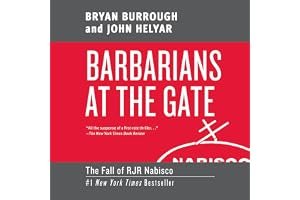
A #1 New York Times bestseller and arguably the best business narrative ever written, Barbarians at the Gate is the classic account of the fall of RJR Nabisco. An enduring masterpiece of investigative journalism by Bryan Burrough and John Helyar, it includes a new afterword by the authors that brings this remarkable story of greed and double-dealings up to date twenty years after the famed deal. The Los Angeles Times calls Barbarians at the Gate, “Superlative.” The Chicago Tribune raves, “It’s hard to imagine a better story...and it’s hard to imagine a better account.” And in an era of spectacular business crashes and federal bailouts, it still stands as a valuable cautionary tale that must be heeded.
…
Recommended by Bill Liao, Bogdan Iordache, David Rothschild, and 2 others.
Bill Liao
The human world occurs in language so best get good at it! [source]
Bogdan Iordache
There are quite a few good business books on technology, and I'll list below some I find to be a good starting point. Personally, I like biographies a lot and I mostly read biographies of dead people, because those are the most honest ones. So because the computer age is still very young, there won't be a lot of biographies in my list. [source]
Scott Kupor
@JPHampstead @TimParksauthor Barbarians is a great book. Hope you enjoy mine! [source]
One of the most popular personal development and self-improvement books of all time, Think and Grow Rich has sold over 100 million copies worldwide since its first publication during the Great Depression. In this hardcover edition, Napoleon Hill presents a "Philosophy of Achievement" in 13 principles drawn from the success stories of such greats as Andrew Carnegie, Henry Ford, Thomas Edison, and other millionaires of his time.
Think and Grow Rich reveals the secrets that can bring you fortune. By suppressing negative thoughts and keeping your focus on the long term, you can find true and lasting success. Napoleon Hill details his philosophy through the following 13 principles:
Desire Faith Autosuggestion Specialized Knowledge Imagination Organized Planning Decision Persistence Power of the Master Mind The Mystery of Sex Transmutation The Subconscious Mind The Brain The Sixth Sense Follow the steps outlined here, and you may just find the path to your own personal fortune.
For anyone interested in my career path, I’d recommend books in various genres. On a real practical level, I’d certainly recommend reading any and all plant/mushroom/tree/ecology/nature books you can acquire. It’s even more helpful to read the books that pertain specifically to your ecosystem and bioregion. Additionally, I’d also recommend reading a plethora of business and marketing books — both old and new alike. Think And Grow Rich by Napoleon Hill, Crush It! by Gary Vaynerchuk, Influence: The Psychology of Persuasion by Robert Cialdini, and anything by Seth Godin would be my top recommendations. And of course, every book I mentioned in the previous answers are strongly recommended as well. [source]

Alan Pierce
This book dramatically changed the way I structured my day to day life. Based on over two decades of personal interviews and studies of some of history's’ greatest minds, the author distills the lessons he learned and details how you can train and condition your mind through daily habit to master your actions. The way it promotes a disciplined and holistic approach of continual self-improvement, goal setting and strategic decision making really resonated with me. [source]
Cover unavailable
3
King of Capital: The Remarkable Rise, Fall, and Rise Again of Steve Schwarzman and Blackstone
David Carey, John E. Morris
4.7
Strippers and Flippers . . . or a New Positive Force Helping to Drive the Economy . . .
The untold story of Steve Schwarzman and Blackstone, the financier and his financial powerhouse that avoided the self-destructive tendencies of Wall Street. David Carey and John Morris show how Blackstone (and other private equity firms) transformed themselves from gamblers, hostile-takeover artists, and ‘barbarians at the gate’ into disciplined, risk-conscious investors. The financial establishment—banks and investment bankers such as Citigroup, Bear Stearns, Lehman, UBS, Goldman Sachs, Merrill Lynch, Morgan Stanley—were the cowboys, recklessly assuming risks, leveraging up to astronomical levels and driving the economy to the brink of disaster. Blackstone is now ready to break out once again since it is sitting on billions of dollars that can be invested at a time when the market is starved for capital.
The story of a financial revolution—the greatest untold success story on Wall Street: Not only have Blackstone and a small coterie of competitors wrested control of corporations around the globe, but they have emerged as a major force on Wall Street, challenging the likes of Goldman Sachs and Morgan Stanley for dominance. Great human interest story: How Blackstone went from two guys and a secretary to being one of Wall Street’s most powerful institutions, far outgrowing its much older rival KKR; and how Steve Schwarzman, with a pay packet one year of $398 million and $684 million from the Blackstone IPO, came to epitomize the spectacular new financial fortunes amassed in the 2000s. Controversial: Analyzes the controversies surrounding Blackstone and whether it and other private equity firms suck the lifeblood out of companies to enrich themselves—or whether they are a force that helps make the companies they own stronger and thereby better competitors. The story by two insiders with access: Insightful and hard-hitting, filled with never-before-revealed details about the workings of a heretofore secretive company that was the personal fiefdom of Schwarzman and Peter Peterson. Forward-looking: How Blackstone and private equity will drive the economy and provide a model for how financing will work.
…
Recommended by Bogdan Iordache.
Bogdan Iordache
There are quite a few good business books on technology, and I'll list below some I find to be a good starting point. Personally, I like biographies a lot and I mostly read biographies of dead people, because those are the most honest ones. So because the computer age is still very young, there won't be a lot of biographies in my list. [source]
Cover unavailable
4
What It Takes: Lessons in the Pursuit of Excellence
Stephen A. Schwarzman
4.5
NEW YORK TIMES BESTSELLER
From Blackstone chairman, CEO, and co-founder Stephen A. Schwarzman, a long-awaited book that uses impactful episodes from Schwarzman's life to show readers how to build, transform, and lead thriving organizations. Whether you are a student, entrepreneur, philanthropist, executive, or simply someone looking for ways to maximize your potential, the same lessons apply.
People know who Stephen Schwarzman is—at least they think they do. He’s the man who took $400,000 and co-founded Blackstone, the investment firm that manages over $500 billion (as of January 2019). He’s the CEO whose views are sought by heads of state. He’s the billionaire philanthropist who founded Schwarzman Scholars, this century’s version of the Rhodes Scholarship, in China. But behind these achievements is a man who has spent his life learning and reflecting on what it takes to achieve excellence, make an impact, and live a life of consequence.
Folding handkerchiefs in his father’s linen shop, Schwarzman dreamed of a larger life, filled with purpose and adventure. His grades and athleticism got him into Yale. After starting his career in finance with a short stint at a financial firm called DLJ, Schwarzman began working at Lehman Brothers where he ascended to run the mergers and acquisitions practice. He eventually partnered with his mentor and friend Pete Peterson to found Blackstone, vowing to create a new and different kind of financial institution.
Building Blackstone into the leading global financial institution it is today didn’t come easy. Schwarzman focused intensely on culture, hiring great talent, and establishing processes that allow the firm to systematically analyze and evaluate risk. Schwarzman’s simple mantra “don’t lose money” has helped Blackstone become a leading private equity and real estate investor, and manager of alternative assets for institutional investors globally. Both he and the firm are known for the rigor of their investment process, their innovative approach to deal making, the diversification of their business lines, and a conviction to be the best at everything they do.
Schwarzman is also an active philanthropist, having given away more than a billion dollars. In philanthropy, as in business, he is drawn to situations where his capital and energy can be applied to drive transformative solutions and change paradigms, notably in education. He uses the skills learned over a lifetime in finance to design, establish, and support impactful and innovative organizations and initiatives. His gifts have ranged from creating a new College of Computing at MIT for the study of artificial intelligence, to establishing a first-of-its-kind student and performing arts center at Yale, to enabling the renovation of the iconic New York Public Library, to founding the Schwarzman Scholars fellowship program at Tsinghua University in Beijing—the single largest philanthropic effort in China’s history from international donors.
Schwarzman’s story is an empowering, entertaining, and informative guide for anyone striving for greater personal impact. From deal making to investing, leadership to entrepreneurship, philanthropy to diplomacy, Schwarzman has lessons for how to think about ambition and scale, risk and opportunities, and how to achieve success through the relentless pursuit of excellence. Schwarzman not only offers readers a thoughtful reflection on all his own experiences, but in doing so provides a practical blueprint for success.
Reveals how the author has achieved the rarest kind of leverage in multiple fields. [source]
Norman Ornstein
What it Takes remains the best book written about American politics and politicians. i reread every few years. Want to know about Biden? Read it! https://t.co/ZlLwbRqADa [source]

From bestselling writer David Graeber, a powerful argument against the rise of meaningless, unfulfilling jobs, and their consequences.
Does your job make a meaningful contribution to the world? In the spring of 2013, David Graeber asked this question in a playful, provocative essay titled “On the Phenomenon of Bullshit Jobs.” It went viral. After a million online views in seventeen different languages, people all over the world are still debating the answer.
There are millions of people—HR consultants, communication coordinators, telemarketing researchers, corporate lawyers—whose jobs are useless, and, tragically, they know it. These people are caught in bullshit jobs.
Graeber explores one of society’s most vexing and deeply felt concerns, indicting among other villains a particular strain of finance capitalism that betrays ideals shared by thinkers ranging from Keynes to Lincoln. Bullshit Jobs gives individuals, corporations, and societies permission to undergo a shift in values, placing creative and caring work at the center of our culture. This book is for everyone who wants to turn their vocation back into an avocation.
…
Cover unavailable
6
High Growth Handbook
Elad Gil
4.4
Well-known technology executive and angel investor Elad Gil has worked with high growth tech companies like Airbnb, Twitter, Google, Instacart, Coinbase, Stripe, and Square as they've grown from small companies into global brands. Across all of these break-out companies, a set of common patterns has evolved into a repeatable playbook that Gil has codified in High Growth Handbook.
Covering key topics including the role of the CEO, managing your board, recruiting and managing an executive team, M&A, IPOs and late stage funding rounds, and interspersed with over a dozen interviews with some of the biggest names in Silicon Valley including Reid Hoffman (LinkedIn), Marc Andreessen (Andreessen Horowitz), and Aaron Levie (Box), High Growth Handbook presents crystal clear guidance for navigating the most complex challenges that confront leaders and operators in high-growth startups.
In what Reid Hoffman, cofounder of LinkedIn and co-author of the #1 NYT bestsellers The Alliance and The Startup of You calls "a trenchant guide," High Growth Handbook is the playbook for turning a startup into a unicorn.
"Elad Gil is one of Silicon Valley's seriously knowledgeable and battle-tested players. If you want the chance to turn your startup into the next Google or Twitter, then read this trenchant guide from someone who played key roles in the growth of these companies." - Reid Hoffman, co-founder of LinkedIn, co-author of the #1 NYT bestsellers "The Alliance" and "The Startup of You," and host of the podcast Masters of Scale
"Elad eschews trite management aphorisms in favor of pragmatic and straight-shooting insights on complex topics like managing a board of directors, executing functional re-organizations with as little trauma as possible, and everything in-between." - Dick Costolo, former CEO of Twitter and serial entrepreneur
"Elad first invested in Airbnb when we were less than 10 people and provided early advice on scaling the company. This book shares these learnings for the next generation of entrepreneurs." - Nathan Blecharczyk, cofounder of Airbnb, Chief Strategy Officer, and Chairman of Airbnb China
"Elad jam-packs every useful lesson about building and scaling companies into a single, digestible book. My only gripe is that he didn't write this when we were in the early days of Box as it would have saved my ass countless times." -Aaron Levie, cofounder and CEO of Box
"Armed with observations gathered scaling some of the most successful and important companies of Silicon Valley, Elad has no-nonsense, highly applicable advice to any operator transitioning a company from the proverbial garage to the next stage and beyond." - Max Levchin, cofounder and CEO of Affirm, cofounder and CTO of PayPal
"Elad is one of the most experienced operators in Silicon Valley having seen numerous companies hit their inflection point. His advice has been key for Coinbase as we go through hypergrowth, from hiring executives to improving M&A." - Brian Armstrong, cofounder and CEO of Coinbase
"Elad is one of the best connected and respected early stage investors in the Valley - he invested in Minted when we had fewer than 50 employees and his advice was critical to us in growing our business to where we are now, in the low hundreds of millions in sales. In his book, he crystallizes all of these learnings for the next generation of companies." -Mariam Naficy, cofounder and CEO of Minted
…
Recommended by Brian Armstrong, Alok Kejriwal, and Joe Martin.
Alok Kejriwal
Will I work with me? In the book High Growth Handbook, a paragraph was stunning : “Founders should write a guide to working with them. It would be to clarify the founder’s role: “What do I want to be involved in?” Check pic note WHY this is a great idea.. https://t.co/xzdv8cuR4D [source]
Investment Banking: Valuation, Leveraged Buyouts, and Mergers & Acquisitions
Joshua Rosenbaum
4.3
In the constantly evolving world of finance, a solid technical foundation is an essential tool for success. Due to the fast-paced nature of this world, however, no one has been able to take the time to properly codify the lifeblood of the corporate financier's work--namely, valuation. Rosenbaum and Pearl have responded to this need by writing the book that they wish had existed when they were trying to break into Wall Street. Investment Banking: Valuation, Leveraged Buyouts, and Mergers & Acquisitions is a highly accessible and authoritative book that focuses on the primary valuation methodologies currently used on Wall Street--comparable companies, precedent transactions, DCF, and LBO analysis. These methodologies are used to determine valuation for public and private companies within the context of M&A transactions, LBOs, IPOs, restructurings, and investment decisions. Using a step-by-step how-to approach for each methodology, the authors build a chronological knowledge base and define key terms, financial concepts, and processes throughout the book. They also provide a comprehensive overview of the fundamentals of LBOs and an organized M&A sale process.
In the aftermath of the subprime mortgage crisis and ensuing credit crunch, the world of finance is returning to the fundamentals of valuation and critical due diligence. This involves the use of more realistic assumptions governing approach to risk as well as a wide range of value drivers. While valuation has always involved a great deal of "art" in addition to time-tested "science," the artistry is perpetually evolving in accordance with market developments and conditions. In this sense, this book is particularly topical--in addition to detailing the technical fundamentals behind valuation, the authors infuse practical judgment skills and perspective to help guide the science.
…
Cover unavailable
8
The Money Game
Adam Smith
4.3
"This is a modern classic." —Paul A. Samuelson, First American Nobel Prize Winner in Economics
"The best book there is about the stock market and all that goes with it." —The New York Times Book Review
"Anyone whose orientation is toward where the action is, where the happenings happen, should buy a copy of The Money Game and read it with due diligence." —Book World
" 'Adam Smith' is a veteran observer and commentator on the events and people of Wall Street.... His thorough knowledge of financial affairs gives his observations a great degree of authenticity. But the joy of reading this book comes from his delightful sense of humor. He is a lively and ingeniously witty writer who never stoops to acerbity. None of the solemn, sacred cows of Wall Street escapes debunking." —Library Journal
…
Recommended by Brendan Moynihan and John Lanchester.
Adam Smith is a pseudonym – he was an extremely successful professional investor called George Goodman, who also wrote a newspaper column. This is a real insider’s account of the way that the money markets and trading works. [source]
Cover unavailable
9
Advanced Techniques in Day Trading: A Practical Guide to High Probability Strategies and Methods
Andrew Aziz
4.3
This well-thought-out training regimen begins with an in-depth look at the necessary tools of the trade including your scanner, software and platform; and then moves to practical advice on subjects such as how to find the right stocks to trade, how to define support and resistance levels, and how to best manage your trades in the stress of the moment. An extensive review of proven trading strategies follows, all amply illustrated with real examples from recent trades. Risk management is addressed including tips on how to determine proper entry, profit targets and stop losses. Lastly, to bring it all together, there's a "behind the scenes" look at the author's thought process as he walks you through a number of trades. While aimed at the reader with some exposure to day trading, the novice trader will also find much useful information, easily explained, on the pages within. In this book, you'll learn... - How to start day trading as a business - How to day trade stocks, not gamble on them - How to choose a direct access broker, and required tools and platforms - How to plan important day trading strategies - How to execute each trading strategies in detail: entry, exit, stop loss - How to manage the trading plan
…
Cover unavailable
10
The Only Investment Guide You'll Ever Need
Andrew Tobias
4.3
“The Only Investment Guide You'll Ever Need . . . actually lives up to its name.” — Los Angeles Times
“So full of tips and angles that only a booby or a billionaire could not benefit.” — New York Times
For nearly forty years, The Only Investment Guide You'll Ever Need has been a favorite finance guide, earning the allegiance of more than a million readers across America. This completely updated edition will show you how to use your money to your best advantage in today's financial marketplace, no matter what your means.
Using concise, witty, and truly understandable tips and explanations, Andrew Tobias delivers sensible advice and useful information on savings, investments, preparing for retirement, and much more.
@AndrewTobias wrote a fantastic book about how to think about money, spending, saving, and investing. If you don't have these things in focus, I can STRONGLY recommend this book. https://t.co/wa4eOhkxXb https://t.co/hOU23B43Kl [source]
Cover unavailable
11
The Greatest Trade Ever: The Behind-the-Scenes Story of How John Paulson Defied Wall Street and Made Financial History
Gregory Zuckerman
4.3
In 2006, hedge fund manager John Paulson realized something few others suspected--that the housing market and the value of subprime mortgages were grossly inflated and headed for a major fall. Paulson's background was in mergers and acquisitions, however, and he knew little about real estate or how to wager against housing. He had spent a career as an also-ran on Wall Street. But Paulson was convinced this was his chance to make his mark. He just wasn't sure how to do it. Colleagues at investment banks scoffed at him and investors dismissed him. Even pros skeptical about housing shied away from the complicated derivative investments that Paulson was just learning about. But Paulson and a handful of renegade investors such as Jeffrey Greene and Michael Burry began to bet heavily against risky mortgages and precarious financial companies. Timing is everything, though. Initially, Paulson and the others lost tens of millions of dollars as real estate and stocks continued to soar. Rather than back down, however, Paulson redoubled his bets, putting his hedge fund and his reputation on the line. In the summer of 2007, the markets began to implode, bringing Paulson early profits, but also sparking efforts to rescue real estate and derail him. By year's end, though, John Paulson had pulled off the greatest trade in financial history, earning more than $15 billion for his firm--a figure that dwarfed George Soros's billion-dollar currency trade in 1992. Paulson made billions more in 2008 by transforming his gutsy move. Some of the underdog investors who attempted the daring trade also reaped fortunes. But others who got the timing wrong met devastating failure, discovering that being early and right wasn't nearly enough. Written by the prizewinning reporter who broke the story in The Wall Street Journal, The Greatest Trade Ever is a superbly written, fast-paced, behind-the-scenes narrative of how a contrarian foresaw an escalating financial crisis--that outwitted Chuck Prince, Stanley O'Neal, Richard Fuld, and Wall Street's titans--to make financial history.
I have lots of books to recommend, but they are not related to my career path. The only one that is remotely related is Peter Thiel’s Zero to One. That said here are books I would recommend. [source]
Cover unavailable
12
Raising Private Capital: Building Your Real Estate Empire Using Other People's Money
Matt Faircloth
4.3
This book is intended to be a roadmap for real estate investors who are looking to raise their game by injecting more private capital into their business. In the word of real estate, there is more than one way to obtain the money you need: Traditional lending may work for some investors, but going to a bank is simply not an option. Matt will provide the step by step process to acquiring, securing and protecting private money. This book will teach investors how to look into their current network for potential private money partners. It will also teach them how to provide a win-win proposition to money partners all while building the real estate investor's own business. Matt will discuss the specific roles in a deal: the person providing the deal and the person providing the cash and how they both benefit. The book will go into a deep discussion on how to work with your money partners and what types of deals will best benefit them based on their goals and the source of their capital.
…
Cover unavailable
13
The 5x CEO: Learn the Strategies and Tactics of Top Private Equity CEOs to Accelerate Value and Maximize Returns
Samantha Allison, Taavo Godtfredsen
4.3
If you're a CEO in a private equity-backed company, the clock is ticking and expectations are sky-high. Your mission is clear: create extraordinary value, move fast, and deliver results that justify the investment. But how do the top-performing CEOs deliver outstanding returns while others fall short?The 5x CEO is your answer. Based on a two-year research study of over 50 private equity-backed CEOs who achieved exceptional outcomes, averaging a 6.2x Multiple on Invested Capital (MOIC), this book pulls back the curtain on what actually drives success. Co-authors Samantha Allison and Taavo Godtfredsen, experienced coaches and strategic advisors, go beyond theory to give you the playbook elite leaders use to win.At the heart of this book is the 5x Model, a practical framework that reveals what highly successful private equity CEOs do to accelerate execution and maximize value creation. Built around five critical disciplines—Strategic Clarity, Scalable Talent, Relentless Focus, Disciplined Execution, and Energized Culture—the model defines the essential responsibilities CEOs and their leadership teams must master to outperform in today’s high-pressure, high-stakes environment.Packed with insights from both CEOs and private equity sponsors, The 5x CEO gives you a proven blueprint for creating value faster, avoiding costly mistakes, and building a legacy of repeatable success.To access a PDF Audiobook Companion containing images from the book, go to advantageceo.com/audiobook-companion.
…
Cover unavailable
14
Private Equity Investing in Direct Selling: Identifying Risks & Rewards
Brett A Blake
4.3
Cover unavailable
15
Private Equity Defined: Venture, Growth, and Buyouts
Claudia Zeisberger
4.3
The definitive guide to private equity for investors, finance professionals managers and business owners.Private Equity Defined: Venture, Growth and Buyouts presents a unique handbook and valuable on-demand tool for investors, (finance) professionals, managers and business owners looking to engage with private equity or venture funds.
The book systematically distills the essence of private equity across key strategies - Venture Capital, Growth Capital and Leveraged Buyouts - into core concepts, while also presenting standard market practice across all steps of the investment process. Both developed and emerging market considerations are addressed. The book is complimented by Private Equity in Practice: Case Studies from the World of Venture, Growth, and Buyouts, a case book which provides rich, real-life applications of core concepts.
The complexity of the private equity model continues to confuse industry outsiders, with the success of the industry often attributed either to a mystical 'secret sauce' or a ruthless approach to cost cutting and asset stripping. In the authors' experience, however, the competitive advantage of private equity comes from the diligent application of best practices, as described in this book, a keen focus on big drivers of risk and opportunity and, above all, a lot of hard work.
This book provides a comprehensive, unbiased guide to investing market practices, enabling its readers to better understand the inner workings of the private equity model. It can equally serve as a standard introduction to investment professionals new to the field, as a reference book for specific steps along the investment process, or as a comprehensive overview of the mechanics of private equity to students of alternative investing.
Each diligently researched and concisely presented chapter focuses on one specific aspect of private equity and is complemented by a comment from our Guest Authors - all seasoned Private Equity and Venture Capital professionals or founding partners of established funds.
The team of experienced authors ensures the right balance of academic rigor and industry relevancy, given their experience in the world of alternative investments. The chapters and case studies have been refined through in-class discussion at one of the world's preeminent business schools, INSEAD, and bolstered by the research engine of the Global Private Equity Initiative (GPEI), a leading private equity research institution.
…
Cover unavailable
16
The Private Equity Advantage: Balancing Price, Terms, and Legacy When Selling Your Business
Scott Hanson
4.3
When is the right time to sell your business? And how do you ensure the deal protects both value and legacy?For business owners who have spent decades building their firms, the decision to sell represents both opportunity and complexity. The financial stakes are significant. The emotional dimensions run deeper. And the landscape of buyers—from strategic acquirers to private equity firms—can feel difficult to navigate.The Private Equity Advantage provides a comprehensive road map. Scott Hanson, who has founded and successfully sold multiple businesses to both Fortune 500 companies and private equity firms, guides owners through every critical decision. From recognizing optimal timing to understanding private equity partnerships, from structuring tax-efficient deals to communicating effectively with employees, this book addresses the full spectrum of challenges.Readers will learn how to evaluate potential buyers and partnership structures, minimize tax impact while maximizing proceeds, balance financial goals with personal and professional objectives, navigate legal complexities with confidence, and prepare for life after the sale.Featuring expert interviews with investment bankers, attorneys, tax specialists, and private equity professionals, plus real-world case studies, this book delivers practical strategies for one of the most important financial decisions of your career.
…
Cover unavailable
17
Valuation: Measuring and Managing the Value of Companies
McKinsey & Company Inc., Tim Koller, Marc Goedhart, David Wessels
4.3
Hailed by financial professionals worldwide as the single best guide of its kind, Valuation, Fourth Edition is thoroughly revised and expanded to reflect business conditions in today's volatile global economy. Valuation provides up-to-date insights and practical advice on how to create, manage, and measure an organization's value. Along with all-new case studies that illustrate how valuation techniques and principles are applied in real-world situations, this comprehensive guide has been updated to reflect the events of the Internet bubble and its effect on stock markets, new developments in academic finance, changes in accounting rules (both U. S. and IFRS), and an enhanced global perspective. This edition contains the solid framework that managers at all levels, investors, and students have come to trust.
…
Cover unavailable
18
Options as a Strategic Investment
Lawrence G. McMillan
4.3
The market in listed options and non-equity option products provides investors and traders with a wealth of new, strategic opportunities for managing their investments. This updated and revised Fifth Edition of the bestselling Options as a Strategic Investment gives you the latest market-tested tools for improving the earnings potential of your portfolio while reducing downside risk—no matter how the market is performing.
Inside this revised edition are scores of proven techniques and business-tested tactics for investing in many of the innovative new options products available. You will find:
•Buy and sell strategies for Long Term Equity Anticipation Securities (LEAPS) •A thorough analysis of neutral trading, how it works, and various ways it can improve readers’ overall profit picture •Detailed guidance for investing in Preferred Equity Redemption Cumulative Stocks (PERCS) and how to hedge them with common and regular options •An extensive overview of futures and futures options
Written especially for investors who have some familiarity with the option market, this comprehensive reference also shows you the concepts and applications of various option strategies -- how they work, in which situations, and why; techniques for using index options and futures to protect one’s portfolio and improve one’s return; and the implications of the tax laws for option writers, including allowable long-term gains and losses. Detailed examples, exhibits, and checklists show you the power of each strategy under carefully described market conditions.
…
Cover unavailable
19
The Disciplined Trader: Developing Winning Attitudes
Mark Douglas
4.3
The classic book that introduced the investment industry to the concept of trading psychology.
With rare insight based on his firsthand commodity trading experience, author Mark Douglas demonstrates how the mental matters that allow us function effectively in society are often psychological barriers in trading. After examining how we develop losing attitudes, this book prepares you for a thorough "mental housecleaning" of deeply rooted thought processes. And then it shows the reader how to develop and apply attitudes and behaviors that transcend psychological obstacles and lead to success.
The Disciplined Trader helps you join the elite few who have learned how to control their trading behavior (the few traders who consistently take the greatest percentage of profits out of the market) by developing a systematic, step-by-step approach to winning week after week, month after month.
The book is divided into three parts: - An overview of the psychological requirements of the trading environment - A definition of the problems and challenges of becoming a successful trader - Basic insights into what behavior may need to be changed, and how to build a framework for accomplishing this goal - How to develop specific trading skills based on a clear, objective perspective on market action
"A groundbreaking work published in 1990 examining as to why most traders cannot raise their equity on a consistent basis, bringing the reader to practical conclusions to go about changing any limiting mindset."--Larry Pesavento, TradingTutor.com
…
Cover unavailable
20
Investing in Real Estate Private Equity: An Insider’s Guide to Real Estate Partnerships, Funds, Joint Ventures & Crowdfunding
Sean Cook
4.3
Cover unavailable
21
Lessons from Private Equity Any Company Can Use (Memo to the CEO)
Orit Gadiesh
4.3
Cover unavailable
22
La escuela de negocios: Para personas que gustan de ayudar a los demás / The Business School for People Who Like Helping People
Robert T. Kiyosaki
4.3
This book was my introduction to Robert Kiyosaki and one that I've read several times over. Here's why: Robert Kiyosaki doesn't say he's never been INVOLVED with networking, he has. What he says is he didn't make his fortune from network marketing. There's a big difference. Remember that when reading other reviews. Robert explains to the reader how his opinion of networking changed (pg. 24) when, in the early 1990's, a well-respected and financially successful friend told Robert he was involved in network marketing. With Roberts past disinterest in networking, Robert didn't understand why a man who just completed over a billion dollars in commercial real estate transaction would be involved in network marketing.
…
Cover unavailable
23
The Book on Negotiating Real Estate: Expert Strategies for Getting the Best Deals When Buying & Selling Investment Property
J Scott
4.3
Recommended by Chris Mobbs.
Chris Mobbs
The Book on Negotiating Real Estate: Expert Strategies for Getting the Best Deals When Buying & Selling Investment Property https://t.co/KVSKLy5aQU https://t.co/Dbn2sAYpcd [source]
The Masters of Private Equity and Venture Capital: Management Lessons from the Pioneers of Private Investing
Robert Finkel
4.2
Ten Leading private investors share their secrets to maximum profitability
In The Masters of Private Equity and Venture Capital, the pioneers of the industry share the investing and management wisdom they have gained by investing in and transforming their portfolio companies.
Based on original interviews conducted by the authors, this book is filled with colorful stories on the subjects that most matter to the high-level investor, such as selecting and working with management, pioneering new markets, adding value through operational improvements, applying private equity principles to non-profits, and much more.
…
Cover unavailable
26
Investment Banking + Dg, 2nd Edition, University Edition
Joshua Pearl and Joshua Rosenbaum
4.2
World-class valuation and transaction models to complement the global best-selling guide to investment banking
Five valuation models templates along with completed versions are accessible for purchase and use--downloadable in electronic format on the book's website, www.wiley.com/go/investmentbanking2e. Each model comes complete with a user's guide.
The models includeComparable Companies AnalysisPrecedent Transactions AnalysisDiscounted Cash Flow AnalysisLeverage Buyout AnalysisNEW! M&A Model
…
Cover unavailable
27
Day Trading: A Beginner's Guide on How to Trade, Living in the Market and Make Money with Day Trading Investing in Stocks, Forex, and Options with the Best Futures and Strategies for a Trader in 2019
Henry Hill
4.2
What is Day Trading? Are you a beginner and have no clue about day trading? Do you want to become rich? Read On..
The truth is.. Broadly defined as buying and selling the same security in a single day. Armed with a large amount of data, and an even larger bankroll, the best day traders take advantage of high amounts of leverage as well as strategies for success that come to fruition in the short term to make large sums from price movements that are otherwise relatively minor. The goal of this book is simple: it will teach you the basics of Day trading that you can practice as soon as you finish to read it, you will be shown real examples and clear graphs to allow quick learning, it be explained, in simple and not complex terms and it'll allow you if you are a beginners to start investing or if you are an intermediate trader to triple your profits.
You will learn: - Secret techniques to day trade - To read the main tools and charts- The benefits of day trading- Understanding futures- Day trading pros and cons- To avoid common mistakes with day trading- Advice for beginners and tips for success- Building up your watch list- How to invest with an easy and step-by-step guide and more...
The process of day trading can be broken down into 5 steps that will always be the same regardless of the specifics of the trade that is being made. First, you will need to locate an underlying stock that you are interested in trading based on research done ahead of time. Next, you will need to determine if it aligns with your personalized trading plan. Then, you will take a position based on the current trend of the market before buying or selling once a specific type of movement occurs. Finally, you will repeat this process roughly 100 times a day. There are many traders, especially those who are beginners, who worry about getting started in day trading. They think that this is a dangerous or risky method of trading. But for those who truly know how to read the market, and who are willing to choose the right strategy and stick with it, day trading can be a great way to enter the market with a low budget and make some good profits in theprocess.
Very few careers can offer you the freedom, flexibility, and income that trading does. You can live and work anywhere In the world. You can decide when to work and when not to work, you do not have a superior that say you continually what to do, you'll have the freedom from all of these things and money not will be anymore a big problem. And now you're one step away from accomplishing this ...
Buy this book today to reach your FINANCIAL FREEDOM and do not lose the opportunity to double or triple your profit within 10 days, scroll to the top of the page and select the buy now button.
…
Cover unavailable
28
Empire Builder: The Road to a Billion
Adam Coffey
4.2
Cover unavailable
29
The Master Key System: The Original Unabridged and Complete Edition (Charles F. Haanel Classics)
Charles F. Haanel
4.2
Cover unavailable
30
Financial Modeling and Valuation: A Practical Guide to Investment Banking and Private Equity
Paul Pignataro
4.2
Written by the Founder and CEO of the prestigious New York School of Finance, this book schools you in the fundamental tools for accurately assessing the soundness of a stock investment. Built around a full-length case study of Wal-Mart, it shows you how to perform an in-depth analysis of that company's financial standing, walking you through all the steps of developing a sophisticated financial model as done by professional Wall Street analysts. You will construct a full scale financial model and valuation step-by-step as you page through the book.
When we ran this analysis in January of 2012, we estimated the stock was undervalued. Since the first run of the analysis, the stock has increased 35 percent. Re-evaluating Wal-Mart 9months later, we will step through the techniques utilized by Wall Street analysts to build models on and properly value business entities.
Step-by-step financial modeling - taught using downloadable Wall Street models, you will construct the model step by step as you page through the book. Hot keys and explicit Excel instructions aid even the novice excel modeler. Model built complete with Income Statement, Cash Flow Statement, Balance Sheet, Balance Sheet Balancing Techniques, Depreciation Schedule (complete with accelerating depreciation and deferring taxes), working capital schedule, debt schedule, handling circular references, and automatic debt pay downs. Illustrative concepts including detailing model flows help aid in conceptual understanding. Concepts are reiterated and honed, perfect for a novice yet detailed enough for a professional. Model built direct from Wal-Mart public filings, searching through notes, performing research, and illustrating techniques to formulate projections. Includes in-depth coverage of valuation techniques commonly used by Wall Street professionals. Illustrative comparable company analyses - built the right way, direct from historical financials, calculating LTM (Last Twelve Month) data, calendarization, and properly smoothing EBITDA and Net Income. Precedent transactions analysis - detailing how to extract proper metrics from relevant proxy statements Discounted cash flow analysis - simplifying and illustrating how a DCF is utilized, how unlevered free cash flow is derived, and the meaning of weighted average cost of capital (WACC) Step-by-step we will come up with a valuation on Wal-Mart Chapter end questions, practice models, additional case studies and common interview questions (found in the companion website) help solidify the techniques honed in the book; ideal for universities or business students looking to break into the investment banking field.
…
Cover unavailable
31
Big Money in Franchising: Scaling Your Enterprise in the Era of Private Equity
Alicia Miller
4.2
Cover unavailable
32
A Beginner's Guide to Business Valuation: Lessons Learned from 20 Years in the Trenches
Jacob Orosz
4.2
Cover unavailable
33
The Private Equity Playbook: Management’s Guide to Working with Private Equity 2nd Edition
Adam Coffey
4.2
Cover unavailable
34
The Exit-Strategy Playbook: The Definitive Guide to Selling Your Business
Adam Coffey
4.2
Cover unavailable
35
How to Invest in Commercial Real Estate if You Know Nothing about Commercial Real Estate: The Definitive Institutional Real Estate Investing Guide
David A. Dowell
4.2
Cover unavailable
36
Plunder: Private Equity's Plan to Pillage America
Brendan Ballou
4.2
Cover unavailable
37
The Caesars Palace Coup: How A Billionaire Brawl Over the Famous Casino Exposed the Power and Greed of Wall Street
Max Frumes
4.2
Cover unavailable
38
Bad Company: Private Equity and the Death of the American Dream
Megan Greenwell
4.2
Cover unavailable
39
Merchants of Debt: KKR and the Mortgaging of American Business
George Anders
4.2
Cover unavailable
40
Search Funds & Entrepreneurial Acquisitions: The Roadmap for Buying a Business and Leading it to the Next Level
Jan Simon
4.2
Cover unavailable
41
Mastering Private Equity
Claudia Zeisberger, Bowen White, and Michael Prahl
4.2
Cover unavailable
42
Fooling Some of the People All of the Time, a Long Short (and Now Complete) Story, Updated with New Epilogue
David Einhorn
4.2
A revealing look at Wall Street, the financial media, and financial regulators by David Einhorn, the President of Greenlight CapitalCould 2008's credit crisis have been minimized or even avoided? In 2002, David Einhorn-one of the country's top investors-was asked at a charity investment conference to share his best investment advice. Short sell Allied Capital. At the time, Allied was a leader in the private financing industry. Einhorn claimed Allied was using questionable accounting practices to prop itself up. Sound familiar? At the time of the original version of "Fooling Some of the People All of the Time: A Long Short Story" the outcome of his advice was unknown. Now, the story is complete and we know Einhorn was right. In 2008, Einhorn advised the same conference to short sell Lehman Brothers. And had the market been more open to his warnings, yes, the market meltdown might have been avoided, or at least minimized.Details the gripping battle between Allied Capital and Einhorn's Greenlight CapitalIlluminates how questionable company practices are maintained and, at times, even protected by Wall StreetDescribes the failings of investment banks, analysts, journalists, and government regulatorsDescribes how many parts of the Allied Capital story were replayed in the debate over Lehman Brothers
"Fooling Some of the People All of the Time" is an important call for effective government regulation, free speech, and fair play.
…
Cover unavailable
43
Divestitures: Creating Value Through Strategy, Structure, and Implementation
Emilie R. Feldman
4.2
Cover unavailable
44
The 16 % Solution, Revised Edition: How to Get High Interest Rates in a Low-Interest World with Tax Lien Certificates
Joel S. Moskowitz
4.1
Low interest rates can mean high interest from readers.
Dealing with unpaid taxes? Looking for investment opportunities?
With home foreclosures at an all-time high and the erratic stock market damaging 401(k) accounts, people are looking for innovative ways to invest their money and improve their financial situation through different investment vehicles.
Moskowitz explains what tax lien certificates are (liens against property for unpaid taxes), why they are safe investments (certain states insure them), and how they fit into an overall financial plan. This new edition includes updates to the laws and procedures of states and counties that offer tax lien certificates.
…
Cover unavailable
45
The Art of M&A, Sixth Edition: A Merger, Acquisition, and Buyout Guide
Alexandra Reed Lajoux
4.1
Cover unavailable
46
Equity Markets and Portfolio Analysis
R. Stafford Johnson
4.1
Understand today's investment challenges and the role of the Bloomberg system In recent years, changes have swept through the investment industry like wildfire. Academia has followed along and provided new lenses for viewing this transformation, as well as new strategies for gaining a true understanding and knowledge of investment and financial markets. Now, Equity Markets and Portfolio Analysis has been created to further inform investment professionals and finance students on the basic concepts and strategies of investments, and to provide more detailed discussions on advanced strategies and models. The concepts covered in this book will help readers gain a better understanding of the markets and uses for an increasing number of securities, strategies, and methodologies.
Equity Markets and Portfolio Analysis is the only core investment book that covers the functionality of Bloomberg terminals, increasingly critical tools both in the classroom and on the trading floor. As Bloomberg terminals now play a key role in the research, teaching, and managing of student investment funds, understanding the system's information and analytical functions has become more important than ever.
In-depth coverage of fundamentals through more detailed concepts for students and professionals who want to better understand the evaluation, selection, and management of securities One-of-a-kind training and instructional course, introduction to Bloomberg investment subjects, and reference for CFA preparation Bloomberg material provided in an appendix accompanying each chapter, a useful option for professors Ideal for finance practitioners, investment bankers, and academics This unique resource will give readers both the foundational knowledge and the analytical tools necessary for investment success, both in the classroom and in the real world.
…
Cover unavailable
47
Investment Banks, Hedge Funds, and Private Equity
David P. Stowell
4.1
As our economy evolves, private equity groups, hedge funds, and investment banks compete and cooperate in different ways. Their recent innovations are reported and analyzed by the 3rd edition of David Stowell's landmark book, which adds three new cases, significantly revisions of most chapters, and updated figures, tables, and exhibits. It captures the actual work that associates and vice presidents do, providing readers with templates for real transactions. Finally, it provides significantly more content about the ways liquidity is supplied in secondary markets, including an overview of high frequency trading/electronic market making, quantitative trading strategies, and the evolution of cash equities from open outcry pits to fully electronic central limit order books.
…
Cover unavailable
48
Engines That Move Markets: Technology Investing from Railroads to the Internet and Beyond
Alasdair G. M. Nairn
4.1
Cover unavailable
49
The Wyckoff Methodology in Depth: How to trade financial markets logically
Rubén Villahermosa
4.1
Cover unavailable
50
The Predators' Ball: The Inside Story of Drexel Burnham and the Rise of the Junk Bond Raiders
Connie Bruck
4.1
During the 1980s, Michael Milken at Drexel Burnham Lambert was the Billionaire Junk Bond King. He invented such things as "the highly confident letter" (I'm highly confident that I can raise the money you need to buy company X) and "the blind pool" (Here's a billion dollars: let us help you buy a company), and he financed the biggest corporate raiders--men like Carl Icahn and Ronald Perelman.
And then, on September 7, 1988, things changed. The Securities and Exchange Commission charged Milken and Drexel Burnham Lambert with insider trading and stock fraud. Waiting in the wings was the US District Attorney, who wanted to file criminal and racketeering charges. What motivated Milken in his drive for power and money? Did Drexel Burnham Lambert condone the breaking of laws? The Predators' Ball dramatically captures American business history in the making, uncovering the philosophy of greed that has dominated Wall Street in the 1980s.
…
Cover unavailable
51
Leveraged Buyouts, + Website: A Practical Guide to Investment Banking and Private Equity
Paul Pignataro
4.1
A comprehensive look at the world of leveraged buyouts The private equity industry has grown dramatically over the past twenty years. Such investing requires a strong technical know-how in order to turn private investments into successful enterprises. That is why Paul Pignataro has created Leveraged Buyouts + Website: A Practical Guide to Investment Banking and Private Equity.
Engaging and informative, this book skillfully shows how to identify a private company, takes you through the analysis behind bringing such an investment to profitability--and further create high returns for the private equity funds. It includes an informative leveraged buyout overview, touching on everything from LBO modeling, accounting, and value creation theory to leveraged buyout concepts and mechanics.
Provides an in-depth analysis of how to identify a private company, bring such an investment to profitability, and create high returns for the private equity funds Includes an informative LBO model and case study as well as private company valuation Written by Paul Pignataro, founder and CEO of the New York School of Finance If you're looking for the best way to hone your skills in this field, look no further than this book.
…
Cover unavailable
52
Private Debt: Yield, Safety and the Emergence of Alternative Lending (Wiley Finance)
Stephen L. Nesbitt
4.1
Cover unavailable
53
Capital Allocation: Principles, Strategies, and Processes for Creating Long-Term Shareholder Value
David R. Giroux
4.1
Cover unavailable
54
Wealth in Numbers: The Ultimate Dealmaker’s Guide to SPVs, Syndication, and Private Investment
Max Avery, Jake Claver, and Jordan Hutchinson
4.1
Cover unavailable
55
Venture Capital, Private Equity, and the Financing of Entrepreneurship
Josh Lerner, Ann Leamon, Felda Hardymon
4.1
Venture Capital, Private Equity, and the Financing of Entrepreneurship explores the exciting world of active investing and lays out in a clear and readily accessible way their key features, ways of doing business and likely evolution. The book follows the cycle of active investing. Raising funds, considering transactions, structuring and overseeing transactions, and exiting investments are considered in turn. The focus is not just on the U.S. market, but on the increasingly global nature of these activities.
…
Cover unavailable
56
The Lifestyle Investor: The 10 Commandments of Cash Flow Investing for Passive Income and Financial Freedom
Justin Donald
4.1
Cover unavailable
57
Billion Dollar Lessons: What You Can Learn from the Most Inexcusable Business Failures of the Last 25 Years
Paul B. Carroll, Chunka Mui
4.1
How to avoid the mistakes that lead to the majority of business failures.
Most executives shudder at the word “failure” and try to avoid thinking about it. No wonder there are thousands of books about successful companies but virtually none about the lessons to be learned from those that crash and burn.
Paul Carroll and Chunka Mui think there’s enormous value in learning from companies that lost millions (if not billions) in pursuit of strategies that led to spectacular flameouts. Everyone makes mistakes, but why make the same mistakes over and over?
The authors studied the most significant failures of the last twenty-five years: 750 bankruptcies, major writeoffs, and discontinued operations. They found that the #1 cause of failure was misguided strategy— not sloppy execution, lack of leadership, or bad luck. These strategies fall into eight categories, including:
• Trying to fix a core business that’s unfixable • Moving into an “adjacent” market that isn’t really Adjacent • Buying more problems than efficiencies through misguided consolidation
Billion Dollar Lessons offers “devil’s advocate” questions that managers, boards, and investors can adopt.
I am putting this book on here as a cautionary tale for all the supposed business strategists out there. Because it turns out that most (if not all) genius business strategies are totally misguided and lead to catastrophic failure. Your planned merger, roll up, pivot–it’s probably got glaring strategic flaws in it. Why? Because you’re too caught up in your own vision to see what can go wrong, to see where you’ve been overly optimistic, to accept how little you control. Pairing this book with some of the books on war is a good idea. It will humble you and keep you conservative–which all good strategists are. “Boldness” should be used sparingly because it’s often actually just stupidity in disguise. [source]
Cover unavailable
58
The Messy Marketplace: Selling Your Business in a World of Imperfect Buyers
Brent Beshore
4.1
The marketplace for small and midsize businesses is messy. Having peeked behind the curtain at over 10,000 companies, this book aims to demystify the buyers, the process, and the inevitably emotional journey that is selling a company.
Read it. Reference it. Share it.
Think about what outcomes are important to you and why. Here's a cheat sheet:
I want between $ and $ of cash as a financial result. (You'll have to pay off debt, taxes, and transaction costs. Also, something is only worth what someone is willing to pay for it.) I want to work for ___ years in my current position, and am willing to consult with the company for ___ years thereafter. (It's okay to say you want to stick with the company long-term, or leave the day of closing.) I'm looking for a buyer/partner that will take the role in the company. (Example roles include advisory board, passive partner, CEO, and CFO.) The characteristics/values of an ideal buyer would be: My ideal timeline for a transaction would be , but I'd be happy to sell in years. My top non-financial goals are:
…
Cover unavailable
59
The Private Equity Toolkit: A Step-by-Step Guide to Getting Deals Done from Sourcing to Exit (Wiley Finance)
Tamara Sakovska
4.1
Cover unavailable
60
Middle Market M & A: Handbook for Advisors, Investors, and Business Owners (Wiley Finance)
Kenneth H. Marks
4.1
Cover unavailable
61
The Key Man: The True Story of How the Global Elite Was Duped by a Capitalist Fairy Tale
Simon Clark
4.1
Cover unavailable
62
Mergers, Acquisitions, and Corporate Restructurings (Wiley Corporate F&A)
Patrick A. Gaughan
4.1
Cover unavailable
63
Inside Private Equity: The Professional Investor's Handbook
James M. Kocis
4.1
Inside Private Equity explores the complexities of this asset class and introduces new methodologies that connect investment returns with wealth creation. By providing straightforward examples, it demystifies traditional measures like the IRR and challenges many of the common assumptions about this asset class. Readers take away a set of practical measures that empower them to better manage their portfolios.
…
Cover unavailable
64
The New Tycoons: Inside the Trillion Dollar Private Equity Industry That Owns Everything (Bloomberg)
Jason Kelly
4.1
Inside the Trillion Dollar Industry That Owns Everything
What do Dunkin' Donuts, J. Crew, Toys "R" Us, and Burger King have in common? They are all currently or just recently were owned, operated, and controlled by private equity firms. "The New Tycoons: Inside the Trillion Dollar Private Equity Industry That Owns Everything" takes the reader behind the scenes of these firms: their famous billionaire founders, the overlapping stories of their creation and evolution, and the outsized ambitions that led a group of clever bankers from small shops operating in a corner of Wall Street into powerhouse titans of capital. This is the story of the money and the men who handle it.
Go inside the private worlds of founders Henry Kravis, Steve Schwarzman, David Bonderman, and more in "The New Tycoons, "and discover how these men have transformed the industry and built the some of the most powerful and most secretive houses of money in the world.With numerous private equity firms going public for the first time, learn how these firms operate, where their money comes from and where it goes, and how every day millions of customers, employees, and retirees play a role in that complex tangle of moneyAuthor Jason Kelly tells the story of how thirty some years ago a group of colleagues with $120,000 of their own savings founded what would become one of the largest private equity shops in the world, completing the biggest buyout the world has ever seen, and making them all billionaires in the processPresents a never-before-seen look inside a secretive and powerful world on the verge of complete transformation as the industry and its leaders gain public profiles, scrutiny, and political positions
Analyzing the founders and the firms at a crucial moment, when they've elevated themselves beyond their already lofty ambitions into the world of public opinion and valuation, "New Tycoons" looks at one of the most important, yet least examined, trillion-dollar corners of the global economy and what it portends for these new tycoons.
…
Cover unavailable
65
Study Guide for the Fourth Edition of Options as a Strategic Investment
Lawrence G. McMillan
4.1
The market in listed options and non-equity option products provides investors and traders with a wealth of new, strategic opportunities for managing their investments. This updated and revised Third Edition of the bestselling options book of all time gives you the latest market-tested tools for maximizing the earnings potential of your portfolio while reducing downside risk - no matter how the market is performing. Inside this expanded edition are scores of proven techniques and business-tested tactics for investing in many of the innovative new options products available. For example, you'll find buy and sell strategies for Long Term Equity Anticipation Securities (LEAPS); a thorough analysis of neutral trading, how it works, and various ways it can improve your overall profit picture; detailed guidance for investing in Preferred Equity Redemption Cumulative Stocks (PERCS> and how to hedge them with common and regular options; an extensive overview of futures and futures options; and much more. Written especially for investors who have some familiarity with the option market, this comprehensive reference also shows you the concepts and applications of various option strategies - how they work, in which situations, and why ... techniques for using index options and futures to protect your portfolio and improve your return ... and the implications of the tax laws for option writers, including allowable long-term gains and losses. In addition, detailed examples, exhibits, and checklists show you the power of each strategy under carefully described market conditions.
…
Cover unavailable
66
Value Trap: Theory of Universal Valuation
Brian M Nelson
4.1
Award-winning book that recently earned acclaim from the prestigious Next Generation Indie Book Awards! Blue Ink Review Notable Book and Readers' Favorite 5 Stars! Wall Street doesn't know it has a problem. Index and quantitative investors have been free-riding on the backs of active managers for years, but growth in price-agnostic trading may finally have reached the tipping point. Brian Nelson, former Director of Methodology at Morningstar and President of Investment Research at Valuentum, explains how enterprise valuation forms the Theory of Universal Valuation and why a focus on it may not only help you avoid value traps, but also save you from the next financial crisis. This is a 356 page book, including Preface, Notes, Bibliography and Index. The text is a response to many worrisome trends and processes in the investment management business today. The book strives to answer the question: what is the appropriate empirical evidence in evidence-based finance? Surely, not just any empirical evidence will do. The book is not meant to be controversial, but a discussion of the great contradiction of "explaining" stock return behavior between factor-based investing (which is based mostly on ambiguous, realized data within in-sample sets) and the efficient markets hypothesis (which is based on expectations of future data, realized or not) may make it so. The text is heavy in behavioral thinking and puts forth enterprise valuation as a behavioral framework in which to view stock prices and their movements. This book also shows how enterprise valuation is much more than a simple stock valuation tool, but rather that enterprise valuation is truly universal valuation, resting at the intersection of behavioral economics, quantitative theory, equity valuation, and therefore finance, itself. A reading of "The Data Dilemma and Valuentum Investing" in the Preface is necessary to understand the various types of data Nelson refers to frequently in this text: ambiguous, causal and impractical. Also emphasized in this book is the difference between in-sample, out-of-sample and walk-forward studies, the latter the author believes to be the most robust and authentic of processes. In the first section of this book (chapters 1 through 3), Nelson welcomes you on a journey through the early lessons of his career and introduces some of the major shortcomings of traditional quant factor-based analysis, while building up the importance of a common theme in this text: the information contained in share prices. In the second section of this book (chapters 4 through 6), the causal nature of enterprise valuation to stock prices is explained, culminating in the Theory of Universal Valuation, which offers enterprise valuation as the central theme to quantitative value studies, efficient markets hypothesis testing and beyond. If at any time, it gets too theoretical, Nelson encourages the casual reader to skip ahead. In the final section of the book (chapters 7 through 10), Nelson talks about practical application of the principles explained in this text: how enterprise valuation can be used to identify bubbles and mispricings, how it's valuable to dividend-growth and income frameworks, how it's connected to economic moat and economic castle theory, and how it can be applied practically in an equity portfolio setting, as in Valuentum investing. This book is not a how-to manual on how to perform enterprise valuation, or a get-rich-quick investment program, but rather a text that Nelson feels lays the foundation for a genuine conversation about stock investing, a conversation about price versus estimated intrinsic value. The book is chock-full of footnotes, too, offering greater depth in areas that may require it. This book is content-rich for the number of pages, as the author wants every sentence, every paragraph to be worth your while. Mr. Nelson has over 15 years' experience in enterprise valuation and holds the Chartered Financial Analyst designation.
…
Cover unavailable
67
Private Markets: Building Better Portfolios with Private Equity, Private Credit, and Private Real Estate
Tony Davidow
4.1
Cover unavailable
68
Private Equity: How the Business of Private Equity Funds Works
Daniel Burmester
4.1
Private equity funds are often called grasshoppers or corporate raiders. Are these accusations true? Are financial investors who generally acquire non-listed companies and sell them after a few years for as much profit as possible really value destroying? In order to answer these and other questions, it is important to understand the business model of private equity funds. The aim of this book is to convey this understanding. The business model of private equity funds has been explained comprehensively and lively. Furthermore, questions like the following will be discussed: What does a private equity fund earn when selling a portfolio company? What do the investors who provide the capital earn? In the beginning, the historical developments of private equity are explained. Next, there is a comprehensive, lively, and practical explanation of the business model of private equity based on the individual stages of a private equity fund's lifecycle. All stages will be discussed, from the fundraising to the value creation methods to the successful sale of the portfolio company (exit). Later in the book, the leverage buyout valuation (LBO) model, which is used by private equity funds, is explained using a practical case study. After reviewing the case study, readers on their own should be able to build an LBO model using the main functions.
…
Cover unavailable
69
Creating Trinity: Blueprints of a Real Estate Entrepreneur & Investor
Gary Chesson
4.1
Cover unavailable
70
The Future for Investors: Why the Tried and the True Triumph Over the Bold and the New
Jeremy J. Siegel
4.1
The new paradigm for investing and building wealth in the twenty-first century. The Future for Investors reveals new strategies that take advantage of the dramatic changes and opportunities that will appear in world markets.
Jeremy Siegel, one of the world's top investing experts, has taken a long, hard, and in-depth look at the market and the stocks that investors should acquire to build long-term wealth. His surprising finding is that the new technologies, expanding industries, and fast-growing countries that stockholders relentlessly seek in the market often lead to poor returns. In fact, growth itself can be an investment trap, luring investors into overpriced stocks and overly competitive industries.
The Future for Investors shatters conventional wisdom and provides a framework for picking stocks that will be long-term winners. While technological innovation spurs economic growth, it has not been kind to investors. Instead, companies that have marketed tried-and-true products for decades in slow-growth or even declining industries have superior returns to firms that develop "the bold and the new." Industry sectors many regard as dinosaurs--railroads and oil companies, for example--have actually beat the market.
Professor Siegel presents these strategies within the context of the coming shift in global economic power and the demographic age wave that will sweep the United States, Europe, and Japan. Contrary to the popular belief that these economic and demographic trends doom investors to poor returns, Professor Siegel explains the True New Economy and how to take advantage of the coming surge in invention, discovery, and economic growth.
The faster the world changes, the more important it is for investors to heed the lessons of the past and find the tried-and-true companies that can help you beat the market and prosper in the years ahead.
…
Cover unavailable
71
These Are the Plunderers: How Private Equity Runs—and Wrecks—America
Gretchen Morgenson
4.1
Cover unavailable
72
Bull!: A History of the Boom, 1982-1999: What Drove the Breakneck Market--And What Every Investor Needs to Know about Financial Cycles
Maggie Mahar
4.1
In Bull!, Maggie Mahar tells the sweeping tale of the Great Bull Market of 1982-1999, a legendary run-up that pulled the entire nation into its gravitational field.
Mahar lays out the origins of the boom and takes the reader behind the scenes, on Wall Street, on Main Street, and in Washington, letting him see the story through the eyes of the fund managers, market gurus, analysts, politicians, business journalists, and 401(k) investors who, together, helped create the longest-running bull market in U.S. history. Some were touts; others were true believers. On the sidelines, a Greek Chorus of seasoned professionals tried, vainly, to describe the emperor's new clothes.
Filled with colorful portraits of many of the central figures of the boom years -- Alan Greenspan, Henry Blodget, James Cramer, Abby Joseph Cohen -- Bull! draws together a complex cast of characters, illuminating the web of relationships that kept the market aloft.
More than a financial history, Bull! is a lively, often witty social history of the stock market that became a part of popular culture. It is also the tale of individual investors, which chronicles the intimate stories of ordinary people -- housewives and college professors, salesmen and waitresses -- who got caught up in the excitement and then watched their life savings drain away.
How did it happen that the very real risks of investing in stocks were forgotten? Mahar explodes the myth of "stocks for the long run," explaining how the market's promoters crunched the numbers to create the illusion that if an investor stays in the casino just a little longer, he is guaranteed to come out a winner. Casting Warren Buffett in a new light, she explains how a value investor is, in the end, a long-term market timer who understands that success depends on how much you pay when you get into the market -- and when you get out. By putting the bull market of 1982-1999 in a larger historical context, she shows how, over time, longtime bull markets beget longtime bear markets.
The future defies prediction, but the history of financial markets makes one thing clear: markets always revert to a mean. Taken as a single story, Bull! is both an illuminating history and a cautionary tale about investing. Analyzing the economic and psychological forces that drive financial cycles, Mahar shows how an extraordinary influx of cash and credit, combined with the obsessive attention of a new financial media, created a cult of equities. Challenging the notion that stocks always outperform all other investments, she reveals why many of Wall Street's most experienced investors believe that the 21st-century investor needs to throw out the old rule book and make a new beginning as he plans for his financial future.
No investor should keep his or her money in the stock market without first reading this book.
Maggie Mahar had the courage to take a look at what was behind all of this religious belief in markets. Clearly I do not understand how she was able to work as a journalist when she has the attitude and mindset of a truth-seeker. I spent some time looking at the difference between her book and Lowenstein's: not even possible to start comparing. One needs to be a trader to value her work. Read this book now; wait a while then read it again. [source]
Private Equity: Opportunities and Risks (Financial Markets and Investments)
H. Kent Baker, Greg Filbeck, et al
4.1
Cover unavailable
75
Venture Capital and Private Equity: A Casebook
Josh Lerner, Felda Hardymon, Ann Leamon
4.1
Over the past twenty years, the private equity industry has undergone tremendous growth and sweeping changes. With the growth of private equity investing, it is imperative that financial professionals fully understand this complex subject. The cases and notes in this updated edition are designed to provide you with a better understanding of the history of the private equity industry's development and the workings of the industry today. Divided into four modules, the first examines how private equity funds are raised and structured; the second considers the interactions between private equity investors and the entrepreneurs that they finance; the third discusses the process through which private equity investors exit their investments; and the last considers the future of the private equity industry.
…
Cover unavailable
76
$950 Million in 40 Minutes
Meshulam Riklis
4.1
What makes a world-class financial genius tick?
Enter the mind of a financial mastermind who started from scratch to build a worldwide business empire. Meshulam Riklis invites you on this amazing roller coaster ride to meteoric heights, providing valuable tips for life, for success, and for survival. A billionaire shares his secrets
In his story, Riklis shares with you the business techniques that he perfected; "how a small fish eats a big fish," his magic formula for mergers and acquisitions based on his thesis; “the effective use, or rather non-use, of cash in financial transactions,” and the unshakable beliefs that allowed him to found and run some of the most desired brand names in the world such as Elizabeth Arden, Faberge, Cartier, Carnival Cruise Lines, Playtex and the Riviera Hotel & Casino in Las Vegas. But it’s not all roses, right?
Riklis also reveals the personal price he had to pay: three marriages, endless girlfriends, and the relentless loneliness that shadowed him daily. Join Riklis as he rises to the top of the business world and sinks to the oblivion of despair as you draw on his inspiring ability to overcome crises.
…
Cover unavailable
77
Structuring Venture Capital, Private Equity and Entrepreneurial Transactions: 2018 Edition
Jack S. Levin and Donald E. Rocap
4.1
The cornerstone resource from two of the industry's leading authorities is now available with analysis ofextensivechanges resulting from the Tax Act and Proposed Regulations including
Code Section 199A - Reduces the tax rate for certain qualified owners of flow through business entities Reduction of the corporate income tax rate to 21% Imposition of greater than 4 year holding period for carried interest for capital gains interest formula Code Section 163(j) - New limitations on Section 163(j) formula limitations deduction business interests (which applies regardless of whether the business is a corporation, partnership, or sole proprietorships) Structuring Venture Capital, Private Equity and Entrepreneurial Transactions, 2018 Edition, will guide you through the complex changes in the Tax Act and help you and avoid legal pitfalls and minimize your clients' tax liability, as well as maximize returns on successful transactions.
With extensive updates and practical explanations, Structuring Venture Capital gives you one-step-at-a-time, start-to-finish structural guidance for the following common business transactions:
Venture capital financing New business start-ups Brains-and-money deals Growth-equity investments Leveraged and management buyouts Industry consolidations Troubled company workouts and reorganizations Going public Selling a business Forming a private equity fund Guided by Jack S. Levin and Donald E. Rocap's dynamic, transaction-by-transaction approach, you'll make the tax, legal, and economic structuring consequences of every deal benefit your client every time. In this extraordinary hands-on resource by the most sought-after authorities in the field, you'll see exactly how to:
Distribute the tax burden in your client's favor Maximize returns on successful transactions Control future rights to exit a profitable investment And turn every transaction into a winning venture!
…
Cover unavailable
78
Fiasco: The Inside Story of a Wall Street Trader
Frank Partnoy
4.1
"Fiasco" is the shocking story of one man's education in the jungles of Wall Street. As a young derivatives salesman at Morgan Stanley, Frank Partnoy learned to buy and sell billions of dollars worth of securities that were so complex many traders themselves didn't understand them. In his behind-the-scenes look at the trading floor and the offices of one of the world's top investment firms, Partnoy recounts the macho attitudes and fiercely competitive ploys of his office mates. And he takes us to the annual drunken skeet-shooting competition, FIASCO, where he and his colleagues sharpen the killer instincts they are encouraged to use against their competitiors, their clients, and each other. "Fiasco" is the first book to take on the derivatves trading industry--the most highly charged and risky sector of the stock market. More importantly, it is a blistering indictment of the largely unregulated market in derivatives and serves as a warning to unwary investors about real fiascos, which have cost billions of dollars.
I remember reading this shocking book and thinking, holy shit. This book will make you sick. [source]
Cover unavailable
79
The Good, the Bad and the Ugly of Private Equity: Success and Failure in Buyout Land
Sebastien Canderle
4.1
Financial risk is a frequently observed and reported structural issue in leveraged buyouts. Other risks are equally prevalent but behavioural or institutional by nature. Factors like irrational decision-making, market manipulation and the lack of proper regulatory oversight are prominent indicators behind private equity’s most troubling side effects. Drawing on a wide range of case histories and references like the buyouts of Bhs, Hilton, TIM Hellas, Toys “R” Us and Univision, The Good, the Bad and the Ugly of Private Equity investigates the industry’s drivers of success and failure. The book aims to emphasize what differentiates good transactions and fund managers from the bad and truly ugly ones. Sebastien Canderle delivers a well-researched, engaging and illuminating account of the notoriously secretive money machine of private equity and volunteers pertinent prescriptions for change.
…
Cover unavailable
80
Making Sense of Valuations - Vol 1: Step-by-Step Discounted Cash Flow, Cost Valuation, Ratios, COMPS, Precedent Transactions, EVA, WACC and CAPM Guide for Founders, Entrepreneurs & Business Owners
Paris Archer
4.1
Cover unavailable
81
Surviving Wall Street: A Tale of Triumph, Tragedy, and Timing
Scott L. Bok
4.0
Cover unavailable
82
Investment Banking for Dummies
Matthew Krantz and Robert Johnson
4.0
"Investment Banking For Dummies" tracks to typical university courses on the subject and helps business students understand the fundamentals of investment banking. Topics include: Strategies for risk management, such as market, credit, operating, reputation, legal, and funding riskKey investment banking operations including: venture capital and buyouts, Merger & Acquisitions services, equity underwriting, debt, underwriting securitization, financial engineering, investment management, and securities servicesThe latest information on competition and government regulationsRelationships between leveraged buyout (LBO) funds, hedge funds, and corporate and institutional clients
…
Cover unavailable
83
Corporate Finance for Dummies
Michael Taillard
4.0
Score your highest in corporate finance The math, formulas, and problems associated with corporate finance can be daunting to the uninitiated. Corporate Finance For Dummies introduces you to the practices of determining an operating budget, calculating future cash flow, and scenario analysis in a friendly, un-intimidating way that makes comprehension easy.
Corporate Finance For Dummies covers everything you'll encounter in a course on corporate finance, including accounting statements, cash flow, raising and managing capital, choosing investments; managing risk; determining dividends; mergers and acquisitions; and valuation.
Serves as an excellent resource to supplement coursework related to corporate finance Gives you the tools and advice you need to understand corporate finance principles and strategies Provides information on the risks and rewards associated with corporate finance and lending With easy-to-understand explanations and examples, Corporate Finance For Dummies is a helpful study guide to accompany your coursework, explaining the tough stuff in a way you can understand.
…
Cover unavailable
84
The Smartest Investment Book You'll Ever Read: The Proven Way to Beat the "Pros" and Take Control of Your Financial Future
Daniel R. Solin
4.0
What Are You Waiting For?
This book will change the way you think about investing-and the results will prove it!
"This is the simple hands-on, how-to and why book many readers have been looking for." -Scott Burns, syndicated columnist
Daniel Solin cuts through the financial hype to show you exactly how to invest-with an easy-to-follow four-step plan that lets you create and monitor your investment portfolio in ninety minutes or less...and put your investment earnings in the top 5 percent of all professionally managed money.
If you want to gamble, go to Las Vegas-or try stock picking and market timing. If you want to be a Smart Investor, follow this effortless and effective plan.
"The Smartest Investment Book You'll Ever Read will provide the enlightenment and gumption to free yourself from the clutches of the investment industry and the wisdom and direction necessary to get yourself back on track." -William Bernstein, author of A Splendid Exchange and The Four Pillars of Investing
Every day you wait costs you money. Take control of your financial future now!
…
Cover unavailable
85
Money to Burn: The Unvarnished Truth About Leon Black, Apollo, and the Rise of a New Wall Street
William D. Cohan
4.0
INSTANT NEW YORK TIMES BESTSELLERFrom the bestselling author of House of Cards and Power Failure comes the sweeping tale of a powerful and controversial financial empire, set against the turbulent backdrop of a rapidly changing Wall Street.On March 22, 2021, Leon Black, the brilliant and fearsome billionaire founder of investment firm Apollo Global Management, resigned. For more than three decades, Apollo had epitomized the new Wall Street, pioneering both private equity and private credit by delivering staggering returns through aggressive takeovers and astute, contrarian bets. But its most powerful figure would eventually be undone by his own poor judgment, including a friendship and business relationship with the disgraced pedophile Jeffrey Epstein and an affair with a Russian woman intent on a shakedown.Yet the path to that reckoning began long before. When Drexel Burnham Lambert collapsed amid the junk bond crisis of the late 1980s, Apollo rose from its ashes, led by Michael Milken's protégé, a young dealmaker named Leon Black. His financial genius and relentless drive mirrored that of his father, a celebrated Wall Street businessman whose life ended in a shocking scandal and unfathomable tragedy. Black’s inherited appetite for risk propelled him to take Apollo to stratospheric heights—and ultimately to his own spectacular fall from power.With exclusive access to Apollo's big dealmakers and those who know them best, Money to Burn is a riveting saga of extreme wealth, jealous rivalries, and public disgrace. Through propulsive storytelling and meticulous reporting, William D. Cohan exposes the power struggles, betrayals, and courtroom battles that fueled Apollo's meteoric rise—and how one man's hubris and excess altered the course of a global financial powerhouse.
…
Cover unavailable
86
Corporate Financial Distress, Restructuring, and Bankruptcy: Analyze Leveraged Finance, Distressed Debt, and Bankruptcy
Edward I Altman
4.0
A comprehensive look at the enormous growth and evolution of distressed debt markets, corporate bankruptcy, and credit risk models
This Fourth Edition of the most authoritative finance book on the topic updates and expands its discussion of financial distress and bankruptcy, as well as the related topics dealing with leveraged finance, high-yield, and distressed debt markets. It offers state-of-the-art analysis and research on U.S. and international restructurings, applications of distress prediction models in financial and managerial markets, bankruptcy costs, restructuring outcomes, and more.
…
Cover unavailable
87
Financial Modeling and Valuation: A Practical Guide to Investment Banking and Private Equity (Wiley Finance)
Paul Pignataro
4.0
Cover unavailable
88
Gods at War: Shotgun Takeovers, Government by Deal, and the Private Equity Implosion
Steven M. Davidoff
4.0
An engaging exploration of modern-day deals and deal-makingGods at War details the recent deals and events that have forever changed the world of billion-dollar deal-making. This book is a whirlwind tour of the players determining the destiny of corporate America, including the government, private equity, strategic buyers, hedge funds, and sovereign wealth funds.
It not only examines many of the game-changing takeover events that have occurred in the past years, but also puts them into context and exposes what is really going on behind the scenes on Wall Street. Gods at War completely covers the strategic issues that guide the modern-day deal, and since they unfold under the shadow of the law, it also focuses on the legal aspects of deal-making and takeovers.
Each chapter unfolds through the lens of a recent transaction, from the battle between Yahoo! and Microsoft to the United Rental/Cerberus dispute Provides in-depth explanations and analysis of the events and actors that have shaped this fast-moving field Examines the federal government's regulation by deal approach to saving the financial system and explains the government's biggest "deals," including its bail-outs of AIG, Bank of America, and Citigroup Filled with in-depth insights that will enhance your understanding of this field, Gods at War offers an engaging look at deals and deal-makers in the context of recent historical events. It's a book for those who want to understand deals, takeovers, and the people and institutions who shape our world.
…
Cover unavailable
89
Deep Value: Why Activist Investors and Other Contrarians Battle for Control of Losing Corporations (Wiley Finance)
Tobias E. Carlisl
4.0
The economic climate is ripe for another golden age of shareholder activism
Deep Value: How Shareholder Activist Hedge Funds Battle for Control of The World's Leading Corporations is a must-read exploration of deep value investment strategy, describing the evolution of the theories of valuation and shareholder activism from Graham to Icahn and beyond. The book combines engaging anecdotes with industry research to illustrate the principles and methods of this complex strategy, and explains the reasoning behind seemingly incomprehensible activist maneuvers. Written by an active value investor, Deep Value provides an insider's perspective on shareholder activist strategies in a format accessible to both professional investors and laypeople.
The Deep Value investment philosophy as described by Graham initially identified targets by their discount to liquidation value. This approach was extremely effective, but those opportunities are few and far between in the modern market, forcing activists to adapt. Current activists assess value from a much broader palate, and exploit a much wider range of tools to achieve their goals. Deep Value enumerates and expands upon the resources and strategies available to value investors today, and describes how the economic climate is allowing value investing to re-emerge. Topics include:
Target identification, and determining the most advantageous ends Strategies and tactics of effective activism Unseating management and fomenting change Eyeing conditions for the next M&A boom
Activist hedge funds have been quiet since the early 2000s, but economic conditions, shareholder sentiment, and available opportunities are creating a fertile environment for another golden age of activism. Deep Value: How Shareholder Activist Hedge Funds Battle for Control of The World's Leading Corporations provides the in-depth information investors need to get up to speed before getting left behind.
…
Cover unavailable
90
The Wall Street MBA: Your Personal Crash Course in Corporate Finance
Reuben Advani
4.0
Mastering corporate finance is a lot easier than you think. Business school textbooks are notoriously dry, static, and filled with confusing acronyms. The Wall Street MBA takes a different approach by presenting a succinct "crash course," breaking down the main concepts of MBA finance and accounting programs to provide the information and insight you need to: -Review financial statements-Analyze earnings-Detect fraud-Value companies-Determine the cost of capital Fully updated and revised, this new edition will also get you up to speed on important new trends in FinTech, alternative investments, and cost accounting. This highly accessible ground-floor view of corporate accounting offers everything you need to navigate today's financial landscape with the knowledge and confidence of a seasoned pro.
…
Cover unavailable
91
The Paper LBO: Proven Methods for Acing the Private Equity Interview
Adam L McGowan
4.0
Cover unavailable
92
Private Equity as an Asset Class
Guy Fraser-Sampson
4.0
Guy Fraser-Sampson draws upon twenty years' private equity experience to provide a practical guide to mastering the intricacies of this highly specialist asset class. Aimed equally at investors, professionals and business school students, it starts with such fundamental questions as "what is private equity?" and progresses to detailed analysis of venture and buyout returns. It also unveils a totally new concept which looks set to revolutionise thinking in the industry: Total Return investing. Often unfairly reviled, and frequently misunderstood, private equity differs from all other asset classes in various important respects, not least in the nature and timing of its returns, which require a whole new approach for those reared on more traditional investments such as bonds and shares. This book shows how a good grasp of the basic structure of private equity vehicles and returns (including the dreaded J-curve) can lead to full understanding of the techniques needed to measure and analyse performance.
Key points include:
A glossary of private equity terms Venture funds and transactions Buyout funds and transactions Understanding private equity returns Analysis of historic returns How to plan a fund investment programme How to conduct effective due diligence Total Return investing
…
Cover unavailable
93
The Buyout of America: How Private Equity Is Destroying Jobs and Killing the American Economy
Josh Kosman
4.0
Cover unavailable
94
The Dealmaker: Lessons from a Life in Private Equity
Guy Hands
4.0
Cover unavailable
95
Vault Private Equity Career Guide
Mike Martinez
4.0
Careers at private equity firms (which raise funds to invest in private companies) are considered plum jobs in the finance world because of the intellectual challenge and potentially huge financial payoffs. Although private equity is a relatively young business, now there are more than 2,700 such companies worldwide. In this new Guide, Vault guide brings the scoop on the industry.
Cover unavailable
96
Private Equity: A Memoir
Carrie Sun
4.0
Cover unavailable
97
Inside Secrets to Angel Investing: Step-By-Step Strategies to Leverage Private Equity Investment for Passive Wealth Creation
Karen Rands
4.0
This book will give you the Inside Secrets of how the rich get richer by investing in entrepreneurs, funding innovation, and generating job growth.
Everything we know about investing in private companies, owning a part of multiple companies without operating them, has changed.
Never before has there been a better time to invest in private companies to help bring innovation to the market, create jobs, and create wealth.
We call that Compassionate Capitalism.
One Inside Secret: The point is that the wealthy smart investor, the "millionaire next door," has already made his or her money before the public knows the company exists to put their order into their stockbroker. He or she is an an active Angel Investor that invests in private companies, in addition to real estate and public stocks.
The buzz is about CrowdFunding. Angel Investing is more than that. Angel Investing can create passive income, even generational wealth if you learn to invest like a venture capitalist - with discipline and specific intent.
Why buy this book? This book provides a step-by-step approach to finding, evaluating, and making an angel investment in private companies before they go public or grow big enough to be acquired. It is chock full of Inside Secrets based on Karen's 15 years' experience and conversations with hundreds of investors - 44 Inside Secrets to be exact. Get complimentary membership in the National Network of Angel Investors and gain exclusive access to the Investor Resource portal with tools you will use as part of your investor journey - worth over $900. A glossary is included to help you learn the lingo - hundreds to terms to be 'in the know'. Invest with confidence as you add this highly lucrative asset class to your investment portfolio. Karen will take you through the history of angel investing, the economic impact and the trends that drive the market, and even the regulations that create a bubble or pop it. She describes the role that angel investors can play in an entrepreneur endeavor, depending on the amount of time and money they have available to invest. Karen has even made the whole process of finding deals, evaluating them, and ultimately closing the deal easy to understand by comparing it to how we find a mate - from introduction, to the first date, courtship and ultimately marriage -or not;).
With over 300 pages, this book is full of practical information, keen insights, applicable quotes from industry experts, and detailed next steps in each chapter.
If you have thought about diversifying your investment portfolio beyond real estate and traditional stocks & bonds, and desire to have a real impact on bringing innovation to the market and creating jobs as a crowdfund investor or angel investor, this book is a must have.
…
Cover unavailable
98
Tulipomania: The Story of the World's Most Coveted Flower & the Extraordinary Passions It Aroused
Mike Dash
4.0
In the 1630s, visitors to the prosperous trading cities of the Netherlands couldn't help but notice that thousands of normally sober, hardworking Dutch citizens from every walk of life were caught up in an extraordinary frenzy of buying and selling. The object of this unprecedented speculation was the tulip, a delicate and exotic Eastern import that had bewitched horticulturists, noblemen, and tavern owners alike. For almost a year rare bulbs changed hands for incredible and ever-increasing sums, until single flowers were being sold for more than the cost of a house.
Historians would come to call it tulipomania. It was the first futures market in history, and like so many of the ones that would follow, it crashed spectacularly, plunging speculators and investors into economic ruin and despair.
This is the history of the tulip, from its origins on the barren, windswept steppes of central Asia to its place of honor in the lush imperial gardens of Constantinople, to its starring moment as the most coveted--and beautiful--commodity in Europe. Historian Mike Dash vividly narrates the story of this amazing flower and the colorful cast of characters--Turkish sultans, Yugoslav soldiers, French botanists, and Dutch tavern keepers--who were centuries apart historically and worlds apart culturally, but who all had one thing in common: tulipomania.
…
Cover unavailable
99
The CRO's Guide to Winning in Private Equity: A Practical Roadmap for Sales Leaders
JD Miller
4.0
Cover unavailable
100
One Step Ahead: Private Equity and Hedge Funds After the Global Financial Crisis
Timothy Spangler
4.0
A jargon-free guide to how investment funds operate and have broken free of the financial crises to grow and prosper
In One Step Ahead, Timothy Spangler – author of the award-winning Forbes.com blog “Law of the Market” – provides a compelling account of how flexible and entrepreneurial investment firms can prosper in a volatile and rapidly changing financial world.
From the Occupy Movement to the purchase of well-known household brands by private equity firms, Spangler investigates how the structures of alternative investment funds enable them to adapt and react nimbly and effectively to today’s shifting economic and financial landscape. Unpicking the debates and putting disputes in context, Spangler answers the difficult questions: Are new regulations sufficient to prevent another global financial crash? Have regulators got to grips with the institutional failings that allowed Bernie Madoff to fleece investors? Instead of a hedge fund problem or even a private equity problem do we simply have a public pension plan problem? One Step Ahead is the essential, jargon-free guide to understanding how private equity and hedge funds drive financial markets and how they have become vital wealth creation vehicles for both private and public investors in the global economy.