

 1
191 Best Matrices Books of All Time
We've ranked the best matrices books using expert recommendations, sales data, and millions of reader ratings. At Shortform, we know books. Our book guides are the best in the world. Learn why.
1 2
2Special Relativity and Classical Field Theory: The Theoretical Minimum
A funny, insightful, and self-contained guide to Einstein's relativity theory and classical field theories--including electromagnetism
Physicist Leonard Susskind and data engineer Art Friedman are back. This time, they introduce readers to Einstein's special relativity and Maxwell's classical field theory. Using their typical brand of real math, enlightening drawings, and humor, Susskind and Friedman walk us through the complexities of waves, forces, and particles by exploring special relativity and electromagnetism. It's a must-read for both devotees of the series and any armchair physicist who wants to improve their knowledge of physics' deepest truths.
Physicist Leonard Susskind and data engineer Art Friedman are back. This time, they introduce readers to Einstein's special relativity and Maxwell's classical field theory. Using their typical brand of real math, enlightening drawings, and humor, Susskind and Friedman walk us through the complexities of waves, forces, and particles by exploring special relativity and electromagnetism. It's a must-read for both devotees of the series and any armchair physicist who wants to improve their knowledge of physics' deepest truths.
 3
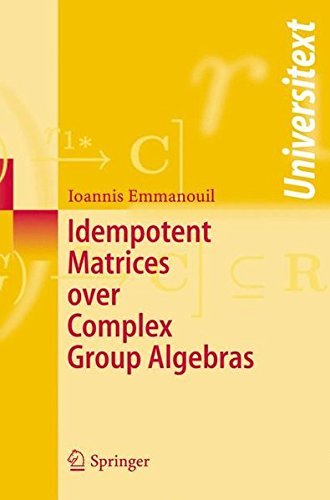
3Idempotent Matrices Over Complex Group Algebras (Universitext)
The study of idempotent elements in group algebras (or, more generally, the study of classes in the K-theory of such algebras) originates from geometric and analytic considerations. For example, C.T.C. Wall [72] has shown that the problem of deciding whether a ?nitely dominated space with fundamental group? is homotopy equivalent to a ?nite CW-complex leads naturally to the study of a certain class in the reduced K-theoryK (Z?) of the group ringZ?. 0 As another example, consider a discrete groupG which acts freely, properly discontinuously, cocompactly and isometrically on a Riemannian manifold. Then, following A. Connes and H. Moscovici [16], the index of an invariant 0th-order elliptic pseudo-di?erential operator is de?ned as an element in the ? ? K -group of the reduced groupC -algebraCG. 0 r Theidempotentconjecture(alsoknownasthegeneralizedKadisonconjec- ? ? ture) asserts that the reduced groupC -algebraCG of a discrete torsion-free r groupG has no idempotents =0,1; this claim is known to be a consequence of a far-reaching conjecture of P. Baum and A. Connes [6]. Alternatively, one mayapproachtheidempotentconjectureasanassertionabouttheconnect- ness of a non-commutative space;ifG is a discrete torsion-free abelian group ? thenCG is the algebra of continuous complex-valued functions on the dual r
 4
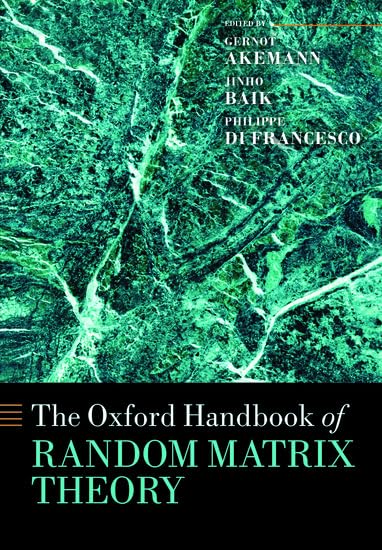
4The Oxford Handbook of Random Matrix Theory
With a foreword by Freeman Dyson, the handbook brings together leading mathematicians and physicists to offer a comprehensive overview of random matrix theory, including a guide to new developments and the diverse range of applications of this approach.
In part one, all modern and classical techniques of solving random matrix models are explored, including orthogonal polynomials, exact replicas or supersymmetry. Further, all main extensions of the classical Gaussian ensembles of Wigner and Dyson are introduced including sparse, heavy tailed, non-Hermitian or multi-matrix models. In the second and larger part, all major applications are covered, in disciplines ranging from physics and mathematics to biology and engineering. This includes standard fields such as number theory, quantum chaos or quantum chromodynamics, as well as recent developments such as partitions, growth models, knot theory, wireless communication or bio-polymer folding.
The handbook is suitable both for introducing novices to this area of research and as a main source of reference for active researchers in mathematics, physics and engineering.
In part one, all modern and classical techniques of solving random matrix models are explored, including orthogonal polynomials, exact replicas or supersymmetry. Further, all main extensions of the classical Gaussian ensembles of Wigner and Dyson are introduced including sparse, heavy tailed, non-Hermitian or multi-matrix models. In the second and larger part, all major applications are covered, in disciplines ranging from physics and mathematics to biology and engineering. This includes standard fields such as number theory, quantum chaos or quantum chromodynamics, as well as recent developments such as partitions, growth models, knot theory, wireless communication or bio-polymer folding.
The handbook is suitable both for introducing novices to this area of research and as a main source of reference for active researchers in mathematics, physics and engineering.
 5
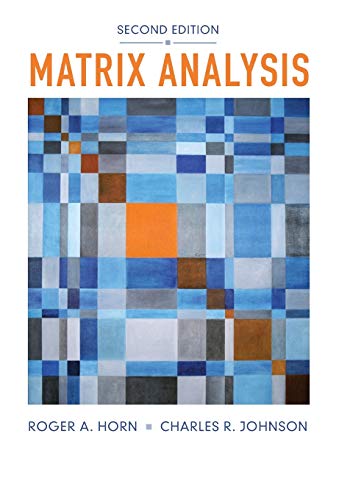
5Matrix Analysis
Linear algebra and matrix theory are fundamental tools in mathematical and physical science, as well as fertile fields for research. This new edition of the acclaimed text presents results of both classic and recent matrix analysis using canonical forms as a unifying theme, and demonstrates their importance in a variety of applications. The authors have thoroughly revised, updated, and expanded on the first edition. The book opens with an extended summary of useful concepts and facts and includes numerous new topics and features, such as: - New sections on the singular value and CS decompositions - New applications of the Jordan canonical form - A new section on the Weyr canonical form - Expanded treatments of inverse problems and of block matrices - A central role for the Von Neumann trace theorem - A new appendix with a modern list of canonical forms for a pair of Hermitian matrices and for a symmetric-skew symmetric pair - Expanded index with more than 3,500 entries for easy reference - More than 1,100 problems and exercises, many with hints, to reinforce understanding and develop auxiliary themes such as finite-dimensional quantum systems, the compound and adjugate matrices, and the Loewner ellipsoid - A new appendix provides a collection of problem-solving hints.
 6
6Matrix Analysis and Applied Linear Algebra Book and Solutions Manual
 7
7Matrix of Power: How the World Has Been Controlled by Powerful People Without Your Knowledge
 8
8An Introduction to Matrices
 9
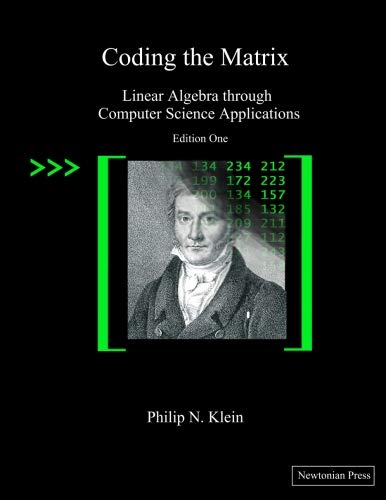
9Coding the Matrix: Linear Algebra Through Computer Science Applications
An engaging introduction to vectors and matrices and the algorithms that operate on them, intended for the student who knows how to program. Mathematical concepts and computational problems are motivated by applications in computer science. The reader learns by "doing," writing programs to implement the mathematical concepts and using them to carry out tasks and explore the applications. Examples include: error-correcting codes, transformations in graphics, face detection, encryption and secret-sharing, integer factoring, removing perspective from an image, PageRank (Google's ranking algorithm), and cancer detection from cell features. A companion web site, codingthematrix.com provides data and support code. Most of the assignments can be auto-graded online. Over two hundred illustrations, including a selection of relevant "xkcd" comics.
Chapters: "The Function," "The Field," "The Vector," "The Vector Space," "The Matrix," "The Basis," "Dimension," "Gaussian Elimination," "The Inner Product," "Special Bases," "The Singular Value Decomposition," "The Eigenvector," "The Linear Program"
Chapters: "The Function," "The Field," "The Vector," "The Vector Space," "The Matrix," "The Basis," "Dimension," "Gaussian Elimination," "The Inner Product," "Special Bases," "The Singular Value Decomposition," "The Eigenvector," "The Linear Program"
 10
10Introductory Mathematical Analysis for Business, Economics, and the Life and Social Sciences
Haeussler, Paul, and Wood establish a strong algebraic foundation that sets this text apart from other applied mathematics texts, paving the way for readers to solve real-world problems that use calculus. Emphasis on developing algebraic skills is extended to the exercises--including both drill problems and applications. The authors work through examples and explanations with a blend of rigor and accessibility. In addition, they have refined the flow, transitions, organization, and portioning of the content over many editions to optimize learning for readers. The table of contents covers a wide range of topics efficiently, enabling readers to gain a diverse understanding.
 11
11The Matrix of the Mind: Object Relations and the Psychoanalytic Dialogue
This book is exciting, original, and above all accessible-a rare combination for a text which deals in depth with psychoanalytical theory. Non-analysts are frequently both baffled and alienated by the jargon and the complexity of works which extend psychoanalytical thinking, but Ogden is revealed in this book as an outstanding communicator as well as a major theoretician. The book's subtitle is a guide to the main focus of the work, which reinterprets the work of Melanie Klein, with its focus on phantasy, in relation to the biological determinants of perception and the meaning and organization of experience in the interpersonal setting of human growth and development. Ogden re-interprets Klein to illuminate Freudian instinct theory, using the contributions of Bion, Fairbairn, and particularly Winnicott-British object relations theorists-to clarify and extend aspects of their work and to move towards an impressive exposition of the way in which the human mind develops." -Pamela M. Ashurst, The British Journal of Psychiatry A Jason Aronson Book
 12
12Data Analytics for Absolute Beginners: A Deconstructed Guide to Data Literacy: (Introduction to Data, Data Visualization, Business Intelligence & Machine Learning)
While exposure to data has become more or less a daily ritual for the rank-and-file knowledge worker, true understanding-treated in this book as data literacy-resides in knowing what lies behind the data. Everything from the data's source to the specific choice of input variables, algorithmic transformations, and visual representation shape the accuracy, relevance, and value of the data and mark its journey from raw data to business insight. It's also important to grasp the terminology and basic concepts of data analytics as much as it is to have the financial literacy to be successful as a decisionmaker in the business world. In this book, we make sense of data analytics without the assumption that you understand specific data science terminology or advanced programming languages to set you on your path. Topics covered in this book: Data MiningBig DataMachine Learning Alternative Data Data ManagementWeb ScrapingRegression AnalysisClustering AnalysisAssociation AnalysisData VisualizationBusiness Intelligence
 13
13Matrix Computations
This revised edition provides the mathematical background and algorithmic skills required for the production of numerical software. It includes rewritten and clarified proofs and derivations, as well as new topics such as Arnoldi iteration, and domain decomposition methods.
 14
14Matrix Methods in Data Mining and Pattern Recognition
Several very powerful numerical linear algebra techniques are available for solving problems in data mining and pattern recognition. This application-oriented book describes how modern matrix methods can be used to solve these problems, gives an introduction to matrix theory and decompositions, and provides students with a set of tools that can be modified for a particular application. Part I gives a short introduction to a few application areas before presenting linear algebra concepts and matrix decompositions that students can use in problem-solving environments such as MATLAB. In Part II, linear algebra techniques are applied to data mining problems. Part III is a brief introduction to eigenvalue and singular value algorithms. The applications discussed include classification of handwritten digits, text mining, text summarization, pagerank computations related to the Google search engine, and face recognition. Exercises and computer assignments are available on a Web page that supplements the book.
 15
15The Inner Matrix: A Guide to Transforming Your Life and Awakening Your Spirit
The Inner Matrix illuminates a proven approach to living a truly rich and meaningful life - one more deeply connected to spirit. Marrying the ancient wisdom traditions of East and West with the latest science in genetics, psychology, and brain function, Klein provides a cutting-edge system to transform your life by shifting deep mental, emotional, and physical patterns that create stress and limit your success. Those engaging Klein's Conscious Transformation practices routinely experience: reduced stress increased focus higher emotional intelligence improved health and well-being enhanced connection to spirit Included is a nine-week strategy guide to assimilate the practices of Conscious Transformation into your daily life. "Joey Klein has artfully bridged ancient traditions with burgeoning Western scientific and biomedical research. He shares powerful testimony and vivid examples of the benefits achieved through this intentional training." -Michael L. Weaver, MD, Emergency Medicine Physician "Applying the book's principles to my mind, emotions, and physical body, I have uncovered the profound spiritual connection I had secretly yearned for but been unable to reach. My entire experience of life has radically changed." -Diane Breneman, JD, Nationally Recognized Trial Attorney
 16
16Transform Your Beliefs, Transform Your Life
As the audience for EFT and tapping grows, this book offers a wonderfully elegant way to harness tapping for deep work with beliefs.
 17
17The Math of Neural Networks
There are many reasons why neural networks fascinate us and have captivated headlines in recent years. They make web searches better, organize photos, and are even used in speech translation. Heck, they can even generate encryption. At the same time, they are also mysterious and mind-bending: how exactly do they accomplish these things ? What goes on inside a neural network? On a high level, a network learns just like we do, through trial and error. This is true regardless if the network is supervised, unsupervised, or semi-supervised. Once we dig a bit deeper though, we discover that a handful of mathematical functions play a major role in the trial and error process. It also becomes clear that a grasp of the underlying mathematics helps clarify how a network learns. In the following chapters we will unpack the mathematics that drive a neural network. To do this, we will use a feedforward network as our model and follow input as it moves through the network.
 18
18The Matrix Energetics Experience Kit
 19
19Matrix Algebra: Theory, Computations and Applications in Statistics
Matrix algebra is one of the most important areas of mathematics for data analysis and for statistical theory. The first part of this book presents the relevant aspects of the theory of matrix algebra for applications in statistics. This part begins with the fundamental concepts of vectors and vector spaces, next covers the basic algebraic properties of matrices, then describes the analytic properties of vectors and matrices in the multivariate calculus, and finally discusses operations on matrices in solutions of linear systems and in eigenanalysis. This part is essentially self-contained.
The second part of the book begins with a consideration of various types of matrices encountered in statistics, such as projection matrices and positive definite matrices, and describes the special properties of those matrices. The second part also describes some of the many applications of matrix theory in statistics, including linear models, multivariate analysis, and stochastic processes. The brief coverage in this part illustrates the matrix theory developed in the first part of the book. The first two parts of the book can be used as the text for a course in matrix algebra for statistics students, or as a supplementary text for various courses in linear models or multivariate statistics.
The third part of this book covers numerical linear algebra. It begins with a discussion of the basics of numerical computations, and then describes accurate and efficient algorithms for factoring matrices, solving linear systems of equations, and extracting eigenvalues and eigenvectors. Although the book is not tied to any particular software system, it describes and gives examples of the use of modern computer software for numerical linear algebra. This part is essentially self-contained, although it assumes some ability to program in Fortran or C and/or the ability to use R/S-Plus or Matlab. This part of the book can be used as the text for a course in statistical computing, or as a supplementary text for various courses that emphasize computations.
The book includes a large number of exercises with some solutions provided in an appendix.
The second part of the book begins with a consideration of various types of matrices encountered in statistics, such as projection matrices and positive definite matrices, and describes the special properties of those matrices. The second part also describes some of the many applications of matrix theory in statistics, including linear models, multivariate analysis, and stochastic processes. The brief coverage in this part illustrates the matrix theory developed in the first part of the book. The first two parts of the book can be used as the text for a course in matrix algebra for statistics students, or as a supplementary text for various courses in linear models or multivariate statistics.
The third part of this book covers numerical linear algebra. It begins with a discussion of the basics of numerical computations, and then describes accurate and efficient algorithms for factoring matrices, solving linear systems of equations, and extracting eigenvalues and eigenvectors. Although the book is not tied to any particular software system, it describes and gives examples of the use of modern computer software for numerical linear algebra. This part is essentially self-contained, although it assumes some ability to program in Fortran or C and/or the ability to use R/S-Plus or Matlab. This part of the book can be used as the text for a course in statistical computing, or as a supplementary text for various courses that emphasize computations.
The book includes a large number of exercises with some solutions provided in an appendix.
 20
20Matrix Groups for Undergraduates (Student Mathematical Library)
Matrix groups are a beautiful subject and are central to many fields in mathematics and physics. They touch upon an enormous spectrum within the mathematical arena. This textbook brings them into the undergraduate curriculum. It is excellent for a one-semester course for students familiar with linear and abstract algebra and prepares them for a graduate course on Lie groups. Matrix Groups for Undergraduates is concrete and example-driven, with geometric motivation and rigorous proofs. The story begins and ends with the rotations of a globe. In between, the author combines rigor and intuition to describe basic objects of Lie theory: Lie algebras, matrix exponentiation, Lie brackets, and maximal tori. The volume is suitable for graduate students and researchers interested in group theory.
 21
21Python: For Beginners: A Crash Course Guide To Learn Python in 1 Week (coding, programming, web-programming, programmer)
Become a Python Programming Expert With Ease! Python is a simple yet powerful programming language that can enable you to start thinking like a programmer right from the beginning. It is very readable and the stress many beginners face about memorizing arcane syntax typically presented by other programming languages will not affect you at all. Conversely, you will be able to concentrate on learning concepts and paradigms of programming. This book shall introduce you to an easy way to learn Python in just 7 days and in this time, be able to complete your own projects! By reading the book and implementing what you learn herein, you will realize just why major institutions like NASA, Google, Mozilla, Yahoo, Dropbox, IBM, Facebook and many others prefer to use python in their core products, services and business processes. Let
 22
22Hacking Reality: Upgrade Your Life From the Inside Out
 23
23Matrix Analysis
This book presents a substantial part of matrix analysis that is functional analytic in spirit. Topics covered include the theory of majorization, variational principles for eigenvalues, operator monotone and convex functions, and perturbation of matrix functions and matrix inequalities. The book offers several powerful methods and techniques of wide applicability, and it discusses connections with other areas of mathematics.
 24
24Matrix Management Reinvented: Book 1 - The New Game in Town
 25
25Quaternions and Rotation Sequences: A Primer with Applications to Orbits, Aerospace, and Virtual Reality
Ever since the Irish mathematician William Rowan Hamilton introduced quaternions in the nineteenth century--a feat he celebrated by carving the founding equations into a stone bridge--mathematicians and engineers have been fascinated by these mathematical objects. Today, they are used in applications as various as describing the geometry of spacetime, guiding the Space Shuttle, and developing computer applications in virtual reality. In this book, J. B. Kuipers introduces quaternions for scientists and engineers who have not encountered them before and shows how they can be used in a variety of practical situations.
The book is primarily an exposition of the quaternion, a 4-tuple, and its primary application in a rotation operator. But Kuipers also presents the more conventional and familiar 3 x 3 (9-element) matrix rotation operator. These parallel presentations allow the reader to judge which approaches are preferable for specific applications. The volume is divided into three main parts. The opening chapters present introductory material and establish the book's terminology and notation. The next part presents the mathematical properties of quaternions, including quaternion algebra and geometry. It includes more advanced special topics in spherical trigonometry, along with an introduction to quaternion calculus and perturbation theory, required in many situations involving dynamics and kinematics. In the final section, Kuipers discusses state-of-the-art applications. He presents a six degree-of-freedom electromagnetic position and orientation transducer and concludes by discussing the computer graphics necessary for the development of applications in virtual reality.
The book is primarily an exposition of the quaternion, a 4-tuple, and its primary application in a rotation operator. But Kuipers also presents the more conventional and familiar 3 x 3 (9-element) matrix rotation operator. These parallel presentations allow the reader to judge which approaches are preferable for specific applications. The volume is divided into three main parts. The opening chapters present introductory material and establish the book's terminology and notation. The next part presents the mathematical properties of quaternions, including quaternion algebra and geometry. It includes more advanced special topics in spherical trigonometry, along with an introduction to quaternion calculus and perturbation theory, required in many situations involving dynamics and kinematics. In the final section, Kuipers discusses state-of-the-art applications. He presents a six degree-of-freedom electromagnetic position and orientation transducer and concludes by discussing the computer graphics necessary for the development of applications in virtual reality.
 26
26Applied Linear Algebra and Matrix Analysis
This new book offers a fresh approach to matrix and linear algebra by providing a balanced blend of applications, theory, and computation, while highlighting their interdependence. Intended for a one-semester course, Applied Linear Algebra and Matrix Analysis places special emphasis on linear algebra as an experimental science, with numerous examples, computer exercises, and projects. While the flavor is heavily computational and experimental, the text is independent of specific hardware or software platforms. Throughout the book, significant motivating examples are woven into the text, and each section ends with a set of exercises.
 27
27Finite-Dimensional Vector Spaces
Master expositor Paul Halmos presents Linear Algebra in the pure axiomatic spirit. He writes "My purpose in this book is to treat linear transformations on finite dimensional vector spaces by the methods of more general theories. The idea is to emphasize the simple geometric notions common to many parts of mathematics and its applications, and to do so in a language that gives away the trade secrets ...." This text is an ideal supplement to modern treatments of Linear Algebra. "The theory is systematically developed by the axiomatic method that has, since von Neumann, dominated the general approach to linear functional analysis and that achieves here a high degree of lucidity and clarity....The book contains about 350 well placed and instructive problems, which cover a considerable part of the subject. All in all this is an excellent work, of equally high value for both student and teacher." --Zentralblatt fur Mathematik.
 28
28Statistical Learning with Sparsity: The Lasso and Generalizations
Discover New Methods for Dealing with High-Dimensional Data
A sparse statistical model has only a small number of nonzero parameters or weights; therefore, it is much easier to estimate and interpret than a dense model. Statistical Learning with Sparsity: The Lasso and Generalizations presents methods that exploit sparsity to help recover the underlying signal in a set of data.
Top experts in this rapidly evolving field, the authors describe the lasso for linear regression and a simple coordinate descent algorithm for its computation. They discuss the application of l1 penalties to generalized linear models and support vector machines, cover generalized penalties such as the elastic net and group lasso, and review numerical methods for optimization. They also present statistical inference methods for fitted (lasso) models, including the bootstrap, Bayesian methods, and recently developed approaches. In addition, the book examines matrix decomposition, sparse multivariate analysis, graphical models, and compressed sensing. It concludes with a survey of theoretical results for the lasso.
In this age of big data, the number of features measured on a person or object can be large and might be larger than the number of observations. This book shows how the sparsity assumption allows us to tackle these problems and extract useful and reproducible patterns from big datasets. Data analysts, computer scientists, and theorists will appreciate this thorough and up-to-date treatment of sparse statistical modeling.
A sparse statistical model has only a small number of nonzero parameters or weights; therefore, it is much easier to estimate and interpret than a dense model. Statistical Learning with Sparsity: The Lasso and Generalizations presents methods that exploit sparsity to help recover the underlying signal in a set of data.
Top experts in this rapidly evolving field, the authors describe the lasso for linear regression and a simple coordinate descent algorithm for its computation. They discuss the application of l1 penalties to generalized linear models and support vector machines, cover generalized penalties such as the elastic net and group lasso, and review numerical methods for optimization. They also present statistical inference methods for fitted (lasso) models, including the bootstrap, Bayesian methods, and recently developed approaches. In addition, the book examines matrix decomposition, sparse multivariate analysis, graphical models, and compressed sensing. It concludes with a survey of theoretical results for the lasso.
In this age of big data, the number of features measured on a person or object can be large and might be larger than the number of observations. This book shows how the sparsity assumption allows us to tackle these problems and extract useful and reproducible patterns from big datasets. Data analysts, computer scientists, and theorists will appreciate this thorough and up-to-date treatment of sparse statistical modeling.
 29
29The Third Eye
"THE THIRD EYE". Sophia Stewart's epic story that was (purportedly) stolen and used to create two of Hollywood's biggest franchises, THE MATRIX and THE TERMINATOR.
Also contains additional information such as Court documents, letters of access, registered return receipts, FBI investigations and Sophia Stewart's future projects.
Also contains additional information such as Court documents, letters of access, registered return receipts, FBI investigations and Sophia Stewart's future projects.
 30
30Spectra and Pseudospectra: The Behavior of Nonnormal Matrices and Operators
Pure and applied mathematicians, physicists, scientists, and engineers use matrices and operators and their eigenvalues in quantum mechanics, fluid mechanics, structural analysis, acoustics, ecology, numerical analysis, and many other areas. However, in some applications the usual analysis based on eigenvalues fails. For example, eigenvalues are often ineffective for analyzing dynamical systems such as fluid flow, Markov chains, ecological models, and matrix iterations. That's where this book comes in.
This is the authoritative work on nonnormal matrices and operators, written by the authorities who made them famous. Each of the sixty sections is written as a self-contained essay. Each document is a lavishly illustrated introductory survey of its topic, complete with beautiful numerical experiments and all the right references. The breadth of included topics and the numerous applications that provide links between fields will make this an essential reference in mathematics and related sciences.
This is the authoritative work on nonnormal matrices and operators, written by the authorities who made them famous. Each of the sixty sections is written as a self-contained essay. Each document is a lavishly illustrated introductory survey of its topic, complete with beautiful numerical experiments and all the right references. The breadth of included topics and the numerous applications that provide links between fields will make this an essential reference in mathematics and related sciences.
 31
31Shaum's Outlines of Matrix Operations
The ideal review for your matrix operations course
More than 40 million students have trusted Schaum's Outlines for their expert knowledge and helpful solved problems. Written by renowned experts in their respective fields, Schaum's Outlines cover everything from math to science, nursing to language. The main feature for all these books is the solved problems. Step-by-step, authors walk readers through coming up with solutions to exercises in their topic of choice.
363 detailed problems with step-by-step solutions
Clear, concise explanations of matrix operations
Help with Eigenvalues and the QR Algorithm
A solved-problem approach that teaches you with hands-on help
Exercises for improving your problem-solving skills
More than 40 million students have trusted Schaum's Outlines for their expert knowledge and helpful solved problems. Written by renowned experts in their respective fields, Schaum's Outlines cover everything from math to science, nursing to language. The main feature for all these books is the solved problems. Step-by-step, authors walk readers through coming up with solutions to exercises in their topic of choice.
363 detailed problems with step-by-step solutions
Clear, concise explanations of matrix operations
Help with Eigenvalues and the QR Algorithm
A solved-problem approach that teaches you with hands-on help
Exercises for improving your problem-solving skills
 32
32The Sustainability Mindset: Using the Matrix Map to Make Strategic Decisions
The Matrix Map--a powerful tool for nonprofit strategic decision-making Nonprofit sustainability lies at the intersection of exceptional impact and financial viability. "The Sustainability Mindset" offers nonprofit professionals and board members a step-by-step guide to move your organization towards this intersection. As outlined in the bestselling book "Nonprofit Sustainability, ""The Matrix Map" is an accessible framework that combines financial and programmatic goals into an integrated strategy. In this next-step resource, the authors detail a rigorous process to develop a meaningful Matrix Map and engage leadership in setting an organization's strategy.
Nonprofits that thrive in today's environment are adaptable with a clear understanding of their impact and business model. This book offers nonprofit boards and staff a framework to do so. Drawing on their in-depth experience, the authors provide an easy-to-follow process complete with tools and templates to help organizations visualize their business model and engage in strategic inquiry. The book provides a variety of illustrative examples to show how the Matrix Map works for all types of organizations. Nonprofit executives and board member are sure to benefit from The Matrix Map analysis. Offers step-by-step guidance for creating a Matrix-Map, a visual representation of an organization's business model Helps organizations assess how each of their programs contributes toward their desired impact and their financial bottom-line. Filled with compelling examples of how The Matrix Map helps nonprofits with strategic decision-making Written by the coauthors of the groundbreaking book "Nonprofit Sustainability"
This comprehensive resource will give any nonprofit the framework they need to make decisions for sustainability and the templates and tools to implement it and help leaders address the challenges inherent in balancing mission impact with financial viability.
Nonprofits that thrive in today's environment are adaptable with a clear understanding of their impact and business model. This book offers nonprofit boards and staff a framework to do so. Drawing on their in-depth experience, the authors provide an easy-to-follow process complete with tools and templates to help organizations visualize their business model and engage in strategic inquiry. The book provides a variety of illustrative examples to show how the Matrix Map works for all types of organizations. Nonprofit executives and board member are sure to benefit from The Matrix Map analysis. Offers step-by-step guidance for creating a Matrix-Map, a visual representation of an organization's business model Helps organizations assess how each of their programs contributes toward their desired impact and their financial bottom-line. Filled with compelling examples of how The Matrix Map helps nonprofits with strategic decision-making Written by the coauthors of the groundbreaking book "Nonprofit Sustainability"
This comprehensive resource will give any nonprofit the framework they need to make decisions for sustainability and the templates and tools to implement it and help leaders address the challenges inherent in balancing mission impact with financial viability.
 33
33GED Preparation 2018 All Subjects: Exam Preparation Book & Practice Test Questions for the GED Test
Test Prep Book's GED Preparation 2018 All Subjects: Exam Preparation Book & Practice Test Questions for the GED Test
Developed by Test Prep Books for test takers trying to achieve a passing score on the GED exam, this comprehensive study guide includes:
-Quick Overview
-Test-Taking Strategies
-Introduction
-Reasoning through Language Arts
-Writing
-Mathematical Reasoning
-Science
-Social Studies
-Practice Questions
-Detailed Answer Explanations
Disclaimer: GED(R) and ACE(R) are registered trademarks of American Council on Education, which was not involved in the production of, and does not endorse, this product.
Each section of the test has a comprehensive review created by Test Prep Books that goes into detail to cover all of the content likely to appear on the GED test.
The Test Prep Books GED practice test questions are each followed by detailed answer explanations. If you miss a question, it's important that you are able to understand the nature of your mistake and how to avoid making it again in the future. The answer explanations will help you to learn from your mistakes and overcome them.
Understanding the latest test-taking strategies is essential to preparing you for what you will expect on the exam. A test taker has to not only understand the material that is being covered on the test, but also must be familiar with the strategies that are necessary to properly utilize the time provided and get through the test without making any avoidable errors. Test Prep Books has drilled down the top test-taking tips for you to know.
Anyone planning to take this exam should take advantage of the GED study guide review material, practice test questions, and test-taking strategies contained in this Test Prep Books study guide.
Developed by Test Prep Books for test takers trying to achieve a passing score on the GED exam, this comprehensive study guide includes:
-Quick Overview
-Test-Taking Strategies
-Introduction
-Reasoning through Language Arts
-Writing
-Mathematical Reasoning
-Science
-Social Studies
-Practice Questions
-Detailed Answer Explanations
Disclaimer: GED(R) and ACE(R) are registered trademarks of American Council on Education, which was not involved in the production of, and does not endorse, this product.
Each section of the test has a comprehensive review created by Test Prep Books that goes into detail to cover all of the content likely to appear on the GED test.
The Test Prep Books GED practice test questions are each followed by detailed answer explanations. If you miss a question, it's important that you are able to understand the nature of your mistake and how to avoid making it again in the future. The answer explanations will help you to learn from your mistakes and overcome them.
Understanding the latest test-taking strategies is essential to preparing you for what you will expect on the exam. A test taker has to not only understand the material that is being covered on the test, but also must be familiar with the strategies that are necessary to properly utilize the time provided and get through the test without making any avoidable errors. Test Prep Books has drilled down the top test-taking tips for you to know.
Anyone planning to take this exam should take advantage of the GED study guide review material, practice test questions, and test-taking strategies contained in this Test Prep Books study guide.
 34
34Introduction to Error Analysis: The Science of Measurements, Uncertainties, and Data Analysis
 35
35Enter the Matrix: Official Strategy Guide
Are you Red or Blue on this?
Are you prepared for what the Matrix has in store for you?
We are!
Another addition to BradyGames' established Signature Series, but with a fresh twist.
The guide incorporates a new level of interactivity between itself, the game, and you! It links with the game in a truly unique way-can you reveal the connection?
Two complete Walkthroughs
Detailed strategies point you in the right direction while expert tactics illustrate how to defeat each challenge!
Become an uber-hacker
Learn the basics behind the in-game hacking system and master it!
Exclusive two-sided Enter the Matrix Poster!
Matrix Code Rain and Matrix Universe Timeline
Interviews and concept art!
Incredible extra content for the true Matrix fan including interviews by Shiny Entertainment President David Perry, the Shiny Dev. Team, and Anthony Wong, the actor who plays Ghost!
Uncover the glitches in the Matrix!
Hack in and get concelead Weapon Drops!
Discover how to unlock ECHUMXBIAOEF and Multiplayer!
Find the Four Hidden Mini-Games
Can you find and decipher over 50 codes within this guide?
Are you prepared for what the Matrix has in store for you?
We are!
Another addition to BradyGames' established Signature Series, but with a fresh twist.
The guide incorporates a new level of interactivity between itself, the game, and you! It links with the game in a truly unique way-can you reveal the connection?
Two complete Walkthroughs
Detailed strategies point you in the right direction while expert tactics illustrate how to defeat each challenge!
Become an uber-hacker
Learn the basics behind the in-game hacking system and master it!
Exclusive two-sided Enter the Matrix Poster!
Matrix Code Rain and Matrix Universe Timeline
Interviews and concept art!
Incredible extra content for the true Matrix fan including interviews by Shiny Entertainment President David Perry, the Shiny Dev. Team, and Anthony Wong, the actor who plays Ghost!
Uncover the glitches in the Matrix!
Hack in and get concelead Weapon Drops!
Discover how to unlock ECHUMXBIAOEF and Multiplayer!
Find the Four Hidden Mini-Games
Can you find and decipher over 50 codes within this guide?
 36
36A Student's Guide to Numerical Methods
This concise, plain-language guide for senior undergraduates and graduate students aims to develop intuition, practical skills and an understanding of the framework of numerical methods for the physical sciences and engineering. It provides accessible self-contained explanations of mathematical principles, avoiding intimidating formal proofs. Worked examples and targeted exercises enable the student to master the realities of using numerical techniques for common needs such as solution of ordinary and partial differential equations, fitting experimental data, and simulation using particle and Monte Carlo methods. Topics are carefully selected and structured to build understanding, and illustrate key principles such as: accuracy, stability, order of convergence, iterative refinement, and computational effort estimation. Enrichment sections and in-depth footnotes form a springboard to more advanced material and provide additional background. Whether used for self-study, or as the basis of an accelerated introductory class, this compact textbook provides a thorough grounding in computational physics and engineering.
 37
37Philosophers Explore the Matrix
The Matrix trilogy is unique among recent popular films in that it is constructed around important philosophical questions--classic questions which have fascinated philosophers and other thinkers for thousands of years. Editor Christopher Grau here presents a collection of new, intriguing essays about some of the powerful and ancient questions broached by The Matrix and its sequels, written by some of the most prominent and reputable philosophers working today. They provide intelligent, accessible, and thought-provoking examinations of the philosophical issues that support the films.
Philosophers Explore The Matrix includes an introduction that surveys the use of philosophical ideas in the film. Topics that the contributors tackle include: how a collaborative dream could differ from hallucination, the difference between the Matrix and the "real" world; why living in the Matrix would be considered "bad"; the similarities between the Matrix and Plato's Cave; the moral status of artificially created beings, whether one can behave immorally in illusory circumstances, and the true nature of free will and responsibility. This volume also includes an appendix of classic philosophical writing on these issues by Plato, Berkeley, Descartes, Putnam, and Nozick.
Philosophers Explore The Matrix will fascinate any fan of the films who wants to delve deeper into their themes, as well as any student of philosophy who desires an accessible entry into this challenging and profoundly vital world of ideas.
Philosophers Explore The Matrix includes an introduction that surveys the use of philosophical ideas in the film. Topics that the contributors tackle include: how a collaborative dream could differ from hallucination, the difference between the Matrix and the "real" world; why living in the Matrix would be considered "bad"; the similarities between the Matrix and Plato's Cave; the moral status of artificially created beings, whether one can behave immorally in illusory circumstances, and the true nature of free will and responsibility. This volume also includes an appendix of classic philosophical writing on these issues by Plato, Berkeley, Descartes, Putnam, and Nozick.
Philosophers Explore The Matrix will fascinate any fan of the films who wants to delve deeper into their themes, as well as any student of philosophy who desires an accessible entry into this challenging and profoundly vital world of ideas.
 38
38Matrix Methods: Applied Linear Algebra
Matrix Methods: Applied Linear Algebra, Third Edition, as a textbook, provides a unique and comprehensive balance between the theory and computation of matrices. The application of matrices is not just for mathematicians. The use by other disciplines has grown dramatically over the years in response to the rapid changes in technology. Matrix methods is the essence of linear algebra and is what is used to help physical scientists; chemists, physicists, engineers, statisticians, and economists solve real world problems.
 39
39Optimization Algorithms on Matrix Manifolds
Many problems in the sciences and engineering can be rephrased as optimization problems on matrix search spaces endowed with a so-called manifold structure. This book shows how to exploit the special structure of such problems to develop efficient numerical algorithms. It places careful emphasis on both the numerical formulation of the algorithm and its differential geometric abstraction--illustrating how good algorithms draw equally from the insights of differential geometry, optimization, and numerical analysis. Two more theoretical chapters provide readers with the background in differential geometry necessary to algorithmic development. In the other chapters, several well-known optimization methods such as steepest descent and conjugate gradients are generalized to abstract manifolds. The book provides a generic development of each of these methods, building upon the material of the geometric chapters. It then guides readers through the calculations that turn these geometrically formulated methods into concrete numerical algorithms. The state-of-the-art algorithms given as examples are competitive with the best existing algorithms for a selection of eigenspace problems in numerical linear algebra.
Optimization Algorithms on Matrix Manifolds offers techniques with broad applications in linear algebra, signal processing, data mining, computer vision, and statistical analysis. It can serve as a graduate-level textbook and will be of interest to applied mathematicians, engineers, and computer scientists.
Optimization Algorithms on Matrix Manifolds offers techniques with broad applications in linear algebra, signal processing, data mining, computer vision, and statistical analysis. It can serve as a graduate-level textbook and will be of interest to applied mathematicians, engineers, and computer scientists.
 40
40Kronecker Products and Matrix Calculus with Applications
Enhanced by many worked examples — as well as problems and solutions — this in-depth text discusses the Kronecker matrix product. Named after a 19th-century German mathematician, Leopold Kronecker, the Kronecker product is an increasingly important and useful matrix operation and an area of matrix calculus with numerous applications. A great deal of information previously only available in specialized and hard-to-find texts and papers is presented here at an undergraduate level.
After the preliminaries of an introductory chapter, the treatment proceeds to examinations of the Kronecker product and its applications. An introduction to matrix calculus is followed by further development of the subject, including an application of Kronecker products. Final chapters explore the derivative of a matrix and some applications of matrix calculus. The text concludes with solutions to the problems that appear at the end of each chapter and helpful tables of formulae and derivatives.
After the preliminaries of an introductory chapter, the treatment proceeds to examinations of the Kronecker product and its applications. An introduction to matrix calculus is followed by further development of the subject, including an application of Kronecker products. Final chapters explore the derivative of a matrix and some applications of matrix calculus. The text concludes with solutions to the problems that appear at the end of each chapter and helpful tables of formulae and derivatives.
 41
41Iterative Methods for Sparse Linear Systems
This book can be used to teach graduate-level courses on iterative methods for linear systems. Engineers and mathematicians will find its contents easily accessible, and practitioners and educators will value it as a helpful resource. The preface includes syllabi that can be used for either a semester- or quarter-length course in both mathematics and computer science.
 42
42Common Core Assessments and Online Workbooks: Grade 3 Mathematics: Parcc Edition
This is an updated edition of ISBN 978-1-940484-18-1.
This Lumos tedBook™ Includes:
Two Performance Based Assessments (PBA)
Two End-of-Year (EOY) Assessments
Concepts, Skills, Procedures
Expressing Mathematical Reasoning
Modeling / Applications
Detailed answer explanations for every question
Strategies for building speed and accuracy
PLUS One Year access to Online Workbooks
Hundreds of practice questions with detailed answers
Anywhere Access! Learn using a smart phone, tablet or personal computer
Self-paced and student-directed
PLUS FREE Lumos StepUp™ Mobile App
Scan QR Code in the book to instantly access online workbooks
Convenient access to the Common Core State Standards
PLUS FREE Lumos SchoolUp™ Mobile App
Create and share School Stickies
School performance reports
Blogs, Standards, Student Reports and More..
Lumos Study Program is used by the leading schools and libraries to improve student achievement on the standardized tests.
How can students succeed on the PARCC test using the Lumos Study Program?
At Lumos Learning, we believe that yearlong learning and adequate practice before the actual test are the keys to student success on the standardized tests. We have designed the Lumos Study Program to help students get plenty of realistic practice before the test and to promote yearlong collaborative learning.
Inside this book, you will find four comprehensive practice tests. Completing these tests will help students master the different areas that are included in the Common Core State Standards and practice test taking skills. The results will help the students and educators get insights into students' strengths and weaknesses in particular content areas.
The Lumos Online Workbooks consist of hundreds of grade appropriate questions based on the CCSS. Students will get instant feedback and can review their answers anytime. Each student's answers and progress can be reviewed by parents and educators to reinforce the learning experience.
What is PARCC?
The Partnership for Assessment of Readiness and College and Careers (PARCC) is one of two state consortiums responsible for developing assessments aligned to the new, more rigorous Common Core State Standards. There are currently 20 states involved in the PARCC consortium and a combination of educational leaders from those states along with test developers are working together to create the new computer based English Language Arts and Math assessments.
What are the planned parts of PARCC assessments?
Although still in design phase, PARCC has released a plan for the yearly assessments. They will consist of:
Optional diagnostic assessment
Mid-year assessment
Performance-based assessment
End of year assessment
Speaking and listening component assessment
How is this Lumos tedBook™ aligned to PARCC Guidelines?
Although the PARCC assessments will be conducted online, the practice tests here have been created to accurately reflect the depth and rigor of PARCC tasks in a pencil and paper format. Students will still be exposed to the Technology Enhanced Constructed-Response (TECR) style questions so they become familiar with the wording and how to think through these types of tasks.
This Lumos tedBook™ Includes:
Two Performance Based Assessments (PBA)
Two End-of-Year (EOY) Assessments
Concepts, Skills, Procedures
Expressing Mathematical Reasoning
Modeling / Applications
Detailed answer explanations for every question
Strategies for building speed and accuracy
PLUS One Year access to Online Workbooks
Hundreds of practice questions with detailed answers
Anywhere Access! Learn using a smart phone, tablet or personal computer
Self-paced and student-directed
PLUS FREE Lumos StepUp™ Mobile App
Scan QR Code in the book to instantly access online workbooks
Convenient access to the Common Core State Standards
PLUS FREE Lumos SchoolUp™ Mobile App
Create and share School Stickies
School performance reports
Blogs, Standards, Student Reports and More..
Lumos Study Program is used by the leading schools and libraries to improve student achievement on the standardized tests.
How can students succeed on the PARCC test using the Lumos Study Program?
At Lumos Learning, we believe that yearlong learning and adequate practice before the actual test are the keys to student success on the standardized tests. We have designed the Lumos Study Program to help students get plenty of realistic practice before the test and to promote yearlong collaborative learning.
Inside this book, you will find four comprehensive practice tests. Completing these tests will help students master the different areas that are included in the Common Core State Standards and practice test taking skills. The results will help the students and educators get insights into students' strengths and weaknesses in particular content areas.
The Lumos Online Workbooks consist of hundreds of grade appropriate questions based on the CCSS. Students will get instant feedback and can review their answers anytime. Each student's answers and progress can be reviewed by parents and educators to reinforce the learning experience.
What is PARCC?
The Partnership for Assessment of Readiness and College and Careers (PARCC) is one of two state consortiums responsible for developing assessments aligned to the new, more rigorous Common Core State Standards. There are currently 20 states involved in the PARCC consortium and a combination of educational leaders from those states along with test developers are working together to create the new computer based English Language Arts and Math assessments.
What are the planned parts of PARCC assessments?
Although still in design phase, PARCC has released a plan for the yearly assessments. They will consist of:
Optional diagnostic assessment
Mid-year assessment
Performance-based assessment
End of year assessment
Speaking and listening component assessment
How is this Lumos tedBook™ aligned to PARCC Guidelines?
Although the PARCC assessments will be conducted online, the practice tests here have been created to accurately reflect the depth and rigor of PARCC tasks in a pencil and paper format. Students will still be exposed to the Technology Enhanced Constructed-Response (TECR) style questions so they become familiar with the wording and how to think through these types of tasks.
 43
43An Introduction to the Theory of Numbers
The fifth edition of this classic reference work has been updated to give a reasonably accurate account of the present state of knowledge.
 44
44The Baby Matrix: Why Freeing Our Minds From Outmoded Thinking About Parenthood & Reproduction Will Create a Better World
Why does our society hold the belief that we are all destined to have children? Why do we believe that parenthood is the ultimate road to fulfillment in life? In The Baby Matrix: Why Freeing Our Minds From Outmoded Thinking About Parenthood & Reproduction Will Create a Better World, author Laura Carroll answers these questions and more through an exploration of and critical look at the pervasiveness of “pronatalism” – the belief that having children should be the central focus of every adult’s life.
Carroll examines the historical origins of pronatalism, the reasons why it has such a deep hold on societies even though most people remain unaware of it, and whether it makes sense –for individuals or for the world as a whole. She shows the ways in which pronatalism is perpetuated, scrutinizes seven major pronatalist assumptions that lead people to accept them without question, and offers alternative assumptions that reflect realities, true reproductive freedom and responsibility in today's society. Whether you are already a parent, want to be a parent, or don’t want children, you will never think about parenthood in the same way.
Investigating what few have had the courage to discuss, The Baby Matrix examines the negative effects of pronatalist beliefs, including how they dictate the “normal path” to adulthood, put unwarranted pressure on people to have biological children, and fail to foster a society in which those who are best suited to become parents are the ones who have children.
Carroll also brings to light the impact that pronatalism has had on the world at large and will continue to have if its ubiquitous influence is not challenged. Citing compelling statistics, she shows how our belief that we can have as many children as we want is a serious threat in a world with finite resources. In the process, she brings into focus how every life brought into the world directly affects our survival.
This manifesto makes the case for why it’s time for all of us to understand why we can no longer afford to leave pronatalist assumptions unquestioned. Without compromise, The Baby Matrix is a reality check for us all. Are we willing to hold on to beliefs that aren’t necessarily true … even to our detriment? This book will make you examine your own intentions and beliefs, will rile you, and might just change your mind.
The Baby Matrix is a must-read for anyone interested in psychology, sociology, anthropology, parenting issues, environmentalism, and social justice. But most of all, it’s for anyone, parent or not, who reveres the truth and wants the best for themselves, their families, and our world.
Carroll examines the historical origins of pronatalism, the reasons why it has such a deep hold on societies even though most people remain unaware of it, and whether it makes sense –for individuals or for the world as a whole. She shows the ways in which pronatalism is perpetuated, scrutinizes seven major pronatalist assumptions that lead people to accept them without question, and offers alternative assumptions that reflect realities, true reproductive freedom and responsibility in today's society. Whether you are already a parent, want to be a parent, or don’t want children, you will never think about parenthood in the same way.
Investigating what few have had the courage to discuss, The Baby Matrix examines the negative effects of pronatalist beliefs, including how they dictate the “normal path” to adulthood, put unwarranted pressure on people to have biological children, and fail to foster a society in which those who are best suited to become parents are the ones who have children.
Carroll also brings to light the impact that pronatalism has had on the world at large and will continue to have if its ubiquitous influence is not challenged. Citing compelling statistics, she shows how our belief that we can have as many children as we want is a serious threat in a world with finite resources. In the process, she brings into focus how every life brought into the world directly affects our survival.
This manifesto makes the case for why it’s time for all of us to understand why we can no longer afford to leave pronatalist assumptions unquestioned. Without compromise, The Baby Matrix is a reality check for us all. Are we willing to hold on to beliefs that aren’t necessarily true … even to our detriment? This book will make you examine your own intentions and beliefs, will rile you, and might just change your mind.
The Baby Matrix is a must-read for anyone interested in psychology, sociology, anthropology, parenting issues, environmentalism, and social justice. But most of all, it’s for anyone, parent or not, who reveres the truth and wants the best for themselves, their families, and our world.
 45
45Matrix Differential Calculus with Applications in Statistics and Econometrics
A brand new, fully updated edition of a popular classic on matrix differential calculus with applications in statistics and econometrics
This exhaustive, self-contained book on matrix theory and matrix differential calculus provides a treatment of matrix calculus based on differentials and shows how easy it is to use this theory once you have mastered the technique. Jan Magnus, who, along with the late Heinz Neudecker, pioneered the theory, develops it further in this new edition and provides many examples along the way to support it.
Matrix calculus has become an essential tool for quantitative methods in a large number of applications, ranging from social and behavioral sciences to econometrics. It is still relevant and used today in a wide range of subjects such as the biosciences and psychology. Matrix Differential Calculus with Applications in Statistics and Econometrics, Third Edition contains all of the essentials of multivariable calculus with an emphasis on the use of differentials. It starts by presenting a concise, yet thorough overview of matrix algebra, then goes on to develop the theory of differentials. The rest of the text combines the theory and application of matrix differential calculus, providing the practitioner and researcher with both a quick review and a detailed reference.
Fulfills the need for an updated and unified treatment of matrix differential calculus Contains many new examples and exercises based on questions asked of the author over the years Covers new developments in field and features new applications Written by a leading expert and pioneer of the theory Part of the Wiley Series in Probability and Statistics Matrix Differential Calculus With Applications in Statistics and Econometrics Third Edition is an ideal text for graduate students and academics studying the subject, as well as for postgraduates and specialists working in biosciences and psychology.
This exhaustive, self-contained book on matrix theory and matrix differential calculus provides a treatment of matrix calculus based on differentials and shows how easy it is to use this theory once you have mastered the technique. Jan Magnus, who, along with the late Heinz Neudecker, pioneered the theory, develops it further in this new edition and provides many examples along the way to support it.
Matrix calculus has become an essential tool for quantitative methods in a large number of applications, ranging from social and behavioral sciences to econometrics. It is still relevant and used today in a wide range of subjects such as the biosciences and psychology. Matrix Differential Calculus with Applications in Statistics and Econometrics, Third Edition contains all of the essentials of multivariable calculus with an emphasis on the use of differentials. It starts by presenting a concise, yet thorough overview of matrix algebra, then goes on to develop the theory of differentials. The rest of the text combines the theory and application of matrix differential calculus, providing the practitioner and researcher with both a quick review and a detailed reference.
Fulfills the need for an updated and unified treatment of matrix differential calculus Contains many new examples and exercises based on questions asked of the author over the years Covers new developments in field and features new applications Written by a leading expert and pioneer of the theory Part of the Wiley Series in Probability and Statistics Matrix Differential Calculus With Applications in Statistics and Econometrics Third Edition is an ideal text for graduate students and academics studying the subject, as well as for postgraduates and specialists working in biosciences and psychology.
 46
46Matrices: Theory and Applications
This book is a clean and concise introduction to the basic theory of matrices. It also contains many interesting applications of matrices to different aspects of mathematics and also other areas of science and engineering. With forty percent new material, this second edition is significantly different from the first edition. The book mixes together algebra, analysis, complexity theory and numerical analysis. As such, this book will provide many scientists, not just mathematicians, with a useful and reliable reference. It is intended for advanced undergraduate and graduate students with either applied or theoretical goals. This book is based on a course given by the author at the Ecole Normale Superieure de Lyon.
 47
47Linear Algebra and Matrix Theory
This revision of a well-known text includes more sophisticated mathematical material. A new section on applications provides an introduction to the modern treatment of calculus of several variables, and the concept of duality receives expanded coverage. Notations have been changed to correspond to more current usage.
 48
48The Rebellious Slave: Breaking the Matrix
 49
49A Survey of Matrix Theory and Matrix Inequalities
Concise, masterly survey of a substantial part of modern matrix theory introduces broad range of ideas involving both matrix theory and matrix inequalities. Also, convexity and matrices, localization of characteristic roots, proofs of classical theorems and results in contemporary research literature, more. Undergraduate-level. 1969 edition. Bibliography.
 50
50Master the Matrix: 7 Essentials for Getting Things Done in Complex Organizations
You're in a matrix, whether you realize it or not. The test: Do you have multiple bosses ? Do you depend on a variety of resources throughout the organization to get your tasks done, and do these resources report into other people or teams? If you answered "yes" to either, you're in a matrix role. Matrix roles are everywhere. The field customer contact person who writes contracts, negotiates delivery and troubleshoots product issues is in a matrix role. So is the product manager simultaneously accountable for numbers in her country, region and business unit despite the fact they are in conflict, or the HR person who reports both to a globalized function and the head of the business they support.
"Master the Matrix" is based on the experiences and ideas of over 100 matrix practitioners, combined into matrix mastery essentials such as Start with Partnerships, Flex Your Influence Muscle, and Communicate without Assumption.
"Master the Matrix" is based on the experiences and ideas of over 100 matrix practitioners, combined into matrix mastery essentials such as Start with Partnerships, Flex Your Influence Muscle, and Communicate without Assumption.
 51
51The Theory of Matrices: With Applications
In this book the authors try to bridge the gap between the treatments of matrix theory and linear algebra. It is aimed at graduate and advanced undergraduate students seeking a foundation in mathematics, computer science, or engineering. It will also be useful as a reference book for those working on matrices and linear algebra for use in their scientific work.
 52
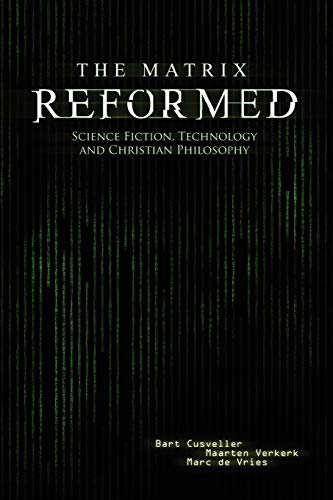
52The Matrix Reformed: Science Fiction, Technology, and Christian Philosophy
The Matrix Reformed provides an analysis of both science fiction and the contemporary adoration of technology from a Christian point-of-view, weaving a discussion of issues in religion, philosophy, and ethics in major sci-fi works (e.g., The Matrix, Star Wars, and Star Trek) with the insights and claims of Kierkegaard, Descartes, and Herman Dooyeweerd.
 53
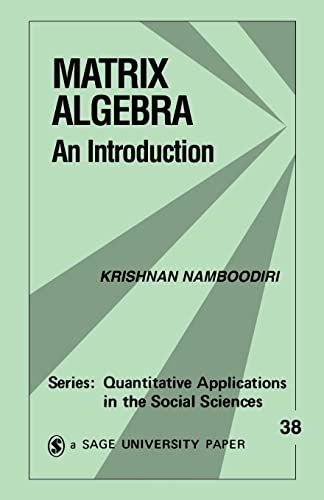
53Matrix Algebra: An Introduction
Matrix Algebra is a vital tool for mathematics in the social sciences, and yet many social scientists have only a rudimentary grasp of it. This volume serves as a complete introduction to matrix algebra, requiring no background knowledge beyond basic school algebra. Namboodiri's presentation is smooth and readable: it begins with the basic definitions and goes on to explain elementary manipulations and the concept of linear dependence, eigenvalues, and eigenvectors -- supplying illustrations through fully-worked examples.
 54
54Advanced Mathematical Methods for Engineering and Science Students
This textbook provides a solid foundation to a number of important topics in mathematics of interest to science and engineering students. Included are tensor algebra, ordinary differential equations, contour integration, Laplace and Fourier transforms, partial differential equations and the calculus of variations. The authors' approach is simple and direct with an emphasis on the analytical understanding of the material. The text is virtually selfcontained, assuming only that the student has a solid understanding of ancillary mathematics. Each chapter contains a large number of worked examples, and concludes with problems for solution, with answers in the back of the book.
 55
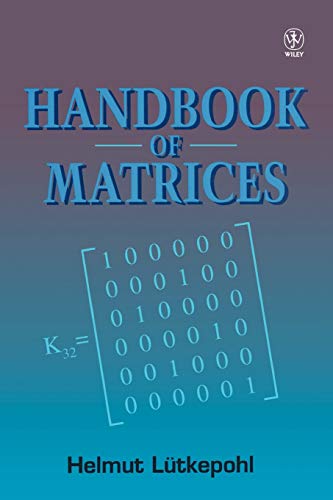
55Hdbk of Matrices
Matrices are used in many areas such as staustics, econometrics, mathematics, natural sciences and engineering. This handbook provides a collection of numerous results for easy reference in one source, together with a comprehensive dictionary of matrices and related terms.
The book is structured and cross-referenced so that specific results and information are easy to locate References for proofs and computational algorithms are provided. Researchers, professionals and students using matrix techniques will find this book to be an invaluable resource for their work.
Contents Definitions, Notation, Terminology Rules for Matrix Operations Matrix Valued Functions of a Matrix Trace, Determinant and Rank of a Matrix Eigenvalues and Singular Values Matrix Decompositions and Canonical Forms Vectorization Operators Vector and Matrix Norms Properties of Special Matrices Vector and Matrix Derivatives Polynomials, Power Series and Matrices Appendix References Index A Dictionary of Matrices and Related Terms
--back cover
The book is structured and cross-referenced so that specific results and information are easy to locate References for proofs and computational algorithms are provided. Researchers, professionals and students using matrix techniques will find this book to be an invaluable resource for their work.
Contents Definitions, Notation, Terminology Rules for Matrix Operations Matrix Valued Functions of a Matrix Trace, Determinant and Rank of a Matrix Eigenvalues and Singular Values Matrix Decompositions and Canonical Forms Vectorization Operators Vector and Matrix Norms Properties of Special Matrices Vector and Matrix Derivatives Polynomials, Power Series and Matrices Appendix References Index A Dictionary of Matrices and Related Terms
--back cover
 56
56Matrix Analysis for Scientists & Engineers
Matrix Analysis for Scientists and Engineers provides a blend of undergraduate- and graduate-level topics in matrix theory and linear algebra that relieves instructors of the burden of reviewing such material in subsequent courses that depend heavily on the language of matrices. Consequently, the text provides an often-needed bridge between undergraduate-level matrix theory and linear algebra and the level of matrix analysis required for graduate-level study and research. The text is sufficiently compact that the material can be taught comfortably in a one-quarter or one-semester course. Throughout the book, the author emphasizes the concept of matrix factorization to provide a foundation for a later course in numerical linear algebra. The author addresses connections to differential and difference equations as well as to linear system theory and encourages instructors to augment these examples with other applications of their own choosing.
 57
57Matrix Algebra From A Statistician's Perspective
This book presents matrix algebra in a way this is well suited for those with an interest in statistics or a related discipline. It provides thorough and unified coverage of the fundamental concepts along with the specialized topics encountered in areas of statistics, such as linear statistical models and multivariate analysis. It includes a number of very useful results that have only been available from relatively obscure sources. Detailed proofs are provided for all results.
 58
58Python: Programming: Your Step By Step Guide To Easily Learn Python in 7 Days (Python for Beginners, Python Programming for Beginners, Learn Python, Python Language)
Are You Ready To Learn Python Easily? Learning Python Programming in 7 days is possible, although it might not look like it
 59
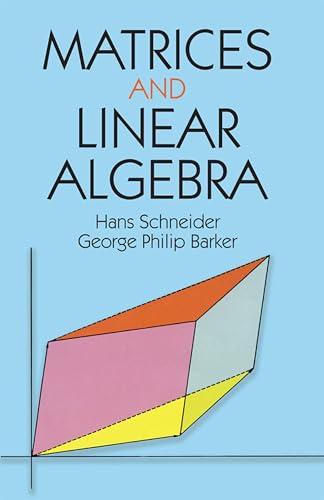
59Matrices and Linear Algebra
Linear algebra is one of the central disciplines in mathematics. A student of pure mathematics must know linear algebra if he is to continue with modern algebra or functional analysis. Much of the mathematics now taught to engineers and physicists requires it.
This well-known and highly regarded text makes the subject accessible to undergraduates with little mathematical experience. Written mainly for students in physics, engineering, economics, and other fields outside mathematics, the book gives the theory of matrices and applications to systems of linear equations, as well as many related topics such as determinants, eigenvalues, and differential equations.
Table of Contents:
l. The Algebra of Matrices
2. Linear Equations
3. Vector Spaces
4. Determinants
5. Linear Transformations
6. Eigenvalues and Eigenvectors
7. Inner Product Spaces
8. Applications to Differential Equations
For the second edition, the authors added several exercises in each chapter and a brand new section in Chapter 7. The exercises, which are both true-false and multiple-choice, will enable the student to test his grasp of the definitions and theorems in the chapter. The new section in Chapter 7 illustrates the geometric content of Sylvester's Theorem by means of conic sections and quadric surfaces. 6 line drawings. lndex. Two prefaces. Answer section.
This well-known and highly regarded text makes the subject accessible to undergraduates with little mathematical experience. Written mainly for students in physics, engineering, economics, and other fields outside mathematics, the book gives the theory of matrices and applications to systems of linear equations, as well as many related topics such as determinants, eigenvalues, and differential equations.
Table of Contents:
l. The Algebra of Matrices
2. Linear Equations
3. Vector Spaces
4. Determinants
5. Linear Transformations
6. Eigenvalues and Eigenvectors
7. Inner Product Spaces
8. Applications to Differential Equations
For the second edition, the authors added several exercises in each chapter and a brand new section in Chapter 7. The exercises, which are both true-false and multiple-choice, will enable the student to test his grasp of the definitions and theorems in the chapter. The new section in Chapter 7 illustrates the geometric content of Sylvester's Theorem by means of conic sections and quadric surfaces. 6 line drawings. lndex. Two prefaces. Answer section.
 60
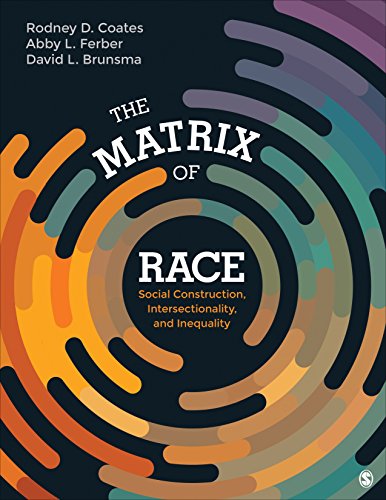
60The Matrix of Race: Social Construction, Intersectionality, and Inequality
The Matrix of Race, for race and ethnic relations courses, is written by three leading scholars -- Rodney D. Coates, David L. Brunsma, and Abby L. Ferber -- and reflects a very contemporary way of looking at race, minorities, and intergroup relations. Older texts use a "categorical" approach and feature a series of chapters that examine one minority group at a time (African Americans, Latino/a Americans, Asian Americans, Native Americans, etc.). Newer texts designed within the last 5-10 years are more likely to be organized topically, discuss various racial and ethnic minorities within the context of these topics, and use the most current theories and perspectives in this field. The Matrix of Race is built around these core ideas: -Race is a both a social construction and a social institution -Race is intersectional--it is embedded within other statuses (such as gender, social class, sexuality) -Concepts of race change over time and as we move from one physical location to another -We are all active agents in upholding, reproducing, or resisting constructions of race.
 61
61Health Sciences Literature Review Made Easy: The Matrix Method
Health Sciences Literature Review Made Easy: The Matrix Method, Fifth Edition describes the practical and useful methods for reviewing scientific literature in the health sciences. The goal of this text is to serve as a resource for students who need a practical, step-by-step set of instructions for how to organize, conduct, and write a synthesis of literature on a topic of their choice.
Key Features:
Includes author hints for conducting a review
Caroline's Quest details the process for conducting a review
Method Maps provide a visual approach for conducting a methodological review
Data Visualization reviews the history of data visualization to communicate scientific findings
Features websites and e-tutorials for citing reference materials
Key Features:
Includes author hints for conducting a review
Caroline's Quest details the process for conducting a review
Method Maps provide a visual approach for conducting a methodological review
Data Visualization reviews the history of data visualization to communicate scientific findings
Features websites and e-tutorials for citing reference materials
 62
62Dancing Matrix: How Science Confronts Emerging Viruses
Even as humanity reels beneath the assault of AIDS, epidemiologists are gearing themselves up for the plague's successor. It might be dengue fever, whose carrier, the Asian tiger mosquito, has recently appeared in the United States, or Creutzfeldt-Jakob disease, which has been transmitted by contaminated human growth hormone. The next pandemic might be caused by any of a dozen viruses that were once confined to other species or territories but now place human beings at risk as we increasingly cross their boundaries.
Updated to include the latest research and developments, this fascinating and sometimes unsetting book sums up all that we currently know about viruses: what they are, how they spread, and how scientists are trying to outwit them. Interweaving theory and real-life medical drama, A Dancing Matrix is science reportage at its most suspenseful and informative.
Updated to include the latest research and developments, this fascinating and sometimes unsetting book sums up all that we currently know about viruses: what they are, how they spread, and how scientists are trying to outwit them. Interweaving theory and real-life medical drama, A Dancing Matrix is science reportage at its most suspenseful and informative.
 63
63Direct Methods for Sparse Linear Systems
Computational scientists often encounter problems requiring the solution of sparse systems of linear equations. Attacking these problems efficiently requires an in-depth knowledge of the underlying theory, algorithms, and data structures found in sparse matrix software libraries. Here, Davis presents the fundamentals of sparse matrix algorithms to provide the requisite background. The book includes CSparse, a concise downloadable sparse matrix package that illustrates the algorithms and theorems presented in the book and equips readers with the tools necessary to understand larger and more complex software packages. With a strong emphasis on MATLAB(R) and the C programming language, Direct Methods for Sparse Linear Systems equips readers with the working knowledge required to use sparse solver packages and write code to interface applications to those packages. The book also explains how MATLAB performs its sparse matrix computations.
 64
64The Matrix Reader: Examining the Dynamics of Oppression and Privilege
Written by four authors from different disciplinary backgrounds, this reader promotes a commitment to an intersectional approach to teaching race, class, gender and sexuality. Unlike most books of its kind, it highlights the duality of privilege and oppression and the effects that race, gender, and sexuality have on our lives. This reader includes poems, reflective literary prose, historical events and documents, images drawn from the media, contemporary statistics of inequalities, visual images, and tools that empower students to become agents for social change.
 65
65An Introduction to Matrices, Sets and Groups for Science Students
This outstanding text offers undergraduate students of physics, chemistry, and engineering a concise, readable introduction to matrices, sets, and groups. Concentrating mainly on matrix theory, the book is virtually self-contained, requiring a minimum of mathematical knowledge and providing all the background necessary to develop a thorough comprehension of the subject.
Beginning with a chapter on sets, mappings, and transformations, the treatment advances to considerations of matrix algebra, inverse and related matrices, and systems of linear algebraic equations. Additional topics include eigenvalues and eigenvectors, diagonalisation and functions of matrices, and group theory. Each chapter contains a selection of worked examples and many problems with answers, enabling readers to test their understanding and ability to apply concepts.
Beginning with a chapter on sets, mappings, and transformations, the treatment advances to considerations of matrix algebra, inverse and related matrices, and systems of linear algebraic equations. Additional topics include eigenvalues and eigenvectors, diagonalisation and functions of matrices, and group theory. Each chapter contains a selection of worked examples and many problems with answers, enabling readers to test their understanding and ability to apply concepts.
 66
66Matrices and Linear Transformations
Undergraduate-level introduction to linear algebra and matrix theory deals with matrices and linear systems, vector spaces, determinants, linear transformations, similarity, polynomials, and polynomial matrices. Also spectral decomposition, Jordan canonical form, solution of the matrix equation AX=XB, and over 375 problems, many with answers. "Comprehensive." — Electronic Engineer's Design Magazine.
 67
67Proofs and Confirmations: The Story of the Alternating-Sign Matrix Conjecture
This introduction to recent developments in algebraic combinatorics illustrates how research in mathematics actually progresses. The author recounts the dramatic search for and discovery of a proof of a counting formula conjectured in the late 1970s: the number of n x n alternating sign matrices, objects that generalize permutation matrices. While it was apparent that the conjecture must be true, the proof was elusive. As a result, researchers became drawn to this problem and made connections to aspects of the invariant theory of Jacobi, Sylvester, Cayley, MacMahon, Schur, and Young; to partitions and plane partitions; to symmetric functions; to hypergeometric and basic hypergeometric series; and, finally, to the six-vertex model of statistical mechanics. This volume is accessible to anyone with a knowledge of linear algebra, and it includes extensive exercises and Mathematica programs to help facilitate personal exploration. Students will learn what mathematicians actually do in an interesting and new area of mathematics, and even researchers in combinatorics will find something unique within Proofs and Confirmations.
 68
68Hello Again, Linear Algebra: A Second Look at the Subject through a Collection of Exercises and Solutions
 69
69Matrices
 70
70Functions of Matrices
A thorough and elegant treatment of the theory of matrix functions and numerical methods for computing them, including an overview of applications, new and unpublished research results, and improved algorithms. Key features include a detailed treatment of the matrix sign function and matrix roots; a development of the theory of conditioning and properties of the Frechet derivative; Schur decomposition; block Parlett recurrence; a thorough analysis of the accuracy, stability, and computational cost of numerical methods; general results on convergence and stability of matrix iterations; and a chapter devoted to the f(A)b problem. Ideal for advanced courses and for self-study, its broad content, references and appendix also make this book a convenient general reference. Contains an extensive collection of problems with solutions and MATLAB implementations of key algorithms.
 71
71The Theory of Matrices in Numerical Analysis
Aspects of the theory most useful in developing and appraising computational methods for solving systems of linear equations and for finding characteristic roots. Basic identities and inequalities; norms, bounds and convergence; localization theorems and other inequalities; the solution of linear systems; much more.
 72
72Algebraic Structure and Matrices Book 2
This book was originally published in 1965. Dr Maxwell relates the ideas being introduced into the teaching of elementary university and advanced school algebra to the topics and methods with which teachers and students are already familiar and which are treated in the author's Advanced Algebra, Part I. Dr Maxwell shows the student meeting modern algebra for the first time what it is all about and leads those who will be taking the subject further to a firm grasp of the details that will come later in their course. From a discussion of algebraic systems with a single operation, he introduces the idea of a group and goes on to survey other algebraic structures: vector spaces, fields and rings. The second section is on linear algebra, mainly in terms of matrices and the solution of linear equations. A final section introduces the reader to more advanced concepts, including eigenvectors and eigenvalues and their use for quadratic forms. There is a large number of examples, with answers.
 73
73Introduction to Matrix Methods in Optics
Clear, accessible guide requires little prior knowledge and considers just two topics: paraxial imaging and polarization. Lucid discussions of paraxial imaging properties of a centered optical system, optical resonators and laser beam propagation, matrices in polarization optics and propagation of light through crystals, much more. 60 illustrations. Appendixes. Bibliography.
 74
74Linear Algebra and Matrix Theory
Advanced undergraduate and first-year graduate students have long regarded this text as one of the best available works on matrix theory in the context of modern algebra. Teachers and students will find it particularly suited to bridging the gap between ordinary undergraduate mathematics and completely abstract mathematics.
The first five chapters treat topics important to economics, psychology, statistics, physics, and mathematics. Subjects include equivalence relations for matrixes, postulational approaches to determinants, and bilinear, quadratic, and Hermitian forms in their natural settings. The final chapters apply chiefly to students of engineering, physics, and advanced mathematics. They explore groups and rings, canonical forms for matrixes with respect to similarity via representations of linear transformations, and unitary and Euclidean vector spaces. Numerous examples appear throughout the text.
The first five chapters treat topics important to economics, psychology, statistics, physics, and mathematics. Subjects include equivalence relations for matrixes, postulational approaches to determinants, and bilinear, quadratic, and Hermitian forms in their natural settings. The final chapters apply chiefly to students of engineering, physics, and advanced mathematics. They explore groups and rings, canonical forms for matrixes with respect to similarity via representations of linear transformations, and unitary and Euclidean vector spaces. Numerous examples appear throughout the text.
 75
75Quantum Mechanics in Simple Matrix Form
This elementary text introduces basic quantum mechanics to undergraduates with no background in mathematics beyond algebra. Containing more than 100 problems, it provides an easy way to learn part of the quantum language and apply it to problems.
Emphasizing the matrices representing physical quantities, it describes states simply by mean values of physical quantities or by probabilities for possible values. This approach requires using the algebra of matrices and complex numbers together with probabilities and mean values, a technique introduced at the outset and used repeatedly. Students discover the essential simplicity of quantum mechanics by focusing on basics and working only with key elements of the mathematical structure--an original point of view that offers a refreshing alternative for students new to quantum mechanics.
Emphasizing the matrices representing physical quantities, it describes states simply by mean values of physical quantities or by probabilities for possible values. This approach requires using the algebra of matrices and complex numbers together with probabilities and mean values, a technique introduced at the outset and used repeatedly. Students discover the essential simplicity of quantum mechanics by focusing on basics and working only with key elements of the mathematical structure--an original point of view that offers a refreshing alternative for students new to quantum mechanics.
 76
76Gnu Octave Manual Version 3
This manual is the definitive guide to GNU Octave, an interactive environment for numerical computation. GNU Octave provides a convenient command-line interface for solving linear and nonlinear problems using vectors and matrices. This updated edition of the manual covers version 3 of GNU Octave, and includes documentation for new features such as sparse matrices, linear programming and computational geometry. GNU Octave is free software, distributed under the GNU General Public License (GPL). All the money raised from the sale of this book supports the development of free software. For each copy sold $1 will be donated to the GNU Octave Development Fund. About the authors: John W. Eaton is the original developer of GNU Octave.
 77
77A Textbook of Matrices
 78
78Python: For Beginners: A Smarter and Faster Way to Learn Python in One Day (includes Hands-On Project)
 79
79Topics in Matrix Analysis
Building on the foundations of its predecessor volume, Matrix Analysis, this book treats in detail several topics with important applications and of special mathematical interest in matrix theory not included in the previous text. These topics include the field of values, stable matrices and inertia, singular values, matrix equations and Kronecker products, Hadamard products, and matrices and functions. The authors assume a background in elementary linear algebra and knowledge of rudimentary analytical concepts. The book should be welcomed by graduate students and researchers in a variety of mathematical fields both as an advanced text and as a modern reference work.
 80
80Topics in Random Matrix Theory
 81
81Common Core Assessments and Online Workbooks: Grade 4 Mathematics, Parcc Edition: Common Core State Standards Aligned
This Lumos tedBook Includes: 3 Practice tests Detailed answer explanations for every question In-depth coverage of multiple-choice, Short Constructed Response (SCR) and Extended Constructed Response (ECR) questions Strategies for building speed and accuracy Aligned with the Common Core State Standards (CCSS) PLUS One Year access to Online Workbooks Hundreds of practice questions with detailed answers Anywhere Access! Learn using a smart phone, tablet or personal computer Self-paced and student-directed
PLUS FREE Lumos StepUp Mobile App Scan QR Code in the book to instantly access online workbooks Convenient access to the Common Core State Standards
Lumos Study Program is used by the leading schools and libraries to improve student achievement on the standardized tests.
How can students succeed on the PARCC test using the Lumos Study Program?
At Lumos Learning, we believe that yearlong learning and adequate practice before the actual test are the keys to student success on the standardized tests. We have designed the Lumos Study Program to help students get plenty of realistic practice before the test and to promote yearlong collaborative learning.
Inside this book, you will find three comprehensive practice tests. Completing these tests will help students master the different areas that are included in the Common Core State Standards and practice test taking skills. The results will help the students and educators get insights into students' strengths and weaknesses in particular content areas. These insights could be used to help students strengthen their skills in difficult topics and to improve speed and accuracy while taking the test.
The Lumos Online Workbooks consist of hundreds of grade appropriate questions based on the CCSS. Students will get instant feedback and can review their answers anytime. Each student's answers and progress can be reviewed by parents and educators to reinforce the learning experience.
What is PARCC? The Partnership for Assessment of Readiness and College and Careers (PARCC) is one of two state consortiums responsible for developing assessments aligned to the new, more rigorous Common Core State Standards. There are currently 20 states involved in the PARCC consortium and a combination of educational leaders from those states along with test developers are working together to create the new computer based English Language Arts and Math assessments.
When is the PARCC Timeline? Currently, PARCC is set to deliver the new assessments for the 2014-2015 school year.
What are the planned parts of PARCC assessments? Although still in design phase, PARCC has released a plan for the yearly assessments. They will consist of: Optional diagnostic assessment Mid-year assessment Performance-based assessment End of year assessment Speaking and listening component assessment
Is this book completely aligned with the PARCC assessment guidelines?
This PARCC tedBook is aligned to the Common Core State Standards. Most states that are in the PARCC consortium will measure student achievement through state tests in the Spring of 2014 and PARCC assessments in the 2014-2015 academic year. This book is designed to assist students and teachers during the transitional assessment period.
PLUS FREE Lumos StepUp Mobile App Scan QR Code in the book to instantly access online workbooks Convenient access to the Common Core State Standards
Lumos Study Program is used by the leading schools and libraries to improve student achievement on the standardized tests.
How can students succeed on the PARCC test using the Lumos Study Program?
At Lumos Learning, we believe that yearlong learning and adequate practice before the actual test are the keys to student success on the standardized tests. We have designed the Lumos Study Program to help students get plenty of realistic practice before the test and to promote yearlong collaborative learning.
Inside this book, you will find three comprehensive practice tests. Completing these tests will help students master the different areas that are included in the Common Core State Standards and practice test taking skills. The results will help the students and educators get insights into students' strengths and weaknesses in particular content areas. These insights could be used to help students strengthen their skills in difficult topics and to improve speed and accuracy while taking the test.
The Lumos Online Workbooks consist of hundreds of grade appropriate questions based on the CCSS. Students will get instant feedback and can review their answers anytime. Each student's answers and progress can be reviewed by parents and educators to reinforce the learning experience.
What is PARCC? The Partnership for Assessment of Readiness and College and Careers (PARCC) is one of two state consortiums responsible for developing assessments aligned to the new, more rigorous Common Core State Standards. There are currently 20 states involved in the PARCC consortium and a combination of educational leaders from those states along with test developers are working together to create the new computer based English Language Arts and Math assessments.
When is the PARCC Timeline? Currently, PARCC is set to deliver the new assessments for the 2014-2015 school year.
What are the planned parts of PARCC assessments? Although still in design phase, PARCC has released a plan for the yearly assessments. They will consist of: Optional diagnostic assessment Mid-year assessment Performance-based assessment End of year assessment Speaking and listening component assessment
Is this book completely aligned with the PARCC assessment guidelines?
This PARCC tedBook is aligned to the Common Core State Standards. Most states that are in the PARCC consortium will measure student achievement through state tests in the Spring of 2014 and PARCC assessments in the 2014-2015 academic year. This book is designed to assist students and teachers during the transitional assessment period.
 82
82Matrices and Transformations
This text stresses the use of matrices in study of transformations of the plane. Familiarizes reader with role of matrices in abstract algebraic systems and illustrates its effective use as mathematical tool in geometry. Includes proofs of most theorems. Answers to odd-numbered exercises.
 83
83Competitive Spirits: Latin America's New Religious Economy
For over four centuries the Catholic Church enjoyed a religious monopoly in Latin America in which potential rivals were repressed or outlawed. Latin Americans were born Catholic and the only real choice they had was whether to actively practice the faith. Taking advantage of the legal disestablishment of the Catholic Church between the late 1800s and the early 1900s, Pentecostals almost single-handedly built a new pluralist religious economy. By the 1950s, many Latin Americans were free to choose from among the hundreds of available religious "products," a dizzying array of religious options that range from the African-Brazilian religion of Umbanda to the New Age group known as the Vegetable Union.
R. Andrew Chesnut shows how the development of religious pluralism over the past half-century has radically transformed the "spiritual economy" of Latin America. In order to thrive in this new religious economy, says Chesnut, Latin American spiritual "firms" must develop an attractive product and know how to market it to popular consumers. Three religious groups, he demonstrates, have proven to be the most skilled competitors in the new unregulated religious economy. Protestant Pentecostalism, the Catholic Charismatic Renewal, and African diaspora religions such as Brazilian Candomble and Haitian Vodou have emerged as the most profitable religious producers. Chesnut explores the general effects of a free market, such as introduction of consumer taste and product specialization, and shows how they have played out in the Latin American context. He notes, for example, that women make up the majority of the religious consumer market, and explores how the three groups have developed to satisfy women's tastes and preferences. Moving beyond the Pentecostal boom and the rise and fall of liberation theology, Chesnut provides a fascinating portrait of the Latin American religious landscape.
R. Andrew Chesnut shows how the development of religious pluralism over the past half-century has radically transformed the "spiritual economy" of Latin America. In order to thrive in this new religious economy, says Chesnut, Latin American spiritual "firms" must develop an attractive product and know how to market it to popular consumers. Three religious groups, he demonstrates, have proven to be the most skilled competitors in the new unregulated religious economy. Protestant Pentecostalism, the Catholic Charismatic Renewal, and African diaspora religions such as Brazilian Candomble and Haitian Vodou have emerged as the most profitable religious producers. Chesnut explores the general effects of a free market, such as introduction of consumer taste and product specialization, and shows how they have played out in the Latin American context. He notes, for example, that women make up the majority of the religious consumer market, and explores how the three groups have developed to satisfy women's tastes and preferences. Moving beyond the Pentecostal boom and the rise and fall of liberation theology, Chesnut provides a fascinating portrait of the Latin American religious landscape.
 84
84A Course in Metric Geometry.
This text is an approach to geometry based on the notion of length on a topological space. This approach has experienced a very fast development and penetrated into many other mathematical disciplines, such as group theory, dynamical systems, and partial differential equations.
 85
85Problems and Solutions in Introductory and Advanced Matrix Calculus
As an extensive collection of problems with detailed solutions in introductory and advanced matrix calculus, this self-contained book is ideal for both graduate and undergraduate mathematics students. The coverage includes systems of linear equations, linear differential equations, functions of matrices and the Kronecker product. Many of the problems are related to applications in areas such as group theory, Lie algebra theory and graph theory. Thus, physics and engineering students will also benefit from the book. Exercises for matrix-valued differential forms are also included.
 86
86Matrices W/Applications in Statistics
 87
87Introduction to Matrix Analysis
Long considered to be a classic in its field, this was the first book in English to include three basic fields of the analysis of matrices - symmetric matrices and quadratic forms, matrices and differential equations, and positive matrices and their use in probability theory and mathematical economics. Written in lucid, concise terms, this volume covers all the key aspects of matrix analysis and presents a variety of fundamental methods. Originally published in 1970, this book replaces the first edition previously published by SIAM in the Classics series. Here you will find a basic guide to operations with matrices and the theory of symmetric matrices, plus an understanding of general square matrices, origins of Markov matrices and non-negative matrices in general, minimum-maximum characterization of characteristic roots, Kronecker products, functions of matrices, and much more. These ideas and methods will serve as powerful analytical tools.
 88
88Mathematical Methods for Engineers and Scientists 1: Complex Analysis, Determinants and Matrices
The topics of this set of student-oriented books are presented in a discursive style that is readable and easy to follow. Numerous clearly stated, completely worked out examples together with carefully selected problem sets with answers are used to enhance students' understanding and manipulative skill. The goal is to help students feel comfortable and confident in using advanced mathematical tools in junior, senior, and beginning graduate courses.
 89
89The Matrix
The Matrix (1999) was a true end-of-the-millennium movie, a statement of the American Zeitgeist, and a prognosis for the future of big-budget Hollywood filmmaking. Starring Keanu Reeves as Neo, a computer programmer transformed into a messianic freedom fighter, The Matrix blends science fiction with conspiracy thriller conventions and outlandish martial arts created with groundbreaking digital techniques. A box-office triumph, the film was no populist confection: its blatant allusions to highbrow contemporary philosophy added to its appeal as a mystery to be decoded.
Joshua Clover undertakes the task of decoding the film. Examining The Matrix's digital effects and how they were achieved, he shows how the film represents a melding of cinema and video games (the greatest commercial threat to have faced Hollywood since the advent of television) and achieves a hybrid kind of immersive entertainment. He also unpacks the movie's references to philosophy, showing how The Matrix ultimately expresses the crisis American culture faced at the end of the 1990s.
Joshua Clover undertakes the task of decoding the film. Examining The Matrix's digital effects and how they were achieved, he shows how the film represents a melding of cinema and video games (the greatest commercial threat to have faced Hollywood since the advent of television) and achieves a hybrid kind of immersive entertainment. He also unpacks the movie's references to philosophy, showing how The Matrix ultimately expresses the crisis American culture faced at the end of the 1990s.
 90
90Matrix Mathematics: Theory, Facts, and Formulas - Second Edition
When first published in 2005, Matrix Mathematics quickly became the essential reference book for users of matrices in all branches of engineering, science, and applied mathematics. In this fully updated and expanded edition, the author brings together the latest results on matrix theory to make this the most complete, current, and easy-to-use book on matrices.
Each chapter describes relevant background theory followed by specialized results. Hundreds of identities, inequalities, and matrix facts are stated clearly and rigorously with cross references, citations to the literature, and illuminating remarks. Beginning with preliminaries on sets, functions, and relations, Matrix Mathematics covers all of the major topics in matrix theory, including matrix transformations; polynomial matrices; matrix decompositions; generalized inverses; Kronecker and Schur algebra; positive-semidefinite matrices; vector and matrix norms; the matrix exponential and stability theory; and linear systems and control theory. Also included are a detailed list of symbols, a summary of notation and conventions, an extensive bibliography and author index with page references, and an exhaustive subject index. This significantly expanded edition of Matrix Mathematics features a wealth of new material on graphs, scalar identities and inequalities, alternative partial orderings, matrix pencils, finite groups, zeros of multivariable transfer functions, roots of polynomials, convex functions, and matrix norms.
Covers hundreds of important and useful results on matrix theory, many never before available in any book
Provides a list of symbols and a summary of conventions for easy use
Includes an extensive collection of scalar identities and inequalities
Features a detailed bibliography and author index with page references
Includes an exhaustive subject index with cross-referencing
-- "Monatshefte f�r Mathematik"
Each chapter describes relevant background theory followed by specialized results. Hundreds of identities, inequalities, and matrix facts are stated clearly and rigorously with cross references, citations to the literature, and illuminating remarks. Beginning with preliminaries on sets, functions, and relations, Matrix Mathematics covers all of the major topics in matrix theory, including matrix transformations; polynomial matrices; matrix decompositions; generalized inverses; Kronecker and Schur algebra; positive-semidefinite matrices; vector and matrix norms; the matrix exponential and stability theory; and linear systems and control theory. Also included are a detailed list of symbols, a summary of notation and conventions, an extensive bibliography and author index with page references, and an exhaustive subject index. This significantly expanded edition of Matrix Mathematics features a wealth of new material on graphs, scalar identities and inequalities, alternative partial orderings, matrix pencils, finite groups, zeros of multivariable transfer functions, roots of polynomials, convex functions, and matrix norms.
Covers hundreds of important and useful results on matrix theory, many never before available in any book
Provides a list of symbols and a summary of conventions for easy use
Includes an extensive collection of scalar identities and inequalities
Features a detailed bibliography and author index with page references
Includes an exhaustive subject index with cross-referencing
-- "Monatshefte f�r Mathematik"
 91
91