We've ranked the best differential equations books using expert recommendations, sales data, and millions of reader ratings. At Shortform, we know books. Our book guides are the best in the world. Learn why.
Cover unavailable
1
Ordinary Differential Equations
Morris Tenenbaum
5.0
Skillfully organized introductory text examines origin of differential equations, then defines basic terms and outlines the general solution of a differential equation. Subsequent sections deal with integrating factors; dilution and accretion problems; linearization of first order systems; Laplace Transforms; Newton's Interpolation Formulas, more.
Cover unavailable
2
Partial Differential Equations for Scientists and Engineers
Stanley J. Farlow
4.8
Most physical phenomena, whether in the domain of fluid dynamics, electricity, magnetism, mechanics, optics, or heat flow, can be described in general by partial differential equations. Indeed, such equations are crucial to mathematical physics. Although simplifications can be made that reduce these equations to ordinary differential equations, nevertheless the complete description of physical systems resides in the general area of partial differential equations. This highly useful text shows the reader how to formulate a partial differential equation from the physical problem (constructing the mathematical model) and how to solve the equation (along with initial and boundary conditions). Written for advanced undergraduate and graduate students, as well as professionals working in the applied sciences, this clearly written book offers realistic, practical coverage of diffusion-type problems, hyperbolic-type problems, elliptic-type problems, and numerical and approximate methods. Each chapter contains a selection of relevant problems (answers are provided) and suggestions for further reading.
…
Cover unavailable
3
A Student's Guide to Maxwell's Equations
Daniel Fleisch
4.6
Gauss's law for electric fields, Gauss's law for magnetic fields, Faraday's law, and the Ampere-Maxwell law are four of the most influential equations in science. In this guide for students, each equation is the subject of an entire chapter, with detailed, plain-language explanations of the physical meaning of each symbol in the equation, for both the integral and differential forms. The final chapter shows how Maxwell's equations may be combined to produce the wave equation, the basis for the electromagnetic theory of light. This book is a wonderful resource for undergraduate and graduate courses in electromagnetism and electromagnetics. A website hosted by the author at www.cambridge.org/9780521701471 contains interactive solutions to every problem in the text as well as audio podcasts to walk students through each chapter.
…
Cover unavailable
4
Ordinary Differential Equations
V.I. Arnold and Richard A. Silverman
4.6
Few books on Ordinary Differential Equations (ODEs) have the elegant geometric insight of this one, which puts emphasis on the qualitative and geometric properties of ODEs and their solutions, rather than on routine presentation of algorithms.
Cover unavailable
5
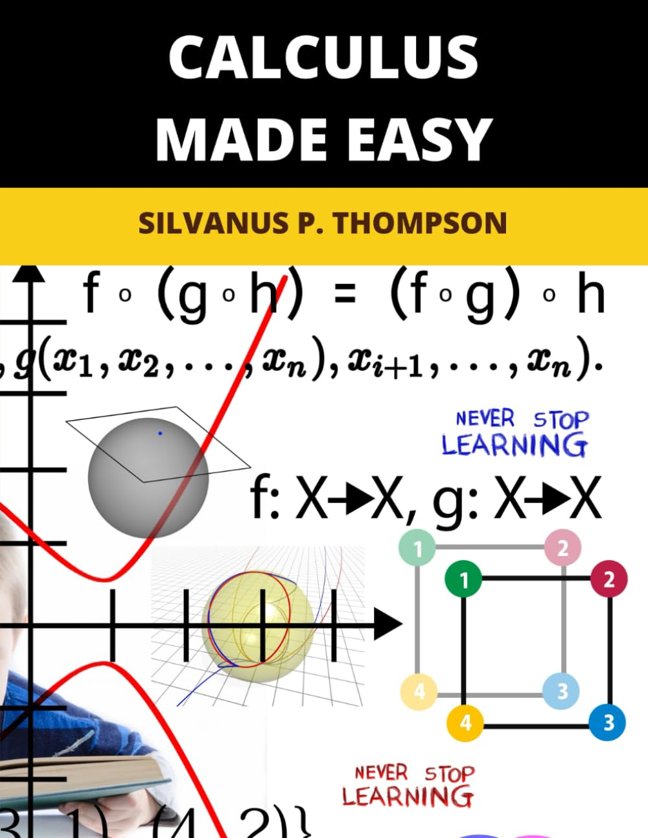
Calculus Made Easy
Silvanus P. Thompson, Martin Gardner
4.6
Calculus Made Easy has long been the most popular calculus primer, and this major revision of the classic math text makes the subject at hand still more comprehensible to readers of all levels. With a new introduction, three new chapters, modernized language and methods throughout, and an appendix of challenging and enjoyable practice problems, Calculus Made Easy has been thoroughly updated for the modern reader.
…
Cover unavailable
6
Special Relativity and Classical Field Theory: The Theoretical Minimum
Leonard Susskind
4.5
A funny, insightful, and self-contained guide to Einstein's relativity theory and classical field theories--including electromagnetism
Physicist Leonard Susskind and data engineer Art Friedman are back. This time, they introduce readers to Einstein's special relativity and Maxwell's classical field theory. Using their typical brand of real math, enlightening drawings, and humor, Susskind and Friedman walk us through the complexities of waves, forces, and particles by exploring special relativity and electromagnetism. It's a must-read for both devotees of the series and any armchair physicist who wants to improve their knowledge of physics' deepest truths.
…
Cover unavailable
7
Partial Differential Equations
Lawrence C. Evans
4.5
Cover unavailable
8
Things to Make and Do in the Fourth Dimension
Matt Parker
4.5
- Cut pizzas in new and fairer ways! - Fit a 2p coin through an impossibly small hole! - Make a perfect regular pentagon by knotting a piece of paper! - Tie your shoes faster than ever before, saving literally seconds of your life! - Use those extra seconds to contemplate the diminishing returns of an exclamation-point at the end of every bullet-point! - Make a working computer out of dominoes!
Maths is a game. This book can be cut, drawn in, folded into shapes and will even take you to the fourth dimension.
So join stand-up mathematician Matt Parker on a journey through narcissistic numbers, optimal dating algorithms, at least two different kinds of infinity and more.
…
Cover unavailable
9
Differential Equations (Quick Study Academic)
Inc. BarCharts
4.5
Cover unavailable
10
Differential Equations and Linear Algebra
Gilbert Strang
4.5
Differential equations and linear algebra are two central topics in the undergraduate mathematics curriculum. This innovative textbook allows the two subjects to be developed either separately or together, illuminating the connections between two fundamental topics, and giving increased flexibility to instructors. It can be used either as a semester-long course in differential equations, or as a one-year course in differential equations, linear algebra, and applications. Beginning with the basics of differential equations, it covers first and second order equations, graphical and numerical methods, and matrix equations. The book goes on to present the fundamentals of vector spaces, followed by eigenvalues and eigenvectors, positive definiteness, integral transform methods and applications to PDEs. The exposition illuminates the natural correspondence between solution methods for systems of equations in discrete and continuous settings. The topics draw on the physical sciences, engineering and economics, reflecting the author's distinguished career as an applied mathematician and expositor.
…
Cover unavailable
11
An Introduction to Ordinary Differential Equations
Earl A. Coddington
4.4
"Written in an admirably cleancut and economical style." — Mathematical Review. A thorough, systematic first course in elementary differential equations for undergraduates in mathematics and science, requiring only basic calculus for a background, and including many exercises designed to develop students' technique in solving equations. With problems and answers. Index.
Cover unavailable
12
Visual Differential Geometry and Forms: A Mathematical Drama in Five Acts
Tristan Needham
4.4
Cover unavailable
13
Principles of Mathematical Analysis
Walter Rudin
4.4
The third edition of this well known text continues to provide a solid foundation in mathematical analysis for undergraduate and first-year graduate students. The text begins with a discussion of the real number system as a complete ordered field. (Dedekind's construction is now treated in an appendix to Chapter I.) The topological background needed for the development of convergence, continuity, differentiation and integration is provided in Chapter 2. There is a new section on the gamma function, and many new and interesting exercises are included. This text is part of the Walter Rudin Student Series in Advanced Mathematics.
…
Cover unavailable
14
Partial Differential Equations with Fourier Series and Boundary Value Problems: Third Edition
Nakhle H. Asmar
4.4
This text provides an introduction to partial differential equations and boundary value problems, including Fourier series. The treatment offers students a smooth transition from a course in elementary ordinary differential equations to more advanced topics in a first course in partial differential equations. This widely adopted and successful book also serves as a valuable reference for engineers and other professionals. The approach emphasizes applications, with particular stress on physics and engineering applications. Rich in proofs and examples, the treatment features many exercises in each section. Relevant Mathematica files are available for download from author Nakhlé Asmar's website; however, the book is completely usable without computer access. The Students' Solutions Manual can be downloaded for free from the Dover website, and the book includes information on how instructors may request the Instructor Solutions Manual. The text is suitable for undergraduates in mathematics, physics, engineering, and other fields who have completed a course in ordinary differential equations.
…
Cover unavailable
15
Solomon Academy's IAAT Practice Tests: Practice Tests for IOWA Algebra Aptitude Test
Yeon Rhee
4.4
This book is designed towards mastering the Iowa Algebra Aptitude Test (IAAT), a placement test which allows students to demonstrate their readiness and ability to succeed in Algebra 1. The book contains a review of essential theorems specific to the IAAT: Pre-Algebraic Number Skills and Concepts, Mathematical Data Interpretation and Analysis, Representing Relationships, and Symbols. There are 7 full-length math tests with detailed solutions and explanations for all questions.
…
Cover unavailable
16
Guide to Distribution Theory and Fourier
Robert S Strichartz
4.4
This important book provides a concise exposition of the basic ideas of the theory of distribution and Fourier transforms and its application to partial differential equations. The author clearly presents the ideas, precise statements of theorems, and explanations of ideas behind the proofs. Methods in which techniques are used in applications are illustrated, and many problems are included. The book also introduces several significant recent topics, including pseudodifferential operators, wave front sets, wavelets, and quasicrystals. Background mathematical prerequisites have been kept to a minimum, with only a knowledge of multidimensional calculus and basic complex variables needed to fully understand the concepts in the book.A Guide to Distribution Theory and Fourier Transforms can serve as a textbook for parts of a course on Applied Analysis or Methods of Mathematical Physics, and in fact it is used that way at Cornell.
…
Cover unavailable
17
Numerical Methods for Partial Differential Equations: Finite Difference and Finite Volume Methods
Sandip Mazumder Ph.D.
4.4
Numerical Methods for Partial Differential Equations: Finite Difference and Finite Volume Methods focuses on two popular deterministic methods for solving partial differential equations (PDEs), namely finite difference and finite volume methods. The solution of PDEs can be very challenging, depending on the type of equation, the number of independent variables, the boundary, and initial conditions, and other factors. These two methods have been traditionally used to solve problems involving fluid flow.
For practical reasons, the finite element method, used more often for solving problems in solid mechanics, and covered extensively in various other texts, has been excluded. The book is intended for beginning graduate students and early career professionals, although advanced undergraduate students may find it equally useful.
The material is meant to serve as a prerequisite for students who might go on to take additional courses in computational mechanics, computational fluid dynamics, or computational electromagnetics. The notations, language, and technical jargon used in the book can be easily understood by scientists and engineers who may not have had graduate-level applied mathematics or computer science courses.
…
Cover unavailable
18
Introduction to the Theory of Distributions
F. G. Friedlander
4.3
The theory of distributions is an extension of classical analysis, an area of particular importance in the field of linear partial differential equations. Underlying it is the theory of topological vector spaces, but it is possible to give a systematic presentation without a knowledge of this. The material in this book, based on graduate lectures given over a number of years requires few prerequisites but the treatment is rigorous throughout. From the outset, the theory is developed in several variables. It is taken as far as such important topics as Schwartz kernels, the Paley-Wiener-Schwartz theorem and Sobolev spaces. In this second edition, the notion of the wavefront set of a distribution is introduced. It allows many operations on distributions to be extended to larger classes and gives much more precise understanding of the nature of the singularities of a distribution. This is done in an elementary fashion without using any involved theories. This account will be useful to graduate students and research workers who are interested in the applications of analysis in mathematics and mathematical physics.
…
Cover unavailable
19
Schaum's Outline of Differential Equations, Fifth Edition
BRONSON
4.3
Study smarter and stay on top of your differential equations course with the bestselling Schaum’s Outline―now with the NEW Schaum’s app and website! Schaum’s Outline of Differential Equations, Fifth Edition is the go-to study guide for all students of science who need to learn or refresh their knowledge of differential equations. With an outline format that facilitates quick and easy review and mirrors the course in scope and sequence, this book helps you understand basic concepts and get the extra practice you need to excel in the course. It supports the all major differential equations textbooks and is useful for study in Calculus (I, II, and III), Mathematical Modeling, Introductory Differential Equations and Differential Equations. Chapters include an Introduction to Modeling and Qualitative Methods, Classifications of First-Order Differential Equations, Linear Differential Equations, Variation of Parameters, Initial-Value Problems for Linear Differential Equations, Graphical and Numerical Methods for Solving First-Order Differential Equations, Solutions of Linear Differential Equations with Constant Coefficients by Laplace Transforms, and more.Features:NEW to this edition: the new Schaum’s app and website!NEW CHAPTERS include Autonomous Differential Equations and Qualitative Methods; Eigenvalues and Eigenvectors; three chapters dealing with Solutions of Systems of Autonomous Equations via Eigenvalues and Eigenvectors (real and distinct, real and equal, and complex conjugate Eigenvalues)20 problem-solving videos online563 solved problemsOutline format provides a quick and easy review of differential equationsClear, concise explanations of differential equations conceptsHundreds of examples with explanations of key conceptsSupports all major textbooks for differential equations coursesAppropriate for the following courses: Calculus (I, II, and III), Mathematical Modeling, Introductory Differential Equations, and Differential Equations
…
Cover unavailable
20
Differential Equations with Applications and Historical Notes
George F. Simmons
4.3
Written by a highly respected educator, this third edition updates the classic text designed for a first course in differential equations. With an emphasis on modeling, this edition presents a new section on Gauss s bell curve and improved sections on Fourier analysis, numerical methods, and linear algebra. The text includes unique examples and exercises as well as interesting historical notes throughout."
…
Cover unavailable
21
Numerical Methods for Ordinary Differential Equations: Initial Value Problems
David F. F. Griffiths, Desmond J. Higham
4.3
Numerical Methods for Ordinary Differential Equations is a self-contained introduction to a fundamental field of numerical analysis and scientific computation. Written for undergraduate students with a mathematical background, this book focuses on the analysis of numerical methods without losing sight of the practical nature of the subject.
It covers the topics traditionally treated in a first course, but also highlights new and emerging themes. Chapters are broken down into `lecture' sized pieces, motivated and illustrated by numerous theoretical and computational examples.
Over 200 exercises are provided and these are starred according to their degree of difficulty. Solutions to all exercises are available to authorized instructors.
The book covers key foundation topics:
o Taylor series methods
o Runge--Kutta methods
o Linear multistep methods
o Convergence
o Stability
and a range of modern themes:
o Adaptive stepsize selection
o Long term dynamics
o Modified equations
o Geometric integration
o Stochastic differential equations
The prerequisite of a basic university-level calculus class is assumed, although appropriate background results are also summarized in appendices. A dedicated website for the book containing extra information can be found via www.springer.com
…
Cover unavailable
22
Hyperbolic Partial Differential Equations
Peter D. Lax
4.3
Cover unavailable
23
Differential Equations Essential Skills Practice Workbook with Answers
Chris McMullen
4.3
This workbook on ordinary differential equations serves either as a handy supplement to current students or as a useful review for students who have previously studied the material. This book focuses on essential techniques for solving and understanding differential equations. Topics include:first-order differential equationssecond-order differential equationsseparable equationslinear equationshomogeneous equationsexact differential equationsautonomous differential equationsthe Wronskianinitial-value and boundary-value problemsapplications of differential equationspower series solutionsrecurrence relationsLegendre, Chebyshev, Laguerre, and Hermite PolynomialsRodrigues’ formulaand moreThe author, Chris McMullen, Ph.D., has over twenty years of experience teaching math skills to physics students. He prepared this workbook of the Improve Your Math Fluency series to share his strategies for solving differential equations.
…
Cover unavailable
24
Calculus Made Easy: 2026 New Edition
Silvanus P. Thompson
4.3
Calculus Made Easy is a masterfully crafted mathematics guide by Silvanus P. Thompson that demystifies the complexities of calculus, transforming what is often perceived as a daunting subject into an accessible and enjoyable learning adventure for maths learners from all levels.Instead of drowning readers in complicated equations, the author builds a solid foundation with intuitive explanations, unlocking the secrets of calculus through relatable, real-world applications.Calculus Made Easy is more than just a textbook because it contains both theoretical explanations as well as practices and answers ensuring that readers not only solve problems but comprehend the underlying principles.This book encourages active learning, transforming every page into a step forward on your path to calculus mastery.Besides that, this 2026 edition also comes with additional detailed summary of each chapter for readers to solidify the understanding.Here's the comprehensive topics on calculus you'll learn inside:To Deliver You From The Preliminary TerrorsOn Different Degrees of SmallnessOn Relative GrowingsSimplest CasesNext Stage. What To Do With ConstantsSums, Differences, Products And QuotientsSuccessive DifferentiationWhen Time VariesIntroducing A Useful DodgeGeometrical Meaning Of DifferentiationMaxima And MinimaCurvature Of CurvesOther Useful DodgesOn True Compound Interest And The Law Of Organic GrowthHow To Deal With Sines and CosinesPartial DifferentiationIntegrationIntegrating As The Reverse Of DifferentiatingOn Finding Areas By IntegratingDodges, Pitfalls, And TriumphsWhether you're a student, a teacher, a lifelong learner, or someone simply curious about the beauty of mathematics, this timeless guide would be your friendly companion in your journey to mastering calculus.
…
Cover unavailable
25
Partial Differential Equations in Engineering Problems
Kenneth S. Miller
4.3
Cover unavailable
26
A First Course in Differential Equations: With Modeling Applications
Dennis G. Zill
4.3
A First Course in Differential Equations with Modeling Applications, 9th Edition strikes a balance between the analytical, qualitative, and quantitative approaches to the study of differential equations. This proven and accessible text speaks to beginning engineering and math students through a wealth of pedagogical aids, including an abundance of examples, explanations, "Remarks" boxes, definitions, and group projects. Using a straightforward, readable, and helpful style, this book provides a thorough treatment of boundary-value problems and partial differential equations.
…
Cover unavailable
27
University Math and Statistics: Quick Web Links to FREE 260+ Textbooks, 800+ Lecture notes, 1000+ Worked examples, past exams papers with solutions, Dictionaries,Software and tools, and Many more...
Dr. Web Links
4.3
Cover unavailable
28
Calculus, Volume 2: Multi-Variable Calculus and Linear Algebra with Applications
Tom M. Apostol
4.3
An introduction to the calculus, with an excellent balance between theory and technique. Integration is treated before differentiation -- this is a departure from most modern texts, but it is historically correct, and it is the best way to establish the true connection between the integral and the derivative. Proofs of all the important theorems are given, generally preceded by geometric or intuitive discussion. This Second Edition introduces the mean-value theorems and their applications earlier in the text, incorporates a treatment of linear algebra, and contains many new and easier exercises. As in the first edition, an interesting historical introduction precedes each important new concept.
…
Cover unavailable
29
The Mathematics of Diffusion
John Crank
4.3
Recommended by Math Prof.
Math Prof
Late English mathematician, John Crank, known for the Crank-Nicolson method in numerical soln of PDEs, has a great online book, The Mathematics of Diffusion. https://t.co/NLxTXFAqIW [source]
Cover unavailable
30
Schaum's Outline of Differential Equations
Richard Bronson and Gabriel Costa
4.3
Tough Test Questions? Missed Lectures? Not Enough Time? Fortunately, there's Schaum's. This all-in-one-package includes more than 550 fully solved problems, examples, and practice exercises to sharpen your problem-solving skills. Plus, you will have access to 30 detailed videos featuring Math instructors who explain how to solve the most commonly tested problems--it's just like having your own virtual tutor! You'll find everything you need to build confidence, skills, and knowledge for the highest score possible.
More than 40 million students have trusted Schaum's to help them succeed in the classroom and on exams. Schaum's is the key to faster learning and higher grades in every subject. Each Outline presents all the essential course information in an easy-to-follow, topic-by-topic format. Helpful tables and illustrations increase your understanding of the subject at hand.
This Schaum's Outline gives you
563 fully solved problems Concise explanation of all course concepts Covers first-order, second-order, and nth-order equations Fully compatible with your classroom text, Schaum's highlights all the important facts you need to know. Use Schaum's to shorten your study time--and get your best test scores!
Schaum's Outlines--Problem Solved.
…
Cover unavailable
31
Differential Equations for Dummies
Steven Holzner
4.3
The fun and easy way to understand and solve complex equations Many of the fundamental laws of physics, chemistry, biology, and economics can be formulated as differential equations. This plain-English guide explores the many applications of this mathematical tool and shows how differential equations can help us understand the world around us. Differential Equations For Dummies is the perfect companion for a college differential equations course and is an ideal supplemental resource for other calculus classes as well as science and engineering courses. It offers step-by-step techniques, practical tips, numerous exercises, and clear, concise examples to help readers improve their differential equation-solving skills and boost their test scores.
…
Cover unavailable
32
An Introduction to Stochastic Differential Equations
Lawrence C. Evans
4.3
This book provides a quick, but very readable introduction to stochastic differential equations, that is, to differential equations subject to additive "white noise" and related random disturbances. The exposition is concise and strongly focused upon the interplay between probabilistic intuition and mathematical rigor. Topics include a quick survey of measure theoretic probability theory, followed by an introduction to Brownian motion and the Îto stochastic calculus, and finally the theory of stochastic differential equations. The text also includes applications to partial differential equations, optimal stopping problems and option pricing.
This book can be used as a text for senior undergraduates or beginning graduate students in mathematics, applied mathematics, physics, financial mathematics, etc., who want to learn the basics of stochastic differential equations. The reader is assumed to be fairly familiar with measure theoretic mathematical analysis, but is not assumed to have any particular knowledge of probability theory (which is rapidly developed in Chapter 2 of the book)
…
Cover unavailable
33
Differential Equations
Shepley L. Ross
4.3
This revised introduction to the basic methods, theory and applications of elementary differential equations employs a two part organization. Part I includes all the basic material found in a one semester introductory course in ordinary differential equations. Part II introduces students to certain specialized and more advanced methods, as well as providing a systematic introduction to fundamental theory.
…
Cover unavailable
34
An Introduction to Ordinary Differential Equations
Ravi P. Agarwal, Donal O'Regan
4.3
Ordinary differential equations serve as mathematical models for many exciting real world problems. Rapid growth in the theory and applications of differential equations has resulted in a continued interest in their study by students in many disciplines. This textbook organizes material around theorems and proofs, comprising of 42 class-tested lectures that effectively convey the subject in easily manageable sections. The presentation is driven by detailed examples that illustrate how the subject works. Numerous exercise sets, with an "answers and hints" section, are included. The book further provides a background and history of the subject.
…
Cover unavailable
35
A First Course in Differential Equations: The Classic Fifth Edition
Dennis G. Zill
4.3
The CLASSIC EDITION of Zill's respected book was designed for instructors who prefer not to emphasize technology, modeling, and applications, but instead want to focus on fundamental theory and techniques. Zill's CLASSIC EDITION, a reissue of the fifth edition, offers his excellent writing style, a flexible organization, an accessible level of presentation, and a wide variety of examples and exercises, all of which make it easy to teach from and easy for readers to understand and use.
…
Cover unavailable
36
Ordinary Differential Equations
Edward L. Ince
4.3
The theory of ordinary differential equations in real and complex domains is here clearly explained and analyzed. Not only classical theory, but also the main developments of modern times are covered. Exhaustive sections on the existence and nature of solutions, continuous transformation groups, the algebraic theory of linear differential systems, and the solution of differential equations by contour integration are as valuable to the pure mathematician as the fine treatment of the equations of Legendre, Bessel, and Mathieu, the conditions for the oscillatory character of solutions of a differential equation, and the relation between a linear differential system and an integral equation are to the engineer and the physicist. Partial contents: real domain (elementary methods of integration, the existence and nature of solutions, continuous transformation-groups, linear differential equations-the general theory, with constant coefficients, solutions, algebraic theory, Sturmian theory, and later developments); complex domain (existence theorems, equations of first order, non-linear equations of higher order, solutions, systems, classifications of linear equations, oscillation theorems). "Highly recommended." — Electronics Industries. "Deserves the highest praise." — Bulletin, American Mathematical Society.
…
Cover unavailable
37
Schaum's Outline of Partial Differential Equations (Schaum's)
Paul DuChateau, D. Zachmann
4.3
Confusing Textbooks? Missed Lectures? Not Enough Time?Fortunately for you, there's Schaum's Outlines. More than 40 million students have trusted Schaum's to help them succeed in the classroom and on exams. Schaum's is the key to faster learning and higher grades in every subject. Each Outline presents all the essential course information in an easy-to-follow, topic-by-topic format. You also get hundreds of examples, solved problems, and practice exercises to test your skills. This Schaum's Outline gives youPractice problems with full explanations that reinforce knowledge Coverage of the most up-to-date developments in your course field In-depth review of practices and applications Fully compatible with your classroom text, Schaum's highlights all the important facts you need to know. Use Schaum's to shorten your study time-and get your best test scores!Schaum's Outlines-Problem Solved.
…
Cover unavailable
38
Partial Differential Equations I: Basic Theory
Michael E. Taylor
4.3
This is the first of three volumes on partial differential equations. It introduces basic examples of partial differential equations, arising in continuum mechanics, electromagnetism, complex analysis and other areas. It also develops a number of tools for their solution, including Fourier analysis, distribution theory and Sobolev spaces. These tools are applied to the treatment of basic problems in linear PDE, including the Laplace equation, heat equation and wave equation, as well as more general elliptic, parabolic and hyperbolic equations.
…
Cover unavailable
39
The Magic of Math: Solving for x and Figuring Out Why
Arthur Benjamin
4.3
The world's greatest mental mathematical magician takes us on a spellbinding journey through the wonders of numbers (and more)
"Arthur Benjamin ... joyfully shows you how to make nature's numbers dance."--Bill Nye (the science guy)
The Magic of Math is the math book you wish you had in school. Using a delightful assortment of examples-from ice-cream scoops and poker hands to measuring mountains and making magic squares-this book revels in key mathematical fields including arithmetic, algebra, geometry, and calculus, plus Fibonacci numbers, infinity, and, of course, mathematical magic tricks. Known throughout the world as the "mathemagician," Arthur Benjamin mixes mathematics and magic to make the subject fun, attractive, and easy to understand for math fan and math-phobic alike.
"A positively joyful exploration of mathematics." -Publishers Weekly, starred review
"Each [trick] is more dazzling than the last." -Physics World
…
Cover unavailable
40
Stochastic Differential Equations: An Introduction with Applications
Bernt Oksendal
4.3
This edition contains detailed solutions of selected exercises. Many readers have requested this, because it makes the book more suitable for self-study. At the same time new exercises (without solutions) have beed added. They have all been placed in the end of each chapter, in order to facilitate the use of this edition together with previous ones. Several errors have been corrected and formulations have been improved. This has been made possible by the valuable comments from (in alphabetical order) Jon Bohlin, Mark Davis, Helge Holden, Patrick Jaillet, Chen Jing, Natalia Koroleva, MarioLefebvre, Alexander Matasov, Thilo Meyer-Brandis, Keigo Osawa, Bjorn Thunestvedt, Jan Uboe and Yngve Williassen. I thank them all for helping to improve the book. My thanks also go to Dina Haraldsson, who once again has performed the typing and drawn the ?gures with great skill. Blindern, September 2002 Bernt Oksendal xv Preface to Corrected Printing, Fifth Edition The main corrections and improvements in this corrected printing are from Chapter 12. I have bene?tted from useful comments from a number of p- ple, including (in alphabetical order) Fredrik Dahl, Simone Deparis, Ulrich Haussmann, Yaozhong Hu, Marianne Huebner, Carl Peter Kirkebo, Ni- lay Kolev, Takashi Kumagai, Shlomo Levental, Geir Magnussen, Anders Oksendal, Jur ] gen Pottho?, Colin Rowat, Stig Sandnes, Lones Smith, S- suo Taniguchi and Bjorn Thunestvedt. I want to thank them all for helping me making the book better. I also want to thank Dina Haraldsson for pro?cient typing.
…
Cover unavailable
41
A Mathematical Introduction to Robotic Manipulation
Richard M. Murray
4.2
A Mathematical Introduction to Robotic Manipulation presents a mathematical formulation of the kinematics, dynamics, and control of robot manipulators. It uses an elegant set of mathematical tools that emphasizes the geometry of robot motion and allows a large class of robotic manipulation problems to be analyzed within a unified framework.
The foundation of the book is a derivation of robot kinematics using the product of the exponentials formula. The authors explore the kinematics of open-chain manipulators and multifingered robot hands, present an analysis of the dynamics and control of robot systems, discuss the specification and control of internal forces and internal motions, and address the implications of the nonholonomic nature of rolling contact are addressed, as well.
The wealth of information, numerous examples, and exercises make A Mathematical Introduction to Robotic Manipulation valuable as both a reference for robotics researchers and a text for students in advanced robotics courses.
…
Cover unavailable
42
The Essential John Nash
John Nash
4.2
When John Nash won the Nobel prize in economics in 1994, many people were surprised to learn that he was alive and well. Since then, Sylvia Nasar's celebrated biography A Beautiful Mind, the basis of a new major motion picture, has revealed the man. The Essential John Nash reveals his work--in his own words. This book presents, for the first time, the full range of Nash's diverse contributions not only to game theory, for which he received the Nobel, but to pure mathematics--from Riemannian geometry and partial differential equations--in which he commands even greater acclaim among academics. Included are nine of Nash's most influential papers, most of them written over the decade beginning in 1949.
From 1959 until his astonishing remission three decades later, the man behind the concepts "Nash equilibrium" and "Nash bargaining"--concepts that today pervade not only economics but nuclear strategy and contract talks in major league sports--had lived in the shadow of a condition diagnosed as paranoid schizophrenia. In the introduction to this book, Nasar recounts how Nash had, by the age of thirty, gone from being a wunderkind at Princeton and a rising mathematical star at MIT to the depths of mental illness.
In his preface, Harold Kuhn offers personal insights on his longtime friend and colleague; and in introductions to several of Nash's papers, he provides scholarly context. In an afterword, Nash describes his current work, and he discusses an error in one of his papers. A photo essay chronicles Nash's career from his student days in Princeton to the present. Also included are Nash's Nobel citation and autobiography.
The Essential John Nash makes it plain why one of Nash's colleagues termed his style of intellectual inquiry as "like lightning striking." All those inspired by Nash's dazzling ideas will welcome this unprecedented opportunity to trace these ideas back to the exceptional mind they came from.
…
Cover unavailable
43
Numerical Solution of Partial Differential Equations by the Finite Element Method
Claes Johnson
4.2
An accessible introduction to the finite element method for solving numeric problems, this volume offers the keys to an important technique in computational mathematics. Suitable for advanced undergraduate and graduate courses, it outlines clear connections with applications and considers numerous examples from a variety of science- and engineering-related specialties. 1987 edition.
Cover unavailable
44
Modern Calculus and Analytic Geometry
Richard A. Silverman
4.2
A self-contained text for an introductory course, this volume places strong emphasis on physical applications. Key elements of differential equations and linear algebra are introduced early and are consistently referenced, all theorems are proved using elementary methods, and numerous worked-out examples appear throughout. The highly readable text approaches calculus from the student's viewpoint and points out potential stumbling blocks before they develop. A collection of more than 1,600 problems ranges from exercise material to exploration of new points of theory — many of the answers are found at the end of the book; some of them worked out fully so that the entire process can be followed. This well-organized, unified text is copiously illustrated, amply cross-referenced, and fully indexed.
…
Cover unavailable
45
Nonlinear Potential Theory Of Degenerate Elliptic Equations
Juha Heinonen
4.2
This book provides a detailed introduction to nonlinear potential theory based on supersolutions to certain degenerate elliptic equations of the p-Laplacian type. Recent research has shown that classical notions such as blayage, polar sets, Perron's method, and fine topology have their proper analogues in a nonlinear setting, and this book presents a coherent exposition of this natural extension of classical potential theory. Yet fundamental differences to classical potential theory exist, and in many places a new approach is mandatory. Sometimes new or long-forgotten methods emerge that are applicable to problems in classical potential theory. Quasiregular mappings constitute a natural field of applications, and a careful study of the potential theoretical aspects of these mappings is included. The principle aim of the book is to explore the ground where partial differential equations, harmonic analysis, and function theory meet. The quasilinear equations considered in this book involve a degeneracy condition given in terms of a weight function and therefore most results appear here for the first time in print. The reader interested exclusively in the unweighted theory will find new results, new proofs, and a reorganization of the material as compared to the existing literature. The book is intended for researchers and graduate students in potential theory, variational calculus, partial differential equations, and quasiconformal mappings.
…
Cover unavailable
46
Fundamentals of Differential Equations
R. Kent Nagle
4.2
For one-semester sophomore- or junior-level courses in Differential Equations.An introduction to the basic theory and applications of differential equations Fundamentals of Differential Equations presents the basic theory of differential equations and offers a variety of modern applications in science and engineering. This flexible text allows instructors to adapt to various course emphases (theory, methodology, applications, and numerical methods) and to use commercially available computer software. For the first time, MyLab(TM) Math is available for this text, providing online homework with immediate feedback, the complete eText, and more. Note that a longer version of this text, entitled Fundamentals of Differential Equations and Boundary Value Problems, 7th Edition, contains enough material for a two-semester course. This longer text consists of the main text plus three additional chapters (Eigenvalue Problems and Sturm--Liouville Equations; Stability of Autonomous Systems; and Existence and Uniqueness Theory). Also available with MyLab Math MyLab(TM) Math is an online homework, tutorial, and assessment program designed to work with this text to engage students and improve results. Within its structured environment, students practice what they learn, test their understanding, and pursue a personalized study plan that helps them absorb course material and understand difficult concepts. Note: You are purchasing a standalone product; MyLab does not come packaged with this content. Students, if interested in purchasing this title with MyLab, ask your instructor for the correct package ISBN and Course ID. Instructors, contact your Pearson representative for more information. If you would like to purchase both the physical text and MyLab, search for: 0134768744 / 9780134768748 Fundamentals of Differential Equations plus MyLab Math with Pearson eText -- Title-Specific Access Card Package, 9/ePackage consists of: 0134764838 / 9780134764832 MyLab Math with Pearson eText -- Standalone Access Card -- for Fundamentals of Differential Equations 0321977068 / 9780321977069 Fundamentals of Differential Equations
…
Cover unavailable
47
Basic Linear Partial Differential Equations
Francois Treves
4.2
Focusing on the archetypes of linear partial differential equations, this text for upper-level undergraduates and graduate students features most of the basic classical results. The methods, however, are decidedly nontraditional: in practically every instance, they tend toward a high level of abstraction. This approach recalls classical material to contemporary analysts in a language they can understand, as well as exploiting the field's wealth of examples as an introduction to modern theories. The four-part treatment covers the basic examples of linear partial differential equations and their fundamental solutions; the Cauchy problem; boundary value problems; and mixed problems and evolution equations. Nearly 400 exercises appear throughout the text, several containing detailed information that enables readers to reconstruct the proofs.
…
Cover unavailable
48
Solution Techniques for Elementary Partial Differential Equations
Christian Constanda
4.2
Solution Techniques for Elementary Partial Differential Equations, Third Edition remains a top choice for a standard, undergraduate-level course on partial differential equations (PDEs). Making the text even more user-friendly, this third edition covers important and widely used methods for solving PDEs.
New to the Third Edition
New sections on the series expansion of more general functions, other problems of general second-order linear equations, vibrating string with other types of boundary conditions, and equilibrium temperature in an infinite strip Reorganized sections that make it easier for students and professors to navigate the contents Rearranged exercises that are now at the end of each section/subsection instead of at the end of the chapter New and improved exercises and worked examples A brief Mathematica(R) program for nearly all of the worked examples, showing students how to verify results by computer
This bestselling, highly praised textbook uses a streamlined, direct approach to develop students' competence in solving PDEs. It offers concise, easily understood explanations and worked examples that allow students to see the techniques in action.
…
Cover unavailable
49
Applications of Lie Groups to Differential Equations
Peter J. Olver
4.2
Symmetry methods have long been recognized to be of great importance for the study of the differential equations. This book provides a solid introduction to those applications of Lie groups to differential equations which have proved to be useful in practice. The computational methods are presented so that graduate students and researchers can readily learn to use them. Following an exposition of the applications, the book develops the underlying theory. Many of the topics are presented in a novel way, with an emphasis on explicit examples and computations. Further examples, as well as new theoretical developments, appear in the exercises at the end of each chapter.
…
Cover unavailable
50
Numerical Solution of Ordinary Differential Equations
Kendall Atkinson
4.2
A concise introduction to numerical methodsand the mathematical framework neededto understand their performance"Numerical Solution of Ordinary Differential Equations" presents a complete and easy-to-follow introduction to classical topics in the numerical solution of ordinary differential equations. The book's approach not only explains the presented mathematics, but also helps readers understand how these numerical methods are used to solve real-world problems.
Unifying perspectives are provided throughout the text, bringing together and categorizing different types of problems in order to help readers comprehend the applications of ordinary differential equations. In addition, the authors' collective academic experience ensures a coherent and accessible discussion of key topics, including:
Euler's method
Taylor and Runge-Kutta methods
General error analysis for multi-step methods
Stiff differential equations
Differential algebraic equations
Two-point boundary value problems
Volterra integral equations
Each chapter features problem sets that enable readers to test and build their knowledge of the presented methods, and a related Web site features MATLAB programs that facilitate the exploration of numerical methods in greater depth. Detailed references outline additional literature on both analytical and numerical aspects of ordinary differential equations for further exploration of individual topics.
"Numerical Solution of Ordinary Differential Equations" is an excellent textbook for courses on the numerical solution of differential equations at the upper-undergraduate and beginning graduate levels. It also serves as a valuable reference for researchers in the fields of mathematics and engineering.
…
Cover unavailable
51
Partial Differential Equations: An Introduction
Walter A. Strauss
4.2
Our understanding of the fundamental processes of the natural world is based to a large extent on partial differential equations (PDEs). The second edition of Partial Differential Equations provides an introduction to the basic properties of PDEs and the ideas and techniques that have proven useful in analyzing them. It provides the student a broad perspective on the subject, illustrates the incredibly rich variety of phenomena encompassed by it, and imparts a working knowledge of the most important techniques of analysis of the solutions of the equations.
In this book mathematical jargon is minimized. Our focus is on the three most classical PDEs, the wave, heat and Lapace equations. Advanced concepts are introduced frequently but with the least possible technicalities. The book is flexibly designed for juniors, seniors or beginning graduate students in science, engineering or mathematics.
…
Cover unavailable
52
A Geometric Approach to Differential Forms
David Bachman
4.2
The modern subject of differential forms subsumes classical vector calculus. This text presents differential forms from a geometric perspective accessible at the undergraduate level. The book begins with basic concepts such as partial differentiation and multiple integration and gently develops the entire machinery of differential forms. The author approaches the subject with the idea that complex concepts can be built up by analogy from simpler cases, which, being inherently geometric, often can be best understood visually. Each new concept is presented with a natural picture that students can easily grasp. Algebraic properties then follow. This facilitates the development of differential forms without assuming a background in linear algebra. Throughout the text, emphasis is placed on applications in 3 dimensions, but all definitions are given so as to be easily generalized to higher dimensions. Containing excellent motivation, numerous illustrations and solutions to selected problems in an appendix, the material has been tested in the classroom along all three potential course tracks.
…
Cover unavailable
53
Numerical Methods for Partial Differential Equations
G. Evans
4.2
The subject of partial differential equations holds an exciting place in mathematics. Inevitably, the subject falls into several areas of mathematics. At one extreme the interest lies in the existence and uniqueness of solutions, and the functional analysis of the proofs of these properties. At the other extreme lies the applied mathematical and engineering quest to find useful solutions, either analytically or numerically, to these important equations which can be used in design and construction. The book presents a clear introduction of the methods and underlying theory used in the numerical solution of partial differential equations. After revising the mathematical preliminaries, the book covers the finite difference method of parabolic or heat equations, hyperbolic or wave equations and elliptic or Laplace equations. Throughout, the emphasis is on the practical solution rather than the theoretical background, without sacrificing rigour.
…
Cover unavailable
54
Differential Equations and Their Applications
Martin Braun
4.2
Used in undergraduate classrooms across the USA, this is a clearly written, rigorous introduction to differential equations and their applications. Fully understandable to students who have had one year of calculus, this book distinguishes itself from other differential equations texts through its engaging application of the subject matter to interesting scenarios. This fourth edition incorporates earlier introductory material on bifurcation theory and adds a new chapter on Sturm-Liouville boundary value problems. Computer programs in C, Pascal, and Fortran are presented throughout the text to show readers how to apply differential equations towards quantitative problems.
…
Cover unavailable
55
Differential Equations with Boundary-Value Problems
Dennis G. Zill
4.2
Straightforward and easy to read, DIFFERENTIAL EQUATIONS WITH BOUNDARY-VALUE PROBLEMS, 9th Edition, gives you a thorough overview of the topics typically taught in a first course in Differential Equations as well as an introduction to boundary-value problems and partial Differential Equations. Your study will be supported by a bounty of pedagogical aids, including an abundance of examples, explanations, "Remarks" boxes, definitions, and more.
…
Cover unavailable
56
Schaum's Outline of Advanced Mathematics for Engineers and Scientists
Murray Spiegel
4.2
Cover unavailable
57
The Analysis of Linear Partial Differential Operators I: Distribution Theory and Fourier Analysis
Lars Hörmander
4.2
The main change in this edition is the inclusion of exercises with answers and hints. This is meant to emphasize that this volume has been written as a general course in modern analysis on a graduate student level and not only as the beginning of a specialized course in partial differen tial equations. In particular, it could also serve as an introduction to harmonic analysis. Exercises are given primarily to the sections of gen eral interest; there are none to the last two chapters. Most of the exercises are just routine problems meant to give some familiarity with standard use of the tools introduced in the text. Others are extensions of the theory presented there. As a rule rather complete though brief solutions are then given in the answers and hints. To a large extent the exercises have been taken over from courses or examinations given by Anders Melin or myself at the University of Lund. I am grateful to Anders Melin for letting me use the problems originating from him and for numerous valuable comments on this collection. As in the revised printing of Volume II, a number of minor flaws have also been corrected in this edition. Many of these have been called to my attention by the Russian translators of the first edition, and I wish to thank them for our excellent collaboration."
…
Cover unavailable
58
Theory of Ordinary Differential Equations
Earl A. Coddington, Norman Levinson
4.2
Reprint. Originally published: New York: McGraw-Hill, 1955. (International series in pure and applied mathematics)
Cover unavailable
59
Computational Partial Differential Equations
Hans P. Langtangen, Hans Petter Langtangen
4.2
This text teaches finite element methods and basic finite difference methods from a computational point of view. It emphasizes developing flexible computer programs using the numerical library Diffpack, which is detailed for problems including model equations in applied mathematics, heat transfer, elasticity, and viscous fluid flow. This edition offers new applications and projects, and all program examples are available on the Internet.
…
Cover unavailable
60
Elementary Differential Equations And Boundary Value Problems
Boyce, Richard C. DiPrima
4.2
This book covers all the essential topics on differential equations, including series solutions, Laplace transforms, systems of equations, numerical methods and phase plane methods. Clear explanations are detailed with many current examples.
Cover unavailable
61
Inequalities
G. Hardy
4.2
First published in 1934, this presentation of both the statement and proof of all the standard inequalities of analysis has become a classic work in mathematical literature.
Cover unavailable
62
Geometric Numerical Integration: Structure-Preserving Algorithms for Ordinary Differential Equations
Ernst Hairer, Christian Lubich, et al.
4.2
This book covers numerical methods that preserve properties of Hamiltonian systems, reversible systems, differential equations on manifolds and problems with highly oscillatory solutions. It presents atheory of symplectic and symmetric methods, which include various specially designed integrators, as well as discusses their construction and practical merits. The long-time behavior of the numerical solutions is studied using a backward error analysis combined with KAM theory.
…
Cover unavailable
63
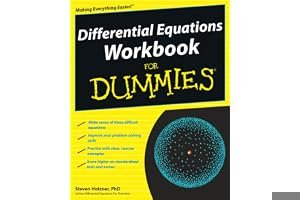
Differential Equations Workbook for Dummies
Steven Holzner
4.2
Make sense of these difficult equations Improve your problem-solving skills Practice with clear, concise examples Score higher on standardized tests and exams Get the confidence and the skills you need to master differential equations!
Need to know how to solve differential equations? This easy-to-follow, hands-on workbook helps you master the basic concepts and work through the types of problems you'll encounter in your coursework. You get valuable exercises, problem-solving shortcuts, plenty of workspace, and step-by-step solutions to every equation. You'll also memorize the most-common types of differential equations, see how to avoid common mistakes, get tips and tricks for advanced problems, improve your exam scores, and much more!
More than 100 Problems!
Detailed, fully worked-out solutions to problems The inside scoop on first, second, and higher order differential equations A wealth of advanced techniques, including power series
THE DUMMIES WORKBOOK WAY
Quick, refresher explanations Step-by-step procedures Hands-on practice exercises Ample workspace to work out problems Online Cheat Sheet A dash of humor and fun
…
Cover unavailable
64
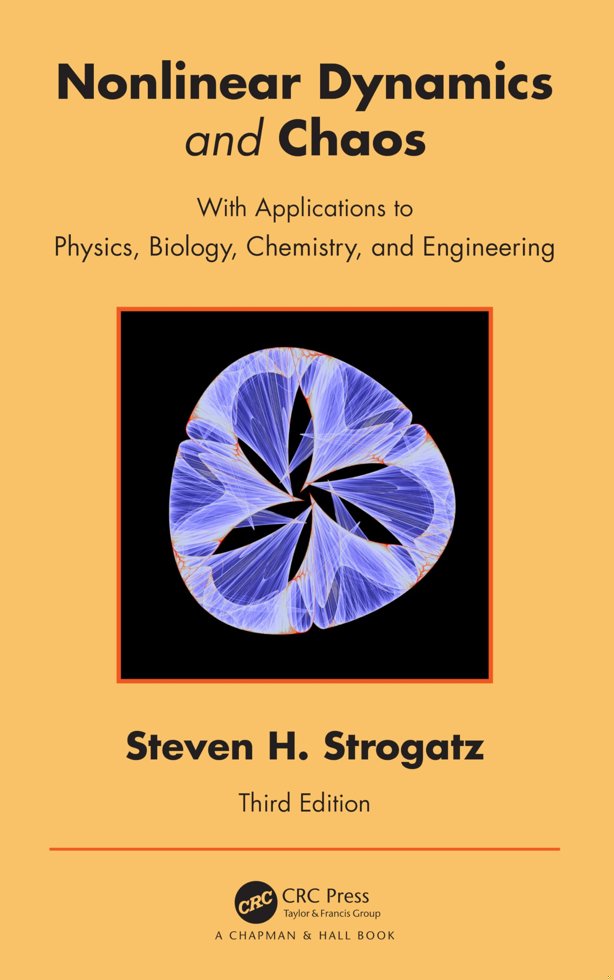
Nonlinear Dynamics and Chaos
Steven H Strogatz
4.2
The goal of this third edition of Nonlinear Dynamics and Chaos: With Applications to Physics, Biology, Chemistry, and Engineeringis the same as previous editions: to provide a good foundation - and a joyful experience - for anyone who’d like to learn about nonlinear dynamics and chaos from an applied perspective.The presentation stresses analytical methods, concrete examples, and geometric intuition. The theory is developed systematically, starting with first-order differential equations and their bifurcations, followed by phase plane analysis, limit cycles and their bifurcations, and culminating with the Lorenz equations, chaos, iterated maps, period doubling, renormalization, fractals, and strange attractors.The prerequisites are comfort with multivariable calculus and linear algebra, as well as a first course in physics. Ideas from probability, complex analysis, and Fourier analysis are invoked, but they're either worked out from scratch or can be safely skipped (or accepted on faith).Changes to this edition include substantial exercises about conceptual models of climate change, an updated treatment of the SIR model of epidemics, and amendments (based on recent research) about the Selkov model of oscillatory glycolysis. Equations, diagrams, and every word has been reconsidered and often revised. There are also about 50 new references, many of them from the recent literature.The most notable change is a new chapter. Chapter 13 is about the Kuramoto model.The Kuramoto model is an icon of nonlinear dynamics. Introduced in 1975 by the Japanese physicist Yoshiki Kuramoto, his elegant model is one of the rare examples of a high-dimensional nonlinear system that can be solved by elementary means.Students and teachers have embraced the book in the past, its general approach and framework continue to be sound.
…
Cover unavailable
65
Differential and Integral Equations
Peter Collins
4.2
Differential and integral equations involve important mathematical techniques, and as such will be encountered by mathematicians, and physical and social scientists, in their undergraduate courses. This text provides a clear, comprehensive guide to first- and second-order ordinary and partial differential equations, whilst introducing important and useful basic material on integral equations. Readers will encounter detailed discussion of the wave, heat and Laplace equations, of Green's functions and their application to the Sturm-Liouville equation, and how to use series solutions, transform methods and phase-plane analysis. The calculus of variations will take them further into the world of applied analysis.
Providing a wealth of techniques, but yet satisfying the needs of the pure mathematician, and with numerous carefully worked examples and exercises, the text is ideal for any undergraduate with basic calculus to gain a thorough grounding in 'analysis for applications'.
…
Cover unavailable
66
Numerical Solution of Partial Differential Equations: Finite Difference Methods
G. D. Smith
4.2
Substantially revised, this authoritative study covers the standard finite difference methods of parabolic, hyperbolic, and elliptic equations, and includes the concomitant theoretical work on consistency, stability, and convergence. The new edition includes revised and greatly expanded sections on stability based on the Lax-Richtmeyer definition, the application of Pade approximants to systems of ordinary differential equations for parabolic and hyperbolic equations, and a considerably improved presentation of iterative methods. A fast-paced introduction to numerical methods, this will be a useful volume for students of mathematics and engineering, and for postgraduates and professionals who need a clear, concise grounding in this discipline.
The ideal review for your partial differential equations course
More than 40 million students have trusted Schaum's Outlines for their expert knowledge and helpful solved problems. Written by renowned experts in their respective fields, Schaum's Outlines cover everything from math to science, nursing to language. The main feature for all these books is the solved problems. Step-by-step, authors walk readers through coming up with solutions to exercises in their topic of choice. 290 fully worked problems of varying difficulty Clear, concise explanations of differential and difference methods Help with variation formulation of boundary value problems and variation approximation methods Outline format supplies a concise guide to the standard college course in partial differential equations Appropriate for the following courses: Partial Differential Equations I, Partial Differential Equations II, Applied Math I, Applied Math II Complete course content in easy-to-follow outline form. Hundreds of solved problems
…
Cover unavailable
68
The Essence of Chaos
Edward Lorenz
4.2
Chaos surrounds us. Seemingly random events -- the flapping of a flag, a storm-driven wave striking the shore, a pinball's path -- often appear to have no order, no rational pattern. Explicating the theory of chaos and the consequences of its principal findings -- that actual, precise rules may govern such apparently random behavior -- has been a major part of the work of Edward N. Lorenz. In The Essence of Chaos, Lorenz presents to the general reader the features of this "new science," with its far-reaching implications for much of modern life, from weather prediction to philosophy, and he describes its considerable impact on emerging scientific fields.
Unlike the phenomena dealt with in relativity theory and quantum mechanics, systems that are now described as "chaotic" can be observed without telescopes or microscopes. They range from the simplest happenings, such as the falling of a leaf, to the most complex processes, like the fluctuations of climate. Each process that qualifies, however, has certain quantifiable characteristics: how it unfolds depends very sensitively upon its present state, so that, even though it is not random, it seems to be. Lorenz uses examples from everyday life, and simple calculations, to show how the essential nature of chaotic systems can be understood. In order to expedite this task, he has constructed a mathematical model of a board sliding down a ski slope as his primary illustrative example. With this model as his base, he explains various chaotic phenomena, including some associated concepts such as strange attractors and bifurcations.
As a meteorologist, Lorenz initially became interested in the field of chaos because of its implications for weather forecasting. In a chapter ranging through the history of weather prediction and meteorology to a brief picture of our current understanding of climate, he introduces many of the researchers who conceived the experiments and theories, and he describes his own initial encounter with chaos.
A further discussion invites readers to make their own chaos. Still others debate the nature of randomness and its relationship to chaotic systems, and describe three related fields of scientific thought: nonlinearity, complexity, and fractality. Appendixes present the first publication of Lorenz's seminal paper "Does the Flap of a Butterfly's Wing in Brazil Set Off a Tornado in Texas?"; the mathematical equations from which the copious illustrations were derived; and a glossary.
…
Cover unavailable
69
An Introduction to Pseudo-Differential Operators
Man-Wah Wong
4.1
This book gives a straightforward account of a class of pseudo-differential operators. It is ideal for courses in functional analysis, Fourier analysis and partial differential equations. Exercises are also included in the text.
Cover unavailable
70
Schaum's Outline Of Theory And Problems Of Differential Equations
Frank Ayres Jr.
4.1
Cover unavailable
71
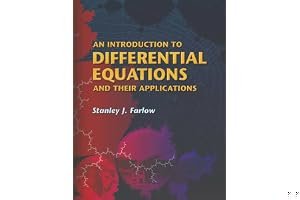
An Introduction to Differential Equations and Their Applications
Stanley J. Farlow
4.1
Intended for use in a beginning one-semester course in differential equations, this text is designed for students of pure and applied mathematics with a working knowledge of algebra, trigonometry, and elementary calculus. Its mathematical rigor is balanced by complete but simple explanations that appeal to readers' physical and geometric intuition. Starting with an introduction to differential equations, the text proceeds to examinations of first- and second-order differential equations, series solutions, the Laplace transform, systems of differential equations, difference equations, nonlinear differential equations and chaos, and partial differential equations. Numerous figures, problems with solutions, and historical notes clarify the text.
…
Cover unavailable
72
Differential Equations Demystified
Steven G. Krantz
4.1
Here's the perfect self-teaching guide to help anyone master differential equations--a common stumbling block for students looking to progress to advanced topics in both science and math. Covers First Order Equations, Second Order Equations and Higher, Properties, Solutions, Series Solutions, Fourier Series and Orthogonal Systems, Partial Differential Equations and Boundary Value Problems, Numerical Techniques, and more.
…
Cover unavailable
73
Optimal Control and Estimation
Robert F. Stengel
4.1
Graduate-level text provides introduction to optimal control theory for stochastic systems, emphasizing application of basic concepts to real problems.
Cover unavailable
74
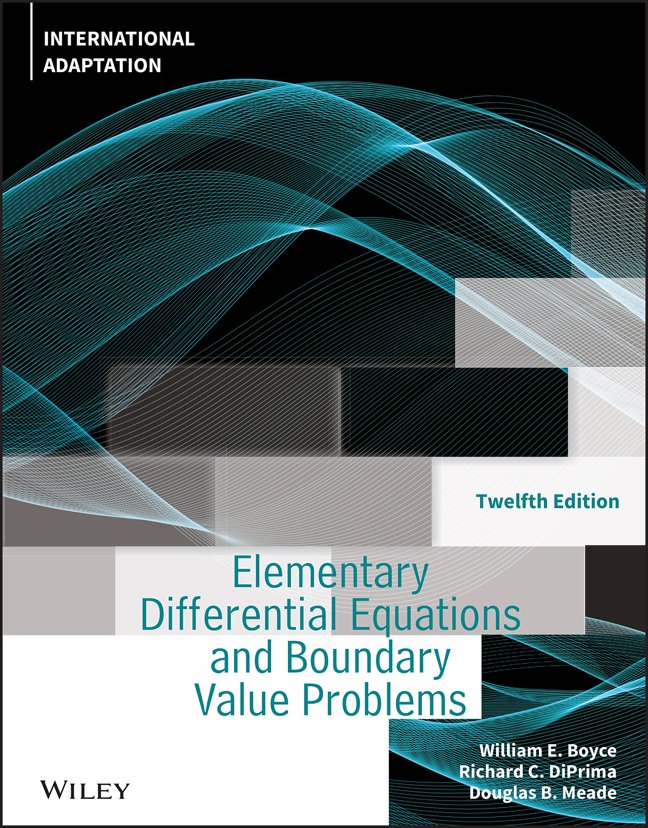
Elementary Differential Equations and Boundary Value Problems, International Adaptation
William E. Boyce, Richard C. DiPrima, Douglas B. Meade
4.1
Boyce’s Elementary Differential EquationsandBoundary Value Problems is written from the viewpoint of the applied mathematician, with diverse interest in differential equations, ranging from quite theoretical to intensely practical–and usually a combination of both. The intended audience for the text is undergraduate STEM students taking an introductory course in differential equations. The main prerequisite for engaging with the program is a working knowledge of calculus, gained from a normal two or three semester course sequence or its equivalent, while a basic familiarity with matrices is helpful.This new edition of the book aims to preserve, and to enhance the qualities that have made previous editions so successful. It offers a sound and accurate exposition of the elementary theory of differential equations with considerable material on methods of solution, analysis, and approximation that have proved useful in a wide variety of applications.
…
Cover unavailable
75
A First Course in the Finite Element Method
Daryl L. Logan
4.1
A First Course in the Finite Element Analysis provides a simple, basic approach to the finite element method that can be understood by both undergraduate and graduate students. It does not have the usual prerequisites (such as structural analysis) required by most available texts in this area. The book is written primarily as a basic learning tool for the undergraduate student in civil and mechanical engineering whose main interest is in stress analysis and heat transfer. The text is geared toward those who want to apply the finite element method as a tool to solve practical physical problems. This revised fourth edition includes the addition of a large number of new problems (including SI problems), an appendix for mechanical and thermal properties, and more civil applications.
…
Cover unavailable
76
A Primer on Wavelets and Their Scientific Applications
James S. Walker
4.1
The rapid growth of wavelet applications-speech compression and analysis, image compression and enhancement, and removing noise from audio and images-has created an explosion of activity in creating a theory of wavelet analysis and applying it to a wide variety of scientific and engineering problems. It becomes important, then, that engineers and scientists have a working understanding of wavelets. Until now, however, the study of wavelets has been beyond the mathematical grasp of many who need this understanding. Most treatments of the subject involve ideas from functional analysis, harmonic analysis, and other difficult mathematical techniques.
Wavelets and their Scientific Applications offers an introduction to wavelet analysis without mathematical rigor, requiring only algebra and some very basic calculus. The author stresses applications, and explains, using elementary algebra, how wavelet methods are typically applied in analyzing digital data.
Software is available for download through CRC's Website that will enable recording, playing, and modifying sound files, and includes a facility for displaying, printing and modifying IEEE gray field images. Unlike other software packages for wavelet analysis, the author developed this attractive, easy-to-use software without the need for a C++ compiler or MATLAB�. Throughout the book the author provides numerous suggestions for computer experiments designed to challenge and enhance the reader's comprehension and provide practice in applying the concepts learned.
Wavelets and their Scientific Applications thus provides the perfect vehicle for understanding wavelets and their uses. It provides a fast-track learning opportunity for scientists and mathematicians unfamiliar with wavelet concepts and applications, and it is ideal for anyone without an extensive mathematical background.
…
Cover unavailable
77
Algebra 1 Workbook: The Self-Teaching Guide and Practice Workbook with Exercises and Related Explained Solution. You Will Get and Improve Your Algebra 1 Skills and Knowledge from A to Z
Richard Carter
4.1
Cover unavailable
78
Differential Equations, Dynamical Systems, and an Introduction to Chaos (Pure and Applied Mathematics)
Morris W. Hirsch, Stephen Smale, Robert L. Devaney
4.1
Differential Equations, Dynamical Systems, and an Introduction to Chaos, Second Edition, provides a rigorous yet accessible introduction to differential equations and dynamical systems.
The original text by three of the world's leading mathematicians has become the standard textbook for graduate courses in this area. Thirty years in the making, this Second Edition brings students to the brink of contemporary research, starting from a background that includes only calculus and elementary linear algebra.
The book explores the dynamical aspects of ordinary differential equations and the relations between dynamical systems and certain fields outside pure mathematics. It presents the simplification of many theorem hypotheses and includes bifurcation theory throughout. It contains many new figures and illustrations; a simplified treatment of linear algebra; detailed discussions of the chaotic behavior in the Lorenz attractor, the Shil'nikov systems, and the double scroll attractor; and increased coverage of discrete dynamical systems.
This book will be particularly useful to advanced students and practitioners in higher mathematics.
…
Cover unavailable
79
Differential Forms
Henri Cartan
4.1
Cover unavailable
80
Differential Equations
K. A. Stroud and Dexter Booth
4.1
Using the same innovative and proven approach that made the authors' Engineering Mathematics a worldwide bestseller, this book can be used in the classroom or as an in-depth self-study guide. Its unique programmed approach patiently presents the mathematics in a step-by-step fashion together with a wealth of worked examples and exercises. It also contains Quizzes, Learning Outcomes, and Can You? checklists that guide readers through each topic and reinforce learning and comprehension. Both students and professionals alike will find this book a very effective learning tool and reference. Offers many practical do’s and don’ts while covering all the popular Fanuc control systems exclusively.
Numerous examples and sample programs are used throughout and serve as practical applications of the techniques presented and as the basis of ready-to-run macro programs.
…
Cover unavailable
81
Do Dice Play God?: The Mathematics of Uncertainty
Ian Stewart
4.1
A celebrated mathematician explores how math helps us make sense of the unpredictable We would like to believe we can know things for certain. We want to be able to figure out who will win an election, if the stock market will crash, or if a suspect definitely committed a crime. But the odds are not in our favor. Life is full of uncertainty --- indeed, scientific advances indicate that the universe might be fundamentally inexact --- and humans are terrible at guessing. When asked to predict the outcome of a chance event, we are almost always wrong. Thankfully, there is hope. As award-winning mathematician Ian Stewart reveals, over the course of history, mathematics has given us some of the tools we need to better manage the uncertainty that pervades our lives. From forecasting, to medical research, to figuring out how to win Let's Make a Deal, Do Dice Play God? is a surprising and satisfying tour of what we can know, and what we never will.
…
Cover unavailable
82
Introduction to Partial Differential Equations with Applications
E. C. Zachmanoglou and Dale W. Thoe
4.1
This introductory text explores the essentials of partial differential equations applied to common problems in engineering and the physical sciences. It reviews calculus and ordinary differential equations, explores integral curves and surfaces of vector fields, the Cauchy-Kovalevsky theory and more. Includes problems and answers.
Cover unavailable
83
Introduction to Partial Differential Equations
Peter J. Olver
4.1
This textbook is designed for a one year course covering the fundamentals of partial differential equations, geared towards advanced undergraduates and beginning graduate students in mathematics, science, engineering, and elsewhere. The exposition carefully balances solution techniques, mathematical rigor, and significant applications, all illustrated by numerous examples. Extensive exercise sets appear at the end of almost every subsection, and include straightforward computational problems to develop and reinforce new techniques and results, details on theoretical developments and proofs, challenging projects both computational and conceptual, and supplementary material that motivates the student to delve further into the subject.
No previous experience with the subject of partial differential equations or Fourier theory is assumed, the main prerequisites being undergraduate calculus, both one- and multi-variable, ordinary differential equations, and basic linear algebra. While the classical topics of separation of variables, Fourier analysis, boundary value problems, Green's functions, and special functions continue to form the core of an introductory course, the inclusion of nonlinear equations, shock wave dynamics, symmetry and similarity, the Maximum Principle, financial models, dispersion and solutions, Huygens' Principle, quantum mechanical systems, and more make this text well attuned to recent developments and trends in this active field of contemporary research. Numerical approximation schemes are an important component of any introductory course, and the text covers the two most basic approaches: finite differences and finite elements.
…
Cover unavailable
84
Oscillations in Nonlinear Systems
Jack K. Hale
4.1
By focusing on ordinary differential equations that contain a small parameter, this concise graduate-level introduction to the theory of nonlinear oscillations provides a unified approach to obtaining periodic solutions to nonautonomous and autonomous differential equations. It also indicates key relationships with other related procedures and probes the consequences of the methods of averaging and integral manifolds. Part I of the text features introductory material, including discussions of matrices, linear systems of differential equations, and stability of solutions of nonlinear systems. Part II offers extensive treatment of periodic solutions, including the general theory for periodic solutions based on the work of Cesari-Halel-Gambill, with specific examples and applications of the theory. Part III covers various aspects of almost periodic solutions, including methods of averaging and the existence of integral manifolds. An indispensable resource for engineers and mathematicians with knowledge of elementary differential equations and matrices, this text is illuminated by numerous clear examples.
…
Cover unavailable
85
Equivalence, Invariants and Symmetry
Peter J. Olver
4.1
This book presents an innovative synthesis of methods used to study problems of equivalence and symmetry which arise in an variety of mathematical fields and physical applications. Systematic and constructive methods for solving equivalence problems and calculating symmetries are developed and applied to a wide variety of mathematical systems, including differential equations, variational problems, manifolds, Riemannian metrics, polynomials, and differential operators. This book will be a valuable resource for students and researches in geometry, analysis, algebra, mathematical physics and related fields.
…
Cover unavailable
86
Introduction to the Modern Theory of Dynamical Systems
Anatole Katok
4.1
This book provides a self-contained comprehensive exposition of the theory of dynamical systems. The book begins with a discussion of several elementary but crucial examples. These are used to formulate a program for the general study of asymptotic properties and to introduce the principal theoretical concepts and methods. The main theme of the second part of the book is the interplay between local analysis near individual orbits and the global complexity of the orbit structure. The third and fourth parts develop the theories of low-dimensional dynamical systems and hyperbolic dynamical systems in depth. The book is aimed at students and researchers in mathematics at all levels from advanced undergraduate and up.
…
Cover unavailable
87
A First Look at Perturbation Theory
James G. Simmonds
4.1
Undergraduates in engineering and the physical sciences receive a thorough introduction to perturbation theory in this useful and accessible text. Students discover methods for obtaining an approximate solution of a mathematical problem by exploiting the presence of a small, dimensionless parameter — the smaller the parameter, the more accurate the approximate solution. Knowledge of perturbation theory offers a twofold benefit: approximate solutions often reveal the exact solution's essential dependence on specified parameters; also, some problems resistant to numerical solutions may yield to perturbation methods. In fact, numerical and perturbation methods can be combined in a complementary way. The text opens with a well-defined treatment of finding the roots of polynomials whose coefficients contain a small parameter. Proceeding to differential equations, the authors explain many techniques for handling perturbations that reorder the equations or involve an unbounded independent variable. Two disparate practical problems that can be solved efficiently with perturbation methods conclude the volume. Written in an informal style that moves from specific examples to general principles, this elementary text emphasizes the "why" along with the "how"; prerequisites include a knowledge of one-variable calculus and ordinary differential equations. This newly revised second edition features an additional appendix concerning the approximate evaluation of integrals.
…
Cover unavailable
88
Galois' Dream: Group Theory and Differential Equations: Group Theory and Differential Equations
Michio Kuga, Susan Addington, Motohico Mulase
4.1
First year, undergraduate, mathematics students in Japan have for many years had the opportunity of a unique experience---an introduction, at an elementary level, to some very advanced ideas in mathematics from one of the leading mathematicians of the world. English reading students now have the opportunity to enjoy this lively presentation, from elementary ideas to cartoons to funny examples, and to follow the mind of an imaginative and creative mathematician into a world of enduring mathematical creations.
…
Cover unavailable
89
Ordinary and Partial Differential Equations
Paul Blanchard
4.1
Cover unavailable
90
Differential Equations (with CD-ROM)
Paul Blanchard, Robert L. Devaney, Glen R. Hall
4.1
Cover unavailable
91
Student's Solutions Manual for Fundamentals of Differential Equations and Fundamentals of Differential Equations and Boundary Value Problems
R. Kent Nagle, Edward B. Saff, et al.
4.0
Cover unavailable
92
Ordinary Differential Equations
Garrett Birkhoff
4.0
A carefully revised edition of the well-respected ODE text, whose unique treatment provides a smooth transition to critical understanding of proofs of basic theorems. First chapters present a rigorous treatment of background material; middle chapters deal in detail with systems of nonlinear differential equations; final chapters are devoted to the study of second-order linear differential equations. The power of the theory of ODE is illustrated throughout by deriving the properties of important special functions, such as Bessel functions, hypergeometric functions, and the more common orthogonal polynomials, from their defining differential equations and boundary conditions. Contains several hundred exercises. Prerequisite is a first course in ODE.
…
Cover unavailable
93
Differential Equations and Boundary Value Problems: Computing and Modeling
C. Henry Edwards
4.0
This book reflects the new excitement in Elementary Differential Equations as the availability of specialized scientific computing environments and software systems continues to reshape the role and applications of the discipline. The new approach found in the "Second Edition" employs tools like Maple, Mathematica, and MATLAB to shift in emphasis from traditional manual methods to new computer-based methods that open a wider range of realistic applications. Coverage begins and ends with discussions of mathematical modeling of real-world phenomena, with a fresh new computational flavor evident in figures, examples, problems, and projects throughout the text.
…
Cover unavailable
94
Differential Equations in 24 Hours: with Solutions and Historical Notes
Scott Imhoff PhD
4.0
The title of this book is intended to be more of a challenge than a promise. No one can promise you that you will learn differential equations in 24 hours. That is up to you. What this book does is it makes it possible to learn basic differential equations in the minimum amount of time needed. It has a concise style of presentation and the right number of exercises and examples—not too many, not too few. All of the solutions to all of the exercises are presented in detail in Appendix 1. This allows reinforcement learning and verification of success. Biographical sketches of important mathematicians are included to provide additional motivation; however, they can be skipped in the interest of further time savings. The material which can be skipped appears in italics. The content taught here is equivalent to the material presented in the junior-level course in differential equations that the author teaches at University of Colorado Denver. It grew out of his earlier book, Shortcut to Ordinary Differential Equations. The present book, expanded slightly and equipped with all of the solutions, covers basically the same topics that were taught in a junior-level course in differential equations that the author took at Indiana University-Purdue University Indianapolis.
Numerical Methods for Partial Differential Equations
William F Ames
4.0
Cover unavailable
97
Differential Equations and Linear Algebra
Stephen W. Goode
4.0
Cover unavailable
98
Introduction to Nonlinear Differential and Integral Equations
Harold T. Davis
4.0
Topics covered include differential equations of the 1st order, the Riccati equation and existence theorems, 2nd order equations, elliptic integrals and functions, the technique of continuous analysical continuation, the phenomena of the phase plane, nonlinear mechanics, nonlinear integral equations, problems from the calculus of variations and more. 1960 edition. Includes 137 problems.
Cover unavailable
99
Differential Equations and Linear Algebra (Classic Version)
Jerry Farlow, James E. Hall, et al.
4.0
For sophomore-level courses in Differential Equations and Linear Algebra. This title is part of the Pearson Modern Classics series. Pearson Modern Classics are acclaimed titles at a value price. Please visit www.pearsonhighered.com/math-classics... for a complete list of titles. Extensively rewritten throughout, the 2nd Edition of this flexible text features a seamless integration of linear algebra into the discipline of differential equations. Abundant computer graphics, IDE interactive illustration software, and well-thought-out problem sets make it an excellent choice for either the combination DE/LA course or pure differential equations courses. The authors' consistent, reader-friendly presentation encourages students to think both quantitatively and qualitatively when approaching differential equations - and reinforces concepts using similar methods to solve various systems (algebraic, differential, and iterative).
…
Cover unavailable
100
A Second Course in Elementary Differential Equations
Paul Waltman
4.0
Focusing on applicable rather than applied mathematics, this versatile text is appropriate for advanced undergraduates majoring in any discipline. A thorough examination of linear systems of differential equations inaugurates the text, reviewing concepts from linear algebra and basic theory. The heart of the book develops the ideas of stability and qualitative behavior. Starting with two-dimensional linear systems, the author reviews the use of polar coordinate techniques as well as Liapunov stability and elementary ideas from dynamic systems. Existence and uniqueness theorems receive a rigorous treatment, and the text concludes with a survey of linear boundary value problems. 1986 edition. 39 figures.


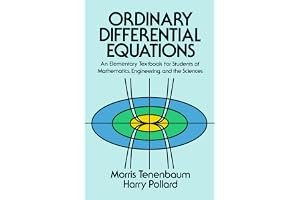 1
1