We've ranked the best black holes books using expert recommendations, sales data, and millions of reader ratings. At Shortform, we know books. Our book guides are the best in the world. Learn why.
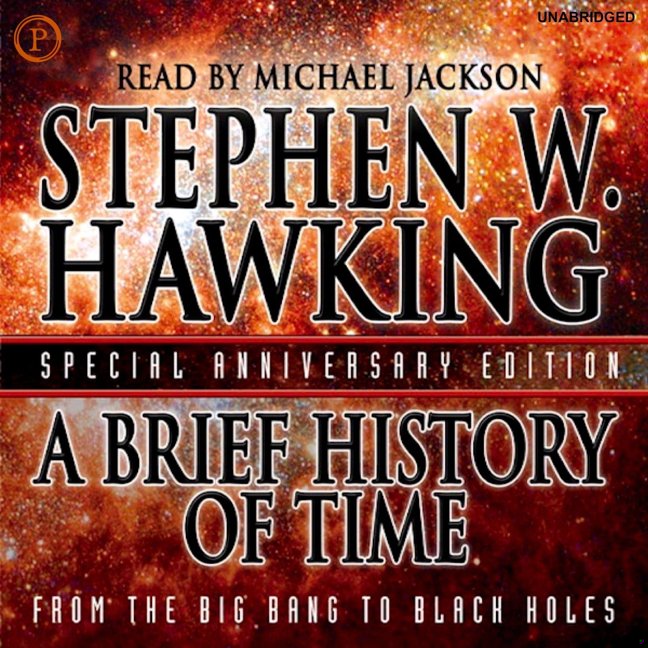
In the ten years since its publication in 1988, Stephen Hawking's classic work has become a landmark volume in scientific writing, with more than nine million copies in forty languages sold worldwide. That edition was on the cutting edge of what was then known about the origins and nature of the universe. But the intervening years have seen extraordinary advances in the technology of observing both the micro- and the macrocosmic worlds. These observations have confirmed many of Professor Hawking's theoretical predictions in the first edition of his book, including the recent discoveries of the Cosmic Background Explorer satellite (COBE), which probed back in time to within 300,000 years of the universe's beginning and revealed wrinkles in the fabric of space-time that he had projected. Eager to bring to his original text the new knowledge revealed by these observations, as well as his own recent research, Professor Hawking has prepared a new introduction to the book, written an entirely new chapter on wormholes and time travel, and updated the chapters throughout.

…
Recommended by Richard Branson, Adam Hart-Davis, Anurag Ramdasan, and 2 others.
Today is World Book Day, a wonderful opportunity to address this #ChallengeRichard sent in by Mike Gonzalez of New Jersey: Make a list of your top 65 books to read in a lifetime. [source]
Adam Hart-Davis
When Stephen Hawking wrote A Brief History of Time..his publisher told him that every equation he left in would halve the number of readers [source]
Anurag Ramdasan
My first intro into the world of physics and this got me completely hooked!

Cover unavailable
2
The Martian
Andy Weir
4.7
Note: Alternate-Cover Edition for this ASIN can be found here
Six days ago, astronaut Mark Watney became one of the first people to walk on Mars.
Now, he's sure he'll be the first person to die there.
After a dust storm nearly kills him and forces his crew to evacuate while thinking him dead, Mark finds himself stranded and completely alone with no way to even signal Earth that he’s alive—and even if he could get word out, his supplies would be gone long before a rescue could arrive.
Chances are, though, he won't have time to starve to death. The damaged machinery, unforgiving environment, or plain-old "human error" are much more likely to kill him first.
But Mark isn't ready to give up yet. Drawing on his ingenuity, his engineering skills—and a relentless, dogged refusal to quit—he steadfastly confronts one seemingly insurmountable obstacle after the next. Will his resourcefulness be enough to overcome the impossible odds against him?
…
Recommended by Ev Williams, Craig Barrett, Dan Christensen, and 2 others.
Craig Barrett
Former CEO/Intel
This book didn’t really change my mind, but rather reinforced the concept of the power of the individual. At a time when we depend more and more on big institutions to solve our business and social problems the real solutions are crafted by individual actions and initiative. This is true in the business world, where ideas from individual researchers or entrepreneurs can create mega companies overnight, and in the social sector, where such actions as high performing charter schools run circles around a moribund K-12 education system. Best we all remember that the next meaningful advances will come from individual initiative rather than massive governmental programs. After all, Google, Facebook, Uber, microloans and countless other success stories were not products of big government. [source]
Dan Christensen
@EconTalker @cable_co1 The Martian... hey it can’t all be economics and it’s a great book [source]
Fabrice Grinda
I have lots of books to recommend, but they are not related to my career path. The only one that is remotely related is Peter Thiel’s Zero to One. That said here are books I would recommend. [source]
Cover unavailable
3
The Hobbit
J. R. R. Tolkien
4.7
Bilbo Baggins is a hobbit who enjoys a comfortable, unambitious life, rarely traveling any farther than his pantry or cellar. But his contentment is disturbed when the wizard Gandalf and a company of dwarves arrive on his doorstep one day to whisk him away on an adventure. They have launched a plot to raid the treasure hoard guarded by Smaug the Magnificent, a large and very dangerous dragon. Bilbo reluctantly joins their quest, unaware that on his journey to the Lonely Mountain he will encounter both a magic ring and a frightening creature known as Gollum. (back cover)
Today is World Book Day, a wonderful opportunity to address this #ChallengeRichard sent in by Mike Gonzalez of New Jersey: Make a list of your top 65 books to read in a lifetime. [source]
First up, The Hobbit, or There and Back Again, by JRR Tolkien. But you knew I was going to say that. This one book, which was published in 1937, defined so many variables for the fantasy tradition that are still in place today. Tolkien’s extraordinary achievement was to recover the epic landscapes of Anglo-Saxon myth, bring them back to life, and then to take us through them on foot, so we could see the details up close, at human scale. The Hobbit is both mythic and relatable at the same time – The New Yorker writer Adam Gopnik recently called it “an arranged marriage between the Elder Edda and The Wind in the Willows”, and I think that’s entirely fair. Though I would give more credit to the bass register of Tolkien’s imagination, its abyssal depths. Mole never delved as deep as the Mines of Moria. [source]
Cover unavailable
4
Ready Player One
Ernest Cline
4.6
The bestselling cult classic--soon to be a major motion picture directed by Steven Spielberg.
At once wildly original and stuffed with irresistible nostalgia, READY PLAYER ONE is a spectacularly genre-busting, ambitious, and charming debut--part quest novel, part love story, and part virtual space opera set in a universe where spell-slinging mages battle giant Japanese robots, entire planets are inspired by Blade Runner, and flying DeLoreans achieve light speed.
It's the year 2045, and the real world is an ugly place.
Like most of humanity, Wade Watts escapes his grim surroundings by spending his waking hours jacked into the OASIS, a sprawling virtual utopia that lets you be anything you want to be, a place where you can live and play and fall in love on any of ten thousand planets.
And like most of humanity, Wade dreams of being the one to discover the ultimate lottery ticket that lies concealed within this virtual world. For somewhere inside this giant networked playground, OASIS creator James Halliday has hidden a series of fiendish puzzles that will yield massive fortune--and remarkable power--to whoever can unlock them.
For years, millions have struggled fruitlessly to attain this prize, knowing only that Halliday's riddles are based in the pop culture he loved--that of the late twentieth century. And for years, millions have found in this quest another means of escape, retreating into happy, obsessive study of Halliday's icons. Like many of his contemporaries, Wade is as comfortable debating the finer points of John Hughes's oeuvre, playing Pac-Man, or reciting Devo lyrics as he is scrounging power to run his OASIS rig.
And then Wade stumbles upon the first puzzle.
Suddenly the whole world is watching, and thousands of competitors join the hunt--among them certain powerful players who are willing to commit very real murder to beat Wade to this prize. Now the only way for Wade to survive and preserve everything he knows is to win. But to do so, he may have to leave behind his oh-so-perfect virtual existence and face up to life--and love--in the real world he's always been so desperate to escape.
A world at stake. A quest for the ultimate prize. Are you ready?
…
Recommended by Steve Jurvetson, Brian Armstrong, Astro Teller, and 5 others.
Steve Jurvetson
A gift to all of my Apple II programming buddies from high school and Dungeons & Dragons comrades. [source]
The last novel I read was Ernest Cline’s “Ready Player One: A Novel,” because my buddy Mike Maddock said, “You gotta read this book!” And I tore it up. I read the whole book in less than two days. It’s something I wish everyone, including myself, did more of. [source]
Cover unavailable
5
The Black Hole War: My Battle with Stephen Hawking to Make the World Safe for Quantum Mechanics
This book discusses some of the deepest features of the laws of nature. [source]
Cover unavailable
6
Black Holes & Time Warps: Einstein's Outrageous Legacy
Kip S. Thorne, Stephen Hawking
4.6
Ever since Albert Einstein's general theory of relativity burst upon the world in 1915 some of the most brilliant minds of our century have sought to decipher the mysteries bequeathed by that theory, a legacy so unthinkable in some respects that even Einstein himself rejected them.
Which of these bizarre phenomena, if any, can really exist in our universe? Black holes, down which anything can fall but from which nothing can return; wormholes, short spacewarps connecting regions of the cosmos; singularities, where space and time are so violently warped that time ceases to exist and space becomes a kind of foam; gravitational waves, which carry symphonic accounts of collisions of black holes billions of years ago; and time machines, for traveling backward and forward in time.
Kip Thorne, along with fellow theorists Stephen Hawking and Roger Penrose, a cadre of Russians, and earlier scientists such as Oppenheimer, Wheeler and Chandrasekhar, has been in the thick of the quest to secure answers. In this masterfully written and brilliantly informed work of scientific history and explanation, Dr. Thorne, the Feynman Professor of Theoretical Physics at Caltech, leads his readers through an elegant, always human, tapestry of interlocking themes, coming finally to a uniquely informed answer to the great question: what principles control our universe and why do physicists think they know the things they think they know? Stephen Hawking's A Brief History of Time has been one of the greatest best-sellers in publishing history. Anyone who struggled with that book will find here a more slowly paced but equally mind-stretching experience, with the added fascination of a rich historical and human component.
This book is just plain fun. I said before that if somebody asked me for a book to learn about relativity, I probably wouldn’t pick Einstein’s: I would pick Kip Thorne’s. [source]
Kip Thorne’s book mostly focuses on space time. It is really the most modern exposition yet at a popular level of Einstein’s theory of relativity…So if you want to know what a wormhole is, and how time machines might work, this is the book for you. [source]
Cosmos has 13 heavily illustrated chapters, corresponding to the 13 episodes of the Cosmos television series. In the book, Sagan explores 15 billion years of cosmic evolution and the development of science and civilization. Cosmos traces the origins of knowledge and the scientific method, mixing science and philosophy, and speculates to the future of science. The book also discusses the underlying premises of science by providing biographical anecdotes about many prominent scientists throughout history, placing their contributions into the broader context of the development of modern science.
The book covers a broad range of topics, comprising Sagan's reflections on anthropological, cosmological, biological, historical, and astronomical matters from antiquity to contemporary times. Sagan reiterates his position on extraterrestrial life—that the magnitude of the universe permits the existence of thousands of alien civilizations, but no credible evidence exists to demonstrate that such life has ever visited earth.
…
Recommended by Richard Branson, Ante Shoda, Anurag Ramdasan, and 1 others.
Today is World Book Day, a wonderful opportunity to address this #ChallengeRichard sent in by Mike Gonzalez of New Jersey: Make a list of your top 65 books to read in a lifetime. [source]
Ante Shoda
It explains 14 billion years of the evolution of the universe, a sort of engineering experiment on the largest possible scale. It spans all scales of space and time, describing everything from the largest scales of the universe to the smallest scales of molecules and atoms. It’s a good book for putting everything in perspective. [source]
Anurag Ramdasan
This book helped draft a great perspective on the world and the universe at large and made me a fan of the Cosmos!
Cover unavailable
8
The Hitchhiker's Guide To The Galaxy (Hitchhiker's Guide to the Galaxy, #1)
Douglas Adams
4.5
One Thursday lunchtime Earth is unexpectedly demolished to make way for a new hyperspace bypass. For Arthur Dent, who has only just had his house demolished that morning, this is already more than he can cope with. Sadly, however, the weekend has only just begun. And the Galaxy is a very, very large and startling place indeed.
I guess when I was around 12 or 15... I had an existential crisis, and I was reading various books on trying to figure out the meaning of life and what does it all mean? It all seemed quite meaningless and then we happened to have some books by Nietzsche and Schopenhauer in the house, which you should not read at age 14 (laughter). It is bad, it’s really negative. So then I read Hitchhikers Guide to the Galaxy which is quite positive I think and it highlighted an important point which is that a lot of times the question is harder than the answer. And if you can properly phrase the question, then the answer is the easy part. So, to the degree that we can better understand the universe, then we can better know what questions to ask. Then whatever the question is that most approximates: what’s the meaning of life? That’s the question we can ultimately get closer to understanding. And so I thought to the degree that we can expand the scope and scale of consciousness and knowledge, then that would be a good thing. [source]
Today is World Book Day, a wonderful opportunity to address this #ChallengeRichard sent in by Mike Gonzalez of New Jersey: Make a list of your top 65 books to read in a lifetime. [source]
Michael Arrington
Founder/TechCrunch
Not sure what you’ll learn from HHGTTG, but it’s one of the funniest series of books of all time and if you haven’t read it you pretty much have to. It’s actually a five book series that’s called a trilogy, and if Adams hadn’t died of a heart attack at age 49 in 2001 there would have likely been more books written. HHGTTG and the WWII epic Catch-22 are among my favorite books when contemplating the meaninglessness and hilarity of life (HHGTTG begins with the Earth being destroyed to to make way for a hyperspatial express route). Like Dune, skip the movie, it doesn’t do the books justice. [source]
Cover unavailable
9
Death by Black Hole: And Other Cosmic Quandaries
Neil deGrasse Tyson
4.5
A vibrant collection of essays on the cosmos from the nation's best-known astrophysicist. "One of today's best popularizers of science." —Kirkus Reviews.
Loyal readers of the monthly "Universe" essays in Natural History magazine have long recognized Neil deGrasse Tyson's talent for guiding them through the mysteries of the cosmos with stunning clarity and almost childlike enthusiasm. Here, Tyson compiles his favorite essays across a myriad of cosmic topics.
The title essay introduces readers to the physics of black holes by explaining the gory details of what would happen to your body if you fell into one. "Holy Wars" examines the needless friction between science and religion in the context of historical conflicts. "The Search for Life in the Universe" explores astral life from the frontiers of astrobiology. And "Hollywood Nights" assails the movie industry's feeble efforts to get its night skies right.
Known for his ability to blend content, accessibility, and humor, Tyson is a natural teacher who simplifies some of the most complex concepts in astrophysics while simultaneously sharing his infectious excitement about our universe.
…
Cover unavailable
10
My Heart and Other Black Holes
Jasmine Warga, Rebecca Lowman, et al
4.4
Sixteen-year-old physics nerd Aysel is obsessed with plotting her own death. With a mother who can barely look at her without wincing, classmates who whisper behind her back, and a father whose violent crime rocked her small town, Aysel is ready to turn her potential energy into nothingness.
There’s only one problem: she’s not sure she has the courage to do it alone. But once she discovers a website with a section called Suicide Partners, Aysel’s convinced she’s found her solution: a teen boy with the username FrozenRobot (aka Roman) who’s haunted by a family tragedy is looking for a partner.
Even though Aysel and Roman have nothing in common, they slowly start to fill in each other’s broken lives. But as their suicide pact becomes more concrete, Aysel begins to question whether she really wants to go through with it. Ultimately, she must choose between wanting to die or trying to convince Roman to live so they can discover the potential of their energy together. Except that Roman may not be so easy to convince.
Stephen Hawking was recognized as one of the greatest minds of our time and a figure of inspiration after defying his ALS diagnosis at age twenty-one. He is known for both his breakthroughs in theoretical physics as well as his ability to make complex concepts accessible for all, and was beloved for his mischievous sense of humor. At the time of his death, Hawking was working on a final project: a book compiling his answers to the "big" questions that he was so often posed--questions that ranged beyond his academic field.
Within these pages, he provides his personal views on our biggest challenges as a human race, and where we, as a planet, are heading next. Each section will be introduced by a leading thinker offering his or her own insight into Professor Hawking's contribution to our understanding.
…
Cover unavailable
12
A Black Hole Is Not a Hole
Carolyn Cinami DeCristofano, Michael Carroll
4.3
Get ready to S-T-R-E-T-C-H your mind!
What is a black hole? Where do they come from? How were they discovered? Can we visit one? Carolyn Cinami DeCristofano takes readers on a ride through the galaxies (ours, and others), answering these questions and many more about the phenomenon known as a black hole.
In lively and often humorous text, the book starts off with a thorough explanation of gravity and the role it plays in the formation of black holes. Paintings by Michael Carroll, coupled with real telescopic images, help readers visualize the facts and ideas presented in the text, such as how light bends, and what a supernova looks like.
A BLACK HOLE IS NOT A HOLE is an excellent introduction to an extremely complex scientific concept. Back matter includes a timeline which sums up important findings discussed throughout, while the glossary and index provide a quick point of reference for readers. Children and adults alike will learn a ton of spacey facts in this far-out book that’s sure to excite even the youngest of astrophiles.
…
Cover unavailable
13
The Universe in a Nutshell
Stephen William Hawking
4.3
Stephen Hawking’s phenomenal, multimillion-copy bestseller, A Brief History of Time, introduced the ideas of this brilliant theoretical physicist to readers all over the world.
Now, in a major publishing event, Hawking returns with a lavishly illustrated sequel that unravels the mysteries of the major breakthroughs that have occurred in the years since the release of his acclaimed first book.
Cover unavailable
14
All the Bright Places
Jennifer Niven
4.3
The Fault in Our Stars meets Eleanor and Park in this exhilarating and heart-wrenching love story about a girl who learns to live from a boy who intends to die.
Soon to be a major motion picture starring Elle Fanning! Theodore Finch is fascinated by death, and he constantly thinks of ways he might kill himself. But each time, something good, no matter how small, stops him.
Violet Markey lives for the future, counting the days until graduation, when she can escape her Indiana town and her aching grief in the wake of her sister’s recent death.
When Finch and Violet meet on the ledge of the bell tower at school, it’s unclear who saves whom. And when they pair up on a project to discover the “natural wonders” of their state, both Finch and Violet make more important discoveries: It’s only with Violet that Finch can be himself—a weird, funny, live-out-loud guy who’s not such a freak after all. And it’s only with Finch that Violet can forget to count away the days and start living them. But as Violet’s world grows, Finch’s begins to shrink.
This is an intense, gripping novel perfect for fans of Jay Asher, Rainbow Rowell, John Green, Gayle Forman, and Jenny Downham from a talented new voice in YA, Jennifer Niven.
…
Cover unavailable
15
What's Inside a Black Hole? Theories about Space Phenomena
Tom Jackson
4.3
What happens when someone or something goes into a black hole? This book introduces some of the major ideas in cosmology, bringing quarks, preons, hypothetical subparticles, pulsars, galaxies, the Big Bang theory, dark energy, and gravitational waves to life with accessible language and vivid full-color art work. The text includes fascinating sidebars and fact boxes that add extra excitement to this look into deep space phenomena. Whether it's about Stephen Hawking or the James Webb telescope, even the most reluctant readers are sure to enjoy this book.
…
Cover unavailable
16
The Illustrated A Brief History of Time/The Universe in a Nutshell
Stephen Hawking
4.3
The Illustrated A Brief History of Time
In the years since its publication in 1988, Stephen Hawking's A Brief History of Time has established itself as a landmark volume in scientific writing and an international publishing phenomenon. The book as on the cutting edge of what was then known about the nature of the universe, but since that time there have been extraordinary advances in the technology of observing both the micro- and the macrocosmic worlds. These observations have confirmed many of Professor Hawking's theoretical predictions in the first edition of his book.
Eager to bring to his original text the new knowledge revealed by these many observations, as well as his own most recent research, for this expanded edition Professor Hawking prepared a new introduction to the book, wrote an entirely new chapter on wormholes and time travel, and updated the original text. In addition, this edition is enhanced throughout with more than 240 full-color illustrations, including satellite images, photographs made possible by spectacular technological advances such as the Hubble Space Telescope, and computer-generated images of three- and four-dimensional realities. A classic work that now brings to the reader the latest understanding of cosmology, The Illustrated A Brief History of Time is the story of the ongoing search for the tantalizing secrets at the heart of time and space.
The Universe in a Nutshell
In this book, Stephen Hawking takes us to the cutting edge of theoretical physics, where truth is often stranger than fiction, to explain in layman's terms the principles that control our universe.
Like many in the community of theoretical physics, Professor Hawking is seeking to uncover the grail of science—the elusive Theory of Everything that lies at the hart of the cosmos. In his accessible and often playful style, he guides us on his search to uncover the secrets of the universe—from supergravity to supersymmetry, from quantum theory to M-theory, from holography to duality. He takes us to the wild frontiers of science and lets us behind the scenes of one of his most exciting intellectual adventures as he seeks to "combine Einstein's General Theory of Relativity and Richard Feynman's idea of multiple histories into one complete unified theory that will describe everything that happens in the universe."
With characteristic exuberance, Professor Hawking invites us to be fellow travelers on this extraordinary journey through spacetime. Copious four-color illustrations help clarify this journey into a surreal wonderland where particles, sheets, and strings move in eleven dimensions and where the original cosmic seed from which our universe sprang was a tiny nut.
The Universe in a Nutshell is essential reading for all of us who want to understand the universe in which we live. Like its companion volume, A Brief History of Time, it conveys the excitement felt within the scientific community as the secrets of the universe reveal themselves.
…
Cover unavailable
17
The Convoluted Universe - Book One
Dolores Cannon
4.3
This is the sequel to 'The Custodians'. The book contains some of the more complicated concepts in Metaphysics that Dolores Cannon discovered through twenty years of using deep hypnosis to explore the subconscious mind. Some of the topics explored in this book: The origin, knowledge and destruction of Atlantis; The explanations of Earth mysteries, including -- the Pyramids, Easter Island, the Bermuda Triangle, the Ark of the Covenant, Loch Ness Monster, Nazca Lines; Characteristics of other Planets, Parallel Universes, Parallel Lifetimes and Realities; Other Dimensions and much more. This book is intended for those readers who want their minds expanded by the more complicated Metaphysical ideas that border on 'Quantum Physics'.
…
Cover unavailable
18
Black Holes, Wormholes and Time Machines
Jim Al-Khalili
4.3
Do you know: What might happen if you fall into a black hole?
That the Universe does not have an edge?
That the reason it gets dark at night is proof of the Big Bang?
That cosmic particles time-travel through the atmosphere defying death?
That our past, present and future might all coexist "out there"?
With two remarkable ideas, Albert Einstein revolutionized our view of the Universe. His first was that nothing can travel faster than light-the ultimate speed limit. This simple fact leads to the unavoidable conclusion that space and time must be linked together forever as Spacetime. With his second monumental insight, Einstein showed how Spacetime is warped and stretched by the gravity of all objects in the Universe and even punctured by black holes. But such possible twisting of Spacetime allowed a magic not even Einstein could have imagined: time-travel.
Theoretical physicist Jim Al-Khalili finally lays science fiction to rest as he opens up Einstein's Universe. Leading us gently and light-heartedly through the dizzying world of our space and time, he even gives us the recipe for a time machine, capable of taking us Back to the Future, to Alice's Wonderland, or on a trip with the Terminator.
…
Cover unavailable
19
Black Hole Blues and Other Songs from Outer Space
Howard Hughes
4.3
The full inside story of the detection of gravitational waves at LIGO, one of the most ambitious feats in scientific history.
Travel around the world 100 billion times. A strong gravitational wave will briefly change that distance by less than the thickness of a human hair. We have perhaps less than a few tenths of a second to perform this measurement. And we don’t know if this infinitesimal event will come next month, next year or perhaps in thirty years.
In 1916 Einstein predicted the existence of gravitational waves: miniscule ripples in the very fabric of spacetime generated by unfathomably powerful events. If such vibrations could somehow be recorded, we could observe our universe for the first time through sound: the hissing of the Big Bang, the whale-like tunes of collapsing stars, the low tones of merging galaxies, the drumbeat of two black holes collapsing into one. For decades, astrophysicists have searched for a way of doing so…
In 2016 a team of hundreds of scientists at work on a billion-dollar experiment made history when they announced the first ever detection of a gravitational wave, confirming Einstein’s prediction. This is their story, and the story of the most sensitive scientific instrument ever made: LIGO.
Based on complete access to LIGO and the scientists who created it, Black Hole Blues provides a firsthand account of this astonishing achievement: a compelling, intimate portrait of cutting-edge science at its most awe-inspiring and ambitious.
…
Cover unavailable
20
Llama Destroys the World
Jonathan Stutzman, Heather Fox
4.3
Meet Llama, the next great picture-book megastar, who has most definitely driven a bus and who loves tacos way more than you.
He also loves cake, and that’s where our story begins.
On Monday, Llama discovers a pile of cake, which he promptly eats. On Tuesday, Llama squeezes into his dancing pants, which he promptly rips. The force of the rip creates a black hole (naturally). By Friday, Llama will (indirectly) destroy the world.
…
Cover unavailable
21
Astrophysics for Young People in a Hurry
Neil deGrasse Tyson and Gregory Mone
4.3
From the basics of physics to big questions about the nature of space and time, celebrated astrophysicist and science communicator Neil deGrasse Tyson breaks down the mysteries of the cosmos into bite-sized pieces. Astrophysics for Young People in a Hurry describes the fundamental rules and unknowns of our universe clearly—and with Tyson’s characteristic wit, there’s a lot of fun thrown in, too.
This adaptation by Gregory Mone includes full-color photos, infographics, and extra explanations to make even the trickiest concepts accessible. Building on the wonder inspired by outer space, Astrophysics for Young People in a Hurry introduces an exciting field and the principles of scientific inquiry to young readers.
…
Cover unavailable
22
Black Holes (Mega Bites)
Alex Barnett, Stuart Clark
4.3
Did you know you can tell how hot a star is by looking at its colour? This volume is crammed full of quirky facts and figures, close-up views and feature boxes on all kinds of space oddities.
Cover unavailable
23
George's Secret Key Paperback Collection: George's Secret Key to the Universe; George's Cosmic Treasure Hunt; George and the Big Bang
Lucy Hawking, Stephen Hawking, et al.
4.3
Join George and Annie as they explore the galaxy in this cosmic adventure series from acclaimed scientist Stephen Hawking and his daughter Lucy Hawking.
This three-book collection includes: George’s Secret Key to the Universe George’s Cosmic Treasure Hunt George and the Big Bang
Cover unavailable
24
Knife: A New Harry Hole Novel
Jo Nesbo
4.3
Brilliant, audaciously rogue police officer Harry Hole from The Snowman and The Thirst is back and in the throes of a new, unanticipated rage--once again hunting the murderer who has haunted his entire career.
Harry Hole is not in a good place. Rakel--the only woman he's ever loved--has ended it with him, permanently. He's been given a chance for a new start with the Oslo Police, but it's in the cold case office, when what he really wants is to be investigating cases he suspects have ties to Svein Finne, the serial rapist and murderer who Harry helped put behind bars. And now, Finne is free after a decade-plus in prison--free and, Harry is certain, unreformed and ready to take up where he left off. But things will get worse. When Harry wakes up the morning after a drunken night with blood that's clearly not his own on his hands, it's only the very beginning of what will be a waking nightmare the likes of which even he could never have imagined.
…
Cover unavailable
25
Black Holes and Baby Universes
Stephen W. Hawking
4.3
NY Times bestseller. 13 extraordinary essays shed new light on the mysteries of the universe & on one of the most brilliant thinkers of our time. In his phenomenal bestseller A Brief History of Time, Stephen Hawking literally transformed the way we think about physics, the universe, reality itself. In these thirteen essays and one remarkable extended interview, the man widely regarded as the most brilliant theoretical physicist since Einstein returns to reveal an amazing array of possibilities for understanding our universe. Building on his earlier work, Hawking discusses imaginary time, how black holes can give birth to baby universes, and scientists’ efforts to find a complete unified theory that would predict everything in the universe. With his characteristic mastery of language, his sense of humor and commitment to plain speaking, Stephen Hawking invites us to know him better—and to share his passion for the voyage of intellect and imagination that has opened new ways to understanding the very nature of the cosmos.
…
Cover unavailable
26
Big Bang, Black Holes, No Math
David Toback
4.3
Cover unavailable
27
Black Hole
Charles Burns
4.3
Suburban Seattle, the mid-1970s. We learn from the out-set that a strange plague has descended upon the area’s teenagers, transmitted by sexual contact. The disease is manifested in any number of ways — from the hideously grotesque to the subtle (and concealable) — but once you’ve got it, that’s it. There’s no turning back.
As we inhabit the heads of several key characters — some kids who have it, some who don’t, some who are about to get it — what unfolds isn’t the expected battle to fight the plague, or bring heightened awareness to it , or even to treat it. What we become witness to instead is a fascinating and eerie portrait of the nature of high school alienation itself — the savagery, the cruelty, the relentless anxiety and ennui, the longing for escape.
And then the murders start.
As hypnotically beautiful as it is horrifying, Black Hole transcends its genre by deftly exploring a specific American cultural moment in flux and the kids who are caught in it- back when it wasn’t exactly cool to be a hippie anymore, but Bowie was still just a little too weird.
To say nothing of sprouting horns and molting your skin…
…
Cover unavailable
28
Black Holes (The Universe)
Chris Ferrie and Susan Batori
4.3
Expand your young reader's universe! Simple, straightforward text paired with vibrant photos and colorful diagrams breaks down scientific concepts of black holes, such as gravity, light, and energy. Readers will learn about the formation and different sizes of black holes. Also discussed are the discovery of black holes and how scientists study them with telescopes and other tools. Features include a table of contents, fun facts, a glossary with phonetics, and an index. Buddy Books is an imprint of ABDO Publishing Group.
…
Cover unavailable
29
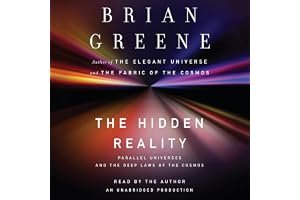
The Hidden Reality: Parallel Universes and the Deep Laws of the Cosmos
Brian Greene
4.2
From the best-selling author of The Elegant Universe and The Fabric of the Cosmos comes his most expansive and accessible book to date—a book that takes on the grandest question: Is ours the only universe?
There was a time when “universe” meant all there is. Everything. Yet, in recent years discoveries in physics and cosmology have led a number of scientists to conclude that our universe may be one among many. With crystal-clear prose and inspired use of analogy, Brian Greene shows how a range of different “multiverse” proposals emerges from theories developed to explain the most refined observations of both subatomic particles and the dark depths of space: a multiverse in which you have an infinite number of doppelgängers, each reading this sentence in a distant universe; a multiverse comprising a vast ocean of bubble universes, of which ours is but one; a multiverse that endlessly cycles through time, or one that might be hovering millimeters away yet remains invisible; another in which every possibility allowed by quantum physics is brought to life. Or, perhaps strangest of all, a multiverse made purely of math.
Greene, one of our foremost physicists and science writers, takes us on a captivating exploration of these parallel worlds and reveals how much of reality’s true nature may be deeply hidden within them. And, with his unrivaled ability to make the most challenging of material accessible and entertaining, Greene tackles the core question: How can fundamental science progress if great swaths of reality lie beyond our reach?
Sparked by Greene’s trademark wit and precision, The Hidden Reality is at once a far-reaching survey of cutting-edge physics and a remarkable journey to the very edge of reality—a journey grounded firmly in science and limited only by our imagination.
…
Cover unavailable
30
Escape from the Black Hole: The True Story of a Former Hip-Hop Artist
Ivor Myers
4.2
Cover unavailable
31
The Care and Feeding of a Pet Black Hole
Michelle Cuevas
4.2
A girl's friendship with a lonely black hole leads her to face her own sadness in this original, funny, and touching middle grade novel for fans of Crenshaw and Flora & Ulysses.
When eleven-year-old Stella Rodriguez shows up at NASA to request that her recording be included in Carl Sagan's Golden Record, something unexpected happens: A black hole follows her home, and sets out to live in her house as a pet. The black hole swallows everything he touches, which is challenging to say the least--but also turns out to be a convenient way to get rid of those items that Stella doesn't want around. Soon the ugly sweaters her aunt has made for her all disappear within the black hole, as does the smelly class hamster she's taking care of, and most important, all the reminders of her dead father that are just too painful to have around.
It's not until Stella, her younger brother, Cosmo, the family puppy, and even the bathroom tub all get swallowed up by the black hole that Stella comes to realize she has been letting her own grief consume her. And that's not the only thing she realizes as she attempts to get back home. This is an astonishingly original and funny adventure with a great big heart.
…
Cover unavailable
32
The Theory of Everything: The Origin and Fate of the Universe
Stephen W. Hawking, S. W.;Hawking
4.2
Based on a series of lectures given at Cambridge University, Professor Hawking's work introduced "the history of ideas about the universe" as well as today's most important scientific theories about time, space, and the cosmos in a clear, easy-to-understand way. "The Theory of Everything" presents the most complex theories, both past and present, of physics; yet it remains clear and accessible. It will enlighten readers and expose them to the rich history of scientific thought and the complexities of the universe in which we live.
…
Cover unavailable
33
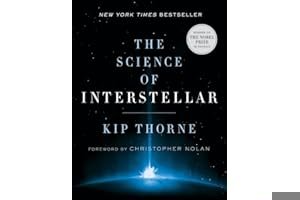
The Science of Interstellar
Kip Thorne
4.2
A journey through the otherworldly science behind Christopher Nolan’s highly anticipated film, Interstellar, from executive producer and theoretical physicist Kip Thorne.
Interstellar, from acclaimed filmmaker Christopher Nolan, takes us on a fantastic voyage far beyond our solar system. Yet in The Science of Interstellar, Kip Thorne, the physicist who assisted Nolan on the scientific aspects of Interstellar, shows us that the movie’s jaw-dropping events and stunning, never-before-attempted visuals are grounded in real science. Thorne shares his experiences working as the science adviser on the film and then moves on to the science itself. In chapters on wormholes, black holes, interstellar travel, and much more, Thorne’s scientific insights—many of them triggered during the actual scripting and shooting of Interstellar—describe the physical laws that govern our universe and the truly astounding phenomena that those laws make possible.
...eminent and prolific science writers summarize the astrophysical principles and observations that make these mind- and space-bending events at least feasible...young scientists...will be sucked in by the dramatic illustrations. -- School Library Journal
Cover unavailable
35
The Last Time We Say Goodbye
Cynthia Hand
4.2
There's death all around us. We just don't pay attention. Until we do.
The last time Lex was happy, it was before. When she had a family that was whole. A boyfriend she loved. Friends who didn't look at her like she might break down at any moment.
Now she's just the girl whose brother killed himself. And it feels like that's all she'll ever be.
As Lex starts to put her life back together, she tries to block out what happened the night Tyler died. But there's a secret she hasn't told anyone-a text Tyler sent, that could have changed everything.
Lex's brother is gone. But Lex is about to discover that a ghost doesn't have to be real to keep you from moving on.
…
Cover unavailable
36
Ilium (Ilium, #1)
Dan Simmons
4.2
The Trojan War rages at the foot of Olympos Mons on Mars—observed and influenced from on high by Zeus and his immortal family—and twenty-first-century professor Thomas Hockenberry is there to play a role in the insidious private wars of vengeful gods and goddesses. On Earth, a small band of the few remaining humans pursues a lost past and devastating truth—as four sentient machines depart from Jovian space to investigate, perhaps terminate, the potentially catastrophic emissions emanating from a mountaintop miles above the terraformed surface of the Red Planet.
…
Cover unavailable
37
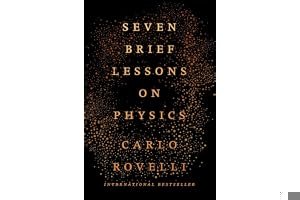
Seven Brief Lessons on Physics
Carlo Rovelli
4.2
All the beauty of modern physics in fewer than a hundred pages.
This is a book about the joy of discovery. A playful, entertaining, and mind-bending introduction to modern physics, it's already a major bestseller in Italy and the United Kingdom. Carlo Rovelli offers surprising—and surprisingly easy to grasp—explanations of general relativity, quantum mechanics, elementary particles, gravity, black holes, the complex architecture of the universe, and the role humans play in this weird and wonderful world. He takes us to the frontiers of our knowledge: to the most minute reaches of the fabric of space, back to the origins of the cosmos, and into the workings of our minds. “Here, on the edge of what we know, in contact with the ocean of the unknown, shines the mystery and the beauty of the world,” Rovelli writes. “And it’s breathtaking.”
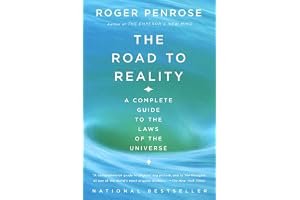
The Road to Reality: A Complete Guide to the Laws of the Universe
Roger Penrose
4.2
Roger Penrose, one of the most accomplished scientists of our time, presents the only comprehensive and comprehensible account of the physics of the universe. From the very first attempts by the Greeks to grapple with the complexities of our known world to the latest application of infinity in physics, The Road to Reality carefully explores the movement of the smallest atomic particles and reaches into the vastness of intergalactic space. Here, Penrose examines the mathematical foundations of the physical universe, exposing the underlying beauty of physics and giving us one the most important works in modern science writing.
…
Cover unavailable
39
Everything about Black Holes Astronomy Books Grade 6 - Astronomy & Space Science
Baby Professor
4.2
Is it true that within a black hole is a polarity so intense that not even light can escape? But despite that, there has been several studies made by scientists about the subject. The most interesting fruits of the years of labor and observation have been recorded in the pages of this reference book for sixth graders. Go ahead and secure a copy today!
Cover unavailable
40
Black Holes and Warped Spacetime
William J. Kaufmann
4.2
Cover unavailable
41
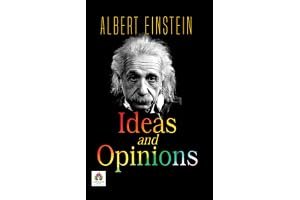
Ideas and Opinions
Albert Einstein
4.2
A new edition of the most definitive collection of Albert Einstein's popular writings, gathered under the supervision of Einstein himself. The selections range from his earliest days as a theoretical physicist to his death in 1955; from such subjects as relativity, nuclear war or peace, and religion and science, to human rights, economics, and government.
Cover unavailable
42
A User's Guide to the Universe: Surviving the Perils of Black Holes, Time Paradoxes, and Quantum Uncertainty
Dave Goldberg and Jeff Blomquist
4.2
NOW AVAILABLE IN PAPERBACK
Answers to science's most enduring questions from "Can I break the light-speed barrier like on Star Trek?" and "Is there life on other planets?" to "What is empty space made of?" This is an indispensable guide to physics that offers readers an overview of the most popular physics topics written in an accessible, irreverent, and engaging manner while still maintaining a tone of wry skepticism. Even the novice will be able to follow along, as the topics are addressed using plain English and (almost) no equations. Veterans of popular physics will also find their nagging questions addressed, like whether the universe can expand faster than light, and for that matter, what the universe is expanding into anyway.
Gives a one-stop tour of all the big questions that capture the public imagination including string theory, quantum mechanics, parallel universes, and the beginning of time Explains serious science in an entertaining, conversational, and easy-to-understand way Includes dozens of delightfully groan-worthy cartoons that explain everything from special relativity to Dark Matter Filled with fascinating information and insights, this book will both deepen and transform your understanding of the universe.
…
Cover unavailable
43
George's Secret Key to the Universe
Stephen Hawking, Lucy Hawking, et al.
4.2
In their bestselling book for young readers, noted physicist Stephen Hawking and his daughter, Lucy, provide a grand and funny adventure that explains fascinating information about our universe, including Dr. Hawking's latest ideas about black holes. It's the story of George, who's taken through the vastness of space by a scientist, his daughter, and their super-computer named Cosmos. George's Secret Key to the Universe was a New York Times bestseller and a selection of Al's Book Club on the Today show.
…
Cover unavailable
44
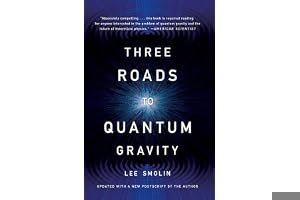
Three Roads To Quantum Gravity
Lee Smolin
4.2
"It would be hard to imagine a better guide to this difficult subject."--Scientific American In Three Roads to Quantum Gravity, Lee Smolin provides an accessible overview of the attempts to build a final "theory of everything." He explains in simple terms what scientists are talking about when they say the world is made from exotic entities such as loops, strings, and black holes and tells the fascinating stories behind these discoveries: the rivalries, epiphanies, and intrigues he witnessed firsthand.
"Provocative, original, and unsettling." -The New York Review of Books
"An excellent writer, a creative thinker."-Nature
…
Cover unavailable
45
Geons, Black Holes and Quantum Foam: A Life in Physics
Kenneth W. Ford, John Archibald Wheeler
4.2
He studied with Niels Bohr, taught Richard Feynman, and boned up on relativity with his friend and colleague Albert Einstein. John Archibald Wheeler's fascinating life brings us face to face with the central characters and discoveries of modern physics. He was the first American to learn of the discovery of nuclear fission, later coined the term "black hole," led a renaissance in gravitation physics, and helped to build Princeton University into a mecca for physicists.
From nuclear physics, to quantum theory, to relativity and gravitation, Wheeler's work has set the trajectory of research for half a century. His career has brought him into contact with the most brilliant minds of his field; Fermi, Bethe, Rabi, Teller, Oppenheimer, and Wigner are among those he called colleagues and friends. In this rich autobiography, Wheeler reveals in fascinating detail the excitement of each discovery, the character of each colleague, and the underlying passion for knowledge that drives him still.
…
Cover unavailable
46
The Geometry of Kerr Black Holes
Barrett O'Neill
4.2
This unique monograph by a noted UCLA professor examines in detail the mathematics of Kerr black holes, which possess the properties of mass and angular momentum but carry no electrical charge. Suitable for advanced undergraduates and graduate students of mathematics, physics, and astronomy as well as professional physicists, the self-contained treatment constitutes an introduction to modern techniques in differential geometry. The text begins with a substantial chapter offering background on the mathematics needed for the rest of the book. Subsequent chapters emphasize physical interpretations of geometric properties such as curvature, geodesics, isometries, totally geodesic submanifolds, and topological structure. Further investigations cover relativistic concepts such as causality, Petrov types, optical scalars, and the Goldberg-Sachs theorem. Four helpful appendixes supplement the text.
…
Cover unavailable
47
Black Hole Focus: How Intelligent People Can Create a Powerful Purpose for Their Lives
Isaiah Hankel
4.2
.".".an absurdly motivating book." -"A.J. Jacobs, New York Times bestselling author" "
Black Hole Focus is a handbook for intelligent people looking for step-by-step guidance in creating a focus so powerful it will transform lives.
Through personal (and sometimes embarrassing) stories, Dr. Isaiah Hankel breaks down the primary driver behind the actions of successful people: focus.
Divided into three parts, Black Hole Focus explains why you need a focus, how to create your focus, and what your newfound focus can do for you in the face of adversity.
In Black Hole Focus, you’ll also discover…
How to create powerful priorities that will keep you focused and eliminate even the worst distractions (like Facebook!). The 6 ways to get 10,000 hours of experience in less than a year (chances are, you’re already using 2-3 of them). What 3 skills you must learn for securing your future (skills that automation will never replace).
…
Cover unavailable
48
The Black Hole Book
Alex Miller
4.2
The Black Hole Book is your guide to the mysteries of Deep Space in astrological interpretation. These celestial powerhouses are revealed as important formative agents, both in our character and in the events unfolding in the world around us. With extensive interpretive material on Black Hole interaction with each planet that can be applied to the birth chart, supported by detailed examples from celebrity charts and current events, The Black Hole Book also delves into cutting edge astrophysical theory to explain the scientific background on how these energy transducers operate and the effect they have in our lives. Whether amateur or beginning student, novice or seasoned astrological professional, The Black Hole Book offers something for everyone, and opens a window into a dynamic level of celestial functioning underpinning the planetary energies of our solar system. Astrologer Alex Miller has encapsulated more than twenty years of active research and counseling with these anomalies to provide a roadmap to the inner workings of that most elusive of celestial phenomena, the Black Hole.
…
Cover unavailable
49
Exploring Black Holes
Laura Hamilton Waxman
4.2
What space objects can have millions of times more mass than our Sun, but they remain invisible? Black holes! Their gravity is so strong that not even light can escape. In this book, you'll learn about one of the amazing wonders of space. As part of the Searchlight Books(TM) collection, this series explores outer space and sheds light on the question What's Amazing about Space? Fantastic photos, kid-friendly explanations of science concepts, and useful diagrams will help you discover the answers!
-- "Journal"
…
Cover unavailable
50
Black Holes and the Universe
Igor Novikov, Vitaly Kisin
4.2
Formed by the force of gravity, warping space and time, crushing stars and perhaps galaxies, black holes represent the most condensed state of matter in the universe. Their properties and significance are explored by a scientist hailed as Russia's answer to Stephen Hawking.
Cover unavailable
51
Olympos (Ilium, #2)
Dan Simmons
4.2
Librarian's Note: Alternate Edition with same isbn & isbn 13: January 2011
THE EXTRAORDINARY AND MAGNIFICENT EPIC CONCLUSION TO THE HUGO AWARD-NOMINATED ILIUM
Beneath the gaze of the gods, the mighty armies of Greece and Troy met in fierce and glorious combat, scrupulously following the text set forth in Homer's timeless narrative, but that was before twenty-first century scholar Thomas Hockenberry stirred the bloody brew, causing an enraged Achilles to join forces with his archenemy Hector and turn his murderous wrath on Zeus and the entire pantheon of divine manipulators; before the swift and terrible mechanical creatures that catered for centuries to the pitiful idle remnants of Earth's human race began massing in the millions, to exterminate rather than serve.
And now all bets are off.
…
Cover unavailable
52
Brainwashed (Crime Travelers, #1)
Paul Aertker
4.2
While sleeping on the roof of his father’s hotel, thirteen-year-old Lucas Benes finds a baby alone and learns that the Good Company has restarted its profitable kidnapping business.
Brainwashed (Crime Travelers #1) tracks the secret urban adventures of the New Resistance, a network of international teenage spies. Headquartered in Las Vegas’s posh Globe Hotel, the New Resistance sends its Tier One kids to Paris on its biggest mission to date. Lucas leads a group of friends through the hotspots of Paris—from the catacombs to the Eiffel tower—in an all-out effort to sabotage a brainwashing ceremony that could potentially turn them all into “Good” kids.
…
Cover unavailable
53
The World Treasury of Physics, Astronomy & Mathematics from Albert Einstein to Stephen W. Hawking & from Annie Dillard to John Updike
Timothy Ferris
4.2
The most Eloquent and inspired scienc writing of our time.An astonishing cast of more than ninety renowned writers provides thoughtful and lucid reflections on some of the major scentific topics of our time - from black holes and galaxies to artificial intelligence and chaos theory. Featuring essays, articles, and poems penned by notables in the worlds of both science and literature, this unique book will delight the science enthusiast and the inquisitive general reader alike.
…
Cover unavailable
54
The Life of the Cosmos
Lee Smolin
4.2
Cosmologist Lee Smolin offers a startling new theory of the universe that is at once elegant, comprehensive, and radically different from anything proposed before. In The Life of the Cosmos, Smolin cuts the Gordian knot of cosmology with a simple, powerful idea: "The underlying structure of our world, " he writes, "is to be found in the logic of evolution." Today's physicists have overturned Newton's view of the universe, yet they continue to cling to an understanding of reality not unlike Newton's own - as a clock, an intricate mechanism, governed by laws which are mathematical and eternally true. Smolin argues that the laws of nature we observe may be in part the result of a process of natural selection which took place before the big bang. Smolin's ideas are based on recent developments in cosmology, quantum theory, relativity and string theory, yet they offer, at the same time, an unprecedented view of how these developments may fit together to form a new theory of cosmology. From this perspective, the lines between the simple and the complex, the fundamental and the emergent, and even between the biological and the physical are redrawn. The result is a framework that illuminates many intractable problems, from the paradoxes of quantum theory and the nature of space and time to the problem of constructing a final theory of physics. As he argues for this new view, Smolin introduces the reader to recent developments in a wide range of fields, from string theory and quantum gravity to evolutionary theory the structure of galaxies. He examines the philosophical roots of controversies in the foundations of physics, and shows how they may be transformed as science moves towardunderstanding the universe as an interrelated, self-constructed entity, within which life and complexity have a natural place, and in which "the occurrence of novelty, indeed the perpetual birth of novelty, can be understood."
…
Cover unavailable
55
Black Hole: How an Idea Abandoned by Newtonians, Hated by Einstein, and Gambled On by Hawking Became Loved
Marcia Bartusiak
4.2
The contentious history of the idea of the black hole—the most fascinating and bizarre celestial object in the heavens
For more than half a century, physicists and astronomers engaged in heated dispute over the possibility of black holes in the universe. The weirdly alien notion of a space-time abyss from which nothing escapes—not even light—seemed to confound all logic. This engrossing book tells the story of the fierce black hole debates and the contributions of Einstein and Hawking and other leading thinkers who completely altered our view of the universe.
Renowned science writer Marcia Bartusiak shows how the black hole helped revive Einstein’s greatest achievement, the general theory of relativity, after decades during which it had been pushed into the shadows. Not until astronomers discovered such surprising new phenomena as neutron stars and black holes did the once-sedate universe transform into an Einsteinian cosmos, filled with sources of titanic energy that can be understood only in the light of relativity. This book celebrates the hundredth anniversary of general relativity, uncovers how the black hole really got its name, and recounts the scientists’ frustrating, exhilarating, and at times humorous battles over the acceptance of one of history’s most dazzling ideas.
…
Cover unavailable
56
Black Holes (A True Book: Space)
Ker Than
4.2
Can anything escape the gravitational pull of a black hole? A True Book: Space series dives into the many components that make each planet distinctive and exceptional, as well as explore many of the other components that make up Space. This series includes an age appropriate (grades 3-5) introduction to curriculum-relevant subjects and a robust resource section that encourages independent study.
This book describes how black holes form, their different sizes, how scientists find black holes in space, and if anything can escape from its gravitational pull.
…
Cover unavailable
57
The Black Hole of High Conflict: Your Child-Safe Guide for Navigating High Conflict Divorce and Custody Issues
Brook D Olsen
4.2
"As went the marriage so goes the divorce" and "Stay away from the flypaper!" These were the most important words spoken to me when I was going through my own high conflict divorce some 13 years ago. My therapist's advice changed the way I thought about nearly everything that happened from that point forward and, most importantly, how I reacted to events during the 2-1/2 year divorce process. If you have been caught up in the long and painful path of a high conflict divorce you will probably agree with these statements. If you are just beginning the divorce process, please take time to reflect on these statements. I believe they will save you great pain and help you find your way through this most treacherous time. If you are reading this material you are likely someone who is looking (or knows someone who is looking) for answers regarding the cycle and traits of a high conflict divorce. In the pages to come I will give you a perspective that you may not hear from the established minds in the worlds of family law or mental health. My goal is to offer you a highly effective process to navigate through high conflict divorce, and get you to think outside of the traditional "box." I have developed leading-edge strategies that have been enormously successful in helping clients and students through the maze of high conflict divorce. Most Family Court professionals believe that all parents have to find a way to co-parent and generate orders that reflect this, even in the face of clear evidence that in high conflict situations, co-parenting only makes the problem worse. These beliefs about co-parenting are based on the normal behavior of the vast majority of separated parents (around 70%). Parents in the remaining high conflict group (around 30%) are not capable of co-parenting in the traditional sense. Familiarizing yourself with the traits and behaviors of high conflict personalities is probably the single most important undertaking necessary to changing the way YOU think, react and behave when it comes to dealing with the other parent. It isn't advanced psychology to state that most all of our worldviews and behaviors are a product of our history. Examining the history of your relationship, as well as any childhood issues experienced by you or the other parent, will help you not only understand better the other parent's point of view, but will give you a good predictor of the behavior to come. This book will change how you think and what you believe regarding the family court system, and free you from the recurring nightmare of being entangled in a fight that makes no sense. It is not intended to be digested in one sitting. Exercises are included at the end of each chapter and will require extra time and effort. If you choose to use them, they will enhance your understanding and effectiveness of the material presented. These are contemplative exercises of the material presented in each chapter.
…
Cover unavailable
58
Antimatter
Frank Close
4.2
Of all the mind-bending discoveries of physics--quarks, black holes, strange attractors, curved space--the existence of antimatter is one of the most bizarre. It is also one of the most difficult, literally and figuratively, to grasp.
Antimatter explores this strange mirror world, where particles have identical yet opposite properties to those that make up the familiar matter we encounter everyday, where left becomes right, positive becomes negative, and where--should matter and antimatter meet--the resulting flash of blinding energy would make even thermonuclear explosions look feeble by comparison. Antimatter is an idea long beloved of science-fiction writers--but here, renowned science writer Frank Close shows that the reality of antimatter is even more intriguing than the fiction. We know that at one time antimatter and matter existed in perfect counterbalance, and that antimatter then perpetrated a vanishing act on a cosmic scale that remains one of the great mysteries of the universe. Today, antimatter does not exist normally, at least on Earth, but we know that it is real, as scientists are now able to make small pieces of it in particle accelerators, such as that at CERN in Geneva. Looking at the remarkable prediction of antimatter and how it grew from the meeting point of relativity and quantum theory in the early 20th century, at the discovery of the first antiparticles, at cosmic rays, annihilation, antimatter bombs, and antiworlds, Close separates the facts from the fiction about antimatter, and explains how its existence can give us profound clues about the origins and structure of the universe.
For all those wishing to take a closer look at the flip side of the visible world, this lucidly written book shines a bright light into a truly strange realm.
"Beautifully written... This book will inspire a sense of awe in even the most seasoned of physics readers." --Amanda Gefter, New Scientist
"This is a must read for fans of science and science fiction alike." --John Gribbin, www.bbcfocusmagazine.com
…
Cover unavailable
59
A Relativist's Toolkit
Eric Poisson
4.2
This textbook fills a gap in the existing literature on general relativity by providing the advanced student with practical tools for the computation of many physically interesting quantities. The context is provided by the mathematical theory of black holes, one of the most successful and relevant applications of general relativity. Topics covered include congruences of timelike and null geodesics, the embedding of spacelike, timelike and null hypersurfaces in spacetime, and the Lagrangian and Hamiltonian formulations of general relativity.
…
Cover unavailable
60
Radical Amazement: Contemplative Lessons from Black Holes, Supernovas, and Other Wonders of the Universe
Judy Cannato
4.2
Invites us to explore the harmony of science and spirituality. This book offers a collection of practical reflections, prayers and meditations which unifies the worlds of science and religion, weaving profound spiritual lessons.
Cover unavailable
61
Nor Crystal Tears (Humanx Commonwealth, #9)
Alan Dean Foster
4.2
Before Man and insectlike Thranx had become allies, when the reptilian AAnn were just occasional raiders of Thranx colony worlds, one young Thranx agricultural expert lived a life of quiet desperation.
A dreamer in a world of sensible, stable beings, Ryo buried himself in his work -- reclaiming marshland from a tenacious jungle -- until he came across a letter describing a relative's encounter with horrid, two-legged, soft-skinned space-going beasts...
…
Cover unavailable
62
Our Chemical Hearts
Krystal Sutherland
4.2
Henry Page has never been in love. He fancies himself a hopeless romantic, but the slo-mo, heart palpitating, can't-eat-can't-sleep kind of love that he's been hoping for just hasn't been in the cards for him-at least not yet. Instead, he's been happy to focus on his grades, on getting into a semi-decent college and finally becoming editor of his school newspaper. Then Grace Town walks into his first period class on the third Tuesday of senior year and he knows everything's about to change.
Grace isn't who Henry pictured as his dream girl-she walks with a cane, wears oversized boys' clothes, and rarely seems to shower. But when Grace and Henry are both chosen to edit the school paper, he quickly finds himself falling for her. It's obvious there's something broken about Grace, but it seems to make her even more beautiful to Henry, and he wants nothing more than to help her put the pieces back together again. And yet, this isn't your average story of boy meets girl. Krystal Sutherland's brilliant debut is equal parts wit and heartbreak, a potent reminder of the bittersweet bliss that is first love.
…
Cover unavailable
63
Vacuum Diagrams (Xeelee Sequence, #5)
Stephen Baxter
4.2
"And everywhere the Humans went, they found life..." This dazzling future history, winner of the 2000 Philip K. Dick Award, is the most ambitious and exciting since Asimov's classic Foundation saga. It tells the story of Humankind - all the way to the end of the Universe itself.
Here, in luminous and vivid narratives spanning five million years, are the first Poole wormholes spanning the solar system; the conquest of Human planets by Squeem; GUTships that outrace light; the back-time invasion of the Qax; the mystery and legacy of the Xeelee, and their artifacts as large as small galaxies; photino birds and Dark Matter; and the Ring, where Ghost, Human, and Xeelee contemplate the awesome end of Time.
Contents: Prologue: Eve (1997) The Sun-People (1993) The Logic Pool (1994) Gossamer (1995) Cilia-of-Gold (1994) Lieserl (1993) Pilot (1993) The Xeelee Flower (1987) More Than Time or Distance (1988) The Switch (1990) Blue Shift (1989) The Quagma Datum (1989) Planck Zero (1992) The Gödel Sunflowers (1992) Vacuum Diagrams (1990) Stowaway (1991) The Tyranny of Heaven (1990) Hero (1995) Secret History (1991) Shell (1987) The Eighth Room (1989) The Baryonic Lords (1991) Epilogue: Eve (1997)
…
Cover unavailable
64
Icarus at the Edge of Time
Brian Greene
4.2
A futuristic reimaging of the classic Greek myth, as a boy ventures through deep space and challenges the awesome power of black holes. The beauty of the book lies in the images, provided by NASA and the Hubble Space telescope, and printed on board rather than paper.
Cover unavailable
65
The Forge of God (Forge of God, #1)
GREG BEAR
4.2
On July 26, Arthur Gordon learns that Europa, the sixth moon of Jupiter, has disappeared. Not hiding, not turned black, but gone. On September 28th, Edward Shaw, a geologist working in Death valley, finds a mysterious new cinder cone in very well-mapped area As more unexplained phenomena spring up around the globeL: a granite mountain appearing in Australia, sounds emanating from the Earth's core, flashes of light among the asteroids, it becomes clear to some that the end is approaching, and there is nothing that can be done. In The Forge of God, award-winning author Greg Bear describes the final days of the world on both a massive, scientific scale and in the everyday, emotional context of individual human lives. Facing the destruction of all they know, some people turn to God, others to their families, and a few turn to saviors promising escape from a planet tearing itself apart. Will they make it in time? And who gets left behind to experience the last moments of beauty and chaos on Earth?
…
Cover unavailable
66
The Collapsing Universe
Isaac asimov
4.2
Was the mysterious 30-megaton blast that flattened a Siberian forest in 1908 actually caused by a small black hole? Does matter drawn into a black hole reappear out the 'other side' as anti-matter, a sort of mirror-image of the universe as we know it? Could back holes explain the 'Big Bang'? Does their existence raise the possibility that matter can move faster than the speed of light? The noted scientist and science fiction author explores the exciting implications of black holes, taking the reader on an engaging tour from the atom's innermost core to the outermost reaches of the universe.
…
Cover unavailable
67
Beyond the Solar System: Exploring Galaxies, Black Holes, Alien Planets, and More; A History with 21 Activities
Mary Kay Carson
4.1
Winner of: NSTA-CBC Outstanding Science Trade Books for Students K-12 for 2014 list
Humans have gazed into the night sky for thousands of years and wondered, What are those twinkling lights? Though the sun, moon, and planets moved across the background of stars, the stars themselves appeared immovable, forever fixed in constellations. Only when astronomers began taking a closer look did anyone realize what a fascinating, ever-changing universe lies beyond our solar system—red giant and white dwarf stars, spiral galaxies, wispy nebulae, black holes, and much more.
In Beyond the Solar System, author Mary Kay Carson traces the evolution of humankind’s astronomical knowledge, from the realization that we are not at the center of the universe to recent telescopic proof of planets orbiting stars outside our solar system. In addition to its engaging history, this book contains 21 hands-on projects to further explore the subjects discussed. Readers will build a three-dimensional representation of the constellation Orion, model the warping of space-time caused by a black hole, see how the universe expands using an inflating balloon, and construct a reflecting telescope out of a makeup mirror and a magnifying glass. Beyond the Solar System also includes minibiographies of famous astronomers, a time line of major scientific discoveries, a suggested reading list, a glossary of technical terms, and a list of websites for further exploration.
…
Cover unavailable
68
Gateway (Heechee Saga, #1)
Frederik Pohl
4.1
Gateway opened on all the wealth of the Universe... and on reaches of unimaginable horror.
When prospector Robinette Broadhead went out to Gateway on the Heechee spacecraft, he decided he would know which was the right mission to make him his fortune. Three missions later, now famous and permanently rich, Rob Broadhead has to face what happened to him and what he has become... in a journey into himself as perilous and even more horrifying than the nightmare trip through the interstellar void that he drove himself to take!
…
Cover unavailable
69
Endless Universe: Beyond the Big Bang
Paul J. Steinhardt, Neil Turok
4.1
Two world-renowned scientists present an audacious new vision of the cosmos that “steals the thunder from the Big Bang theory.” —Wall Street Journal
The Big Bang theory—widely regarded as the leading explanation for the origin of the universe—posits that space and time sprang into being about 14 billion years ago in a hot, expanding fireball of nearly infinite density. Over the last three decades the theory has been repeatedly revised to address such issues as how galaxies and stars first formed and why the expansion of the universe is speeding up today. Furthermore, an explanation has yet to be found for what caused the Big Bang in the first place.
In Endless Universe, Paul J. Steinhardt and Neil Turok, both distinguished theoretical physicists, present a bold new cosmology. Steinhardt and Turok “contend that what we think of as the moment of creation was simply part of an infinite cycle of titanic collisions between our universe and a parallel world” (Discover). They recount the remarkable developments in astronomy, particle physics, and superstring theory that form the basis for their groundbreaking “Cyclic Universe” theory. According to this theory, the Big Bang was not the beginning of time but the bridge to a past filled with endlessly repeating cycles of evolution, each accompanied by the creation of new matter and the formation of new galaxies, stars, and planets.
Endless Universe provides answers to longstanding problems with the Big Bang model, while offering a provocative new view of both the past and the future of the cosmos. It is a “theory that could solve the cosmic mystery” (USA Today).
…
Cover unavailable
70
Quasars, Pulsars, and Black Holes
Frederic golden
4.1
Cover unavailable
71
Cockroaches (Harry Hole, #2)
Jo Nesbo
4.1
When the Norwegian ambassador to Thailand is found dead in a Bangkok brothel, Inspector Harry Hole is dispatched from Oslo to help hush up the case.
But once he arrives Harry discovers that this case is about much more than one random murder. There is something else, something more pervasive, scrabbling around behind the scenes. Or, put another way, for every cockroach you see in your hotel room, there are hundreds behind the walls. Surrounded by round-the-clock traffic noise, Harry wanders the streets of Bangkok lined with go-go bars, temples, opium dens, and tourist traps, trying to piece together the story of the ambassador’s death even though no one asked him to, and no one wants him to—not even Harry himself.
…
Cover unavailable
72
Einstein's Monsters: The Life and Times of Black Holes
Chris Impey
4.1
Black holes are the most extreme objects in the universe, and yet they are ubiquitous. Every massive star leaves behind a black hole when it dies, and every galaxy harbors a supermassive black hole at its center. Frighteningly enigmatic, these dark giants continue to astound even the scientists who spend their careers studying them. Which came first, the galaxy or its central black hole? What happens if you travel into one—instant death or something weirder? And, perhaps most important, how can we ever know anything for sure about black holes when they destroy information by their very nature?
In Einstein’s Monsters, distinguished astronomer Chris Impey takes readers on an exploration of these and other questions at the cutting edge of astrophysics, as well as the history of black holes’ role in theoretical physics—from confirming Einstein’s equations for general relativity to testing string theory. He blends this history with a poignant account of the phenomena scientists have witnessed while observing black holes: stars swarming like bees around the center of our galaxy; black holes performing gravitational waltzes with visible stars; the cymbal clash of two black holes colliding, releasing ripples in space-time.
Clear, compelling, and profound, Einstein’s Monsters reveals how our comprehension of black holes is intrinsically linked to how we make sense of the universe and our place within it. From the small questions to the big ones—from the tiniest particles to the nature of space-time itself—black holes might be the key to a deeper understanding of the cosmos.
…
Cover unavailable
73
Exploring Black Holes: Introduction to General Relativity
Edwin F. Taylor and John Archibald Wheeler
4.1
A concise, direct examination of general relativity and black holes, "Exploring Black Holes" provides tools that motivate tools that motivate readers to become active participants in carrying out their own investigations about curved spacetime near earth and black holes. The authors use calculus and algebra to make general relativity accessible, and use quotes from well-known personalities, including Einstein, to offer further insight. Five chapters introduce basic theory. The book also includes seven projects regarding the analysis of major applications. Discussions provide the background needed to carry out projects. The book's projects guide readers as they fill in steps, compute outcomes and carry out their own investigations. For astronomers, mathematicians and people interested in learning about the relativity of black holes.
…
Cover unavailable
74
The Annals of the Heechee (Heechee Saga, #4)
Frederik Pohl
4.1
Advanced Heechee technology had enabled Robinette Broadhead to live after death as a machine-stored personality, enjoying his life by flitting along the wires from party to party with a host of other machine-people. But suddenly his decadent existence ends when an all powerful alien race intent on the utter destruction of all intelligent life reappears after eons of silence, and threatens the lives of all heechee and humans. Even Robin, virtually immortal and with unlimited access to millennia of accumulated data, cannot discover how to stop these aliens. It began to seem that only a face to face meeting could determine the future of the entire universe....
…
Cover unavailable
75
Einstein's Unfinished Symphony: Listening to the Sounds of Space-Time
Marcia Bartusiak
4.1
In a handful of observatories around the world, scientists are waiting, and listening. Their quest: to be the first to detect gravitational waves, infinitesimal quakes that stretch and compress space-time and could add a brand-new dimension to our universal knowledge-allowing us to hear a sun going supernova, black holes colliding, and perhaps one day, the remnant rumble of the Big Bang itself...
Cover unavailable
76
Monologues for Calculating the Density of Black Holes
Anders Nilsen
4.1
Monologues for Calculating the Density of Black Holes takes up where the artist's first volume, Monologues for the Coming Plague, left off. Like the Coming Plague, Black Holes is a creatively experimental laboratory, comprising a collection of free flowing stream-of-consciousness gags, strips, and drawings that slowly coalesce into an unexpectedly compelling and complex narrative. The hints of story that came together in Coming Plague are extrapolated and expanded upon and grow to incorporate some of Nilsen's other outre strips from the anthology MOME, two of which are reprinted here in expanded form. The book is an audacious investigation into the rhythms of storytelling, the blurring of media, and an exercise in reconciling contrasts. It is playful, provocative and serious all at once—another tour de force by Anders Nilsen, impeccably and uniquely designed, in black and white and color.
…
Cover unavailable
77
Black Holes: And Other Bizarre Space Objects
David Jefferis
4.1
Cover unavailable
78
The Little Book of Black Holes
Steven S. Gubser, Frans Pretorius
4.1
Dive into a mind-bending exploration of the physics of black holes
Black holes, predicted by Albert Einstein's general theory of relativity more than a century ago, have long intrigued scientists and the public with their bizarre and fantastical properties. Although Einstein understood that black holes were mathematical solutions to his equations, he never accepted their physical reality--a viewpoint many shared. This all changed in the 1960s and 1970s, when a deeper conceptual understanding of black holes developed just as new observations revealed the existence of quasars and X-ray binary star systems, whose mysterious properties could be explained by the presence of black holes. Black holes have since been the subject of intense research--and the physics governing how they behave and affect their surroundings is stranger and more mind-bending than any fiction.
After introducing the basics of the special and general theories of relativity, this book describes black holes both as astrophysical objects and theoretical "laboratories" in which physicists can test their understanding of gravitational, quantum, and thermal physics. From Schwarzschild black holes to rotating and colliding black holes, and from gravitational radiation to Hawking radiation and information loss, Steven Gubser and Frans Pretorius use creative thought experiments and analogies to explain their subject accessibly. They also describe the decades-long quest to observe the universe in gravitational waves, which recently resulted in the LIGO observatories' detection of the distinctive gravitational wave "chirp" of two colliding black holes--the first direct observation of black holes' existence.
The Little Book of Black Holes takes readers deep into the mysterious heart of the subject, offering rare clarity of insight into the physics that makes black holes simple yet destructive manifestations of geometric destiny.
…
Cover unavailable
79
Introducing Quantum Theory: A Graphic Guide (Introducing...)
J.P. McEvoy
4.1
Quantum theory confronts us with bizarre paradoxes which contradict the logic of classical physics. At the subatomic level, one particle seems to know what the others are doing, and according to Heisenberg's "uncertainty principle", there is a limit on how accurately nature can be observed. And yet the theory is amazingly accurate and widely applied, explaining all of chemistry and most of physics. "Introducing Quantum Theory" takes us on a step-by-step tour with the key figures, including Planck, Einstein, Bohr, Heisenberg and Schrodinger. Each contributed at least one crucial concept to the theory. The puzzle of the wave-particle duality is here, along with descriptions of the two questions raised against Bohr's "Copenhagen Interpretation" - the famous "dead and alive cat" and the EPR paradox. Both remain unresolved.
…
Cover unavailable
80
Black Holes
J Pournelle
4.1
Cover unavailable
81
Unveiling The Edge Of Time: Black Holes, White Holes, and Worm Holes
John Gribbin
4.1
Once the stuff of science-fiction novels, black holes, and their even stranger cosmological counterparts, white holes and worm holes, are now the subject of serious scientific inquiry. Physicists who formerly shunned these astrophysical eccentricities have begun to theorize about them and search for the physical proof of their existence with the zeal of converts. Their unavoidable conclusion of this research is that these "rips in the fabric of spacetime" are not only real, they might actually provide a passage to other universes and travel through time. Unveiling the Edge of Time tells the fascinating story of the theories and discoveries that have led scientists to these astonishing conclusions. Here, acclaimed science writer John Gribbin tells of the scientists and the ideas behind this revolution in cosmology - from the first notions of an object so large its gravity would trap even light, to the most recent developments in the search for "naked singularities" - the center of a black hole where all known laws of physics break down. Gribbin recounts for us such dramatic stories as how Carl Sagan's science-fiction search for a plausible method of hyperspace travel led a fellow physicist to make some of the most startling recent advances in relativity theory. Taking readers into new universes and across time itself, Gribbin provides remarkable descriptions of what it would be like for astronauts taking trips through each of these spacetime "holes" - what they would see and feel as they are drawn across "event horizons" and where they would arrive after passing through a singularity. With a scientist's knowledge of the facts and a writer's gift for description, John Gribbin conveys these extraordinary ideas with both excitement and clarity. The result is an intellectual adventure that will take readers to the farthest reaches of today's science.
…
Cover unavailable
82
The Mathematical Theory of Black Holes
S. Chandrasekhar
4.1
This volume has become one of the modern classics of relativity theory. When it was written in 1983 there was little physical evidence for the existence of black holes. Recent discoveries have only served to underscore the elegant theory developed here, and the book remains one of the clearest statements of the relevant mathematics.
Cover unavailable
83
An Introduction to Black Holes, Information and the String Theory Revolution: The Holographic Universe
Leonard Susskind, James Lindesay
4.1
- A unique exposition of the foundations of the quantum theory of black holes including the impact of string theory, the idea of black hole complementarily and the holographic principle bull; Aims to educate the physicist or student of physics who is not an expert on string theory, on the revolution that has grown out of black hole physics and string theory
Cover unavailable
84
Extraterrestrial Civilizations
Isaac Asimov
4.1
The master of science fiction speculates about life on other planets...
"Intriguing"--Publishers Weekly
Cover unavailable
85
Black Holes: A Very Short Introduction
Katherine Blundell
4.1
Black holes are a constant source of fascination to many due to their mysterious nature. This Very Short Introduction, addresses a variety of questions, including what a black hole actually is, how they are characterized and discovered, and what would happen if you came too close to one. Professor Katherine Blundell looks at the seemingly paradoxical, mysterious, and intriguing phenomena of black holes. Outlining their nature and characteristics, both those resulting from the spectacular collapse of heavy stars, and the giant black holes found at the centres of galaxies, she separates scientific fact from science fiction, and demonstrates the important role they play in the cosmos. ABOUT THE SERIES: The Very Short Introductions series from Oxford University Press contains hundreds of titles in almost every subject area. These pocket-sized books are the perfect way to get ahead in a new subject quickly. Our expert authors combine facts, analysis, perspective, new ideas, and enthusiasm to make interesting and challenging topics highly readable.
…
Cover unavailable
86
Black Holes
Dana Meachen Rau
4.1
Describes the characteristics, formation, and study of black holes in our solar system.
Cover unavailable
87
How to Build a Time Machine
Paul Davies
4.1
With his unique knack for making cutting-edge theoretical science effortlessly accessible, world-renowned physicist Paul Davies now tackles an issue that has boggled minds for centuries: Is time travel possible? The answer, insists Davies, is definitely yes--once you iron out a few kinks in the space-time continuum. With tongue placed firmly in cheek, Davies explains the theoretical physics that make visiting the future and revisiting the past possible, then proceeds to lay out a four-stage process for assembling a time machine and making it work. Wildly inventive and theoretically sound, How to Build a Time Machine is creative science at its best--illuminating, entertaining, and thought provoking.
…
Cover unavailable
88
Black Holes
Martha Elizabeth Hillman Rustad, Ilia I Roussev
4.1
Did you know nothing escapes a black hole? What else do scientists know about these mysterious places in space? Find out more in Black Holes.
Cover unavailable
89
Black Holes
Jean Luminet
4.1
Black holes are the most fascinating discovery of modern astronomy. They have already become legendary, and form the basis of many myths and fantasies. Are they really the monsters of science fiction which devour light and stars? Are they purely hypothetical objects from the theory of relativity or are they an observable reality? In answering these questions, the author takes us on a fabulous voyage through space and time. He explains how stars are born, light up and die. He takes us into the strange world of supernovae, X-ray stars and quasars. We travel on a journey to the very edge of the Universe and to the limits of contemporary physics.
…
Cover unavailable
90
Decoding the Universe: How the New Science of Information Is Explaining Everything in the Cosmos, from Our Brains to Black Holes
Charles Seife
4.1
The author of Zero explains the scientific revolution that is transforming the way we understand our world Previously the domain of philosophers and linguists, information theory has now moved beyond the province of code breakers to become the crucial science of our time. In Decoding the Universe, Charles Seife draws on his gift for making cutting-edge science accessible to explain how this new tool is deciphering everything from the purpose of our DNA to the parallel universes of our Byzantine cosmos. The result is an exhilarating adventure that deftly combines cryptology, physics, biology, and mathematics to cast light on the new understanding of the laws that govern life and the universe.
…
Cover unavailable
91
Black Holes: The Membrane Paradigm
Kip S Thorne
4.1
This pedagogical introduction to the physics of black holes emphasizes the “membrane paradigm”, which translates the mathematics and physics of black holes into a form accessible to readers with little knowledge of general relativity but a solid grounding in nonrelativistic physics. This is accomplished without resort to approximations or loss of content. Instead of treating a black hole’s “event horizon” as a globally defined null surface in four-dimensional space time, the paradigm views it as a two-dimensional membrane in three-dimensional space. Made of viscous fluid, electrically charged and conducting, with finite entropy and temperature but no power to conduct heat, this membrane is seen as having familiar properties that enable the reader to understand intuitively and compute quantitatively the behavior of black holes in complex astrophysical environments.
…
Cover unavailable
92
Really, Really Big Questions About Space and Time
Mark Brake, Nishant Choksi
4.0
Really Really Big Questions From Space and Time is an unusual and fun introduction to space science and astrophysics. It explores those massive, complicated, weird and often unanswered questions such as Does the Universe have a shape? What makes sunshine? Do stars explode? How do you build a time machine? and Do aliens look like me? Your head will spin – with knowledge!
Cover unavailable
93
Black Holes: The Edge Of Space, The End Of Time
Walter Sullivan
4.0
Cover unavailable
94
The Canon: A Whirligig Tour of the Beautiful Basics of Science
Natalie Angier
4.0
From the Pulitzer Prize winner and best-selling author of Woman, a playful, passionate guide to the science all around us With the singular intelligence and exuberance that made Woman an international sensation, Natalie Angier takes us on a whirligig tour of the scientific canon. She draws on conversations with hundreds of the world's top scientists and on her own work as a Pulitzer Prize-winning writer for the New York Times to create a thoroughly entertaining guide to scientific literacy. Angier's gifts are on full display in The Canon, an ebullient celebration of science that stands to become a classic. The Canon is vital reading for anyone who wants to understand the great issues of our time -- from stem cells and bird flu to evolution and global warming. And it's for every parent who has ever panicked when a child asked how the earth was formed or what electricity is. Angier's sparkling prose and memorable metaphors bring the science to life, reigniting our own childhood delight in discovering how the world works. "Of course you should know about science," writes Angier, "for the same reason Dr. Seuss counsels his readers to sing with a Ying or play Ring the Gack: These things are fun and fun is good." The Canon is a joyride through the major scientific disciplines: physics, chemistry, biology, geology, and astronomy. Along the way, we learn what is actually happening when our ice cream melts or our coffee gets cold, what our liver cells do when we eat a caramel, why the horse is an example of evolution at work, and how we're all really made of stardust. It's Lewis Carroll meets Lewis Thomas -- a book that will enrapture, inspire, and enlighten.
…
Cover unavailable
95
Prisons of Light - Black Holes
Kitty Ferguson
4.0
What is a black hole? Could we survive a visit to one? Have we yet discovered any real black holes? These are just some of the tantalizing questions answered in this tour-de-force, jargon-free review of one of the most facinating topics in modern science. In search of the answers, we trace a star from its birth to its death throes, take a hypothetical journey to the border of a black hole and beyond, spend time with leading theoretical physicists and astronomers, and take a whimsical look at some wild ideas black holes have inspired.Prisons of Light - Black Holes is comprehensive and detailed. Yet Kitty Ferguson's lightness of touch and down-to-earth analogies set this book apart from all others on black holes and make it a wonderfully stimulating and entertaining read.
…
Cover unavailable
96
Black Ice: The Lost History of the Colored Hockey League of the Maritimes, 1895-1925
George Fosty and Darril Fosty
4.0
Comprised of the sons and grandsons of runaway American slaves, the Coloured Hockey League of the Maritimes was formed in 1895 in Halifax. Twenty-five years before the negro baseball leagues in the United States and twenty-two years before the birth of the National Hockey League, the Coloured League helped to pioneer the emerging sport of ice hockey. In an era when many believed blacks could not endure cold and possessed ankles too weak to effectively skate, these men defied the established myths. With colorful names such as the Africville Sea-Sides and the New Glasgow Speed Boys, the Coloured League would emerge as a premier force in Canadian hockey.
…
Cover unavailable
97
As She Climbed Across the Table
Jonathan Lethem
4.0
Anna Karenina left her husband for a dashing officer. Lady Chatterley left hers for the gamekeeper. Now Alice Coombs has her boyfriend for nothing … nothing at all. Just how that should have come to pass and what Philip Engstrand, Alice’s spurned boyfriend, can do about it is the premise for this vertiginous speculative romance by the acclaimed author of Gun, with Occasional Music. Alice Coombs is a particle physicist, and she and her colleagues have created a void, a hole in the universe, that they have taken to calling Lack. But Lack is a nullity with taste—tastes; it absorbs a pomegranate, light bulbs, an argyle sock; it disdains a bow tie, an ice ax, and a scrambled duck egg. To Alice, this selectivity translates as an irresistible personality. To Philip, it makes Lack an unbeatable rival, for how can he win Alice back from something that has no flaws—because it has no qualities? Ingenious, hilarious, and genuinely mind-expanding, As She Climbed Across the Table is the best boy-meets-girl-meets-void story ever written.
…
Cover unavailable
98
Artifact
Gregory Benford
4.0
Artifact
A small cube of black rock has been unearthed in a 3500-year-old Mycenaean tomb.
An incomprehensible object in an impossible place; its age, its purpose, and its origins are unknown.
Its discovery has unleashed a global storm of intrigue, theft and espionage, and is pushing nations to the brink of war.
Its substance has scientists baffled. And the miracle it contains does not belong on this Earth.
It is mystery and madness -- an enigma with no equal in recorded history. It is mankind's greatest discovery ... and worst nightmare.
It may have already obliterated a world. Ours is next.
…
Cover unavailable
99
Black Holes, Black Stockings
Olga Broumas, Jane Miller
4.0
Cover unavailable
100
In Search of the Edge of Time: Black Holes, White Holes, Wormholes