

PDF Summary:The Master Guides: Changing Your Habits, by Shortform
Book Summary: Learn the key points in minutes.
Below is a preview of the Shortform book summary of The Master Guides: Changing Your Habits by Shortform. Read the full comprehensive summary at Shortform.
1-Page PDF Summary of The Master Guides: Changing Your Habits
At least 40% to 50% of the things you do and the decisions you make every day are driven by habit, according to experts like Charles Duhigg (The Power of Habit) and James Clear (Atomic Habits). Thus, even small improvements in your habits can have a big impact on your productivity and quality of life. But how do you change them?
In Shortform’s Master Guide to changing habits, we’ve collected the best answers to this question from five best-selling authors and experts on the subject. You’ll learn what habits are, why they’re so hard to break, and how to identify the triggers and behaviors that keep you stuck in the same self-defeating patterns. Then, we’ll share evidence-based strategies and advice for creating a personalized plan, whether you’re looking to cultivate good habits, break bad ones, overhaul your life, or simply tweak the habits that make up your daily routine.
(continued)...
The Fogg Behavior Model
Instead of viewing a habit as a routine that your brain executes automatically in response to a cue and in anticipation of an immediate reward, the Fogg Behavior Model postulates that you’ll perform a given action when your ability to do it multiplied by your motivation to do it exceeds a certain threshold.
For example, suppose you’re on a camping trip in central Idaho when for some reason you start thinking about donuts. To eat a donut, you would have to hike several miles back to your car, drive almost two hours back to the nearest town, and then find a bakery. So, most likely, you wouldn’t eat a donut because it’s just too difficult to get one—your ability to eat a donut is low right now. But, if you were extremely motivated to go find a donut, you could. Conversely, suppose you’re at a conference and there’s a box of donuts on a table with a sign that says, “Free—Take one.” Now, your ability to eat a donut is extremely high, so if you have any motivation at all to eat one, you probably will.
Fogg illustrates his behavior model graphically:
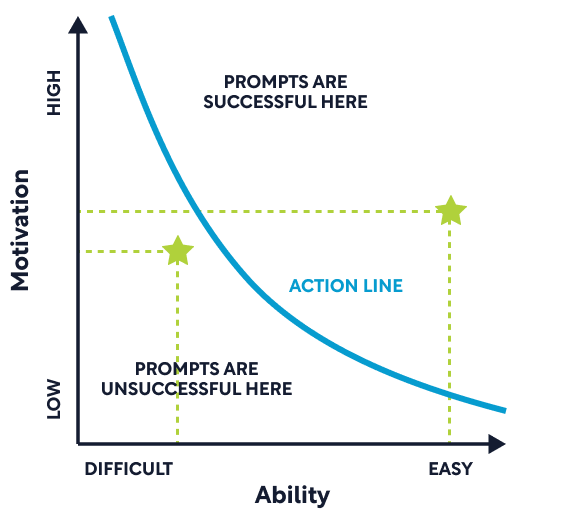
Fogg’s behavior model applies to all actions, not just habitual ones, but it can be used to explain habitual behavior.
In Fogg’s model, the cue (or prompt) of a habit is anything that alerts you to the possibility of performing a certain action. For example, if you have a habit of snacking to relieve stress, feeling stressed alerts you to the possibility of relieving your stress by snacking.
The more you do something, the better you get at doing it: in other words, your ability increases. And the more you crave something, or anticipate a reward for doing it, the greater your motivation to do it will be. Both of these factors increase the likelihood that your combined ability and motivation will be above the threshold and you’ll actually do the behavior whenever you have the opportunity to.
For example, if you’ve had a snacking habit for a long time, you probably have a good supply of snacks on hand. That increases your ability to snack because it makes it easier to access the snack food than if you had to go out and buy it first. And the stronger your cravings for snacks are, the more motivation you’ll have to snack.
Thus, the Fogg Behavior Model helps to explain how habits form: The more you do something, especially something with a built-in reward, the more likely you are to do it again.
Techniques for Changing Your Habits
Different authors suggest different methods for cultivating good habits and breaking bad ones. We’ll discuss them in turn, compare them, and consider how they can be combined for maximum effectiveness.
Fogg’s Methods
BJ Fogg observes that your motivation, especially your motivation to change, tends to fluctuate over time and is difficult to control. Thus, applying his behavioral model, he recommends changing your behavior by manipulating your ability rather than your motivation.
So, if you want to start doing something regularly, find a way to make it so easy that you’ll always do it. For example, if you want to start working out regularly, maybe you begin with a workout routine that consists of doing one sit-up. As this behavior becomes ingrained and thus easier, you can expand your workout.
Similarly, if you want to stop doing something, try to make it harder to do. For example, if you want to quit eating junk food, start by throwing out all the junk food in your house. Then plan your route through the grocery store so that you would have to go out of your way to pick up any more junk food.
You can also find ways to make eliminating something easier by starting small. For example, if you’re trying to quit snacking on candy, maybe you start by eating one less piece of candy at every snack.
Duhigg’s Methods
According to Duhigg, the key to making a new habit stick is to make the cue unmistakable and the craving as strong as possible. For example, if you want to make a habit of going for a run every morning, you could leave your running shoes in the middle of the doorway, where you’ll have to step over them to leave your bedroom in the morning. He says you can intensify the craving by intentionally anticipating the reward. Fantasize about how good you’ll feel after your run and about being in better shape because of your daily running routine.
Conversely, Duhigg says the way to break bad habits is to eliminate either the cue, the craving, or both. To do this, first, you need to identify the parts of the habit you want to change. He notes that this is sometimes difficult because you may not be conscious of what triggers you to perform a certain habit routine, or what it is about doing it that you find pleasurable.
Fully understanding the routine can help you get a better idea of what the reward might be, so he recommends writing down the exact sequence of actions you perform when you act out your habit. Then, start experimenting on yourself. Whenever you catch yourself starting to perform the routine, make a point of doing something differently, and see how you feel afterward. This information can help you determine what the reward really is. Sometimes you can eliminate your craving for something you want to quit by finding a better way to get the same reward.
For example, if you have a habit of walking to the cafeteria on your morning break and getting a soda, try walking somewhere else instead, or try getting something different at the cafeteria. Maybe you’ll find that getting up and walking around on your break is what your body really craves to relieve the discomfort of sitting at your desk all morning. Or maybe you’ll find that you’re just thirsty, and getting some water satisfies your craving as much as a soda.
Similarly, if the cue isn’t obvious, start keeping track of when and where you acted out your habit, what was happening around you, and what you were thinking or feeling at the time. If you can identify the cues that trigger an undesirable behavior, you may be able to eliminate the behavior simply by avoiding the cues.
Clear’s Methods
At a high level, Clear’s approach to changing habits mostly parallels Duhigg's, but Clear offers some additional insight on certain points.
To make a cue for a new habit harder to miss, try using an existing habit as the cue for another behavior. He calls this “habit stacking.” For example, maybe you already have a habit of going outside in the morning to water your flower garden, and you want to get into the habit of jogging every morning. So you use finishing your watering as a cue to go for a run.
Similarly, you can capitalize on your existing cravings by inserting other desirable habits in front of them. For example, maybe you already have a habit of drinking hot chocolate in the morning, after you come back inside from watering your flower garden. So you insert your morning run between watering your garden and drinking hot chocolate. Eventually, this sequence becomes ingrained to the point that your craving for hot chocolate makes you want to go for a run so that you can come back and drink hot chocolate.
Interestingly, while Clear doesn’t mention Fogg’s Behavior Model, he does assert that one of the keys to successfully changing your habits is to make the change as easy as possible. He recommends breaking down new habit routines into small steps that take no more than two minutes each. Then, start your new habit with just the first two-minute step of the process, and build up the rest of it later. This advice closely parallels Fogg’s ability-based approach to changing habits.
That said, where Fogg emphasizes minimizing difficulty so you don’t have to depend on your ever-fluctuating level of motivation, Clear emphasizes the importance of keeping a positive attitude in addition to making your behavioral changes as easy as possible. In particular, Clear advises you to view performing a new habit as an opportunity, not an obligation, and to find ways that the changes reflect your identity, making them more meaningful. He says these techniques can make a big difference in your level of motivation, and thus, in your success rate at cultivating positive new habits.
For example, if you think, “I have to jog every morning so that I don’t gain weight,” you’ll end up associating jogging with the risk of gaining weight, which you probably have negative feelings about. But if you think, “I’m a healthy person and I have the opportunity to keep my body tuned up by jogging regularly,” you’ll probably feel a lot more positive about jogging.
Oakley’s Methods
Oakley’s advice on changing habits generally parallels Clear’s and Duhigg’s: She recommends identifying the parts (cue, routine, reward, and belief) of the habit you want to change and then suggests ways of manipulating each of the parts to change the habit as a whole.
In addition to the techniques that Clear and Duhigg recommend, she points out that sometimes, you have to take a brute force approach to changing a habit by recognizing the cue and deliberately overwriting the routine to replace it with a better behavior, which will presumably have a different reward.
To muster the willpower to pull this off, she recommends practicing “mental contrasting,” in which you reflect on the difference between how your life is now and how you want it to be. Surround yourself with reminders of where you want to be so that you can stay focused.
Oakley also notes that there are two different types of rewards that are both useful for modifying habits: immediate rewards and delayed rewards. As we’ve discussed, immediate rewards are part of the habit itself, and sometimes, you can change them to change the habit.
Delayed rewards don’t influence the habit directly, but they still provide motivation to help you overwrite the routine or continue practicing a positive behavior until it becomes a habit. Thus, she recommends rewarding yourself for reaching goals and milestones as you work on improving your habits.
Finally, Oakley says that since habits develop based on underlying beliefs, new information or new experiences that change your beliefs can be a key factor in changing your habits. To change a habit, believe that you can change and that the change will be beneficial.
She observes that the company you keep can have a significant impact on your habits because the people you choose to associate with tend to reflect and reinforce your beliefs. Associating with other people who share your belief in the change can be a great source of motivation.
Oakley’s emphasis on ways to maximize your motivation tends to contrast with Fogg’s approach. However, the two approaches can still be complementary: Making the change as easy as possible and keeping your motivation as high as possible will both help you develop a good habit.
Want to learn the rest of The Master Guides: Changing Your Habits in 21 minutes?
Unlock the full book summary of The Master Guides: Changing Your Habits by signing up for Shortform .
Shortform summaries help you learn 10x faster by:
- Being 100% comprehensive: you learn the most important points in the book
- Cutting out the fluff: you don't spend your time wondering what the author's point is.
- Interactive exercises: apply the book's ideas to your own life with our educators' guidance.
Here's a preview of the rest of Shortform's The Master Guides: Changing Your Habits PDF summary: