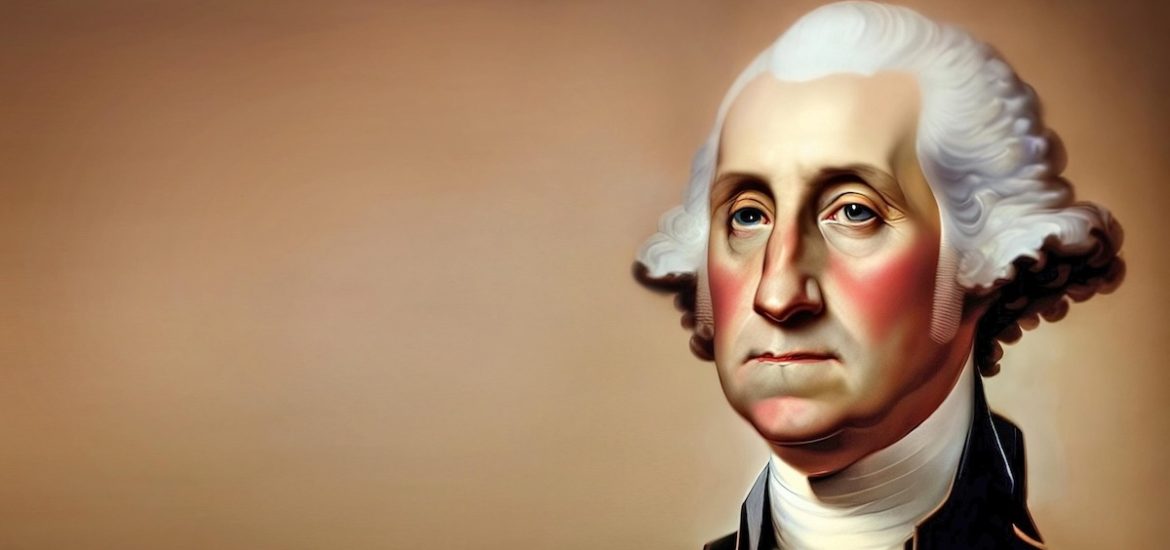
The presidency of George Washington was unlike any that followed it. He wasn’t merely the first president of the United States—he was the living proof that a democratic republic could survive its own founding. From managing crippling war debt to personally leading troops against tax rebels, Washington’s eight years in office (from 1789 to 1797) shaped the country in ways still felt today.
Drawing on biographies and other sources, I explore how Washington governed, what forces he struggled against, and why his legacy endures. I also share what I discovered when I read his diary. Keep reading to learn about America’s first president, George Washington.
Table of Contents
Washington’s Presidency Was Inevitable and Enormous
According to bestselling biographer and Pulitzer Prize winner Ron Chernow, George Washington’s presidency was an inevitability: By the late 1780s, Washington was essentially the only possible choice for president. He commanded near-universal respect after leading the Revolutionary Army to victory, and, when the new government needed a steady hand at its helm, the country turned to him. Washington was formally elected in 1789 and set about appointing a cabinet to assist him.
Interestingly, Washington initially refused the presidency—just as he had initially declined command of the Continental Army. Far from being a sign of weakness, Robert Greene argues in The 48 Laws of Power that this was a shrewd move: By appearing reluctant, Washington avoided stirring up envy, which only increased his popularity and made his eventual acceptance more powerful.
But the job was huge. As Bill O’Reilly and Martin Dugard explain in Confronting the Presidents, Washington inherited a country burdened by massive debt from the Revolutionary War, no standing military to speak of, and deep political fault lines running through his own cabinet.
Domestic Difficulties
Washington’s presidency was largely defined by fierce conflicts within his own administration and among the nation’s citizens. Two of the most consequential struggles of his tenure were the ideological war between Hamilton and Jefferson (over the very nature of American government) and the Whiskey Rebellion (in which that government’s authority was put to a violent test). Together, these episodes forced Washington to do what he would do repeatedly throughout his terms: make hard choices that would set the tone for every leader who came after him.
The Battle Inside Washington’s Cabinet
The most pressing challenge of Washington’s administration might have been the ideological war playing out among his own advisors. O’Reilly and Dugard describe the central tension clearly: Treasury Secretary Alexander Hamilton wanted a strong federal government with the power to manage the whole country, while Secretary of State Thomas Jefferson believed power should rest with the states, keeping the federal government weak. Washington spent much of his presidency searching for compromises both sides could accept.
(Shortform note: Ron Chernow’s biography of Alexander Hamilton elaborates further on the ideological division Washington had to deal with between Federalists and Republicans. Federalists such as Hamilton tended to live in northern, urban areas and wanted a strong, centralized federal government that could represent the nation as a whole. On the other hand, Republicans such as Jefferson believed a strong federal government would no longer need to listen to the people. They preferred stronger state governments that could represent their specific regional populations.)
Chernow goes deeper into this rivalry, describing how formal political parties began to coalesce during Washington’s administration. These were not yet organized parties in the modern sense; they were loose alliances of politicians who shared views on the economy, foreign policy, and slavery. Hamilton and Jefferson emerged as the unofficial leaders of the Federalists and Republicans respectively—and both men continued to dominate American politics even after leaving Washington’s cabinet.
Chernow also notes that party politics itself was viewed with alarm by many at the time. Factions were seen as a threat to effective governance and a throwback to the monarchical system the revolution had rejected. As a result, party activity—such as organizing around a presidential candidate—was largely conducted behind the scenes. Meanwhile, both Hamilton and Jefferson funded pro-party newspapers to build public support for their causes.
Chernow further suggests that Jefferson’s hostility toward Hamilton was partly personal. Washington consulted Hamilton far more often than Jefferson (or even Vice President John Adams), and critics accused Hamilton of being a covert authoritarian who manipulated President Washington. Chernow pushes back on this narrative, pointing out that cabinet records show Washington was entirely willing to disagree with and override Hamilton when he saw fit.
(Shortform note: These accusations are an example of the political trope of the manipulative advisor or “power behind the throne,” who’s accused of using their personal relationship with a ruler to advance their own interests. While some genuine historical examples exist, people often invoke this trope so they can criticize their government without directly attacking the ruler instead scapegoating another, less important figure. The American revolutionaries used this rhetorical sleight-of-hand themselves in their 1774 Petition to the King, in which Congress claimed it was still loyal to King George III and merely resisted the unjust policies of Parliament.)
The Whiskey Rebellion: Washington Rides Again
According to O’Reilly and Dugard, the tensions of Washington’s presidency came to a head with the Whiskey Rebellion. Hamilton had proposed taxing domestic distilled spirits as part of his broader economic program—a policy Chernow credits with helping save the young nation from bankruptcy (by 1790, 90% of government revenue came from import taxes Hamilton had designed). But any tax was deeply unpopular in a country that had revolted against British taxation, and nowhere more so than in the rural mountains of Pennsylvania.
(Shortform note: The government’s tax on whiskey was especially relevant to the rebel farmers because, to them, whiskey wasn’t just a drink; it acted as a makeshift currency for frontier towns. This was because they either didn’t have easy access to coins and paper money or didn’t trust them to hold value. After all, the early US government was unstable and couldn’t afford to pay its many debts, including those to Revolutionary War veterans.)
O’Reilly and Dugard describe how, beginning in 1791, many farmers refused to pay the whiskey tax—and some attacked tax collectors outright. Washington first tried to resolve the situation peaceably, encouraging farmers to comply. But the anti-government violence continued, and, by 1794, the president had seen enough. He personally led over 10,000 troops to suppress the rebellion.
Chernow, O’Reilly, and Dugard all view Washington’s response as a decisive demonstration of federal authority—a remarkable act for a sitting president. Afterward, Washington exercised an equally notable act of restraint: he pardoned two men who had been convicted of treason during the rebellion, an early example of a president using clemency to calm civil unrest and promote national unity.
(Shortform note: Taxes have remained unpopular throughout US history, though most of the taxes modern Americans are familiar with—such as the income tax, sales tax, or taxes designed to fund Social Security—originated in the early 20th century, long after the Founding period. People have differing reasons for resisting taxes; while some argue that taxes are theft by the government, others use tax resistance as a form of conscientious objection or oppose taxes that they feel unjustly target certain groups.)
Foreign Policy
Washington’s decisions weren’t confined to domestic crises. Greene points out that Washington refused to ally the United States with France, even after France had been a crucial supporter during the Revolutionary War. Greene frames this as a deliberate strategy to establish American autonomy: Washington wanted European nations to treat the US as a sovereign equal, not as a client state dependent on foreign favor.
Stepping Down: A Precedent and a Warning
O’Reilly and Dugard note that Washington could have run for a third term; there was nothing legally preventing him. But he was exhausted by political life and, perhaps more importantly, he believed the Constitution was now stable enough to endure without him. That belief, the authors argue, was vindicated by the strength of the institutions he had helped build.
(Shortform note: The fact that Washington was emotionally and physically “done” with political life doesn’t surprise me. On a personal tour of the Library of Congress a few years ago, I had the tremendous privilege of holding one of George Washington’s diaries in my hands and reading from it. He wrote with fond detail about working his land and how the day’s weather might affect the crops. Clearly, this was a man who relished the quiet life of farming.)
Washington’s voluntary departure from power was itself one of his most consequential acts. He established an informal two-term precedent that every president honored for nearly 150 years—until Franklin D. Roosevelt was elected to a third term in 1940 and a fourth in 1944. Congress eventually codified Washington’s precedent into law through the Twenty-Second Amendment, passed in 1951, which formally limits presidents to two terms.
Washington’s Farewell Address
As he prepared to leave office, Washington issued his famous 1796 Farewell Address. Chernow notes that Washington used it to disavow factionalism, urging politicians to seek unity over partisan infighting—a plea that had little immediate effect as Hamilton and Jefferson’s rivalry intensified. O’Reilly and Dugard write that Washington also warned that political parties were the greatest threat to the country’s stability, arguing that internal division would leave the nation vulnerable to external threats.
(Shortform note: In his Farewell Address, Washington went so far as to argue that divisions between different parts of the country or political parties were the greatest threat to the country’s safety, as internal division would leave the country weak to external threats. Some of Washington’s concerns proved to be well-founded decades later when political divisions over slavery boiled over into the American Civil War. Others, such as political polarization, remain popular topics of discussion to this day.)
A Presidency That Still Echoes
The presidency of George Washington provides a portrait of a leader who was neither infallible nor omnipotent but who understood the fragility of what he was building. He held the line against rebellion, navigated vicious ideological conflict within his own cabinet, refused foreign entanglements that might have compromised American independence, and then did something almost no powerful leader in history had done voluntarily: He walked away.
The institutions Washington helped stabilize—the federal government’s authority, the two-term tradition, the use of presidential clemency—are still with us. So are the warnings he issued. As O’Reilly, Dugard, Chernow, and Greene each suggest in their different ways, Washington’s presidency wasn’t just the beginning of American history; in many respects, it set the terms for the debates the country is still having.
To learn more about Washington’s time as president in a broader context, check out Shortform’s guides to these books:
- Confronting the Presidents by Bill O’Reilly and Martin Dugard
- Alexander Hamilton by Ron Chernow
- The 48 Laws of Power by Robert Greene
