Blinkist is a book summary app that aims to give you the key ideas from a nonfiction book in about 15 minutes. I spent several days testing Blinkist’s free trial and comparing its summaries against books I had already read. My experience was mixed. In this Blinkist review, I break down exactly what I liked and where it fell short for me.
Table of Contents
Blinkist Pros and Cons
| Pros | Cons |
| Large library of nonfiction summaries | Summaries often oversimplify complex ideas |
| Audio and text versions available | Offers annual pricing only for paid subscriptions |
| Clean and beginner-friendly interface | Limited tools for active learning |
| Easy to fit into a busy schedule | Encourages consumption more than comprehension |
| Helpful for discovering new books | Many summaries feel too condensed to replace reading the original |
How I Tested Blinkist Day by Day
For my review of Blinkist, I wanted to evaluate the app the way a typical subscriber would use it, so I spent the entire seven-day free trial of the Premium subscription exploring the app across different scenarios. Rather than reading summaries back-to-back, I focused on a different aspect of the experience each day—from discovering new books to testing audio features and revisiting highlights—to see how well Blinkist supported both short-term convenience and long-term learning.
Day 1: Exploring the Platform
On the first day, I focused on getting familiar with Blinkist and understanding how a new user would experience the platform. I completed the onboarding process, explored the app’s recommendations, browsed the catalog, and tested navigation across different sections. I also read several summaries to get a general sense of the reading experience and how content is presented.
Day 2: Testing Popular Titles
My goal for the second day was to compare Blinkist’s summaries against the original books and evaluate how well the app captured key ideas, examples, frameworks, and arguments. I selected well-known titles across a few categories and compared the summaries with my existing knowledge of each book.
Day 3: Learning New Topics
For the third day, I intentionally chose books covering subjects that were unfamiliar to me. This allowed me to evaluate Blinkist as a learning tool rather than simply a summarization tool. I paid close attention to how effectively the summaries explained new concepts and whether I felt I had gained a meaningful understanding of each topic.
Day 4: Audio Listening
On the fourth day, I switched exclusively to Audio Blinks. I listened while walking, driving, exercising, and completing household chores to replicate the way many subscribers are likely to use the app. During this phase, I evaluated the narration quality, playback controls, and how well I retained information while multitasking.
Day 5: Discovery and Recommendations
The fifth day focused on Blinkist’s recommendation engine and content discovery. I explored curated collections, personalized recommendations, and category pages to see how easy it was to find books aligned with my interests. I also sampled summaries from authors I hadn’t previously considered reading.
Day 6: Highlights and Review
On the sixth day, I revisited summaries I had already completed using Blinkist’s highlighting, bookmarking, and library features. I wanted to see how easy it was to review what I’d learned and whether the app encouraged me to retain information beyond the initial reading experience.
Day 7: Everyday Use
For the final day, I used Blinkist as naturally as possible, fitting summaries into spare moments throughout the day rather than setting aside dedicated reading sessions. This helped me evaluate whether the app genuinely integrated into a busy routine and how much information I remembered after using it the way most subscribers probably would.
By the end of the trial, I had tested Blinkist’s core experience from multiple angles, including text summaries, audio summaries, familiar books, unfamiliar topics, content discovery, review tools, and real-world daily use. The following sections break down my review in detail.
Review of Blinkist’s Summaries
I read books across the personal development, biography, business, and relationships categories. For this review, I’ll focus on one book per category to encapsulate the quality of Blinkist’s summaries:
- The Mountain Is You—Personal Development
- I Am Malala—Biography
- How Brands Grow—Business
- Attached—Relationships
Content Quality
During my trial, I often read a Blink while waiting for an appointment or taking a short walk, and I appreciated how quickly I could finish a summary and move on with my day.
That speed, however, comes with an unavoidable tradeoff. As I worked through more summaries, I began noticing a consistent pattern: Blinkist does a good job identifying an author’s central message, but it often strips away the examples, stories, evidence, and supporting arguments that give those ideas meaning and help them stick. For lighter self-improvement books, this wasn’t a significant issue. But for books covering subjects such as psychology, business, leadership, and history, removing about 50% of the book’s content was much more obvious.
What stood out to me most was how often the nuance disappeared. Many nonfiction authors spend hundreds of pages carefully building an argument, acknowledging exceptions, and addressing competing viewpoints before arriving at a conclusion. Blinkist condenses much of that process into a handful of concise takeaways. The summaries remain easy to read, but they can also make complex books feel more straightforward than they actually are.
By the end of my testing, I felt that Blinkist consistently captured where each book arrived, but not always how it got there. As a result, I often finished a summary understanding the author’s main conclusions without fully appreciating the reasoning behind them. For readers who simply want the headline ideas, that may be enough. For those hoping to develop a deeper understanding of a topic, the experience feels incomplete.
Accuracy
I rarely encountered outright inaccuracies while testing Blinkist. The summaries generally represented each author’s core arguments honestly, and I didn’t feel misled about what a book was trying to say.
My hesitation was that reducing hundreds of pages to 15 minutes inevitably changes the reading experience. The summaries are accurate—but they’re selective. Readers should think of them as introductions to a book rather than substitutes for reading it.
This distinction matters because context is often where the most valuable learning happens. By the end of my testing, I felt that Blinkist was generally accurate but frequently incomplete.
Retention and Learning
One question I kept asking myself during the trial was how much information I actually remembered after finishing each summary.
The answer wasn’t always encouraging. What surprised me wasn’t how much I forgot—it was how little the app encouraged me to slow down in the first place. Blinkist makes it incredibly easy to finish one summary and immediately start another. During my trial, I often caught myself thinking, “I have time for just one more Blink.” While that’s enjoyable, it also encouraged me to consume ideas continuously rather than reflect on them.
The highlighting feature helps organize information, but Blinkist offers relatively few opportunities to test your understanding or actively engage with what you’ve read. By the end of the week, I felt I’d been exposed to dozens of interesting ideas, but I hadn’t necessarily internalized them.
Review of Blinkist’s Key Features
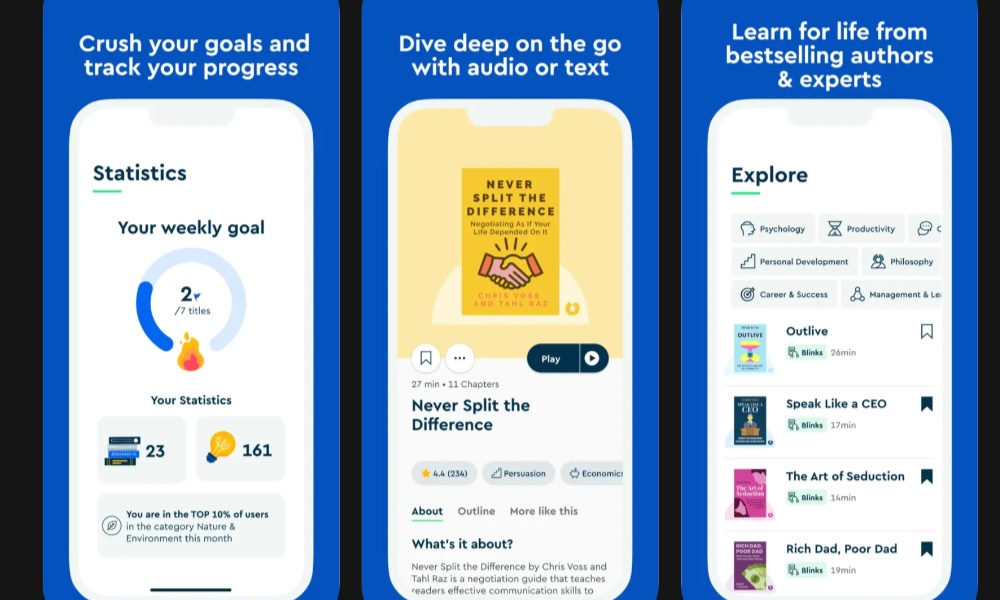
Blinkist keeps its feature set intentionally simple. Rather than overwhelming users with dozens of tools, the app focuses on making it as easy to discover, consume, and revisit nonfiction books. During my trial, these were the features I found myself using most—and the ones that had the biggest impact on my overall experience.
Note: Since I subscribed only to the Premium subscription for a free trial, I didn’t have access to Blinkist AI—a Pro plan feature where you can upload PDFs, paste YouTube links, or feed in podcast episodes and get a Blink-style summary.
Audio Blinks
I enjoyed listening to Audio Blinks during walks and drives, where they transformed otherwise unproductive time into learning opportunities.
However, they’re best suited to lighter or more familiar topics. When listening to summaries covering complex ideas, I often found myself rewinding sections I’d missed while my attention drifted elsewhere. Some of the narrators are also obviously AI-generated, as they sounded flat and monotone, while a few others were enjoyable to listen to.
Highlights and Saving
Blinkist allows users to save highlights and revisit key ideas later. These tools are useful, particularly for readers who want to create a personal knowledge library.
That said, I never felt that these features fundamentally changed the learning experience. They help organize information, but they don’t necessarily deepen understanding.
Personalized Recommendations
The recommendation engine performed well throughout my trial. Blinkist quickly learned my interests and consistently surfaced relevant titles.
While this improves discovery, recommendations alone can’t compensate for limitations in the summaries themselves. Ultimately, the value of the platform still depends on how much users learn from the content they consume.
Review of Blinkist’s User Experience & Interface
Blinkist has one of the cleanest interfaces I’ve used in any learning app. Navigation is intuitive, pages load quickly, and I never struggled to find what I was looking for.
Ironically, that polish also became one of my biggest criticisms.
Because everything is so frictionless, it’s incredibly easy to move from one summary directly into another. I frequently finished a Blink, saw another recommendation, and immediately started reading again. The app creates a satisfying sense of progress, but that progress is measured by how many summaries you’ve completed—not necessarily by how much you’ve learned.
I would’ve liked to see more prompts encouraging reflection before moving on to the next book.
Review of Blinkist’s Pricing
Blinkist offers a free plan with limited access and three paid subscriptions that unlock the full library and additional features. While the seven-day free trial provides enough time to evaluate the app, continuing afterward requires committing to an annual subscription. There isn’t a lower-cost monthly option for readers who simply want to try the service for another month or two.
I also found the growing number of subscription tiers—Premium, Pro, and Platinum—a little confusing. During my trial, I occasionally had to double-check which features belonged to my plan and which required paying more. It’s not a major issue, but Blinkist’s pricing has become noticeably more complicated than the app itself.
Blinkist’s pricing:
- Basic plan: Free
- Premium plan: ~$100/year
- Pro plan: ~$175/year
- Platinum plan: ~$200/year
👉 Check out our full guide to Blinkist’s pricing.
Blinkist vs. Shortform: Which Book Summary App Is Better?
As someone who values understanding over consumption, I found myself wanting more from almost every Blinkist summary I read.
That’s where I think Shortform offers a stronger learning experience.
Rather than condensing a book into a handful of key takeaways, Shortform creates comprehensive book and podcast guides that explain the author’s arguments in greater detail while adding concrete examples, practical exercises, and insightful commentary. Many guides also include practical exercises and reflection questions that encourage you to apply what you’ve learned instead of simply moving on to the next summary.
I also appreciate that Shortform doesn’t treat every book as if the author’s perspective is the final word. Where appropriate, its guides point out limitations, introduce alternative viewpoints, and connect ideas across multiple books. That additional context helped me develop a much deeper understanding of topics than I experienced with Blinkist.
Overall, I’d recommend Shortform to readers who want to understand books and ideas more deeply, retain what they learn, and leave each guide feeling as though they’ve genuinely engaged with the book rather than just skimmed its highlights.
👉 Check out our full comparison guide between Blinkist and Shortform.
Final Verdict
The Blinkist app is sleek, enjoyable to use, and good at making learning feel approachable. It makes it easy to discover new books or fit reading into a busy schedule.
At the same time, I came away feeling that Blinkist is primarily a discovery tool rather than a learning tool. It helped me identify books worth exploring and introduced me to plenty of interesting ideas, but I rarely finished a summary feeling as if I’d fully understood the author’s thinking. To me, this doesn’t feel worthy of an annual subscription.
If your goal is to develop a deeper understanding of nonfiction books and retain more of what you learn, I think Shortform offers the more rewarding experience.
👉 Want to test Shortform for yourself? Sign up for a five-day free trial.
