
What is real wealth, and why does it feel so difficult to pin down? If you’ve wondered whether wealth is about money, freedom, or the value you create, this article breaks down those questions as directly as possible.
To give you clear answers, we’ve gathered ideas from several financial experts. You’ll see how different thinkers define wealth, where value actually comes from, and how these insights can help you move toward financial independence.
Table of Contents
- What Wealth Isn’t
- Uncontrollable Factor #1: The Value of Your Education
- Uncontrollable Factor #2: The Time You Spend Working
- Uncontrollable Factor #3: The Economy
- Uncontrollable Factor #4: The Markets
- Uncontrollable Factor #5: Your Health and Well-Being
- Financial Outcome: You Might Get Rich but You Won’t Be Able to Enjoy It
- The Real Definition of Wealth: Value
- Explore More
What Wealth Isn’t
In The Millionaire Fastlane, MJ DeMarco defines false wealth as: job + market investments = restricted income and a mediocre retirement. According to him, hopeful accumulators follow popular methods touted by financial advisors as a guaranteed path to a comfortable retirement: Get an expensive education, work hard for 40 to 50 years, sacrifice pleasures, budget every cent, buy a house, and funnel all surplus money toward pensions, safe investments, and savings accounts.
DeMarco argues that this formula for wealth severely limits your chances of creating real wealth because it’s entirely dependent on a number of factors that you can’t control: the value of your education, the time you spend working, the economy, interest rates, and your health and well-being. Let’s explore these factors in detail.
Uncontrollable Factor #1: The Value of Your Education
DeMarco claims that investing time and money in an expensive education limits your freedom in two distinct ways: First, it forces you to work so that you can pay off your debts—while your education may increase your salary by 20%, the debts you incur will take more than 20 years to pay off. Second, it shackles you to a specific type of work that “justifies” your education. This limits your financial freedom, as the value of your education depends on the opportunities in your field—if there are no opportunities, your education has no value.
Uncontrollable Factor #2: The Time You Spend Working
DeMarco explains that relying on an hourly wage or salary from your job or business puts a cap on how much you can earn because time is limited: For hourly wages, you can’t work more than 24 hours a day to increase your income. For annual salaries, you can’t work above your life expectancy to accumulate more money.
Uncontrollable Factor #3: The Economy
DeMarco notes that the economy is volatile—an unexpected downturn can significantly impact your ability to receive a consistent income. If you lose your job or business, you won’t be able to make regular contributions to your pension and investment accounts, clear your debts, or pay your mortgage.
Uncontrollable Factor #4: The Markets
DeMarco argues that the compound interest you earn on investments relies on three factors to effectively increase your net worth: time, regular contributions to your account, and a high rate of return. He explains that in theory, investments create wealth by providing a predictable and healthy rate of return over the course of decades.
In reality, however, the rates are too low to make a significant impact on the small, capped sums of money the government allows you to contribute to your investment accounts. You also can’t guarantee that financial managers won’t make poor decisions that lose you money or that the rate of inflation won’t reduce the value of your hard-earned money by the time you retire.
Further, DeMarco argues that you can’t rely on your home equity to increase your net worth because real estate values don’t always rise.
Uncontrollable Factor #5: Your Health and Well-Being
DeMarco warns that working long hours for the hope of a prosperous future negatively impacts your health, relationships, and feelings of freedom. Even if you’re happy to make these sacrifices for now, you can’t guarantee that they’ll pay off. You may not be healthy enough to work for your income until retirement, or, by the time you retire, you may feel too old or have too many health problems to enjoy your money.
Financial Outcome: You Might Get Rich but You Won’t Be Able to Enjoy It
DeMarco argues that committing to lifetime employment, delaying gratification, and waiting decades for compound interest to accumulate won’t guarantee a wealthy retirement—the plan relies on numerous factors that are out of your control. Further, he asserts that sacrificing your time, freedom, and pleasures isn’t worth the effort since you’ll be too old to enjoy your wealth, and inflation will reduce the value of any money you do manage to accumulate.
The Real Definition of Wealth: Value
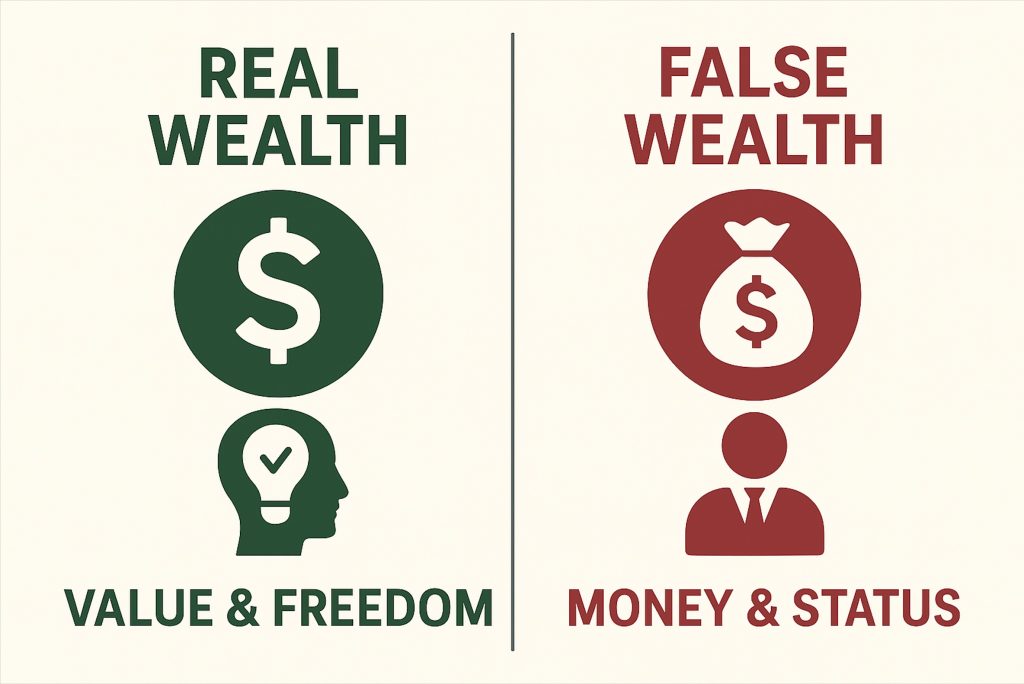
Most people would say someone with a lot of expensive material possessions is wealthy. But most people living high-consumption lifestyles have little accumulated wealth; they spend all they earn. Instead of acquiring material possessions, especially status symbols, the truly wealthy focus on building financial assets that appreciate or increase in value.
Net worth—the current value of your assets minus liabilities—is one way of defining what wealth is.
In The Millionaire Next Door, Thomas J. Stanley and William D. Danko define wealth in two ways: 1) having a net worth of at least $1 million, and 2) having a high net worth for someone of your age and income.
(Shortform note: at the time this book was published, 3.5% of U.S. households had a net worth of at least $1 million. In 2018, the figure was 3%, or 11.8 million U.S. households.) About 95% of millionaires have a net worth of $1 million to $10 million. They are the focus of this book because their level of wealth is attainable by many Americans.
According to Gunderson, the zero-sum framework is rooted inan incorrect theory of what constitutes value—namely, that objects alone have inherent value. According to this view, objects have some fixed, innate worth that exists independently of human perception. Thus, the world’s total wealth is simply the sum of all these objective values. This line of thinking leads you to believe that the only way to increase your wealth is by acquiring more of these inherently valuable objects—assets like cash, gold, real estate, and collectibles—from the finite supply that exists. In the sections below, we’ll explore why Gunderson believes this idea is wrong.
| Are Objects Actually the Roots of Wealth? Some economic thinkers take a different view than Gunderson on the question of where wealth comes from, arguing that wealth is inseparable from material objects. In The Wealth of Nations, Adam Smith, the 18th-century Scottish philosopher who helped found modern economics, writes that a nation’s wealth stems from private ownership of material goods. According to Smith, wealthy nations succeed because they have systems that allow citizens to own, produce, trade, and accumulate material goods. These goods either meet people’s needs at home or can be exported and traded for foreign goods the country needs. In contrast, Smith says poor countries struggle because they don’t have enough private ownership of productive resources. As a result, they can’t produce enough goods for their own people or export enough to trade for what they lack. |
Value Is Subjective
In Killing Sacred Cows, Garrett Gunderson writes that value is inherently human-based—in other words, it’s subjective and exists entirely in people’s minds. Let’s explore this concept a bit further.
Value doesn’t exist as an objective characteristic of things. Instead, it’s rooted in human needs, desires, perceptions, and contexts. When something fulfills a desire, solves a problem, or enhances someone’s life in a way they appreciate, it becomes valuable to them—but, urges Gunderson, this value exists in their perception, not in the thing itself.
Consider a handmade wooden flute crafted by a skilled artisan. The objective characteristics of this flute include its materials, dimensions, and acoustic capabilities. But its value is determined by what it means to different people. To a professional musician specializing in folk music, this particular flute has exceptional value. Its unique tonal qualities perfectly complement her performance style, and its craftsmanship allows for expressive nuances that mass-produced flutes can’t manage. She willingly pays $2,000 for it because it will enhance her recordings and live performances, potentially advancing her career.
But to a casual music enthusiast who appreciates wooden crafts, the same flute holds only moderate value. Sure, he admires its craftsmanship and enjoys playing occasionally, but he doesn’t have the skill to fully utilize its capabilities. He might be willing to pay $500—appreciating it as both an instrument and a decorative piece. Between these two people, nothing about the flute itself changed—the perceived value exists entirely in each person’s mind, shaped by their individual circumstances, knowledge, needs, and goals.
| The Labor Theory of Value Although Gunderson posits a subjective theory of value, other economic thinkers have argued that value can indeed be measured objectively. Famously, Adam Smith maintained in The Wealth of Nations that labor was the foundation of all economic value and thus backed the “labor theory of value.” This theory states that the value of a commodity can be objectively measured by the amount of labor required to produce it. However, this idea has since become controversial and is no longer considered part of mainstream economic thought. Critics of the labor theory of value mainly assert that it can’t be used to accurately understand or predict pricing. They point out that a good that takes twice as much work to produce doesn’t necessarily cost twice as much money, and it’s possible to expend a lot of work on making something nobody wants to buy. However, the labor theory of value still has its supporters. Marxists have taken up the idea to contend that workers produce the “real value” in society, and therefore capitalists are exploiting them by taking value without contributing labor themselves. |
How to Create Value and Wealth
Gunderson writes that the idea that value is subjective has significant implications for wealth creation. Since Gunderson says satisfying human needs is the true source of value, it follows that wealth comes from creating value for others—identifying and addressing what matters to them.
According to Gunderson, wealth-creating entrepreneurs aren’t simply producing goods or services. Instead, they study human needs, desires, and problems to create solutions that people recognize as worth exchanging their resources for. By creating these solutions, entrepreneurs can generate an unlimited amount of wealth—because humanity’s creative potential is boundless.
| Essential Human Needs As you think about how you can harness creativity to address human needs, it’s worth looking at what those core needs are. In Money: Master the Game, life coach Tony Robbins writes that humans have six core needs that we’re always trying to fulfill. To get clear on how your idea can create value for others, consider which of these needs you’re trying to fulfill for them: Need #1: Security—Feeling safe and certain about your circumstances or future. We need this to feel grounded and capable of taking risks. Need #2: Variety—Surprises and unpredictability keep life exciting and enjoyable. If everything was certain ahead of time, life would get dull. Imagine if you knew everything everyone was going to say before they said it. Need #3: Closeness—As social creatures, we all need to feel close and connected to friends and loved ones. Need #4: Meaning—We need to feel important, especially to those we care about. When we matter, life feels more meaningful. Need #5: Participation—When our basic needs are met, we look for spiritual fulfillment. According to Robbins, we can do this by giving our time, energy, and resources to causes larger than ourselves. For example, committing your time and/or money to ending homelessness is a higher-order spiritual calling that could bring you fulfillment. Need #6: Progress—We’re meant to keep developing as life unfolds. Neglecting to grow feels like what it is: stagnation. |
Invest in Your Capacity to Create
Building wealth means creating value for others—generating ideas and products that other people want to exchange their resources for. But to be able to generate those ideas, products, and resources, you need to invest in your own capacity to create. According to Gunderson, while traditional investments like stocks and bonds may appreciate steadily over time, an investment in your personal development can multiply your earning potential exponentially. Every skill you master, every insight you gain, and every relationship you build becomes part of your permanent portfolio. Best of all, unlike market investments that fluctuate with economic conditions, your personal growth compounds reliably over time.
For example, let’s imagine a graphic designer who started her career at age 22 making $42,000 annually at a marketing firm. While her colleagues focused on saving and investing in traditional assets like savings accounts, she invested five hours weekly in developing new skills—mastering UI/UX design principles, learning emerging software, studying business fundamentals, and building a professional network. By 25, she was promoted to senior designer at $65,000. At 28, she used her expanded skillset to launch a freelance business alongside her day job, bringing her combined income to $110,000. By 32, she’d built a small design agency employing five people, generating $450,000 in annual revenue.
Had she instead remained at the marketing firm without investing in her personal growth, her financial trajectory would have looked quite different. Assuming standard annual raises of 3% at the marketing firm, by age 32, her salary would have reached approximately $56,400. If she had followed her colleagues’ approach and saved 15% of her income each year in a mix of retirement accounts and index funds with an average 7% annual return, she would have accumulated roughly $75,000 in investment assets by age 32. While this represents a responsible financial path, it falls short of the $450,000 annual revenue she generates through her agency.
| Attaining Mastery Gunderson suggests that to create wealth, you need to invest in your personal development. In Mastery, Robert Greene identifies two critical areas you should invest in: technical proficiency and social know-how. Technical proficiency involves developing specialized skills and knowledge in your field that enable you to create unique solutions and innovations. As you deepen your expertise, you can identify unmet needs, develop better methods of solving human problems, and create products or services that others value highly. This directly translates to wealth creation as described by Gunderson—your ability to solve problems becomes increasingly valuable in the marketplace. Social know-how helps you effectively communicate your value, collaborate with others to multiply your impact, and navigate professional environments where your ideas can thrive. This skill set enables you to find the right partners, attract clients or investors, and position your creations where they’ll generate maximum value. |
Characteristics of the Wealthy
Thomas J. Stanley and William D. Danko say that many millionaires maintain their lifestyles for years without a paycheck—they’re financially independent. But they didn’t inherit their wealth from their families. More than 80% of them accumulated it over their own lifetime.
Typical millionaires defy stereotypes of the wealthy. They’re self-made businesspeople who have lived in the same town most of their adult lives. They own a business, are married, and live in a modest neighborhood. The key to their success is that they live a lifestyle that makes it possible for them to build wealth.
The authors’ research found that average millionaires share these common characteristics:
- They spend far less than they earn (live below their means).
- They use their time and money efficiently to build wealth.
- They prioritize attaining financial independence over displaying social status.
- Their parents didn’t provide them with financial support as adults.
- Their adult children are self-supporting.
- They’re skilled at identifying investment opportunities.
- They chose the right line of work.
These findings stem from years of research, including interviews with over 500 millionaires and surveys of 11,000 high-net-worth or high-income people in the 1990s. The bottom line is that building wealth and becoming financially independent takes hard work and discipline.
Many more Americans can truly understand and become millionaires if they’re willing to consume less, control their spending, and focus on steadily building their wealth. The trade-off for spending less of your income today is financial independence tomorrow.
Explore More
To learn more about what real wealth is, read Shortform’s full guides to these books:
